

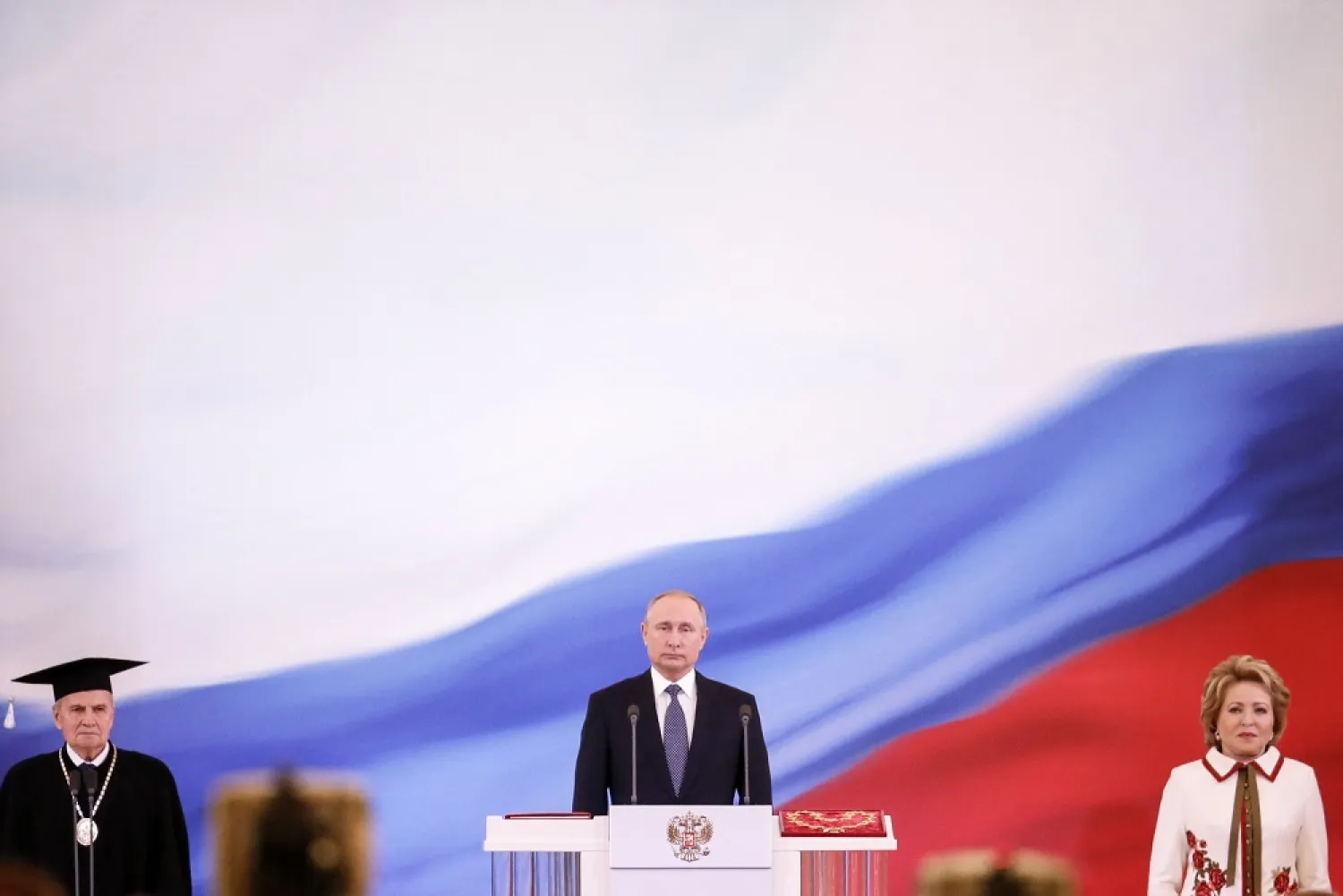

Putin Sworn in for Fourth Term as Russian President

Vladimir Putin is sworn as Russian president during an inauguration ceremony at the Kremlin in Moscow, Russia May 7, 2018. (Reuters)
TT

Putin Sworn in for Fourth Term as Russian President

Vladimir Putin is sworn as Russian president during an inauguration ceremony at the Kremlin in Moscow, Russia May 7, 2018. (Reuters)

Vladimir Putin was sworn in on Monday for a fourth term as Russian president.

Standing in the ornately-decorated Andreyevsky Hall of the Grand Kremlin Palace, with his hand on a gold-embossed copy of the constitution, Putin swore to serve the Russian people, to safeguard rights and freedoms, and protect Russian sovereignty.

"I consider it my duty and my life's aim to do everything possible for Russia, for its present and for its future," Putin said.

"I strongly feel conscious of my colossal responsibility," Putin said at the ceremony before thanking Russians for their "sincere support" and "cohesiveness".

"We have revived pride in our fatherland," Putin said.

"As head of state I will do all I can to multiply the strength and prosperity of Russia."

Putin, in power since 1999, was predictably re-elected in Russia's March presidential election with 76.7 percent of the vote – a race he competed in with no serious challengers.

His most dangerous opponent, Alexei Navalny, was barred from running and on Saturday Navalny and hundreds of his supporters were detained by police while protesting over Putin’s new term under the slogan: “Putin is not our tsar.”

In a speech after the swearing-in ceremony, Putin said that in the next six years Russia would prove a strong, muscular player on the world stage, backed by a powerful military, while pushing hard to improve life for its citizens at home.

"Now, we must use all existing possibilities, first of all for resolving internal urgent tasks of development, for economic and technological breakthroughs, for raising competitiveness in those spheres that determine the future," he said.

"A new quality of life, well-being, security and people's health — that's what's primary today," he added.

For the short journey from his office to the inauguration ceremony, Putin traveled in a new Russian-made limousine. From now on, the limousine will replace the fleet of imported vehicles Putin uses, state television reported.

Soon after, Putin put forward Dmitry Medvedev for the post of prime minister, the Kremlin said in a statement on its website.

Medvedev, who had been prime minister since 2012, resigned earlier on Monday along with the rest of the government in line with procedure. Putin was on Monday sworn in for a fourth term.

His candidacy still has to be approved by the State Duma, or the lower house of parliament.

Foreign diplomats see little prospect that Russia’s standoffs with the West that have dominated the past four years will ease during Putin’s new term.

Clashes in the past few weeks over US sanctions on Russia, the conflict in Syria, and the poisoning in England of former Russian spy Sergei Skripal have left some diplomats worried that the confrontation could spiral out of control.

Opinion polls show Putin has high levels of support among Russian citizens, and Navalny has not been able to inspire a nationwide upsurge of protests.

But the Russian economy is a potential weakness for Putin.

Buffeted by lower oil prices, falls in the rouble, inflation and the impact of sanctions, average monthly wages have fallen from the equivalent of $867 in 2013 to $553 last year.

Russia’s economy, the world’s eleventh largest, returned to growth of 1.5 percent last year, helped by a recovery in oil prices. But that fell short of the government’s 2 percent target and was far from the 8.5 percent growth achieved in 2007, the highest level achieved during Putin’s rule.

Officials and analysts say bold policies with the best chance of reviving growth have been mired in disagreements among Putin’s policy-makers.



China FM Tells Russia’s Lavrov Willing to Work to ‘De-Escalate’ Mideast War

 Russian Foreign Minister Sergei Lavrov speaks during a joint news conference with Egyptian Foreign Minister Badr Abdelatty following their meeting in Moscow, Russia April 3, 2026. (Pavel Bednyakov/Pool via Reuters)
Russian Foreign Minister Sergei Lavrov speaks during a joint news conference with Egyptian Foreign Minister Badr Abdelatty following their meeting in Moscow, Russia April 3, 2026. (Pavel Bednyakov/Pool via Reuters)
TT

China FM Tells Russia’s Lavrov Willing to Work to ‘De-Escalate’ Mideast War

 Russian Foreign Minister Sergei Lavrov speaks during a joint news conference with Egyptian Foreign Minister Badr Abdelatty following their meeting in Moscow, Russia April 3, 2026. (Pavel Bednyakov/Pool via Reuters)
Russian Foreign Minister Sergei Lavrov speaks during a joint news conference with Egyptian Foreign Minister Badr Abdelatty following their meeting in Moscow, Russia April 3, 2026. (Pavel Bednyakov/Pool via Reuters)

China's top diplomat told his Russian counterpart on Sunday that he is willing to work together to "de-escalate" the war in the Middle East, Beijing's state media reported.

Wang Yi told Russian Foreign Minister Sergei Lavrov in a phone call that "China and Russia should uphold fairness on major issues of principle", state news agency Xinhua said, noting that the call came at Lavrov's request.

Wang said that "the situation in the Middle East is still deteriorating and fighting is escalating", Xinhua reported.

He also reiterated China's call for an "immediate ceasefire" to the fighting triggered by US-Israeli strikes against Iran that began on February 28.

"China is willing to continue cooperating with Russia in the UN Security Council, communicating promptly on major issues and making efforts to de-escalate the situation and maintain regional peace and stability and global security," Xinhua quoted Wang as saying.

Beijing and Moscow are close economic and political partners, and the relationship has deepened further since Russia's 2022 invasion of Ukraine.


Migrants Missing after Mediterranean Capsize: NGOs

Hellenic coast guard performs SAR operation, following migrant's boat collision with coast guard off the Aegean island of Chios, near Mersinidi, Greece, February 4, 2026. REUTERS
TT

Migrants Missing after Mediterranean Capsize: NGOs

Hellenic coast guard performs SAR operation, following migrant's boat collision with coast guard off the Aegean island of Chios, near Mersinidi, Greece, February 4, 2026. REUTERS

Dozens of people are missing after a migrant boat capsized in the central Mediterranean, the NGOs Mediterranea Saving Humans and Sea-Watch said Sunday on social media.

Two people died and 32 were rescued from the boat, which had left Libya on Saturday afternoon with around 105 people on board, according to Mediterranea Saving Humans, AFP reported.

"Tragic Easter shipwreck. 32 survivors, two bodies recovered and more than 70 people missing," the NGO wrote on X, adding that the boat capsized in a search-and-rescue zone handled by Libyan authorities.

Sea-Watch said two commercial ships saved the survivors and took them to the Italian island of Lampedusa.

An aerial video it posted showed two men clinging to the hull of the capsized vessel, and the approach of one of the commercial ships.

Mediterranea Saving Humans said the accident was "the consequence of policies by European governments that refuse to open safe and legal pathways" for migrants.

Lampedusa is a key entry point for migrants crossing the Mediterranean from North Africa to Europe.

Since the start of 2026, at least 683 migrants have lost their lives or gone missing on attempts to cross the sea, according to the UN's migration agency IOM.

According to the Italian government, 6,175 migrants arrived on Italian territory over the same period.


Trump Vows Strikes on Iran’s Power Plants, Bridges if Strait of Hormuz isn't Reopened

ABD Başkanı Donald Trump (Reuters)
TT

Trump Vows Strikes on Iran’s Power Plants, Bridges if Strait of Hormuz isn't Reopened

ABD Başkanı Donald Trump (Reuters)

US President Donald Trump has promised strikes on Iran’s power plants and bridges on Tuesday, restating his threat to attack civilian infrastructure if the Strait of Hormuz isn’t reopened.

In an expletive-laden post Sunday morning, Trump promised the “crazy bastards” would be “living in Hell” if the waterway isn’t opened to marine traffic, The AP news reported.

Trump had previously threatened strikes two weeks ago, but extended the deadline for Iran to reopen the waterway twice, claiming there were positive signs in negotiations with the Iranians. But there have been few public signs of progress in a diplomatic off-ramp to the war.