


A Radical Idea: Hold an Auction to Decide the World Cup Hosts to Stop Corruption

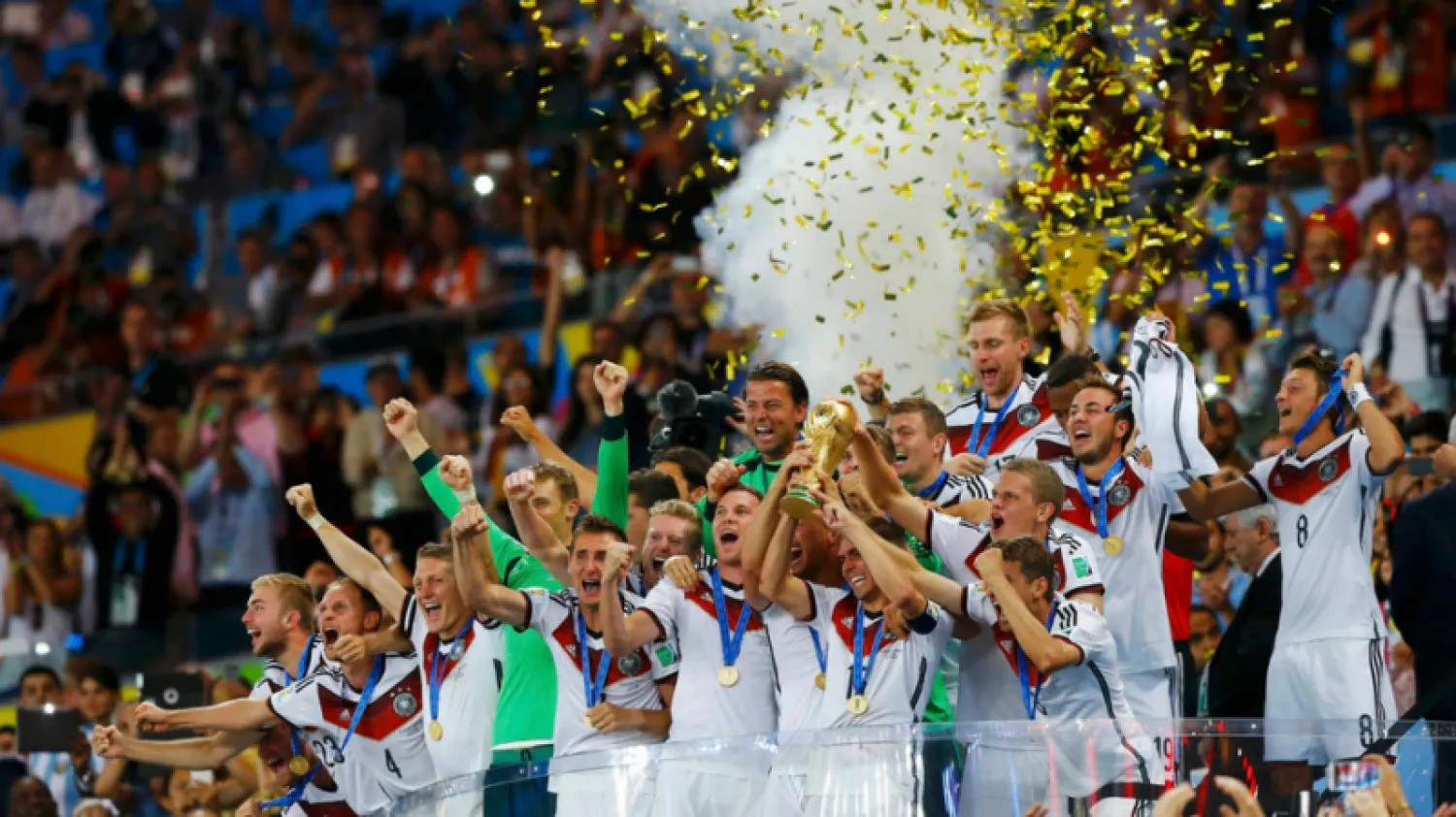
The German national team lifts the World Cup trophy after defeating Argentina in the 2014 final. (Reuters)
TT

A Radical Idea: Hold an Auction to Decide the World Cup Hosts to Stop Corruption

The German national team lifts the World Cup trophy after defeating Argentina in the 2014 final. (Reuters)

You can bet on anything these days. Crossfit. Portuguese futsal. Even ByuL versus Rogue in Starcraft II. Yet, curiously, finding odds about who will host the 2026 World Cup is nigh-on impossible – even though the vote between the Nafta bloc of the US, Canada and Mexico, and new kid on the block Morocco is only six weeks away.

One bookie told me he would be “asking to be picked off” if he offered prices, given the votes for mega-events such as the World Cups and Olympics. As he put it: “You only really get action from people who know something we don’t.”

Yet this time it is supposed to be different. Fifa has ripped up its rulebook following the fallout from awarding the 2018 and 2022 World Cup finals to Russia and Qatar respectively. It has promised greater scrutiny of bids, more transparency, and, most dramatically, changed voting rules so its 211 member associations will decide who hosts rather than two dozen senior executives.

The aim, according to a Fifa spokesman, is to “avoid a return to the secret and subjective decisions of the past”. Good luck with that. As the lack of bookies’ odds indicates, it’s hard to shake off the past. Look at the International Olympic Committee, which expanded its electorate after the Salt Lake City scandal – yet has been hit with investigations into vote-rigging when awarding the Rio and Tokyo Games.

Here is a radical suggestion. Give the World Cup – and the Olympics, for that matter – to the highest bidder.

Sure, it sounds crude. But it would at least be more honest. It recognizes that people are corruptible, and those with large enough wallets will always try to corrupt them. And so it stops it at a stroke. Why engage in backroom deals or bribes, for instance, when there is no advantage in doing so?

Think of the money that might be diverted into grassroots football and poorer nations. The Football Association lost £15m on England’s failed 2018 bid, as well as much of its dignity in cozying up to the likes of Jack Warner. Australia spent $40m of public money on its attempt to host in 2022. For what?

It would also stop political chicanery, too. Only last month US president, Donald Trump, sent a tweet that appeared close to breaching Fifa’s rules when he warned nations thinking of voting against the US/Canada/Mexico bid, saying: “It would be a shame if countries that we always support were to lobby against the US bid. Why should we be supporting these countries when they don’t support us [including at the United Nations]?”

However, Trump is far from alone. Before the 2018 World Cup vote, Russia’s President Vladimir Putin spent hours talking to Fifa delegates – and it probably was not about Moscow’s weather in June.

Of course rules would have to be put in place. Any bid would need to show it had the requisite stadia, security and infrastructure to host a World Cup. A country could not host the tournament more than once in a generation. And it would have to be seen as progressive on human rights and strong on anti-corruption. But once it passed those hurdles, it would be all systems go.

The worry, of course, is the World Cup would be tossed around the same four or five rich global powers. One idea to counter that would be to hold a lottery – rather than an auction – every fifth World Cup with the winner only having to pay a smaller fee, set in advance, to host the tournament.

Certainly David Forrest, an economist at the University of Liverpool, believes the benefits of an auction would negate the downsides. As he explains, in a sense there is already an auction for the World Cup and Olympics. It’s just that countries are spending millions on wooing potential voters – money that would be much better spent going straight into the sport if they win (and not spurned if they didn’t).

As he put it: “A transparent auction would see the money from the highest bid go to Fifa itself rather than to the pockets of Fifa’s voters, and it could be earmarked for supporting recreational football in poor countries. Some of it could be put into a reserve for subsidizing a less-developed nation to host the competition every fifth tournament.”

That is a battle for another day. For now, Fifa watchers are trying to decipher exactly what will happen when the vote finally takes place on June 13.

Some insist a shock Morocco win is now on the cards because Trump has alienated so many African nations by calling them “shithole countries”. Others whisper that some Fifa countries want to give the US a bloody nose in retaliation for the Department of Justice’s 2015 investigation into football-related corruption.

Yet it is easy to be seduced by the counterpoints – that Fifa president Gianni Infantino wants the World Cup back in the US because it could generate $5bn (£3.58bn) in economic activity, far higher than its rival, along with suggestions that Morocco’s bid still has to convince Fifa’s scrutineers to get into the vote.

Either way, vast sums have already been spent. Some of that, surely, could have been saved by simply holding an auction.

The Guardian Sport


Chelsea Injuries up 44% After Club World Cup but Report Says Event Has Had ‘Minimal’ Impact

Chelsea's Reece James, center, lifts the trophy following the Club World Cup final soccer match between Chelsea and PSG at MetLife Stadium in East Rutherford, N.J., Sunday, July 13, 2025. (AP)
TT

Chelsea Injuries up 44% After Club World Cup but Report Says Event Has Had ‘Minimal’ Impact

Chelsea's Reece James, center, lifts the trophy following the Club World Cup final soccer match between Chelsea and PSG at MetLife Stadium in East Rutherford, N.J., Sunday, July 13, 2025. (AP)

Chelsea suffered a 44% spike in injuries after competing in the supersized Club World Cup this year, according to findings published on Tuesday.

But the newly expanded tournament has so far had a “minimal impact” on injuries overall, the latest edition of the Men’s European Football Injury Index found.

There was fierce opposition to FIFA's new flagship club event when it was confirmed in 2023 that it would increase from seven to 32 teams, with players' unions warning of physical and mental burnout of players due to an ever expanding match schedule. But FIFA pressed ahead and staged the tournament in the United States in June-July.

Chelsea went on to win the inaugural competition, receiving the trophy from US President Donald Trump at MetLife Stadium and taking home prize money of around $125 million. But, according to the Index, from June-October, Chelsea picked up more injuries — 23 — than any of the nine clubs from Europe's top leagues that participated in the Club World Cup.

They included star player Cole Palmer, and was a 44% increase on the same period last year.

While Chelsea, which played 64 games over the entire 2024-25 season, saw an increase in injuries, the Index, produced by global insurance firm Howden, found that overall there was a decrease.

“In principle you would expect this increased workload to lead to an increase in the number of injuries sustained, as a possible rise in overall injury severity,” the Index report said, but added: “The data would suggest a minimal impact on overall injury figures.”

Despite the figures, the authors of the report accept it was too early to assess the full impact of the Club World Cup, with the findings only going up to October.

“We would expect to see the impact to spike in that sort of November to February period,” said James Burrows, Head of Sport at Howden. “What we’ve seen previously is that’s where the impact is seen from summer tournaments."

Manchester City has sustained 22 since the tournament, which is the highest among the nine teams from Europe's top leagues — England, Spain, Italy, Germany and France.

Those teams have recorded 146 injuries from June-October, which is down on the previous year's figure of 174.

From August-October that number is 121, the lowest for that three-month period in the previous six years of the Index.


Sunderland Worst Hit by Losing Players to African Cup of Nations 

14 December 2025, United Kingdom, London: Sunderland's Habib Diarra (L) and Leeds United's Gabriel Gudmundsson battle for the ball during the English Premier League soccer match between Brentford and Leeds United at the Gtech Community Stadium. (dpa)
TT

Sunderland Worst Hit by Losing Players to African Cup of Nations 

14 December 2025, United Kingdom, London: Sunderland's Habib Diarra (L) and Leeds United's Gabriel Gudmundsson battle for the ball during the English Premier League soccer match between Brentford and Leeds United at the Gtech Community Stadium. (dpa)

Premier League Sunderland will have to do without six players over the next few weeks and are the club worst hit as the Africa Cup of Nations takes its toll on European clubs competing over the holiday season.

Sunderland, eighth in the standings, had four of their African internationals in action when they beat Newcastle United on Sunday, but like 14 other English top-flight clubs will now lose those players to international duty.

The timing of the African championship, kicking off in Morocco on Sunday and running through to January 18, has long been an irritant for coaches, with leagues in Belgium, France, Germany, Italy, Netherlands, Portugal, and Spain also affected.

Hosting the tournament in the middle of the season impacts around 58% of the players at the Cup of Nations, though the Confederation of African Football did try to mitigate the impact by moving the start to before Christmas, so it is completed before the next round of Champions League matches.

The impact on European clubs was also lessened by allowing them to release players seven days, rather than the mandatory 14 days, before the tournament, meaning they could play for their clubs last weekend.

Sunderland's Congolese Arthur Masuaku and Noah Sadiki, plus full back Reinildo (Mozambique), midfielder Habib Diarra (Mali), and attackers Chemsdine Talbi (Morocco) and Bertrand Traore (Burkina Faso) have now departed for Morocco.

Ironically, Mohamed Salah’s absence from Liverpool to play for Egypt should lower the temperature at the club after his recent outburst against manager Arne Slot, but Manchester United will lose three players in Noussair Mazraoui, Bryan Mbeumo and Amad Diallo, who scored in Monday’s 4-4 draw with Bournemouth.

France is again the country with the most players heading to the Cup of Nations, and with 51 from Ligue 1 clubs. But their absence is much less impactful than previously as Ligue 1 broke after the weekend’s fixtures and does not resume until January 2, by which time the Cup of Nations will be into its knockout stage.

There are 21 players from Serie A clubs, 18 from the Bundesliga, and 15 from LaLiga teams among the 24 squads at the tournament in Morocco.


Rodgers Takes Charge of Saudi Team Al-Qadsiah After Departure from Celtic 

Then-Celtic head coach Brendan Rodgers greets supporters after a Europa League soccer match between Red Star and Celtic at Rajko Mitic Stadium in Belgrade, Serbia, Sept. 24, 2025. (AP)
TT

Rodgers Takes Charge of Saudi Team Al-Qadsiah After Departure from Celtic 

Then-Celtic head coach Brendan Rodgers greets supporters after a Europa League soccer match between Red Star and Celtic at Rajko Mitic Stadium in Belgrade, Serbia, Sept. 24, 2025. (AP)

Brendan Rodgers has returned to football as the coach of Saudi Arabian club Al-Qadsiah, six weeks after resigning from Scottish champion Celtic.

Al-Qadsiah, whose squad includes Italian striker Mateo Retegui and former Real Madrid defender Fernandez Nacho, is in fifth place in the Saudi Pro League in its first season after promotion.

Rodgers departed Celtic on Oct. 27 and has opted to continue his managerial career outside Britain for the first time, having previously coached Liverpool, Leicester and Swansea.

In its statement announcing the hiring of Rodgers on Tuesday, Al-Qadsiah described him as a “world-renowned coach” and said his arrival “reflects the club’s ambitious vision and its rapidly growing sporting project.”

Aramco, the state-owned Saudi oil giant, bought Al-Qadsiah in 2023 in a move that has helped to transform the club’s status.

“This is a landmark moment for the club,” Al-Qadsiah chief executive James Bisgrove said. “The caliber of his experience and track record of winning reflects our ambition and long-term vision to establish Al-Qadsiah as one of Asia’s leading clubs.”

Rodgers is coming off winning back-to-back Scottish league titles with Celtic, where he won 11 major trophies across his two spells. He also won the FA Cup with Leicester.

Al-Qadsiah's last two coaches were former Liverpool striker Robbie Fowler and former Spain midfielder Michel.
