


Guantanamo Detainee Population Quietly Ages

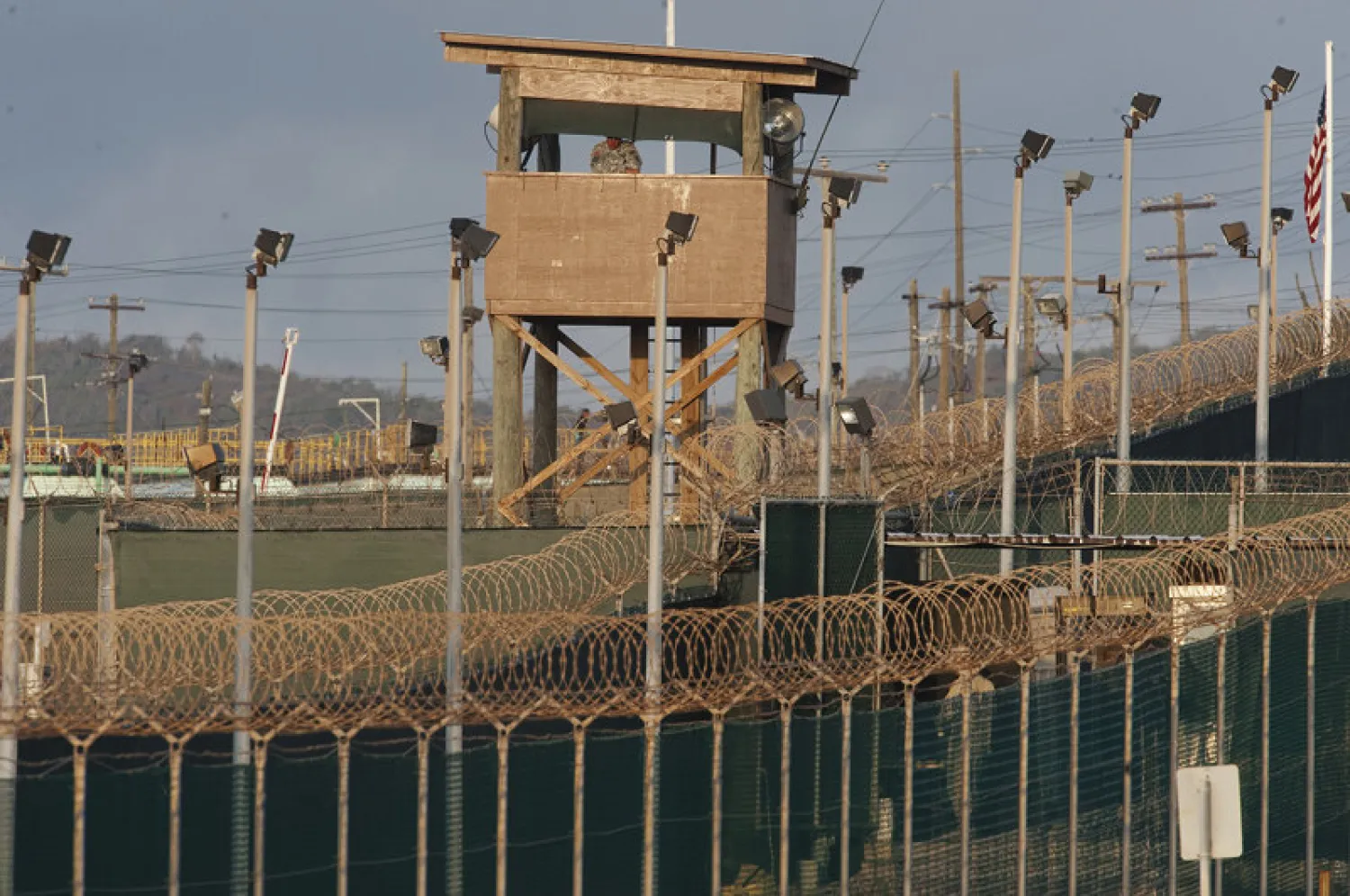
A US military member mans one of the watch towers at Camp Delta at the US Detention Center in Guantanamo Bay, Cuba Paul J. Richards/ AFP
TT

Guantanamo Detainee Population Quietly Ages

A US military member mans one of the watch towers at Camp Delta at the US Detention Center in Guantanamo Bay, Cuba Paul J. Richards/ AFP

They arrived at Guantanamo Bay as young men, captured on the battlefields of Afghanistan and elsewhere early in America's war on terror, following the September 11, 2001 attacks. 

More than 15 years later, most of the inmates at the notorious US military prison have reached middle age. 

This week, the White House seemed to acknowledge the obvious: with no plan or political will to do anything with Guantanamo's 40 remaining inmates, some of them could be stuck there for the rest of their lives.

"The current facility for high value detainees is experiencing structural and system failures that, if unaddressed, could in the future pose life and safety risks to our guard forces and the detainees being held there," the White House said in a policy statement to lawmakers.

"It also does not meet the requirements of the aging detainee population."

The Pentagon does not release any information about Guantanamo inmates, but leaked files published by WikiLeaks and the New York Times offer some insight.

On average, Guantanamo Bay's inmates are now about 46.5 years old.

The eldest, Pakistani national Saifullah Paracha, will turn 71 in August.

The youngest is Saudi citizen Hassan Mohammed Ali Bin Attash, who was born in 1985. He was just 16 or 17 when he was captured in 2002. The documents do not always provide a precise date of birth.

Neither the Pentagon nor Guantanamo Bay immediately responded to requests for comment for this story by Agence France Presse.

Perhaps the most notorious inmate, alleged 9/11 mastermind Khalid Sheikh Mohammed, is 53. 

The black moustache he sported when he was captured in 2003 has long since grown out into a voluminous grey beard that he now dyes orange.

James Connell, the attorney for Ramzi Binalshibh, who is charged as one of Mohammed's co-conspirators, said he'd noticed some accommodations for aging prisoners. 

"Some of attorney-client visiting spaces now have wheelchair ramps," he told AFP, adding that he'd also spotted handles to help inmates get up from the toilet.  

But, he stressed, there is "a lot of need for treatment that has not been given."

The International Committee of the Red Cross (ICRC) visits Guantanamo about four times a year to make sure the prison is complying with detention standards and to assess detainees' treatment.

"It is important to ensure that their health requirements can be adequately met, and we are actively engaged in dialogue with the US authorities on this matter," Marc Kilstein, an ICRC spokesman in Washington, told AFP.

Though the White House statement provided no details on what it envisions the changing needs of the Guantanamo population to be, older prisoners often suffer from chronic, age-related diseases that can be exacerbated by being locked up.

These can include heart failure, diabetes, cognitive problems and liver disease.

It already costs US taxpayers more than $450 million a year to keep the prisoners at Guantanamo Bay.

That figure will only rise as they age, Amnesty International security expert Daphne Eviatar told AFP, as the US is "required under international law to give them medical treatment."

"The US government by keeping them at Guantanamo Bay is essentially committing to taking care of them for the rest of their lives."

Some inmates already suffered poor health when they arrived at Guantanamo, whether through torture, conflict or poor living conditions, she noted.

Exacerbating the situation, Congress won't permit sick inmates to travel to the United States for treatment.

The Pentagon had to send a mobile MRI scanner to Guantanamo last year which cost $370,000 to rent, according to the Miami Herald. Initially, it didn't even work -- though it was later fixed.

As memories of the 9/11 attacks fade somewhat, many Americans are unaware the US still keeps prisoners locked up at Guantanamo. 

Five have been charged in the conspiracy to pull off the attacks and are being prosecuted through a special military commissions process that has been beset with legal challenges and seemingly interminable delays.

Among the rest of the population, two more have been charged with other crimes, two have been convicted and five were cleared for release under president Barack Obama but are now stuck under President Donald Trump, who has said he wants to send ISIS captives to Guantanamo.

But the largest contingent -- 26 inmates -- have never been charged with anything, yet were deemed too dangerous to be released. 

Nine detainees have already died at Guantanamo since it opened in early 2002, mainly through what the military said were suicides.

The way things are going, they are unlikely to be the last.


China FM Tells Russia’s Lavrov Willing to Work to ‘De-Escalate’ Mideast War

 Russian Foreign Minister Sergei Lavrov speaks during a joint news conference with Egyptian Foreign Minister Badr Abdelatty following their meeting in Moscow, Russia April 3, 2026. (Pavel Bednyakov/Pool via Reuters)
Russian Foreign Minister Sergei Lavrov speaks during a joint news conference with Egyptian Foreign Minister Badr Abdelatty following their meeting in Moscow, Russia April 3, 2026. (Pavel Bednyakov/Pool via Reuters)
TT

China FM Tells Russia’s Lavrov Willing to Work to ‘De-Escalate’ Mideast War

 Russian Foreign Minister Sergei Lavrov speaks during a joint news conference with Egyptian Foreign Minister Badr Abdelatty following their meeting in Moscow, Russia April 3, 2026. (Pavel Bednyakov/Pool via Reuters)
Russian Foreign Minister Sergei Lavrov speaks during a joint news conference with Egyptian Foreign Minister Badr Abdelatty following their meeting in Moscow, Russia April 3, 2026. (Pavel Bednyakov/Pool via Reuters)

China's top diplomat told his Russian counterpart on Sunday that he is willing to work together to "de-escalate" the war in the Middle East, Beijing's state media reported.

Wang Yi told Russian Foreign Minister Sergei Lavrov in a phone call that "China and Russia should uphold fairness on major issues of principle", state news agency Xinhua said, noting that the call came at Lavrov's request.

Wang said that "the situation in the Middle East is still deteriorating and fighting is escalating", Xinhua reported.

He also reiterated China's call for an "immediate ceasefire" to the fighting triggered by US-Israeli strikes against Iran that began on February 28.

"China is willing to continue cooperating with Russia in the UN Security Council, communicating promptly on major issues and making efforts to de-escalate the situation and maintain regional peace and stability and global security," Xinhua quoted Wang as saying.

Beijing and Moscow are close economic and political partners, and the relationship has deepened further since Russia's 2022 invasion of Ukraine.


Migrants Missing after Mediterranean Capsize: NGOs

Hellenic coast guard performs SAR operation, following migrant's boat collision with coast guard off the Aegean island of Chios, near Mersinidi, Greece, February 4, 2026. REUTERS
TT

Migrants Missing after Mediterranean Capsize: NGOs

Hellenic coast guard performs SAR operation, following migrant's boat collision with coast guard off the Aegean island of Chios, near Mersinidi, Greece, February 4, 2026. REUTERS

Dozens of people are missing after a migrant boat capsized in the central Mediterranean, the NGOs Mediterranea Saving Humans and Sea-Watch said Sunday on social media.

Two people died and 32 were rescued from the boat, which had left Libya on Saturday afternoon with around 105 people on board, according to Mediterranea Saving Humans, AFP reported.

"Tragic Easter shipwreck. 32 survivors, two bodies recovered and more than 70 people missing," the NGO wrote on X, adding that the boat capsized in a search-and-rescue zone handled by Libyan authorities.

Sea-Watch said two commercial ships saved the survivors and took them to the Italian island of Lampedusa.

An aerial video it posted showed two men clinging to the hull of the capsized vessel, and the approach of one of the commercial ships.

Mediterranea Saving Humans said the accident was "the consequence of policies by European governments that refuse to open safe and legal pathways" for migrants.

Lampedusa is a key entry point for migrants crossing the Mediterranean from North Africa to Europe.

Since the start of 2026, at least 683 migrants have lost their lives or gone missing on attempts to cross the sea, according to the UN's migration agency IOM.

According to the Italian government, 6,175 migrants arrived on Italian territory over the same period.


Trump Vows Strikes on Iran’s Power Plants, Bridges if Strait of Hormuz isn't Reopened

ABD Başkanı Donald Trump (Reuters)
TT

Trump Vows Strikes on Iran’s Power Plants, Bridges if Strait of Hormuz isn't Reopened

ABD Başkanı Donald Trump (Reuters)

US President Donald Trump has promised strikes on Iran’s power plants and bridges on Tuesday, restating his threat to attack civilian infrastructure if the Strait of Hormuz isn’t reopened.

In an expletive-laden post Sunday morning, Trump promised the “crazy bastards” would be “living in Hell” if the waterway isn’t opened to marine traffic, The AP news reported.

Trump had previously threatened strikes two weeks ago, but extended the deadline for Iran to reopen the waterway twice, claiming there were positive signs in negotiations with the Iranians. But there have been few public signs of progress in a diplomatic off-ramp to the war.
