


Six of the Most Dramatic Nights in the European Cup and Champions League

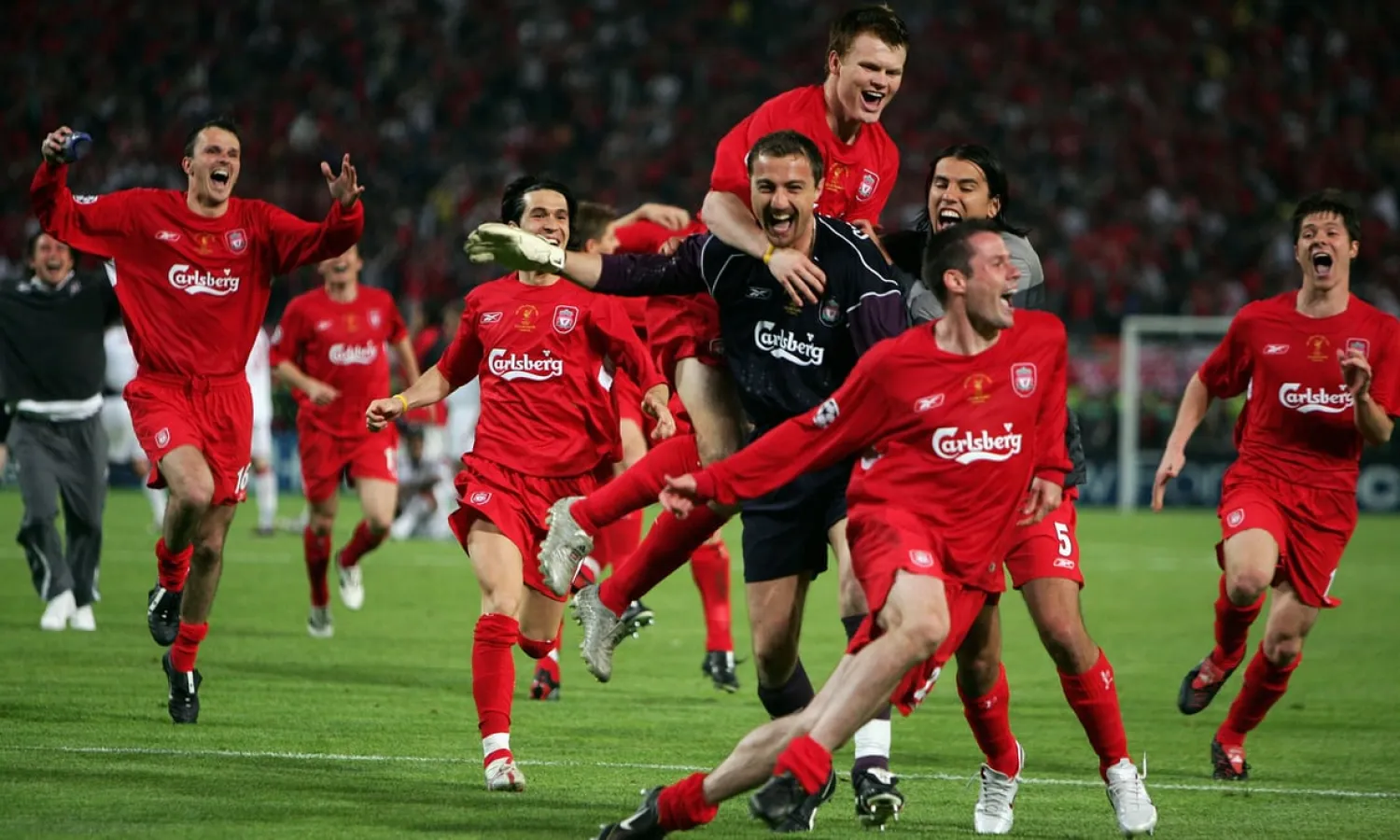
Liverpool’s players mob Jerzy Dudek after beating Milan on penalties to win the 2005 Champions League final. Photograph: Mike Hewitt/Getty Images
TT

Six of the Most Dramatic Nights in the European Cup and Champions League

Liverpool’s players mob Jerzy Dudek after beating Milan on penalties to win the 2005 Champions League final. Photograph: Mike Hewitt/Getty Images

The almost shocking conclusion to what had been a notable Juventus recovery against Real Madrid at the Bernabéu has not only divided opinion – it was a penalty all day long, one could only admire the stealth with which Medhi Benatia administered his shove in the back of Lucas Vázquez and the bravery of Michael Oliver for punishing it – but has also inspired much talk of the evening being one of the most dramatic in the history of the European Cup and Champions League. However the latter stages of the competition have frequently produced controversy, spectacle and drama. Here are six other notable European nights to consider.

1) 2005 final, Milan 3-3 Liverpool (Liverpool win 3-2 on penalties)
Comebacks do not come any more unexpected or spellbinding than this. Call it the greatest of escapes, the miracle of Istanbul or just the ultimate games of two halves but the fact is the first half was so embarrassingly one-sided that some Liverpool supporters are said to have attempted to leave the stadium during the interval, only to find the gates locked. Cue a little tactical adjustment by Rafa Benítez, who brought on Didi Hamann for the second half, and heroic performances by Steven Gerrard and Jerzy Dudek, and Liverpool recovered a three-goal deficit, negotiated extra-time and then won on penalties. Unforgettable.

2) 2009 semi-final, Chelsea 1-1 Barcelona (agg 1-1)
Almost certainly the height of European injustice, as the Norwegian referee Tom Henning Øvrebø waved away four reasonable Chelsea penalty appeals before a 90th-minute goal from Andrés Iniesta swept Pep Guardiola’s Barcelona into the final with their only shot on target. One of the most memorable images of the night was Michael Ballack sprinting half the length of the pitch while remonstrating with the hapless official, before Didier Drogba’s sweary rant to the camera at full-time earned him a five-match ban. Øvrebø apologized some years later but it was far too late to earn Guus Hiddink the shot at Manchester United in Rome he so craved.

3) 2010 semi-final, Barcelona 1-0 Internazionale (agg 2-3)
Barcelona were at the height of their supremacy under Guardiola in 2010 but Inter arrived at the Camp Nou with a 3-1 lead from the first leg. The visitors soon went down to 10 men when Thiago Motta was dismissed in the first half but what followed was a defensive masterclass, more organization than improvisation, as Inter virtually abandoned attack to concentrate their resources on stopping Barcelona from scoring again. This was peak José Mourinho who, after outwitting Guardiola while short-handed, was presented with few problems by Louis van Gaal’s Bayern Munich in the final. Perennial underachievers in Europe, Inter had suddenly landed the treble of the Serie A title, Coppa Italia and Champions League.

4) 1960 final, Real Madrid 7-3 Eintracht Frankfurt
A 10-goal final certainly sounds dramatic, even if the distribution of goals suggests the showpiece might have been a tad one-sided. In Britain at least, this felt like it was the moment when the European Cup came of age, when the scales fell from insular eyes and the attraction of continental competition was suddenly grasped. The final provided royal entertainment for an immense Hampden Park crowd of 127,621, an audience that seemingly included – just like the Sex Pistols at the Free Trade Hall or the Velvet Underground’s first LP – a great many people who would later be inspired to achievements of their own. If this was football, Britain wanted more.

5) 1977 quarter-final, Liverpool 3-1 Saint-Étienne (agg 3-2)
Strange as it might seem now, it came as news to the nation at large to discover there was something intoxicatingly special about European nights at Anfield. Liverpool under Bob Paisley were breaking new ground – in Bill Shankly’s time the club had never been synonymous with European success – and when the French champions scored an away goal the home side needed two more to progress. Thanks in part to a hugely partisan crowd, Ray Kennedy and David “supersub” Fairclough they got them, though knowing what we know now the most arresting sight of the evening was the spilling, seething, all-standing Kop.

6) 1999 final, Bayern Munich 1-2 Manchester United
“Football: bloody hell,” as someone said. The last part of United’s treble was undramatic in normal time – an under-strength side appeared to possess neither the wit nor the will to cancel out Mario Basler’s early goal. The most famous three minutes of stoppage time in history changed all that, however. The substitutes Teddy Sheringham and Ole Gunnar Solskjaer added one late goal and then another to leave the opposing defenders on the floor in dismay. The Uefa president Lennart Johansson had to remove Bayern’s ribbons from the trophy before presenting it. “I can’t believe it,” he said. “The winners are crying and the losers are dancing.”

(The Guardian)


Sudan Dream of AFCON Glory as Conflict Rages at Home

 Sudan's players pose for the team picture before the Africa Cup of Nations group E soccer match between Algeria and Sudan in Rabat, Morocco, Wednesday, Dec. 24, 2025. (AP)
Sudan's players pose for the team picture before the Africa Cup of Nations group E soccer match between Algeria and Sudan in Rabat, Morocco, Wednesday, Dec. 24, 2025. (AP)
TT

Sudan Dream of AFCON Glory as Conflict Rages at Home

 Sudan's players pose for the team picture before the Africa Cup of Nations group E soccer match between Algeria and Sudan in Rabat, Morocco, Wednesday, Dec. 24, 2025. (AP)
Sudan's players pose for the team picture before the Africa Cup of Nations group E soccer match between Algeria and Sudan in Rabat, Morocco, Wednesday, Dec. 24, 2025. (AP)

When war broke out in Sudan in April 2023, Ammar Taifour was in a training camp with his club Al Merrikh in Khartoum.

"I just remember the surprise, the shock of the first gunshots. It was very surprising," the 28-year-old midfielder with the Sudan team at the Africa Cup of Nations tells AFP.

"Then in the days after that there were power cuts and constant gunshots. It was just unbelievable.

"I just pray for peace and for everyone who's in this situation to be safe and make it out."

Taifour, who was born in the United States, is among the lucky ones. He says he is "grateful and blessed" that family members in Sudan were able to leave the country.

Goalkeeper Mohamed Al Nour, meanwhile, had to deal with the anguish of his brother being taken prisoner by the paramilitary Rapid Support Forces.

"Luckily I have not lost any members of my family but my brother was taken prisoner for nine months by the RSF before being released," says Al Nour.

"We have experienced terror, people being killed. We just hope things improve."

The war that erupted close to three years ago between the country's army and its former allies the RSF has had a devastating impact on the population.

Tens of thousands of people have been killed and 11 million driven from their homes in what the UN has declared "the world's worst humanitarian disaster".

Despite that backdrop, Sudan's national football team qualified for the ongoing AFCON in Morocco and on Sunday they beat Equatorial Guinea 1-0 in Casablanca.

It was just their second win at the Cup of Nations in 18 matches across six tournament appearances since they lifted the trophy in 1970.

They play Burkina Faso in their final group game on Wednesday and do so with the pressure off because they are already assured of progressing to the last 16.

That is a remarkable achievement regardless of the current off-field context, given Sudan have only once made the knockout stages at an AFCON since 1970 -- they reached the quarter-finals in 2012.

- 'Big responsibility' -

"It's a big honor," says Taifour. "But also we have big expectations and we want to make it as far as possible and even to win the tournament, make our country happy."

"Obviously it's a big responsibility. I think each one of us as individuals, we know the situation that's going on, we all can relate to it, we all have someone involved.

"So whatever we can do to help, whatever we can do to bring some happiness, we try our best to do so."

Al Nour, also known by his nickname Abooja, adds: "Of course the team has been impacted. Everyone has just tried to get through this period but it has been difficult with the tension all over Sudan."

"In the end our results on the pitch are what make the people happy and boost their morale."

The impact of the conflict on Sudanese football has been enormous, leading to the domestic championship being halted and the country's two biggest clubs going into exile.

Al Hilal and Al Merrikh of Omdurman played in the Mauritanian league last season. A domestic elite league did make its return in July, but now the two rivals are playing in Rwanda.

Some players have moved to different countries like Taifour, who departed Al Merrikh for Libya and is now plying his trade in Tunisia.

Despite that the national team has flourished under Ghanaian coach Kwesi Appiah.

They qualified for the competition at the expense of Ghana and put in some good showings in their World Cup qualifying group, beating the Democratic Republic of Congo and drawing with Senegal en route to finishing third.

In August they got to the semi-finals of the African Nations Championship -- a competition for locally-based players -- and they also appeared at the recent FIFA Arab Cup in Qatar.

"We have tried to use every match as preparation and to build chemistry within the group," says Taifour.

Al Nour, meanwhile, describes Appiah as "an exceptional person. We have learned a lot thanks to him."

It has all led to this, with Sudan now building towards a Cup of Nations knockout tie this weekend and hoping to put smiles on the faces of supporters back home.


Prince Abdul Mohsin Airport Receives First Dakar Rally 2026 Arrivals

This comes as part of ongoing preparations to host the global sporting event - SPA
TT

Prince Abdul Mohsin Airport Receives First Dakar Rally 2026 Arrivals

This comes as part of ongoing preparations to host the global sporting event - SPA

Prince Abdul Mohsin bin Abdulaziz International Airport in Yanbu has received the first arrivals of competitors participating in the Dakar Rally 2026, as part of ongoing preparations to host the global sporting event.

Cluster2 Airports, the operator of Prince Abdul Mohsin bin Abdulaziz International Airport, stated that arrivals will continue from December 28 to December 31, with approximately 17 flights, both private and commercial, designated for the arrival of competitors and participating teams, SPA reported.

The process is being handled with a high level of operational readiness and full coordination among the relevant authorities.

Cluster2 Airports affirmed that operational and service preparations at the airports have been completed to ensure smooth passenger movement and the provision of high-quality services to participating delegations, reflecting the efficiency of the affiliated airports and their ability to accommodate major international events.


Knee Injury for Shaheen Shah Afridi Forces Early Exit from Big Bash League

Pakistan’s ODI’s team captain Shaheen Shah Afridi attends a press conference, in Rawalpindi, Pakistan, on Nov. 10, 2025. (AP Photo/Anjum Naveed, File)
TT

Knee Injury for Shaheen Shah Afridi Forces Early Exit from Big Bash League

Pakistan’s ODI’s team captain Shaheen Shah Afridi attends a press conference, in Rawalpindi, Pakistan, on Nov. 10, 2025. (AP Photo/Anjum Naveed, File)

A knee injury has forced fast bowler Shaheen Shah Afridi to return home after playing four games for Brisbane Heat in the Big Bash League.

“Due to an unexpected injury; I have been called back by the PCB and will have to take a rehab. Hopefully, I will be back in the fields soon,” Afridi wrote on X on Tuesday.

Afridi limped off the field when he picked up the injury on his right knee while bowling against Adelaide Strikers last Saturday, The AP news reported.

Apparently the Pakistan Cricket Board has called back Afridi as a precautionary step with T20 World Cup due to start from February 7.

“I’m massively thankful to the Brisbane Heat team and fans for showering me with immense love and support,” Aridi said, while adding: “Meanwhile, I will be cheering for the amazing team.”

Afridi had a challenging short stint at Brisbane Heat where he picked up just two wickets in four matches at an expensive economy rate of 11.19. In his first game of the season he was removed from the attack in the 18th over when he bowled to waist-high full tosses to Melbourne Renegades’ batters Tim Seifert and Oliver Peake.

It is not the first time that Afridi has hurt his right knee. He sustained an injury on that knee while fielding during a test match in Sri Lanka in 2022 that also ruled him out from the early stages of the T20 World Cup in Australia.

He returned at the later stages of the tournament, but again picked up injury on the same knee during the death overs of the final against England that let the title match slip away from Pakistan.

Pakistan didn’t name Afridi for next month’s three-match T20 series in Sri Lanka as a rotation policy, but he remains one of the key players for the T20 World Cup to be jointly hosted by Sri Lanka and India.
