


Libya: Muslim Brotherhood Demands Haftar’s Exclusion from Paris Summit

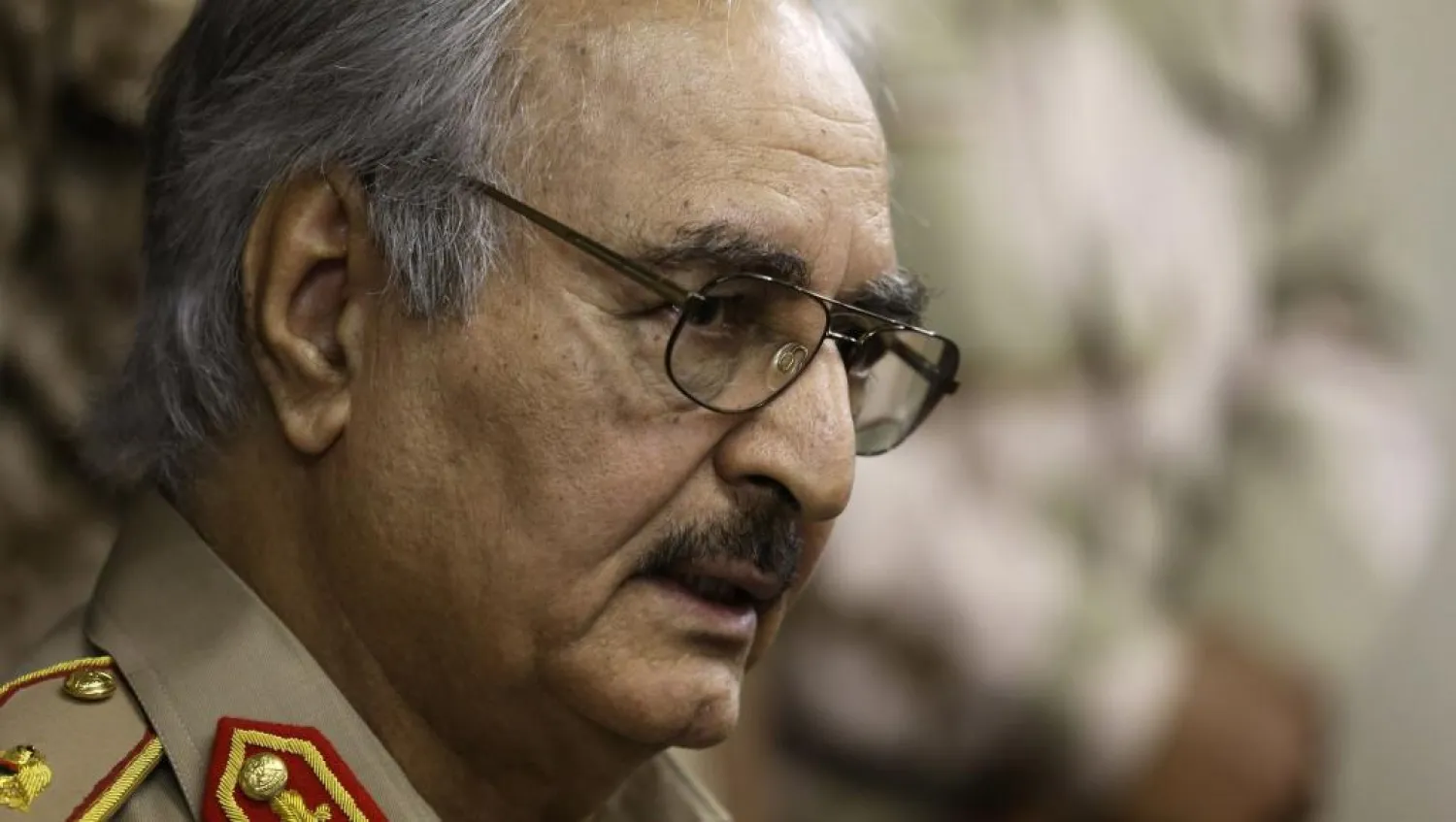
Libyan National Army commander Khalifa Haftar. (Reuters)
TT

Libya: Muslim Brotherhood Demands Haftar’s Exclusion from Paris Summit

Libyan National Army commander Khalifa Haftar. (Reuters)

The Muslim Brotherhood in Libya sought on Sunday to exclude Libyan National Army commander Field Marshal Khalifa Haftar from the international conference in Paris aimed at resolving the North African country’s crisis.

The meeting, hosted by French President Emmanuel Macron on Tuesday, will include the most prominent Libyan officials to prepare for presidential and parliamentary elections.

Newly elected head of the High Council of State Khalid al-Mishri said on Saturday that the Paris meeting should only include the political parties that signed the Skheirat agreement in Morocco in 2015.

Mishri is a prominent member of the political wing of the Mudlim Brotherhood. The High Council of State offers recommendations to the parliament as stipulated in the Skheirat deal.

“Haftar was not part of the agreement and he does not recognize it. The dialogue should just be limited to the High Council of State, parliament and National Accord Government, headed by Prime Minister Fayez al-Sarraj, he added.

He confirmed that he received an invitation from Macron to attend Tuesday’s conference.

He also informed French authorities that elections would be a success if a referendum over the constitution was held.

Haftar meanwhile chose to ignore Mishri’s statements.

He had held talks with Aguila Saleh Issa, the parliament speaker based in the eastern town of Tobruk.

Haftar’s office gave a brief statement after the meeting that did not disclose the issues that the two officials discussed.

This marks the first time in months that the two officials meet amid reports of tensions in their relationship. Saleh was notably absent from the reception dedicated to Haftar upon his return to Libya from a medical stay in Paris back in April.

An informed Libyan official said that a reconciliation was reached between the two figures through efforts sponsored by Egypt and the United Arab Emirates.

Sunday’s meeting between them was therefore aimed at rearranging their political affairs ahead of their departure to Paris, he explained to Asharq Al-Awsat.

The Paris meeting will be sponsored by the United Nations. It will be attended by Sarraj, Saleh, Haftar and Mishri in order to “open a new period of stability and cooperation which is awaited by the Libyan people," a statement from the French presidency said on Sunday.

An aide to Macron said the Libyan leaders had agreed in principle to a roadmap that would pave the way for parliamentary and presidential elections, if possible before the end of the year, reported Agence France Presse on Sunday.

A draft of the 13-point non-binding political roadmap seen by Reuters includes the call for the immediate unification of the central bank and a commitment to support the creation of a national army. It also agrees to an inclusive political national conference within three months.

The draft threatens international sanctions on those that impede the accord or dispute the outcome of elections.

The conference will be attended by some 19 countries and four international organizations, including countries that have influence on the ground such as Egypt, Italy, Qatar, Turkey and the UAE. UN special envoy to Libya Ghassan Salameh will also attend.

“If everyone agrees then it will be a step forward. The idea is to put pressure on the four participants knowing that if their backers tell them to accept this they won’t have a choice,” said a European diplomat. “That’s partly true, but there is also an inter-Libyan dynamic to take into consideration,” said a European diplomat.



Egypt Warns of Moves to Derail Gaza Deal, Fragment Reconstruction

Palestinians walk past makeshift shelters at the Nuseirat camp for displaced people in Gaza (AFP)
TT

Egypt Warns of Moves to Derail Gaza Deal, Fragment Reconstruction

Palestinians walk past makeshift shelters at the Nuseirat camp for displaced people in Gaza (AFP)

Efforts by mediators to advance the second phase of the Gaza ceasefire agreement are intensifying, as Egypt issues fresh warnings that the process could be obstructed just days before it is due to take effect in January.

Egypt’s position, which rejects fragmenting reconstruction, dividing the Gaza Strip, or accepting Israeli conditions regarding stability forces in the enclave, carries important messages aimed at pressuring Israel ahead of a meeting between US President Donald Trump and Israeli Prime Minister Benjamin Netanyahu on Dec. 29, experts told Asharq Al-Awsat.

They expect Washington to press for the launch of the second phase in light of those Egyptian messages.

German Foreign Minister Johann Wadephul said on Friday that Germany would not take part, for the foreseeable future, in an international force for stability in Gaza under the enclave’s peace plan, which is expected to be deployed next month.

The move has reinforced Egyptian concerns voiced by Diaa Rashwan, the head of Egypt’s State Information Service, who accused Netanyahu of trying to reframe the second phase and confine it to a demand to disarm the resistance, something not stipulated in the agreement and well understood by the United States.

He pointed to Israeli efforts to involve a stability force in roles beyond its mandate, such as disarmament, which participating countries would not accept.

Rashwan said on Thursday, according to state-owned Al Qahera News television, that Netanyahu’s attempts could delay or slow implementation but would not succeed in stopping the second phase.

He added that Netanyahu was seeking by all means to avoid moving to the second phase of the Gaza ceasefire agreement and to push Washington into a confrontation with Tehran, which could reignite Gaza and derail the second phase.

On Thursday, Israel’s Ynet news site quoted a military source as saying Netanyahu would brief Trump on intelligence about the threat posed by Iranian ballistic missiles during their expected meeting before the end of the year.

The source said Israel might be forced to confront Iran if the United States fails to reach an agreement to curb Iran’s ballistic missile program.

Mokhtar Ghobashy, Secretary-General of the Al-Farabi Center for Political Studies, stated that the Egyptian statements were clear and explicit, conveying messages to Israel and Washington ahead of the anticipated visit.

He said that when Egyptian anger reaches the level of direct messaging, Washington considers the need to reach a point of convergence between Cairo and Tel Aviv.

Palestinian political analyst Nizar Nazzal said the Egyptian statements carry genuine messages and concerns about Israel entrenching the status quo from a security rather than a political perspective, in the hope that Washington would move seriously to put an end to it.

Egypt’s position extends beyond expressing concern to include explicit warnings. Egyptian Foreign Minister Badr Abdelatty said on Thursday in an interview with Egyptian television that there were two red lines in Gaza.

The first is rejecting any separation between the West Bank and the Gaza Strip, which he said was impossible as both constitute an indivisible unit of the future Palestinian state. The second red line is rejecting any division of the Gaza Strip.

He added that talk about dividing Gaza into red and green zones, or about areas under direct Israeli control receiving food, water and reconstruction while 90 percent of Palestinians elsewhere are denied basic needs under the pretext of Hamas’ presence, is absurd, will not happen and will not be agreed to.

Ghobashy stressed that when Egypt declares red lines, it marks a firm boundary, noting that there are unacceptable violations on the ground from Cairo’s perspective.

He said Cairo was deliberately sending these messages at this time in the hope of strengthening the mediators’ path toward launching the second phase soon, especially since Washington can impose its will if it chooses, particularly when it comes to pressuring Israel to halt actions obstructing the agreement.

Israel Hayom newspaper reported on Thursday that the anticipated meeting between Netanyahu and Trump would conclude with a statement on progress toward the second phase of the Gaza ceasefire agreement.

Rashwan said that all indicators show the US administration has settled on starting the second phase in early January. He added that Trump’s reception of the Israeli prime minister on Dec. 29 likely signals the actual launch of the second phase without ambiguity.

Nazzal expects Netanyahu, in his meeting with Trump, to try to push a narrative of maintaining Israel’s presence along the yellow line, dividing Gaza and starting reconstruction in the part under Israeli control.

But he said Egypt’s warning messages are a preemptive step to avert any new obstacles or US-Israeli alignment that could disrupt the agreement’s course.


Israeli Reservist Rams Vehicle into Palestinian Man Praying in West Bank

Israeli security forces secure a street as they leave the Palestinian village of Bizariya, in the occupied West Bank, where Israeli authorities demolished the house of a Palestinian man killed in July after he and another man reportedly killed an Israeli settler on the same day, on December 24, 2025. (AFP)
TT

Israeli Reservist Rams Vehicle into Palestinian Man Praying in West Bank

Israeli security forces secure a street as they leave the Palestinian village of Bizariya, in the occupied West Bank, where Israeli authorities demolished the house of a Palestinian man killed in July after he and another man reportedly killed an Israeli settler on the same day, on December 24, 2025. (AFP)

An Israeli reservist soldier rammed his vehicle into a Palestinian man as he prayed on a roadside in ​the occupied West Bank on Thursday, after earlier firing shots in the area, the Israeli military said.

"Footage was received of an armed individual running over a Palestinian individual," it said in a statement, adding the individual was a reservist ‌and his ‌military service had ‌been terminated.

The ⁠reservist ​acted "in severe ‌violation of his authority" and his weapon had been confiscated, the military said.

Israeli media reported that he was being held under house arrest.

The Israeli police did not immediately respond to a Reuters request for comment.

The ⁠Palestinian man went to hospital for checks after ‌the attack, but was unhurt ‍and is now ‍at home.

Video which aired on Palestinian ‍TV shows a man in civilian clothing with a gun slung over his shoulder driving an off-road vehicle into a man praying on ​the side of the road.

This year ​was one of the most violent on ⁠record for Israeli civilian attacks against Palestinians in the West Bank, according to United Nations data that shows more than 750 injuries.

More than a thousand Palestinians were killed in the West Bank between October 7, 2023 and October 17, 2025, mostly in operations by security forces and some by settler violence, according to the UN In ‌the same period, 57 Israelis were killed in Palestinian attacks.


Deadly Blast Hits Mosque in Syria’s Homs, Saraya Ansar al-Sunna Claims Responsibility

Syrian security forces stand inside a damaged mosque after several people were killed in an explosion at a mosque as the Syrian Arab News Agency (SANA) said, in Homs, Syria December 26, 2025. REUTERS/Ali Ahmed al-Najjar
TT

Deadly Blast Hits Mosque in Syria’s Homs, Saraya Ansar al-Sunna Claims Responsibility

Syrian security forces stand inside a damaged mosque after several people were killed in an explosion at a mosque as the Syrian Arab News Agency (SANA) said, in Homs, Syria December 26, 2025. REUTERS/Ali Ahmed al-Najjar

A bombing at a mosque in Syria during Friday prayers killed at least eight people and wounded 18 others, authorities said.

Images released by Syria’s state-run Arab News Agency showed blood on the mosque’s carpets, holes in the walls, shattered windows and fire damage. The Imam Ali bin Abi Talib Mosque is located in Homs, Syria's third-largest city.

SANA, citing a security source, said that preliminary investigations indicate that explosive devices were planted inside the mosque. Authorities were searching for the perpetrators, who have not yet been identified, and a security cordon was placed around the building, Syria’s Interior Ministry said in a statement.

In a statement on Telegram, the Saraya Ansar al-Sunna said its fighters "detonated a number of explosive devices" in the mosque.

The same group had previously claimed a suicide attack in June in which a gunman opened fire and then detonated an explosive vest inside a Greek Orthodox church in Dweil’a, on the outskirts of Damascus, killing 25 people as worshippers prayed on a Sunday.

Several countries, including Saudi Arabia, Jordan and Lebanon, condemned the attack.