


India Follows UN Sanctions, not Unilateral Sanctions by Any Country- Indian FM

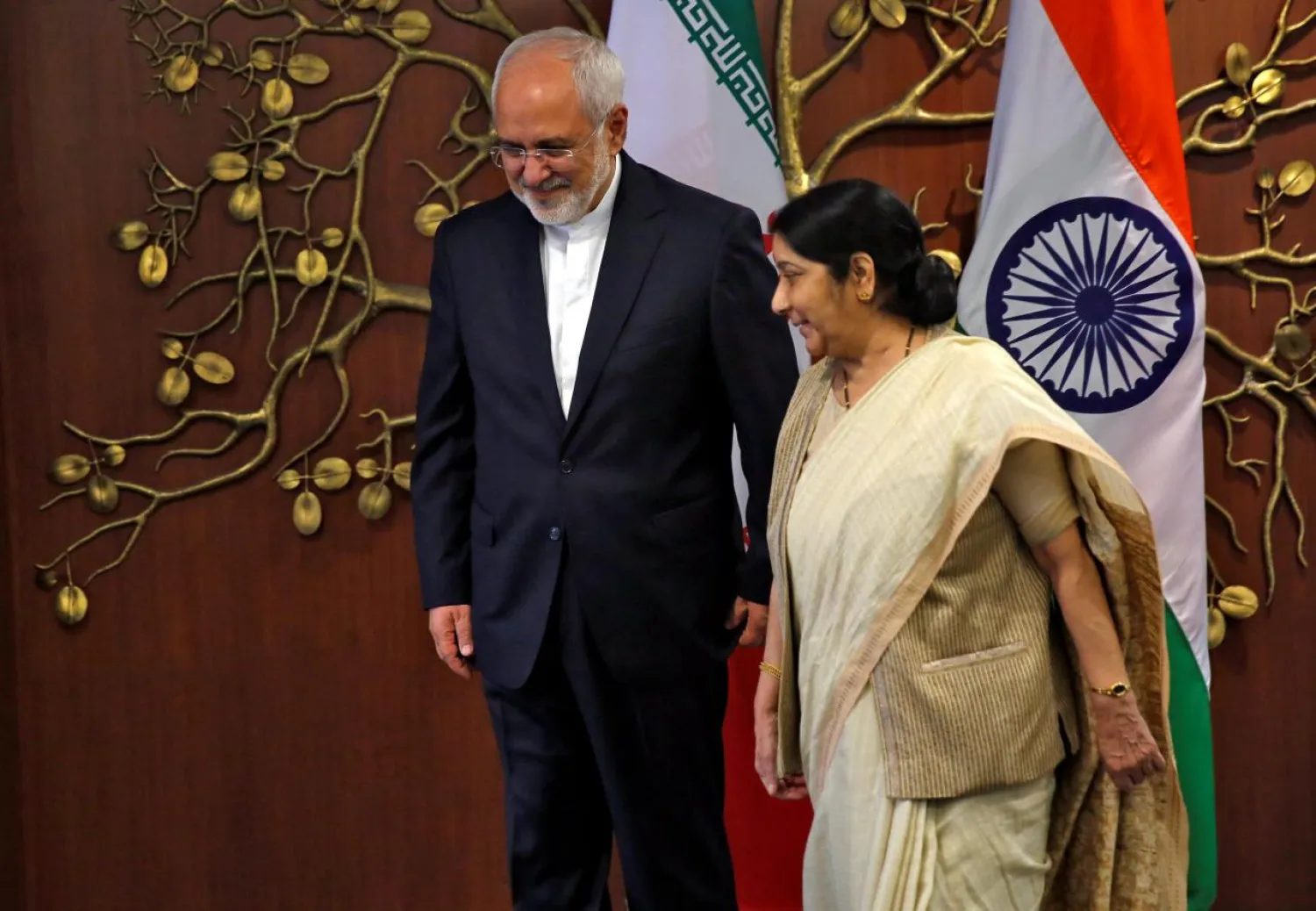
Iran's Foreign Minister Mohammad Javad Zarif and his Indian counterpart Sushma Swaraj walk after a photo opportunity in New Delhi, India, May 28, 2018. REUTERS/Altaf Hussain
TT

India Follows UN Sanctions, not Unilateral Sanctions by Any Country- Indian FM

Iran's Foreign Minister Mohammad Javad Zarif and his Indian counterpart Sushma Swaraj walk after a photo opportunity in New Delhi, India, May 28, 2018. REUTERS/Altaf Hussain

India and China seem unconcerned with US threats to re-impose economic sanctions on Tehran after Washington's withdrawal from Iran's nuclear deal.

In a clear challenge to the United States, Iranian President Hassan Rouhani was officially invited to attend the Shanghai Cooperation Organization (SCO) summit in June in China. Among attendees of the summit are the Chinese president, the Indian prime minister and the Russian president among other members of the organization. It is reported that the Iranian president might meet independently with the leaders of China, India and Russia during that visit.

Indian Foreign Ministry said Iranian Foreign Minister Mohammad Javad Zarif briefed him about the discussions that Iran has undertaken with parties to the Joint Comprehensive Plan of Action following the US decision to withdraw from the agreement.

Zarif told reporters that his visit to New Delhi aims to continue the consultations with Indian political and economic partners in the fields of energy and transport.

The Iranian foreign minister said the economic delegation accompanying him had held talks with their counterparts in India on the reciprocal projects, pointing out that “our discussions also focused on finding common mechanisms that would serve the interests of the two countries in light of the current situation and the availability of the appropriate ground for the establishment of close political and commercial cooperation”.

Srikanth Kondapalli, an expert on China affairs at Jawaharlal Nehru University in New Delhi, said that while supporters of the Iran deal scrambled to save it, the SCO was likely to issue a statement about the situation in the Middle Eastern country in a bid to put more diplomatic pressure on the US.

“Russia and China have huge concerns about the recent developments,” he said.

Kondapalli indicated that India will also be concerned, given that China and India are facing energy security problems because Iran is a huge supplier to them both.

Indian Foreign Minister Sushma Swaraj expressed her support for Iran and declared that the Indian position in this regard is independent of the positions of any other country.

Swaraj said New Delhi will not be dictated by other countries.

"We don't make our foreign policy under pressure from other countries," she said, adding that New Delhi only honors sanctions imposed collectively by members of the United Nations.

"We believe in UN sanctions, but not in country-specific sanctions," she asserted.

According to sources in the Indian Foreign Ministry, New Delhi has instructed Iran that oil imports continue and India will accelerate the work in the development and investment of the Iranian port of Chabahar.

India is the second largest importer of Iranian oil in Asia, and is looking for Iran to a reduce oil import prices, and has been working on the development and modernization of the Iranian port of Chabahar. Oil imports costs are expected to be reduced by third.

Most of Iran's oil exports go to China, worth about $11 billion year-on-year at current prices.

The fact that major European powers, such as France, Germany and the United Kingdom, reaffirmed their commitment to support the Joint Comprehensive Plan of Action (JCPOA) which means energy trade between Tehran and New Delhi will witness little or no change.

For India, the challenge is to preserve its interests in Iran and the wider West Asia region, said Indian journalist Geeta Mohan.

Mohan explained that New Delhi benefited from strained relations between the United States and Iran, where India had the opportunity to strengthen its relations with major states in the region.

India along with Iran and Afghanistan are developing the strategic Iranian port of Chabahar on the southeast coast of Iran.

An official at the Iranian embassy in New Delhi warned earlier that Tehran would not hesitate to involve China in the Chabahar port project if India failed to meet its financial obligations.

If India withdraws from this project, Tehran can have deeper economic ties with Islamabad. Tehran may try to contribute to the China-Pakistan economic corridor, a regional project strongly opposed by India. At the same time, India looks forward to closer bilateral ties with Afghanistan and Iran to contain Pakistan.

An Iranian diplomat in India said the $20 billion port of Chabahar and the North-South International Corridor Agreement between Iran, India and Russia could protect Tehran from US sanctions if India was quick to fund the projects

In the meantime, China continues to finance Iran's infrastructure projects during the first phase of international sanctions against it.

"India needs to establish itself and not lose credibility with Iran for its geopolitical interests in the region," said one Indian diplomat, who did not want to be identified.

Chinese banks have been the main and only source of the vast amounts of capital Iran needs to finance vital infrastructure projects in the country and to develop its $430 billion economy. Trade between China and Iran has doubled since 2006, reaching $28 billion.



Top Trump Iran Negotiator Says Visits US Aircraft Carrier in Middle East

US Special Envoy Steve Witkoff delivers a press conference upon the signing of the declaration on deploying post-ceasefire force in Ukraine, during the so-called "Coalition of the Willing" summit, at the Elysee Palace in Paris, France, January 6, 2026. (Reuters)
TT

Top Trump Iran Negotiator Says Visits US Aircraft Carrier in Middle East

US Special Envoy Steve Witkoff delivers a press conference upon the signing of the declaration on deploying post-ceasefire force in Ukraine, during the so-called "Coalition of the Willing" summit, at the Elysee Palace in Paris, France, January 6, 2026. (Reuters)

US President Donald Trump's lead Iran negotiator Steve Witkoff on Saturday said he visited the USS Abraham Lincoln aircraft carrier currently in the Arabian Sea, with Washington and Tehran due to hold further talks soon.

"Today, Adm. Brad Cooper, Commander of US Naval Forces Central Command, Jared Kushner, and I met with the brave sailors and Marines aboard the USS Abraham Lincoln, her strike group, and Carrier Air Wing 9 who are keeping us safe and upholding President Trump's message of peace through strength," said Witkoff in a social media post.

Iranian Foreign Minister Abbas Araghchi said on Saturday he hoped talks with the United States would resume soon, while reiterating Tehran's red lines and warning against any American attack.


Israel’s Netanyahu Expected to Meet Trump in US on Wednesday and Discuss Iran

Israeli Prime Minister Benjamin Netanyahu delivers a speech during a special session to mark the 77th anniversary of the Knesset's establishment and the 60th anniversary of the dedication of the current building at the Knesset, the Israeli parliament, in Jerusalem, 02 February 2026. (EPA)
TT

Israel’s Netanyahu Expected to Meet Trump in US on Wednesday and Discuss Iran

Israeli Prime Minister Benjamin Netanyahu delivers a speech during a special session to mark the 77th anniversary of the Knesset's establishment and the 60th anniversary of the dedication of the current building at the Knesset, the Israeli parliament, in Jerusalem, 02 February 2026. (EPA)

Israeli Prime Minister Benjamin Netanyahu is expected to meet US President Donald Trump on Wednesday in Washington, where they will discuss negotiations with Iran, Netanyahu's office said on Saturday.

Iranian and US officials held indirect nuclear ‌talks in the ‌Omani capital ‌Muscat ⁠on Friday. ‌Both sides said more talks were expected to be held again soon.

A regional diplomat briefed by Tehran on the talks told Reuters Iran insisted ⁠on its "right to enrich uranium" ‌during the negotiations with ‍the US, ‍and that Tehran's missile capabilities ‍were not raised in the discussions.

Iranian officials have ruled out putting Iran's missiles - one of the largest such arsenals in the region - up ⁠for discussion, and have said Tehran wants recognition of its right to enrich uranium.

"The Prime Minister believes that any negotiations must include limiting ballistic missiles and halting support for the Iranian axis," Netanyahu's office said in a ‌statement.


Italy FM Rules Out Joining Trump’s ‘Board of Peace’

Italy's Minister for Foreign Affairs Antonio Tajani speaks to the press during the EPP Leaders’ meeting, in Zagreb, Croatia, 30 January 2026. (EPA)
TT

Italy FM Rules Out Joining Trump’s ‘Board of Peace’

Italy's Minister for Foreign Affairs Antonio Tajani speaks to the press during the EPP Leaders’ meeting, in Zagreb, Croatia, 30 January 2026. (EPA)

Italy will not take part in US President Donald Trump's "Board of Peace", Italian Foreign Minister Antonio Tajani said Saturday, citing "insurmountable" constitutional issues.

Trump launched his "Board of Peace" at the World Economic Forum in Davos in January and some 19 countries have signed its founding charter.

But Italy's constitution bars the country from joining an organization led by a single foreign leader.

Prime Minister Giorgia Meloni, a Trump ally, last month noted "constitutional problems" with joining, but suggested Trump could perhaps reopen the framework "to meet the needs not only of Italy, but also of other European countries".

Tajani appeared Saturday to rule that out.

"We cannot participate in the Board of Peace because there is a constitutional limit," he told the ANSA news agency.

"This is insurmountable from a legal standpoint," he said, the day after meeting US Secretary of State Marco Rubio and US Vice President JD Vance at the Olympics in Milan.

Although originally meant to oversee Gaza's rebuilding, the board's charter does not limit its role to the Palestinian territory and appears to want to rival the United Nations.