

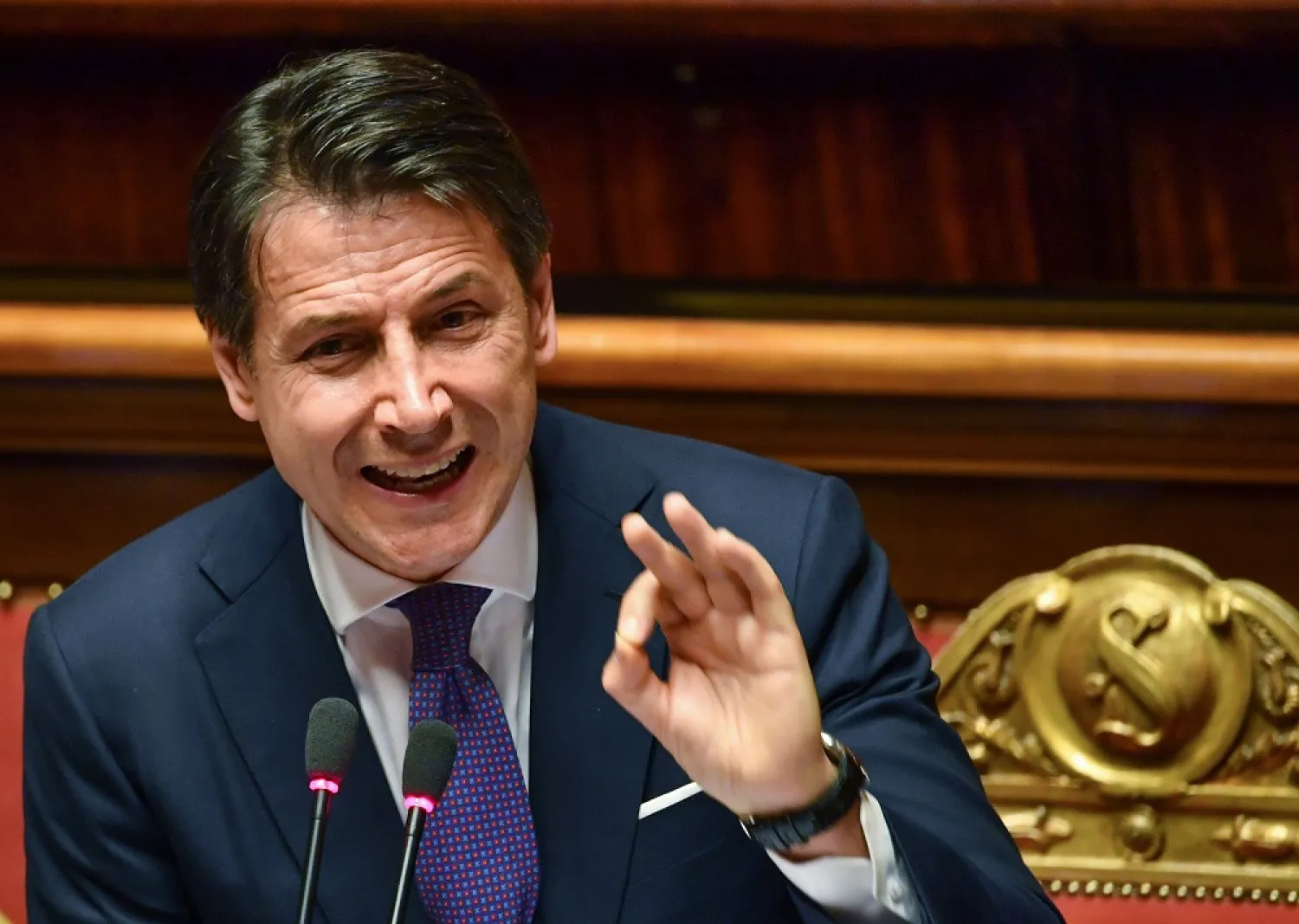

Italy’s New Populist Cabinet Takes Office

Italian Prime Minister Giuseppe Conte. (Getty Images)
TT

Italy’s New Populist Cabinet Takes Office

Italian Prime Minister Giuseppe Conte. (Getty Images)

Italy’s new populist government officially took office on Wednesday after winning parliament’s backing.

The alliance between the anti-establishment Five Star Movement (M5S) and the far-right League was approved by the chamber of deputies with 350 votes in favor, 236 against and 35 abstentions.

Wednesday's vote came a day after the upper house senate approved the government of Prime Minister Giuseppe Conte.

Approval in both houses of parliament gives 53-year-old academic Conte, a political novice, the mandate to carry out his program for a "government of change."

Conte told the lower house that his government aimed to increase growth and simultaneously reduce the debt mountain -- the third largest in the world in absolute terms.

"We will negotiate at the European level ... and we hope to have the firmness and determination needed to be listened to by our partners," he said.

His program also takes a hard line on immigration, promising to curb new arrivals and speed up expulsions of illegal migrants.

On Wednesday, Interior Minister Matteo Salvini went a step further saying that he wanted asylum centers to become closed-off structures so that migrants "aren't strolling about our cities".

A lawyer with little political experience, Conte was nominated by Salvini and Five Star head Luigi Di Maio -- both of whom are now also his deputy prime ministers.

In his first policy speech on Tuesday, Conte called for "obligatory" redistribution of asylum seekers around the EU and a review of sanctions against Russia.

He also reaffirmed several of the coalition's key manifesto pledges, including rejection of austerity in an economy weighed down by the eurozone's second-largest debt ratio.

"We want to reduce our public debt, but we want to do so with growth and not with austerity measures," he told senators.

Ahead of his first engagements, Conte reiterated the government's intention to stay in the EU.

"Europe is our home," Conte said, adding that he wanted a "stronger but also fairer Europe".

But the government's ambitious anti-austerity policies -- which include rolling back pension reform, slashing taxes and a basic universal income for Italy's poorest-- have worried Brussels, given Italy's huge public debt.

"We will get through the summer without difficulties, but there will be problems in the autumn if the new government implements even only 50 percent of what it has planned," head of the European Stability Mechanism (ESM) Klaus Regling told the German newspaper Handelsblatt on Wednesday.

Opposition critics accused Conte of spouting generalities in his two long speeches to parliament over the past two days and condemned him for telling lawmakers he was proud to lead a government that some have defined as "populist".

"You claimed to be populist, but horrible crimes have been committed in this country in the name of populism, racial laws approved and genocide committed in Europe," said Graziano Delrio, a senior figure in the center-left Democratic Party.

Conte makes his debut in the international arena at this week's G7 summit in Canada.

Since being sworn in as interior minister, Salvini has already made waves.

He wasted no time addressing immigration, stressing at the weekend that Italy "cannot be Europe's refugee camp" on a visit to Sicily, one of the country's main refugee landing points

The 45-year-old said the "good times for illegals are over" in a country where around 700,000 migrants have arrived since 2013.

The bullish minister also caused a diplomatic gaffe with Tunisia after accusing the North African country of exporting "convicts" to Italy.

Tunisia's foreign ministry summoned their Italian ambassador and expressed their "deep surprise" at Salvini's comments in light of the two countries' "cooperation in the fight against illegal immigration".



Migrants Missing after Mediterranean Capsize: NGOs

Hellenic coast guard performs SAR operation, following migrant's boat collision with coast guard off the Aegean island of Chios, near Mersinidi, Greece, February 4, 2026. REUTERS
TT

Migrants Missing after Mediterranean Capsize: NGOs

Hellenic coast guard performs SAR operation, following migrant's boat collision with coast guard off the Aegean island of Chios, near Mersinidi, Greece, February 4, 2026. REUTERS

Dozens of people are missing after a migrant boat capsized in the central Mediterranean, the NGOs Mediterranea Saving Humans and Sea-Watch said Sunday on social media.

Two people died and 32 were rescued from the boat, which had left Libya on Saturday afternoon with around 105 people on board, according to Mediterranea Saving Humans, AFP reported.

"Tragic Easter shipwreck. 32 survivors, two bodies recovered and more than 70 people missing," the NGO wrote on X, adding that the boat capsized in a search-and-rescue zone handled by Libyan authorities.

Sea-Watch said two commercial ships saved the survivors and took them to the Italian island of Lampedusa.

An aerial video it posted showed two men clinging to the hull of the capsized vessel, and the approach of one of the commercial ships.

Mediterranea Saving Humans said the accident was "the consequence of policies by European governments that refuse to open safe and legal pathways" for migrants.

Lampedusa is a key entry point for migrants crossing the Mediterranean from North Africa to Europe.

Since the start of 2026, at least 683 migrants have lost their lives or gone missing on attempts to cross the sea, according to the UN's migration agency IOM.

According to the Italian government, 6,175 migrants arrived on Italian territory over the same period.


Trump Vows Strikes on Iran’s Power Plants, Bridges if Strait of Hormuz isn't Reopened

ABD Başkanı Donald Trump (Reuters)
TT

Trump Vows Strikes on Iran’s Power Plants, Bridges if Strait of Hormuz isn't Reopened

ABD Başkanı Donald Trump (Reuters)

US President Donald Trump has promised strikes on Iran’s power plants and bridges on Tuesday, restating his threat to attack civilian infrastructure if the Strait of Hormuz isn’t reopened.

In an expletive-laden post Sunday morning, Trump promised the “crazy bastards” would be “living in Hell” if the waterway isn’t opened to marine traffic, The AP news reported.

Trump had previously threatened strikes two weeks ago, but extended the deadline for Iran to reopen the waterway twice, claiming there were positive signs in negotiations with the Iranians. But there have been few public signs of progress in a diplomatic off-ramp to the war.


Pope Leo Marks First Easter as Pontiff with Call for Hope Amid Global Conflicts

 Pope Leo XIV presides over Easter Mass in St. Peter's Square at the Vatican, Sunday, April 5, 2026 (AP)
Pope Leo XIV presides over Easter Mass in St. Peter's Square at the Vatican, Sunday, April 5, 2026 (AP)
TT

Pope Leo Marks First Easter as Pontiff with Call for Hope Amid Global Conflicts

 Pope Leo XIV presides over Easter Mass in St. Peter's Square at the Vatican, Sunday, April 5, 2026 (AP)
Pope Leo XIV presides over Easter Mass in St. Peter's Square at the Vatican, Sunday, April 5, 2026 (AP)

Pope Leo celebrated his first Easter Mass as pontiff with a call Sunday to exercise hope against “the violence of war that kills and destroys,” saying “we need this song of hope today” as conflicts spread around the world.

With the US-Israeli war on Iran in its second month and Russia’s ongoing campaign in Ukraine, Leo has repeatedly called for a halt in hostilities. In his Easter homily, the pope singled out those who wage war, abuse the weak and prioritize profits.

Leo, the first US-born pope, addressed the faithful from an open-air altar in St. Peter’s Square flanked with white roses, while the steps leading down to the piazza where the faithful gathered were filled with spring perennials, symbolically resonating with the pope’s message of hope.

The pontiff implored the faithful to keep their hope in the face of death, which lurks “in injustices, in partisan selfishness, in the oppression of the poor, in the lack of attention given to the most vulnerable.

“We see it in violence, in the wounds of the world, in the cry of pain that rises from every corner because of the abuses that crush the weakest among us, because of the idolatry of profit that plunders the earth’s resources, because of the violence of war that kills and destroys,” he said.

He quoted his predecessor Pope Francis in warning against falling into indifference in the face of “persistent injustice, evil, indifference and cruelty,” because “it is also true that in the midst of darkness, something new always springs to life and sooner or later produces fruit.”

He will later deliver the traditional “Urbi et Orbi” message — Latin for “to the city and the world.”

Christians in the Holy Land were marking a subdued Easter Traditional ceremonies at the Church of the Holy Sepulchre, revered by Christians as the traditional site of Jesus’ crucifixion and resurrection, were scaled back under an agreement with Israeli police. Authorities have put limits on the sizes of public gatherings due to ongoing missile attacks.

The restrictions also dampened the recent Muslim holy month of Ramadan and Eid al-Fitr holiday, as well as the current weeklong Jewish festival of Passover. On Sunday, the Jewish priestly blessing at the Western Wall — normally attended by tens of thousands — was limited to just 50 people.

The restrictions have strained relations between Israeli authorities and Christian leaders. Police last week prevented two of the church’s top religious leaders, including Latin Patriarch Pierbattista Pizzaballa, from celebrating Palm Sunday at the Church of the Holy Sepulchre.

On Tuesday, the pope had expressed hope that the war could be finished before Easter.