


Tunisia Interior Minister, Officials Fired over Migrant Boat Sinking

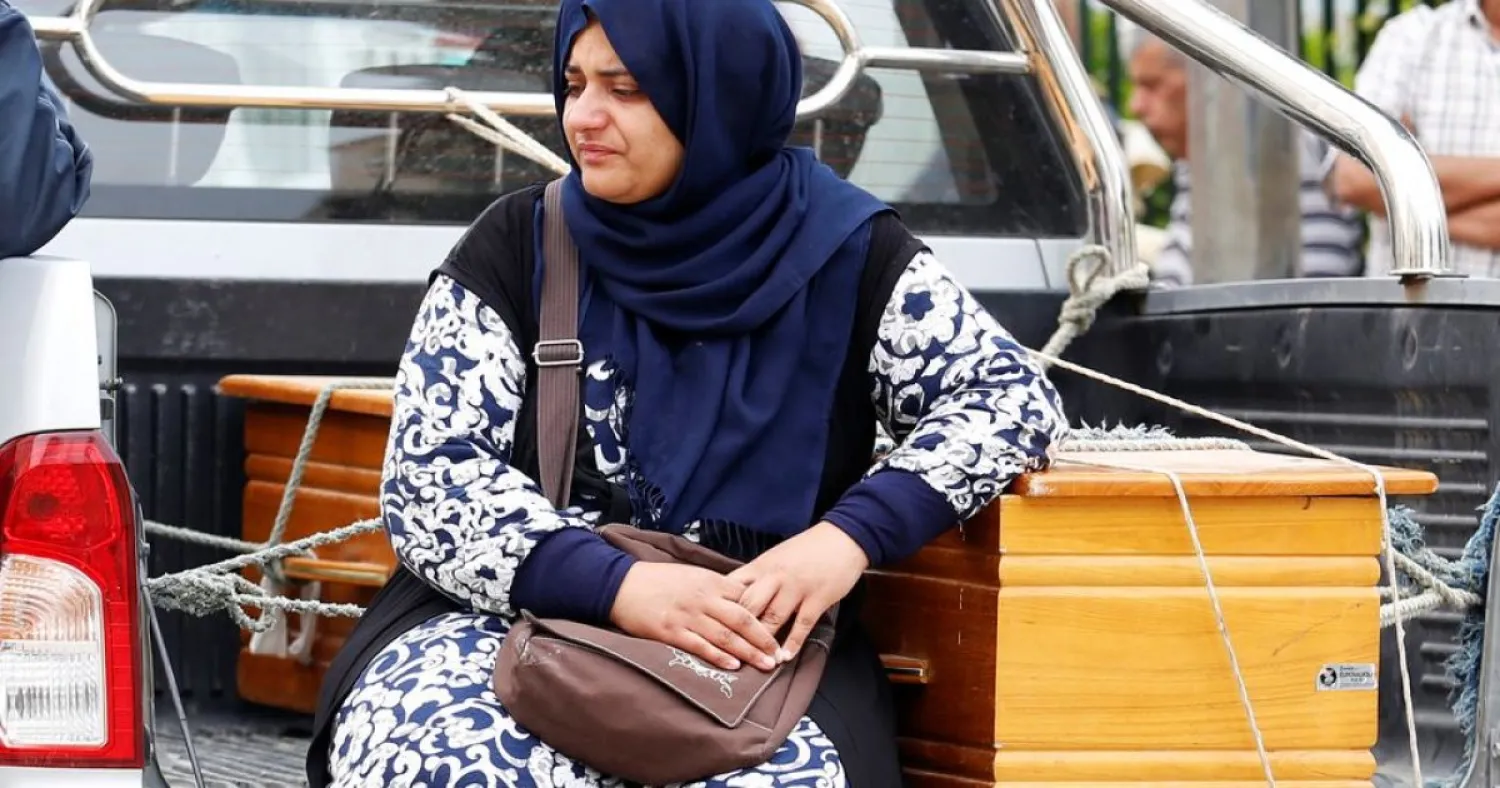
A relative of Tunisian migrants, who drowned when their boat sank, waits outside a hospital morgue to identify the bodies of her kin in Sfax, Tunisia June 4, 2018. (Reuters)
TT

Tunisia Interior Minister, Officials Fired over Migrant Boat Sinking

A relative of Tunisian migrants, who drowned when their boat sank, waits outside a hospital morgue to identify the bodies of her kin in Sfax, Tunisia June 4, 2018. (Reuters)

Tunisian Interior Minister Lotfi Brahem was dismissed from his post on Wednesday as the North African country continued to reel from the weekend’s migrant boat sinking that left at least 66 people dead.

Numerous officials were also sacked from their positions.

No reason was given for the dismissal of Brahem, who the prime minister's office said will be replaced temporarily by Justice Minister Ghazi Jribi.

Sources close to the government told AFP that Brahem's sacking was expected, as he had poor relations with Prime Minister Youssef Chahed.

The minister's departure came after a boat overcrowded with migrants sank after leaving the Kerkennah Islands off the coast of Sfax province.

Earlier on Wednesday Brahem accused officials of negligence over the incident, announcing the sacking of 10 people.

A "preliminary investigation" had shown that officials had "directly or indirectly" failed to carry out their duties, an interior ministry statement said.

Among those fired were national guard officials based in Sfax and others from the maritime unit in Kerkennah.

A total of 68 people were rescued from the vessel after it ran into trouble late on Saturday evening.

On Monday the International Organization for Migration said "at least 112 people" had died in the accident.

Survivors have said the boat was packed with more than 180 people, which would mean dozens are still missing.

Authorities have said eight smugglers have been linked to the capsizing — all of them from Kerkennah — and police were trying to hunt them down.

The shipwreck is the deadliest in the Mediterranean since February 2, when 90 people drowned off the coast of Libya, according to the IOM.

In March, 120 people -- mostly Tunisians -- were rescued by the navy as they tried to reach the Italian coast.

As in other North African countries, desperate youth and even entire families are known to set off from Tunisia to attempt the risky Mediterranean crossing. The high number of deaths in the latest disaster, however, sparked criticism of the security apparatus. In October, a collision between a migrant boat and Navy vessel left 45 migrants dead.

Police oversight in Kerkennah has been reduced following clashes several months ago between officers and protesters seeking jobs at a company extracting oil at a field in the area.

The spokesman for the interior ministry, Khalifa Chibani, has said police forces would be reposted to the island "very shortly."



Muslim Brotherhood Faces Growing Int’l Isolation after Trump Decision

 A previous trial of Muslim Brotherhood members convicted on terrorism charges in Egypt (AFP)
A previous trial of Muslim Brotherhood members convicted on terrorism charges in Egypt (AFP)
TT

Muslim Brotherhood Faces Growing Int’l Isolation after Trump Decision

 A previous trial of Muslim Brotherhood members convicted on terrorism charges in Egypt (AFP)
A previous trial of Muslim Brotherhood members convicted on terrorism charges in Egypt (AFP)

The Muslim Brotherhood is facing growing international isolation after US President Donald Trump moved to designate its branches in Egypt, Jordan, and Lebanon as terrorist organizations.

Argentina has joined the list of countries banning the Brotherhood, announcing on Thursday that it had added the group’s branches in Egypt, Jordan, and Lebanon to its terrorist organizations list, a statement from the office of President Javier Milei said.

Experts and researchers said Trump’s decision would expand the international ban on Brotherhood branches, adding that more countries were likely to take similar steps, although the US measures would not affect all of the group’s branches abroad.

The Argentine move came two days after the US Treasury and State Departments announced on Tuesday the designation of the Muslim Brotherhood in Egypt, along with its branches in Jordan and Lebanon, as terrorist organizations.

Argentina’s government said its decision was based on official reports proving the existence of illicit cross-border activities, including terrorist acts and public calls for violent extremism, as well as links to other terrorist organizations and their potential impact on the Argentine Republic.

It added that the measure would strengthen mechanisms to prevent terrorism, detect it early, and punish its financiers, ensuring that members of the Brotherhood and their allies do not evade accountability.

Maher Farghaly, a researcher on Islamist movements, said the US president’s decision against the Brotherhood would encourage other countries to ban the group and its branches abroad.

He told Asharq Al-Awsat that countries in Latin America, such as Colombia and Venezuela, were expected to take similar steps to classify the group as a terrorist organization.

Farghaly said the successive bans on the Brotherhood were accompanied by similar European moves in Austria and Sweden.

He added that the key issue was the extent to which international decisions would affect the group’s activities abroad, noting that the US measures were partial because they targeted specific branches near Israel, while other Brotherhood-affiliated groups operating under different names were not covered.

In its official statement, Washington said branches of the Muslim Brotherhood claimed to be legitimate civil organizations while secretly and enthusiastically supporting terrorist groups such as Hamas.

Accordingly, the Office of Foreign Assets Control designated the Egyptian and Jordanian branches of the Brotherhood for providing material support to Hamas, classifying them as specially designated global terrorists under counterterrorism authority set out in Executive Order 13224, as amended.

International moves to isolate the Brotherhood confirm the validity of the Arab and Egyptian view of the group, Farghaly said, noting that Cairo had been among the first to designate the Brotherhood as a terrorist organization.

Egypt has classified the Brotherhood as a terrorist group since 2013.

Most of its leaders, including its supreme guide, Mohamed Badie, are imprisoned in Egypt on charges related to violence and killings that took place after the group was removed from power that year.

Other members have fled abroad and are wanted by the Egyptian judiciary, and are currently running the organization amid deep internal divisions, according to observers.

International counterterrorism expert Hatem Saber said the Brotherhood was facing international isolation following recent US decisions.

He said the designation would restrict the group’s movements, particularly in Egypt, Lebanon, and Jordan.

Speaking to Asharq Al-Awsat, he said the decision's impact included freezing the group’s funds, banning its members' travel, preventing them from receiving any support, and criminalizing any individual or institution that provides assistance to the group.

Saber said it would be difficult to impose a comprehensive cross-border ban on the entire organization because of legal challenges in classifying affiliated groups that operate under different names.

He added that Washington’s measures would not apply only within the United States but would also affect any external transactions involving the banned branches.


Sami Nasman, a Hamas Foe, Returns to Run Gaza Security

Sami Nasman (X)
Sami Nasman (X)
TT

Sami Nasman, a Hamas Foe, Returns to Run Gaza Security

Sami Nasman (X)
Sami Nasman (X)

Even the most optimistic advocates of change in Gaza’s system of governance did not expect the list for the proposed Gaza Administration Committee to include figures long described as among Hamas’s fiercest opponents.

Many Palestinians, across factional and popular lines, were surprised by the emergence of Sami Nasman, one of the most prominent officers in the Palestinian General Intelligence Service since its establishment, as the figure selected to oversee the security file in Gaza.

Nasman has a long record of what has been described as hostility toward, and pursuit by, Hamas, which appeared to have little room to reject the names chosen to join the committee.

Who is Sami Nasman?

Sami Nasman was born in 1967 in the Beach refugee camp west of Gaza City and spent most of his life in the Sheikh Radwan neighborhood in the city’s north.

During his secondary and university studies, he joined the Fatah Youth Movement and was active in the first Palestinian uprising that erupted in 1987.

He also took part in armed activities that made him a target for Israeli forces after he formed a cell that targeted those accused of collaborating with Israel’s Shin Bet security agency. That forced him, along with several Fatah activists, to flee the Gaza Strip in 1988.

Nasman experienced a brief period of what was described as limited hostility with Hamas activists during the group’s early formation in 1987, a phase that quickly faded after his departure from Gaza.

While in exile, Nasman moved between Cairo, Tunis, and other capitals, where he met the late Palestinian president Yasser Arafat, according to sources close to him cited by Asharq Al-Awsat.

Return to Gaza, return to hostility

In 1994, as the Palestinian Authority began deploying in Gaza and parts of the West Bank under the 1993 Oslo Accords, Nasman returned to the enclave with others and later settled again in Sheikh Radwan.

He became a senior officer in the Palestinian General Intelligence Service and was considered the right hand of Amin al-Hindi, the agency’s first chief.

Nasman wielded significant influence within the intelligence service, across the broader Palestinian security apparatus, and within Fatah’s institutional circles. He was often described as a “hard man to reckon with,” the sources said.

They added that he held several key posts, including serving as the intelligence chief’s private office chief, leading the counterintelligence department, overseeing investigations into foreigners permitted to enter Gaza, and handling other sensitive assignments.

After his return, and amid Palestinian security activity targeting Hamas and Palestinian Islamic Jihad members, Nasman was accused of leading arrest campaigns against them between 1996 and 2000.

In February 1996, Islamic Jihad accused him of responsibility for the killing of two of its senior field operatives who had carried out an attack in Beit Lid inside Israel that killed more than 20 Israelis.

The two men were surrounded in a house in the Beach camp, just tens of meters from the intelligence service’s Mushtal compound and were killed during an attempted arrest after refusing to surrender.

Sources close to Nasman denied his involvement, saying another officer was responsible. That account could not be independently confirmed, although some testimonies at the time placed him at the scene.

The second intifada

Hostility between Nasman and Hamas deepened with the outbreak of the second Palestinian uprising in late 2000 and the escape of Hamas and Islamic Jihad members from Palestinian Authority prisons.

Tensions escalated further after Hamas won the 2006 legislative elections, a year that also saw an assassination attempt on the intelligence service’s second chief, Ahmed Shaniora, known as Tariq Abu Rajab.

That was followed by an attempt on the life of Maj. Gen. Baha Balousha, which killed his wife and children.

The confrontation between Nasman, his security apparatus, and Hamas reached its peak after Hamas seized control of Gaza in 2006, forcing him, like dozens of other officers, to flee for fear of his life amid accusations that he had overseen the arrest and pursuit of Hamas members.

Nasman exited Gaza via Israeli land crossings to Ramallah, where he later became responsible for the Gaza file within the intelligence service and then an adviser to the agency’s chief for the southern governorates.

Accusations and convictions in absentia

The hostility did not end with his departure. In 2015, Hamas accused Nasman of running networks inside Gaza from Ramallah to stir unrest and carry out assassination attempts against its leaders and officials.

In August 2015, Hamas gave him 10 days to turn himself in.

In March 2016, it sentenced him in absentia to 15 years in prison, along with others who received varying terms, after publishing confessions by Palestinian security operatives who said Nasman had recruited them to carry out the alleged plots.

Sources close to Nasman dismissed the accusations as unfounded, describing them as part of the political infighting that accompanied the Palestinian split.

During the most recent war in Gaza, Hamas again accused him of overseeing an intelligence network that monitored the entry of international and Arab aid convoys into the enclave for espionage purposes, an allegation neither Fatah nor the Palestinian Authority commented on.

In recent months, Nasman joined the ranks of officers who were “forcibly retired and marginalized,” according to sources close to him. He subsequently developed new ties with associates working with the camp of exiled Fatah leader Mohammed Dahlan, meeting them frequently in Cairo.

Other sources said he was nominated by the Dahlan-aligned camp to lead the public security file within the new committee.

Hamas’s position

Nasman’s appointment to the security portfolio has sparked widespread debate in Palestinian circles, raising questions about Hamas’s stance, particularly among its grassroots and organizational ranks, given the well-known hostility toward him.

Officially, Hamas welcomed the formation of the technocratic committee in a joint statement with other Palestinian factions, without voicing objections.

However, Hamas sources told Asharq Al-Awsat that the movement was “compelled at this critical stage to set aside differences, as it has done with other Palestinian Authority and Fatah figures, for the sake of Palestinians in the Gaza Strip.”

Another senior Hamas source said the movement “has little room to maneuver, as it seeks to secure a ceasefire agreement that implements its terms and moves Palestinians into a new political and national phase.”


Hamas Rejects Exclusion from Gaza Political Scene

Tents sheltering displaced Palestinian families line Gaza City’s coastline as strong winter winds sweep the enclave (AFP)
TT

Hamas Rejects Exclusion from Gaza Political Scene

Tents sheltering displaced Palestinian families line Gaza City’s coastline as strong winter winds sweep the enclave (AFP)

A US announcement launched the second phase of a ceasefire agreement in the Gaza Strip, as questions swirl over the future of Hamas after nearly two years of an unprecedented war with Israel that has only partially subsided.

The ceasefire is part of a peace plan proposed by US President Donald Trump, which entered into force in October and stipulates an end to Hamas rule in Gaza and the disarmament of the movement.

Hamas believes there is a clear distinction between not governing Gaza, which it accepts, and being removed entirely from the political landscape, senior Hamas official Mohammed Nazzal said, accusing Israeli Prime Minister Benjamin Netanyahu of seeking to sabotage the ceasefire.

“There is a difference between Hamas not being part of governance and administration in Gaza, which we accept, and between its absence or exclusion from the political scene,” Nazzal told Asharq Al-Awsat.

“Hamas is deeply rooted in Palestinian society in general and Gazan society in particular. Anyone who believes Hamas can be erased from the political scene is delusional.”

Nazzal said that since Hamas joined negotiations to end what he described as a war of genocide in Gaza, representing Palestinian resistance factions, it had shown high flexibility and worked to facilitate mediators’ efforts.

He accused Netanyahu and his governing coalition of repeatedly derailing talks through stalling and maneuvering.

When a ceasefire was first reached in January 2025 under direct pressure from the new Trump administration, Netanyahu was forced to accept the deal but intended to undermine it, Nazzal said, adding that the agreement collapsed in March 2025.

Talks then returned to square one, he said, and stagnated until an attempted assassination of Hamas leaders in Doha in September 2025 embarrassed Washington, particularly after the operation failed and triggered regional and international repercussions.

According to Nazzal, Trump again pressured Netanyahu to reach a new deal, betting that Hamas would reject the plan. “The surprise was that Hamas accepted it as a negotiating framework,” he said.

“That left Netanyahu cornered and forced him to approve the plan against his will.”

Attempts to evade commitments

Nazzal warned that since the signing of the Sharm el-Sheikh agreement in October, Netanyahu has sought to evade and escape the deal through various pretexts.

He said Hamas and other resistance factions thwarted those efforts by maintaining constant communication with the three mediators and briefing them on Israeli violations, as well as keeping the US administration informed, while continuing along the political negotiating track.

“We know Netanyahu does not want to move to the second phase,” Nazzal said. “He is still obstructing the implementation of the first phase and working to undermine it.”

Low-intensity war

Nazzal said Netanyahu wants the war to continue, albeit at a lower intensity, for personal reasons linked to maintaining a wartime atmosphere until Israel’s parliamentary elections at the end of 2026.

He said this helps Netanyahu avoid, in practice, judicial accountability over corruption charges predating Oct. 7 and over the military and security failures of the Oct. 7 attack, for which the opposition holds him responsible.

Regarding the implementation of the first-phase provisions, particularly the Rafah crossing, Nazzal said that efforts by the mediators, led by Egypt, to reopen the crossing have not stopped.

He accused Netanyahu of seeking to open it in one direction only to enable what he described as the forced displacement of Palestinians from Gaza by allowing departures without returns.

Gaza committee

On consultations hosted by Cairo to form a Gaza administration committee, Nazzal said Hamas has made clear it is ready to hand over management of Gaza to a technocratic committee of Palestinian professionals.

He said Hamas, in coordination with other Palestinian factions, submitted 40 names to Egyptian authorities, with none of the proposed figures having any organizational ties to Hamas.

He said the issues of resistance weapons and an international stabilization force in Gaza remain under discussion, with ambiguity persisting on the US side.

Final decisions on both matters, he said, should be made within a comprehensive Palestinian national framework that includes all relevant factions.

Addressing Israeli claims over the remains of hostages, Nazzal said efforts are ongoing to recover the body of the last Israeli captive held by the resistance.

He said US sponsors and mediators are aware that Hamas has exerted intensive efforts and has no interest in withholding the remains, as Israel alleges, since Hamas seeks to prevent Israel from using the issue to avoid moving to the second phase.

Separately, the Gaza mediators Qatar, Egypt, and Türkiye welcomed on Wednesday the formation of a technocratic committee to administer Gaza, chaired by Ali Shaath, according to a joint statement issued by Qatar’s foreign ministry.

The statement described the move as an important step toward reinforcing stability and improving humanitarian conditions in the enclave.

At the same time, US special envoy Steve Witkoff announced the launch of the second phase of Trump’s 20-point plan to end the Gaza conflict, saying it shifts from a ceasefire toward disarmament, technocratic governance, and reconstruction.