

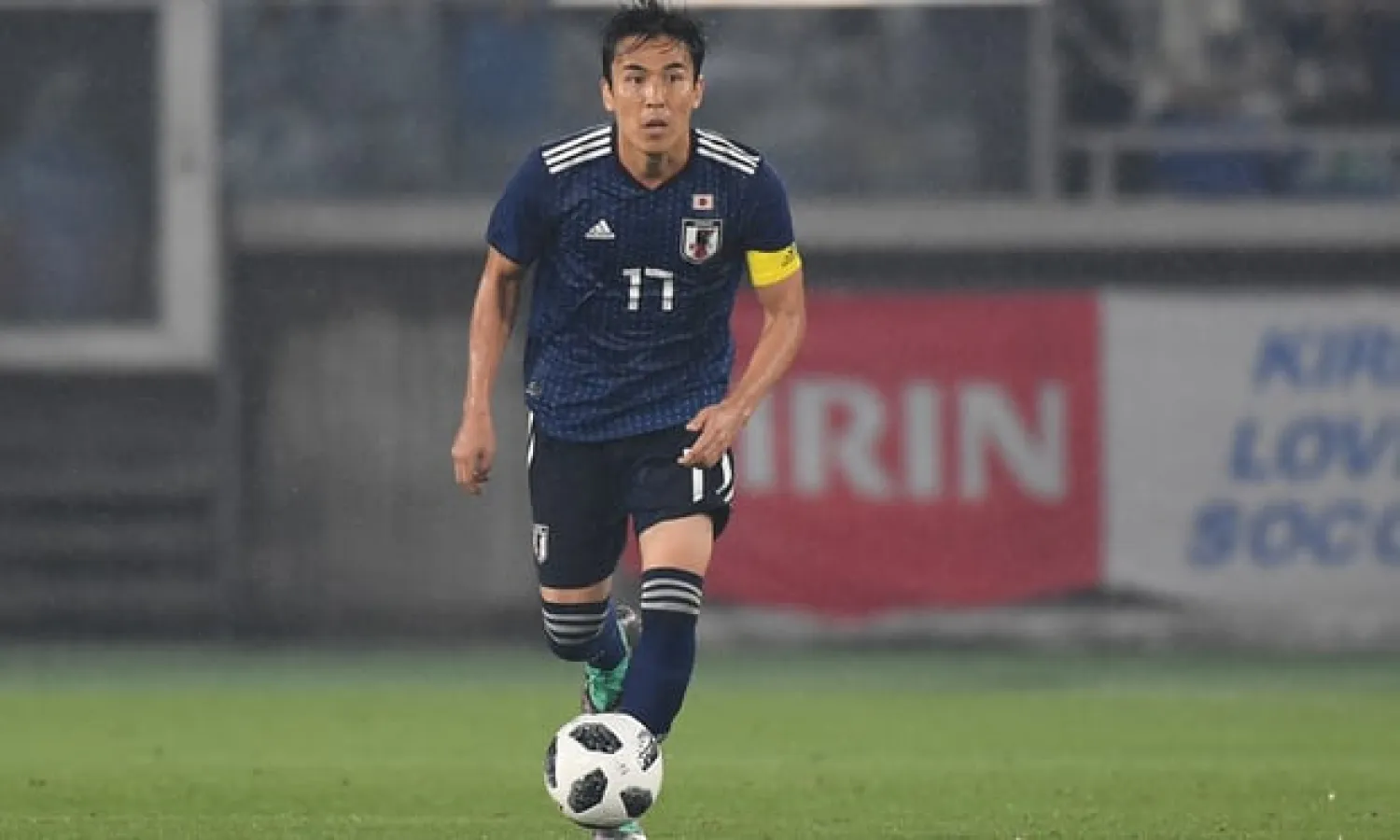

Makoto Hasebe: Slow Starter Whose Diligence Paid off with Japan Captaincy

 Makoto Hasebe took the advice of his grandfather to stick with football and has cemented his position as one of Japan’s greats. Photograph: Masashi Hara/Getty Images
Makoto Hasebe took the advice of his grandfather to stick with football and has cemented his position as one of Japan’s greats. Photograph: Masashi Hara/Getty Images
TT

Makoto Hasebe: Slow Starter Whose Diligence Paid off with Japan Captaincy

 Makoto Hasebe took the advice of his grandfather to stick with football and has cemented his position as one of Japan’s greats. Photograph: Masashi Hara/Getty Images
Makoto Hasebe took the advice of his grandfather to stick with football and has cemented his position as one of Japan’s greats. Photograph: Masashi Hara/Getty Images

Like many other Japanese players of his generation the national captain, Makoto Hasebe, started to dream of becoming a professional footballer when he read the popular and globally famous manga series Captain Tsubasa. Inspired by the miraculous skills of Tsubasa Oozora, the comic books’ eponymous star, Hasebe has been kicking a ball for as long as he can remember.

But there were also unique cultural factors behind Hasebe’s boyhood obsession with the game. In a country that has long been more associated with two other sports, baseball and sumo, his home town of Fujieda in Shizuoka Prefecture was highly unusual by Japanese standards due to its extraordinary passion for football instead. Despite Fujieda’s status as a small provincial city with a population of just over 100,000 people, it has produced a succession of renowned players including Hiroshi Nanami and Masashi Nakayama, who both represented Japan at the 1998 World Cup in France.

Growing up in such an environment Hasebe – who has starred in the Bundesliga for a decade now – was not rated all that highly before his late teens.

Partly thanks to the tutelage of his parents, Hasebe was a diligent schoolboy and, at 15, earned a place at Fujieda Higashi High School. This famous institution accepts only students of strong academic ability, but is also renowned for its highly successful football club who are perennial contenders at the nationally-televised All Japan High School Soccer Tournament each year. At first, Hasebe made little impression within the team and for some time struggled to even make the bench. Team-mates from the time recall that he spent more time during his first year quietly going about chores than actually playing; in particular, they say, he had a most steady arm when it came to marking the lines on the pitch.

It was only towards the end of his second season at Fujieda Higashi that he finally got his chance to make an impression with a football rather than just white paint. A late growth spurt helped him win a regular starting position and, slowly, the confidence of those around him. Even then, his reputation as a player was still only average at best; the future long-serving captain of the Japanese national team was never once seen as a candidate for the armband at his own high school.

However, as a third-year, Hasebe would show a dramatic and sustained improvement in his performances as an attacking midfielder. Around the turn of the millennium, major nationwide tournaments at under-18 level were held every summer, autumn, and winter. Hasebe performed superbly at both the summer and autumn tournaments to attract a surge of attention having been a total unknown just months earlier. Soon afterwards, he earned what would be the first of many call-ups to the Japanese age-level national teams.

The professional J-League clubs did not ignore these performances and it was Urawa Red Diamonds who pursued Hasebe’s signature most persistently. However, the 18-year-old’s parents remained keen that he should continue his education and argued that he should go to university rather than take the risk of turning professional at his age. Even his high school coach, despite such an upturn in performances, told him again: “There is no way you will make it in the professional leagues”.

The only one to offer different advice was another member of Hasebe’s family – his grandfather: “If you’re a man, you take the challenge.” It was his grandfather who had originally bestowed upon him the name Makoto – meaning “honesty” or “integrity” – and he continued to support his beloved grandson’s dreams of playing football for a living by persuading everyone else to put their objections aside. Ultimately, parents and teachers alike would bow to the strength of this ambition and allowed Hasebe to choose his own path.

Roughly a year after Hasebe signed his first professional contract, his grandfather fell ill and passed away. To Hasebe, still only 19, this came as a crushing blow but, at the same time, he discovered an ever more indefatigable desire to make a success of his career. Those who witnessed his second season with Urawa described him as a completely different person as a series of spirited performances led to a regular place in the starting XI for the first team. His development continued unabated towards, at last, captaincy material and his status today as one of the greats of Japanese football.

If Hasebe manages to score in Russia this summer, it would be no surprise to see him point upwards and shout to the heavens. This goal, of course, would be dedicated to the grandfather who has inspired him throughout everything.

The Guardian Sport


Factory Explosion Kills 8 in Northern China

Employees work on an electric vehicle (EV) production line at the Volkswagen Anhui factory in Hefei, Anhui province, China, February 4, 2026. REUTERS/Florence Lo
TT

Factory Explosion Kills 8 in Northern China

Employees work on an electric vehicle (EV) production line at the Volkswagen Anhui factory in Hefei, Anhui province, China, February 4, 2026. REUTERS/Florence Lo

An explosion at a biotech factory in northern China has killed eight people, Chinese state media reported Sunday, increasing the total number of fatalities by one.

State news agency Xinhua had previously reported that seven people died and one person was missing after the Saturday morning explosion at the Jiapeng biotech company in Shanxi province, citing local authorities.

Later, Xinhua said eight were dead, adding that the firm's legal representative had been taken into custody.

The company is located in Shanyin County, about 400 kilometers west of Beijing, AFP reported.

Xinhua said clean-up operations were ongoing, noting that reporters observed dark yellow smoke emanating from the site of the explosion.

Authorities have established a team to investigate the cause of the blast, the report added.

Industrial accidents are common in China due to lax safety standards.
In late January, an explosion at a steel factory in the neighboring province of Inner Mongolia left at least nine people dead.


Saudi Arabia’s flynas, Syrian Civil Aviation Authority Partner to Launch 'flynas Syria'

The new airline will operate commercial air transport services in accordance with approved regulations and standards (flynas)
TT

Saudi Arabia’s flynas, Syrian Civil Aviation Authority Partner to Launch 'flynas Syria'

The new airline will operate commercial air transport services in accordance with approved regulations and standards (flynas)

Saudi budget carrier flynas has signed an agreement with the Syrian General Authority of Civil Aviation and Air Transport to establish a new commercial airline under the name "flynas Syria," with operations scheduled to begin in the fourth quarter of 2026.

Saturday’s agreement comes within the framework of bilateral cooperation between Saudi Arabia and Syria, as well as the strategic investment agreements between the two countries, coordinated with the Saudi Ministry of Investment and the Syrian General Authority of Civil Aviation and Air Transport.

The new airline will operate commercial air transport services in accordance with approved regulations and standards, meeting the highest safety and aviation security requirements. All licensing and operational procedures will be completed in coordination with the relevant authorities.

The carrier will be established as a joint venture, with 51% ownership held by the Syrian General Authority of Civil Aviation and Air Transport and 49% by flynas.

The new airline will operate flights to several destinations across the Middle East, Africa, and Europe. This expansion aims to bolster air traffic to and from Syria, enhance regional and international connectivity, and meet growing demand for air travel.

"This step is part of our commitment to supporting high-quality cross-border investments. The aviation sector is a key enabler of economic development, and the establishment of 'flynas Syria' serves as a model for constructive investment cooperation,” said Saudi Minister of Investment Khalid Al-Falih.

“This partnership enhances economic integration and market connectivity and supports development goals by advancing air transport infrastructure, ultimately serving the mutual interests of both nations and promoting regional economic stability,” he added.

President of the Syrian General Authority of Civil Aviation and Air Transport Omar Hosari also stated that the establishment of flynas Syria represents a strategic step within a comprehensive national vision aimed at rebuilding and developing Syria's civil aviation sector on modern economic and regulatory foundations.

“This will be achieved while balancing safety requirements, operational sustainability, investment stimulation, and passenger services. The partnership reflects the state's orientation toward smart cooperation models with trusted regional partners, ensuring the transfer of expertise, the development of national capabilities, and the enhancement of Syria's air connectivity with regional and international destinations, in line with global best practices in the air transport industry."

flynas Chairman Ayed Al-Jeaid stated that the company continues to pursue strategies aimed at growth and international expansion, describing the agreement as a historic milestone in the company's journey and a promising investment model in partnership with Syria.

flynas CEO Bander Al-mohanna said the step represents a qualitative leap in the company's strategy and financial performance, highlighting the transfer of the company's low-cost aviation experience to the Syrian market to support regional and international air connectivity.

flynas currently operates 23 weekly flights from Riyadh, Jeddah, and Dammam to Damascus, including two daily direct flights from Riyadh, one daily flight from Jeddah, and two weekly flights from Dammam.

The airline made history on June 5, 2025, by adding the Syrian capital to its network, becoming the first Saudi carrier to resume scheduled flights to Damascus.


Iran Warns Will Not Give Up Enrichment Despite US War Threat

Traffic moves through a street in Tehran on February 7, 2026. (Photo by ATTA KENARE / AFP)
TT

Iran Warns Will Not Give Up Enrichment Despite US War Threat

Traffic moves through a street in Tehran on February 7, 2026. (Photo by ATTA KENARE / AFP)

Iran will never surrender the right to enrich uranium, even if war "is imposed on us,” its foreign minister said Sunday, defying pressure from Washington.

"Iran has paid a very heavy price for its peaceful nuclear program and for uranium enrichment," Abbas Araghchi told a forum in Tehran.

"Why do we insist so much on enrichment and refuse to give it up even if a war is imposed on us? Because no one has the right to dictate our behavior," he said, two days after he met US envoy Steve Witkoff in Oman.

The foreign minister also declared that his country was not intimidated by the US naval deployment in the Gulf.

"Their military deployment in the region does not scare us," Araghchi said.
