

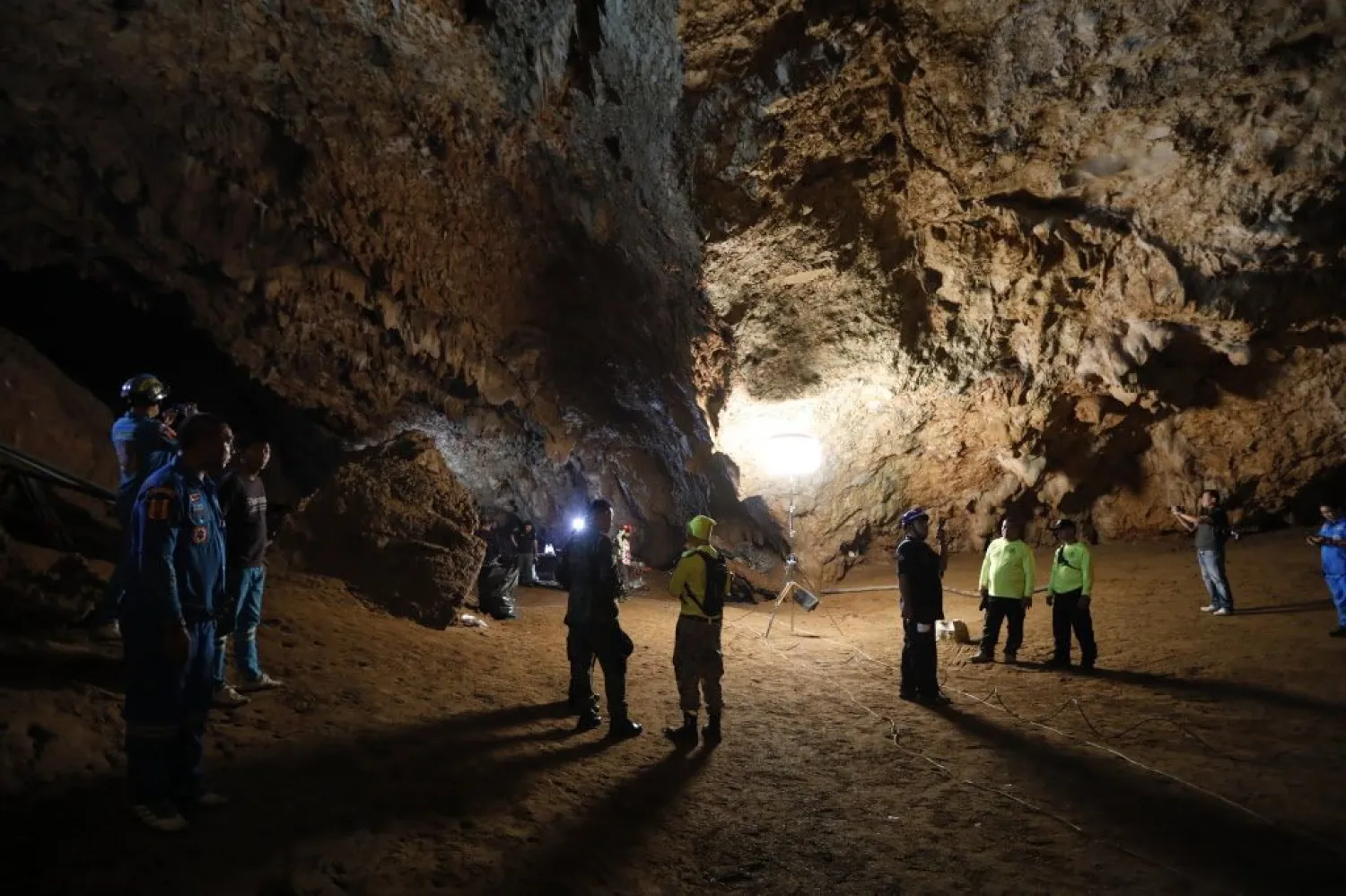

Thai Football Team Found Safe in Cave after Frantic 9-Day Search

Rescue teams gather in a deep cave where the youth football team went missing in Chang Rai, northern Thailand. (AP)
TT

Thai Football Team Found Safe in Cave after Frantic 9-Day Search

Rescue teams gather in a deep cave where the youth football team went missing in Chang Rai, northern Thailand. (AP)

A youth football team and their assistant coach, who went missing in a Thai cave complex over a week ago, were found “safe” on Monday in a miracle rescue after days of painstaking searching by divers.

Rescue teams found the 12 missing boys and their assistant coach inside a cave, showing “signs of life” nine days after they went missing, Chiang Rai province’s governor said.

“Thai Navy seals have found all 13 with signs of life,” Governor Narongsak Osottanakorn told reporters, who broke into spontaneous applause and cheering.

There had been no contact with the boys, aged between 11 and 16, since they went missing with their coach -- aged 25 -- last Saturday.

The massive rescue effort had been hampered by heavy rains that flooded the Tham Luang cave in northern Thailand, blocking access to chambers where it was hoped the group would be found alive.

Osottanakorn broke the news of their rescue, delighting a nation which has anxiously followed every twist and turn of the effort to save them.

“We will take care of them until they can move," he added. "We will bring food to them and a doctor who can dive. I am not sure they can eat as they have not eaten for a while."

Divers took advantage of a brief window of good weather on Monday to edge further into the cave, with the water levels dropping slowly but steadily every hour thanks to round-the-clock pumping.

They had hoped to find the "Wild Boar" team on an elevated ledge dubbed "Pattaya beach".

But the boys had retreated 300-400 meters further as the ledge was submerged, Narongsak added.

The team's travails are not over with a complex operation predicted to try to free the ailing group from the cave -- which is still partially submerged.

Scores of divers -- including foreign experts -- have been sent into the cave with hundreds of oxygen tanks, establishing a base camp inside the chambers over the weekend.

Weary relatives have camped out at the cave's entrance for more than a week, desperately waiting for news of the boys, while the head of the Buddhist clergy has urged prayers from a nation fixated on the fate of the group.

The Prime Minister's Office said Prime Minister Prayuth Chan-ocha "wishes to thank the tremendous efforts of all international units that have come to assist the Thai authorities in rescuing the football team. The Royal Thai Government and the Thai people are grateful for this support and cooperation, and we all wish the team a safe and speedy recovery."

The football team went into the cave on June 23 after a training session and became stranded when heavy rains cut them off from the entrance.

Rescuers found their bicycles, football boots and backpacks near the cave's entrance and discovered handprints and footprints further in.

At 10 kilometers long, Tham Luang cave is one of Thailand's longest and one of the toughest to navigate, with its snaking chambers and narrow passageways.

A sign outside the site warns visitors not to enter the cave during the rainy season between July and November.

A leading American cave rescue expert said many challenges are ahead for rescue divers in Thailand.

Anmar Mirza, the US National Cave Rescue Commission coordinator, explained that the primary decision is now one of whether to try to evacuate them or to supply them in place.

He said: “Supplying them on site may face challenges depending on how difficult the dives are. Trying to take non-divers through a cave is one of the most dangerous situations possible, even if the dives are relatively easy."

He added that "if the dives are difficult then supply will be difficult, but the risk of trying to dive them out is also exponentially greater."



Russia, Türkiye, Iran Presidents in Turkmenistan for Rare Summit

(R-L) Tajik President Emomali Rahmon, Iranian President Masoud Pezeshkian, Russian President Vladimir Putin, Turkmen President Serdar Berdimuhamedov, Turkish President Recep Tayyip Erdogan, Kazakh President Kassym-Jomart Tokayev, and Kyrgyz President Sadyr Japarov attend a wreath-laying ceremony at the Turkmenistan Neutrality Monument in Ashgabat, Turkmenistan, 12 December 2025. EPA/ALEXANDER SHCHERBAK / SPUTNIK / KREMLIN POOL MANDATORY CREDIT
TT

Russia, Türkiye, Iran Presidents in Turkmenistan for Rare Summit

(R-L) Tajik President Emomali Rahmon, Iranian President Masoud Pezeshkian, Russian President Vladimir Putin, Turkmen President Serdar Berdimuhamedov, Turkish President Recep Tayyip Erdogan, Kazakh President Kassym-Jomart Tokayev, and Kyrgyz President Sadyr Japarov attend a wreath-laying ceremony at the Turkmenistan Neutrality Monument in Ashgabat, Turkmenistan, 12 December 2025. EPA/ALEXANDER SHCHERBAK / SPUTNIK / KREMLIN POOL MANDATORY CREDIT

The leaders of Russia, Türkiye and Iran meet Friday in Turkmenistan, an isolated Central Asian state which is marking 30 years of official neutrality with a rare international summit.

The principle of "permanent neutrality" is at the heart of the former Soviet republic's foreign policy -- a doctrine that has contributed to making Turkmenistan one of the world's most isolated countries.

On the guest list are Russian President Vladimir Putin, Turkish President Recep Tayyip Erdogan, and Iranian President Masoud Pezeshkian, along with other regional leaders, AFP said.

Here's five things to know about the desert nation and its position on the world stage:

- Presidential dynasty -

Turkmenistan, which borders Iran, Afghanistan, and the Caspian Sea, has only had three presidents since gaining independence when the Soviet Union collapsed in 1991.

The first was Saparmurat Niyazov, who proclaimed himself both "president for life" and the "father of the Turkmen" (Turkmenbashi), and ruled for 15 years.

The Berdymukhamedov family took over in 2006, with father Gurbanguly becoming president before handing the job to his son Serdar in 2022.

In reality, the pair rule in tandem. Gurbanguly retains immense power and is the subject of an intense personality cult.

Officially proclaimed "leader of the Turkmen nation" and Arkadag, which means hero-protector, he built a vast city named after himself, Arkadag, at a cost of at least $5 billion. He also erected gigantic golden statues of himself, while Serdar is regularly praised in the state-run media.

- Neutrality and isolation -

Turkmenistan is one of the world's most secretive countries, often compared to North Korea for its inaccessibility.

Since the United Nations supported Turkmenistan's "permanent neutrality" status in 1995, it has become a foreign policy cornerstone. An almost 100-meter (300-feet) tall Neutrality Monument, resembling a rocket and featuring a golden statue of the first president, stands in the capital Ashgabat.

The status prohibits Turkmenistan from fully joining any union or military alliance, and is used by the government to implement its isolationist policies.

Ahead of the summit, Serdar Berdymukhamedov published yet another book -- presented as a "precious gift for the Turkmen people" -- extolling the virtues of neutrality.

Turkmenistan's closest relations are with China, Russia, Iran, and Türkiye thanks to gas contracts. Cooperation with the West remains limited.

According to Amnesty International, Turkmenistan is "effectively closed to international human rights NGOs, UN special mechanisms and independent media".

Information on the country is fragmented, tightly controlled and generally unverifiable, "aimed solely at praising the regime", according to Reporters Without Borders.

- Lots of gas, little water -

While Turkmenistan is estimated to have the world's fourth-largest natural gas reserves, water supplies are scarce -- and the situation is expected to worsen due to climate change, scientists warn.

Three-quarters of the country is covered by the vast Karakum desert.

Cotton is another important industry for the Turkmen economy, but the high use of water has contributed to water shortages across the region.

- Methane 'Gateway to Hell' -

A massive five-decade-old fire raging in a natural gas crater is the country's top tourist attraction. The fire has been burning in the Karakum desert since 1971, when Soviet scientists accidentally ignited it.

Turkmen authorities have repeatedly stated their intentions to close the Darvaza crater, dubbed the "Gateway to Hell", but so far without success.

Emissions are a huge problem. Turkmenistan is the world's top methane leaker, according to the International Energy Agency.

- Sacred animals -

Local breeds of horse and dog are sacred and have been elevated to the status of national symbols.

On the orders of Gurbanguly, numerous statues honoring the Alabai -- or Central Asian shepherd-dog -- and the Akhal-Teke horse have been erected and the animals are celebrated on public holidays.

Gurbanguly has even composed a song in honor of his favorite horse.

The father-and-son duo regularly give and receive dogs and horses as gifts, including to other world leaders. They are often filmed cuddling the animals in public.


With a Fatwa and Official Pledges, The Taliban Offer Implicit Reassurances to Pakistan

 Members of the Afghan police during a graduation ceremony on Thursday, in Jalalabad (EPA). 
 Members of the Afghan police during a graduation ceremony on Thursday, in Jalalabad (EPA). 
TT

With a Fatwa and Official Pledges, The Taliban Offer Implicit Reassurances to Pakistan

 Members of the Afghan police during a graduation ceremony on Thursday, in Jalalabad (EPA). 
 Members of the Afghan police during a graduation ceremony on Thursday, in Jalalabad (EPA). 

The Afghan Taliban government has stepped up its implicit reassurances to Pakistan, days after border clashes between the two countries, amid efforts to salvage a fragile ceasefire.

A gathering of more than one thousand Afghan clerics from across the country, attended by Interim Prime Minister Mullah Mohammad Hasan Akhund and other senior officials in Kabul, issued a political and jurisprudential statement (fatwa) on Wednesday, pledging that Afghan territory would not be used to harm any country and vowing to confront those who interfere in conflicts beyond Afghanistan’s borders.

Hours after the fatwa was issued, Afghan Foreign Minister Amir Khan Muttaqi publicly reaffirmed his government’s commitment to its contents, in an attempt to contain tensions that escalated following attacks inside Pakistan attributed to militant groups, most notably the Pakistani Taliban (Tehrik-e-Taliban Pakistan).

In the latest such attack, six Pakistani soldiers were killed on Tuesday when a security post was targeted in the Kurram area near the Afghan border. Islamabad has blamed the escalation of violence on militants using Afghan territory to plan cross-border attacks on its security forces. Kabul, however, rejects these accusations, insisting it has no operational ties to the Pakistani Taliban.

The statement, which was issued at the conclusion of the “Seminar on Defending and Protecting the Islamic System”, provided religious cover for the Kabul government’s position. It affirmed that the emirate “has taken upon itself the obligation that the land of Afghanistan not be used against any country,” stressing that this commitment “is a duty incumbent upon all Muslims.” It warned that anyone who violates this obligation “is considered disobedient and will be subject to the necessary measures.”

While emphasizing that “defending the sovereignty of the country is a religious duty,” the clerics’ statement simultaneously underscored that “all Muslims must refrain from using the land of Afghanistan to harm any other country... and must uphold the commitment undertaken by the Islamic Emirate.”

The statement also affirmed a ban on Afghans traveling abroad to participate in any military activity, declaring that anyone who does so “is in violation and disobedience,” and obligating the authorities to prevent such actions and take appropriate measures.

In addition, it called on Islamic countries to “maintain friendly and positive relations within the framework of brotherhood, to benefit one another, and to avoid division, discord, and conflict”, language widely interpreted as an attempt to de-escalate tensions with Pakistan.

By combining the religious fatwa with official statements and a strong official presence at the clerics’ gathering - which included, alongside the prime minister, the Chief Justice, the Minister for the Promotion of Virtue and Prevention of Vice, the Minister of Higher Education, and other senior officials - the Afghan leadership appeared intent on delivering a dual religious and political pledge. This comes at a time of mounting pressure on Kabul to rein in cross-border militant groups and demonstrate its ability to maintain internal security.

Muttaqi’s remarks reinforced the scholars’ position, as he reiterated Afghanistan’s pledge not to allow its territory to be used against any country. In statements carried by official media, he said: “All of Afghanistan’s scholars have renewed their unified fatwa obligating the ummah to protect the Islamic system.”

He stressed that the leadership “has made a categorical commitment that Afghan soil will not be used to harm any individual or any state... This is the recommendation of the scholars, and obedience to it is obligatory for all Muslims.”

He added that the “scholars have made it clear to the ummah that if any Afghan violates the leadership’s instructions regarding military activities outside the country, the Islamic Emirate has the right to take action against him”, an implicit reference to Afghans joining the Pakistani Taliban.

The minister concluded by emphasizing the scholars’ call for “unity and the rejection of sedition,” saying that the Afghan nation “has, throughout its history, acted in accordance with the fatwas and guidance of its scholars, and will continue to do so today.”

Observers view the statements and the religious-political declaration as “part of a coordinated effort to contain Pakistani anger and to signal Kabul’s willingness to honor its security commitments,” following a series of attacks that reignited border confrontations between the two neighbors. The most recent incident involved an exchange of fire that killed four people last Friday.


North Korea's Kim Vows to Root Out 'Evil', Scolds Lazy Officials

The North Korean leader praised Pyongyang's soldiers fighting against Ukraine alongside Russia. STR / KCNA VIA KNS/AFP
TT

North Korea's Kim Vows to Root Out 'Evil', Scolds Lazy Officials

The North Korean leader praised Pyongyang's soldiers fighting against Ukraine alongside Russia. STR / KCNA VIA KNS/AFP

North Korean leader Kim Jong Un has vowed to root out "evil" and scolded lazy officials while praising his troops fighting with Russia against Ukraine, state media said Friday, capping a major meeting of Pyongyang's top brass.

The three-day meeting of the regime's central committee discussed key policy issues as well as plans for a congress of its ruling party, expected in early 2026 -- North Korea's first in five years.

Wrapping up the meeting on Thursday, Kim condemned "the wrong ideological viewpoint and inactive and irresponsible work attitude" of some officials, the state-run Korean Central News Agency (KCNA) said.

He called on officials to have "greater confidence in and courage for the future of our cause and struggle".

State media did not offer specifics, though it did say the ruling party had revealed numerous recent "deviations" in discipline -- a euphemism for corruption.

The North Korean leader reserved praise for Pyongyang's soldiers fighting against Ukraine alongside Russia, of whom at least 600 have died and thousands more sustained wounds, according to South Korean estimates.

Their work, Kim said, "demonstrated to the world the prestige of our army and state as the ever-victorious army and genuine protector of international justice".

'Modern' armed forces

Analysts say Pyongyang is receiving financial aid, military technology, food and energy supplies from Russia in return for sending troops.

Kim's mention of the troops "signaled Pyongyang's intention to maintain that deployment", Ahn Chan-il, a researcher originally from North Korea, told AFP.

"North Korea is also highly likely to seek a role in post-war reconstruction in Russia once... the conflict ends," he added.

Kim also hailed efforts this year in "modernizing" the country's defenses in the face of great "global geopolitical and technological changes".

Pyongyang's central committee began meeting on Tuesday, the same day North Korea fired a salvo of artillery from a multiple rocket launcher system, which analysts say could strike the South.

Last week, South Korea's dovish President Lee Jae Myung said he felt an apology was due to the North over his predecessor's alleged order to send drones and propaganda leaflets across the border.

Pyongyang has not responded to the overture from Lee, who has sought to mend fractured ties with the North.

And Friday's readout made no mention of South Korea or the United States, whose leader Donald Trump had hoped to meet Kim during a visit to Asia in October.

The pair -- who Trump once famously declared were "in love" -- last met in 2019 at Panmunjom in the Demilitarized Zone (DMZ) separating the two Koreas after the US leader extended an invitation to Kim on Twitter.

But analysts now say that the North Korean leader, increasingly emboldened by his growing ties with Russia, had few good reasons to join the photo-op.