


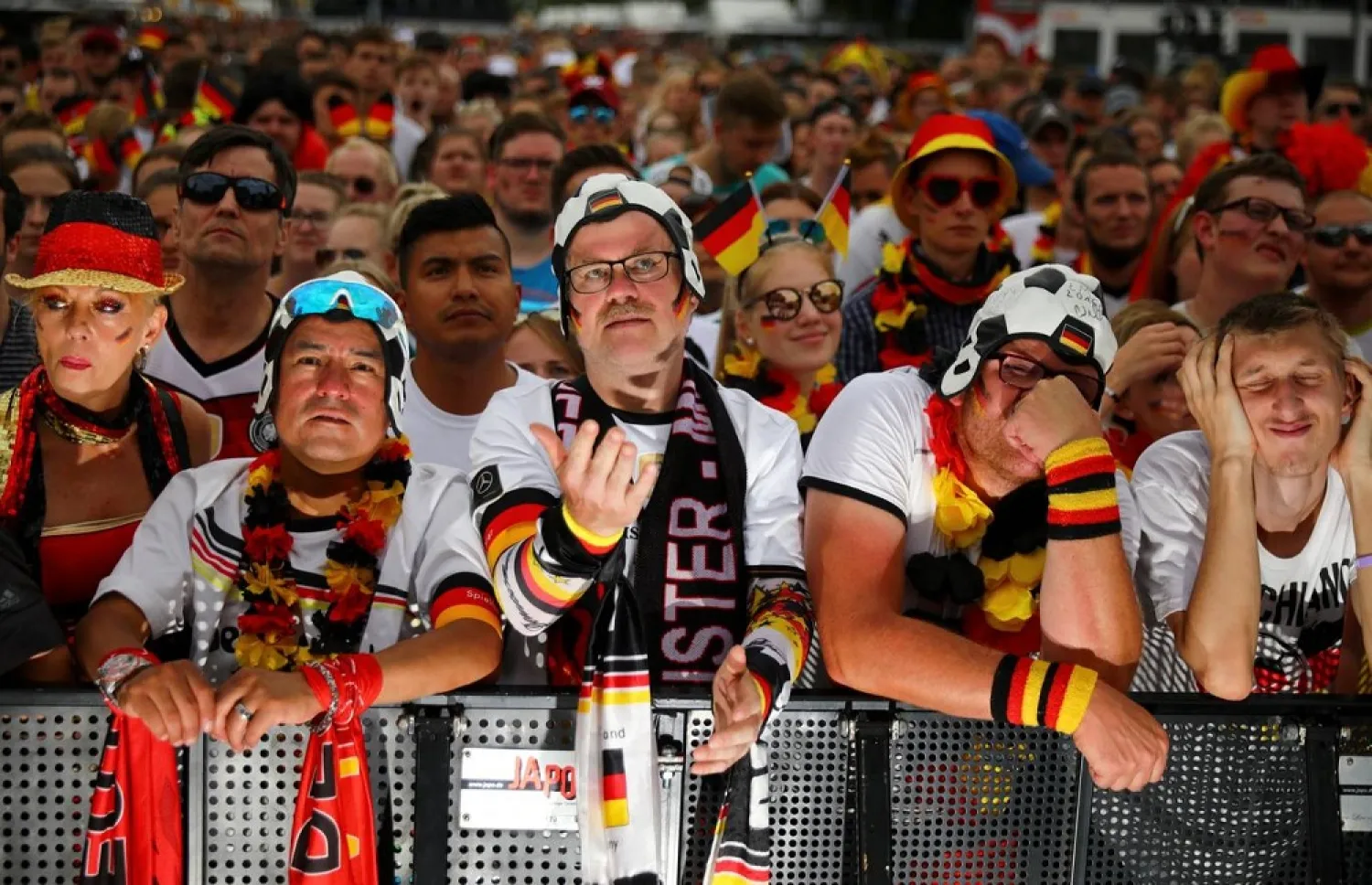

Germans are used to seeing our national team lose – it has happened before and will happen again – but what we are not used to is seeing them leave a World Cup at the group stages, and especially in the manner that has taken place at this tournament, wrote former Germany midfielder Thomas Hitzlsperger.
It is a big surprise, a huge disappointment, and it has left me and many of my compatriots feeling completely empty.
After the dramatic victory over Sweden on Saturday I expected to see a different Germany against South Korea, one re-energized and ready to secure the victory needed to reach the last 16. Instead the players performed with no determination to win. There was minimal risk in their approach and minimal resistance to the attacks South Korea launched against them. This was not the Germany we have been used to for many years now.
What went wrong? It’s hard to pinpoint one reason but increasingly complacency appears to be an issue. Germany performed poorly in their last two games before the start of the tournament, against Austria and Saudi Arabia, and, thinking about it, it has been an issue for much longer than that. Germany didn’t play well in their 0-0 draw with England in November, nor in the subsequent games against France, Spain and Brazil. But nobody really worried because Joachim Löw was in charge and Germany always do well under Löw at major tournaments. But that has not proved to be the case in Russia.
Already there have been calls for a major overhaul of German football. For me that is far too radical. Yes, questions have to be asked by the German Football Federation in regards to how such a high-quality group of players could perform so badly, but the fact they are high-quality players is the reason there doesn’t need to be panic. Germany’s talent pool is broad and the task now is bringing through the excellent young players we have while replacing the older ones who have reached the end of the road.
I’m aware there has been a lot of talk in England about Leroy Sané’s exclusion from the squad following his excellent season with Manchester City and, for me, he is a player who should be reintroduced immediately. He is exactly the caliber of player Germany needs, someone who is young and has raw, dangerous pace.
Among the older players who simply did not perform at this World Cup is Thomas Müller. He was poor from start to finish and needs to raise his level.
Then there is the manager. There will be calls for him to be sacked but for me the decision regarding whether or not Löw continues in his role is down to Löw; if he has the motivation to continue then he should, if he doesn’t then he should move on and perhaps look to manage at club level. Personally I feel he has what it takes to oversee Germany’s post-World Cup transition given his record, talent and awareness of what is happening in world football. What’s for sure is that the German FA won’t sack Löw having handed him a new contract just prior to the World Cup. They trust him fully.
In that sense, the focus will mainly fall on the players, who won all 10 games in qualifying for the World Cup but, once there, failed to perform to an acceptable level. It is widely known they have not enjoyed their base in Moscow and there has been speculation of big rifts in the squad. I cannot confirm or deny that but, what’s for sure, is that something has not been right with the group since they landed in Russia, and indeed in the games that preceded their involvement in the tournament. Quite simply, they have not been up to it for some time and thus the need to decide whose time is up and who, from the next generation of German players, deserves their chance to step up.
It will be a strange few days in Germany as we get used to this situation – the national team leaving a World Cup at the group stages. Some people who only watch the tournament to follow Germany will no doubt switch off and get on with other things, but such is the popularity and importance of football here that most will stick with it until the end. From a neutral’s point of view it is also exciting that there will definitely be a new world champion.
For those of us working on World Cup coverage, tomorrow is another day; more games to watch and analyze. At least some Germans are still part of this tournament.
German freelance journalist Uli Hesse, meanwhile, wrote that the most amazing thing about Germany’s World Cup exit at the group stage is that the sun still rose the next morning. You wouldn’t have thought so on Wednesday evening. Anyone who was walking the streets of Berlin kept staring into the empty faces of people trudging zombie-like to the next tube station and felt like an extra in some post-apocalyptic drama.
One can understand why those fans were shell-shocked. If you count the Confederations Cup as a big tournament, Germany had reached eight semi-finals at major events in a row since 2005. Quite apart from the fact nobody has ever achieved anything remotely like this before – not even one of the many fine Brazilian teams in history, not even the Germans themselves previously – it lulled the country into a sense of security that turned out to be very false indeed.
Make no mistake, there had been warning signs before the national team left for Russia. Not the fitness debate surrounding some players, most notably Manuel Neuer. That was par for the course, as Germany always go into a World Cup haunted by injury worries. No, it’s rather that a strange mood had engulfed the team in the weeks before the tournament.
The preparation matches were sluggish, like the group games that followed. Then there was the debate triggered by Mesut Özil’s and Ilkay Gündogan’s meeting with the Turkish President Recep Tayyip Erdogan. It was shocking to hear German fans booing German internationals. It clearly got under Gündogan’s skin and while Özil outwardly remained his inscrutable self, we can assume he was shaken as well.
Finally, there were reports about two camps in the squad; the established players who won the World Cup and the hungry youngsters who lifted the Confederations Cup. The rift was probably not as deep as some observers claimed, but everybody could see that there was a world of difference between players who were hungry and eager to prove themselves – think Marco Reus and Julian Brandt – and most of the veterans.
For the first time, either as assistant or head coach, Joachim Löw failed to create team spirit, traditionally the side’s biggest strength. Löw must have sensed it, because this concern was probably why he did not call up Bayern Munich striker Sandro Wagner and cut Manchester City’s Leroy Sané from the squad. Two players with a bit of an ego.
Even the fans seemed unprepared for the tournament. There were far fewer Germany flags on display than we have become used to since the 2006 World Cup. One theory says the rise of the political right has reintroduced skepticism about the use of national symbols. Another points towards a growing disillusionment with football in general, epitomized by all those fan protests during the Bundesliga season just past. Personally, I think the fans were just like the players – tired.
So, what now?
First, Löw has to step down. No, this is not a populist call for heads to roll, I’m merely stating the obvious. Actually, there are many good reasons why he should stay on, starting with the fact that his only logical successor, Jurgen Klopp, is unlikely to leave Anfield any time soon. But the unwritten rule says our national coach has to resign if the team is knocked out in the quarter-finals of a tournament. Löw would probably have been the first Germany manager to break this, and may even have kept his job if the team had been eliminated in the round of 16 by the likes of Brazil. But the group stage? No way.
The national team is an institution like Volkswagen, or one of the major parties. And of course Volkswagen CEO Martin Winterkorn resigned in the wake of the emissions scandal, stating: “I am doing this in the interests of the company even though I am not aware of any wrong doing on my part.” And, of course, a party leader steps down after an awful election result, simply because it’s his responsibility.
Also, there is really no alternative. To stay with the political analogy – if Löw decides to continue he’ll be a sitting duck, pretty much like Social Democrat Martin Schulz, who opted not to resign after his party’s September 2017 election debacle. But of course his public standing was so damaged that he belatedly threw in the towel five months after the historic defeat.
But a new national manager won’t be enough. Another reason why Germany’s early exit wasn’t totally unexpected was the fact the recent European club seasons were a disaster for the Bundesliga. Since the 2014 World Cup, only four German clubs have reached the quarter-finals of the Europa League and not one made the semis.
There will be calls for a radical rethinking – and that usually means an attack on the 50+1 rule (which prevents our clubs from being owned or controlled by individuals or companies). However, for anyone who cares about the national team, this would be the worst possible scenario. All examples from abroad indicate that deep-pocketed investors are not interested in grooming homegrown talent, as this takes time and is hardly glamorous. Provided those investors who are supposedly waiting to sink large amounts of cash into our clubs do really exist, their money is going buy expensive foreign stars who will relegate German talents to the bench.
So we have to continue on the path we have chosen – but we should also ask the one question that is truly worrying. It is a question not only raised by the performance of the team in Russia but also by the fact that Borussia Dortmund, widely lauded for their youth movement, had only one player in Germany’s World Cup squad as the talent the club nurtures tends to be foreign: Christian Pulisic, Ousmane Dembélé, Jadon Sancho.
The question is: did we win the 2014 World Cup because our famous Talent Development Program worked a treat and produced amazing players, or did we simply luck into one golden generation and now have to wait until the hand of fate deals us the next?
The Guardian Sport


