Dozens Die in Indonesia Ferry Incident, Search Goes On

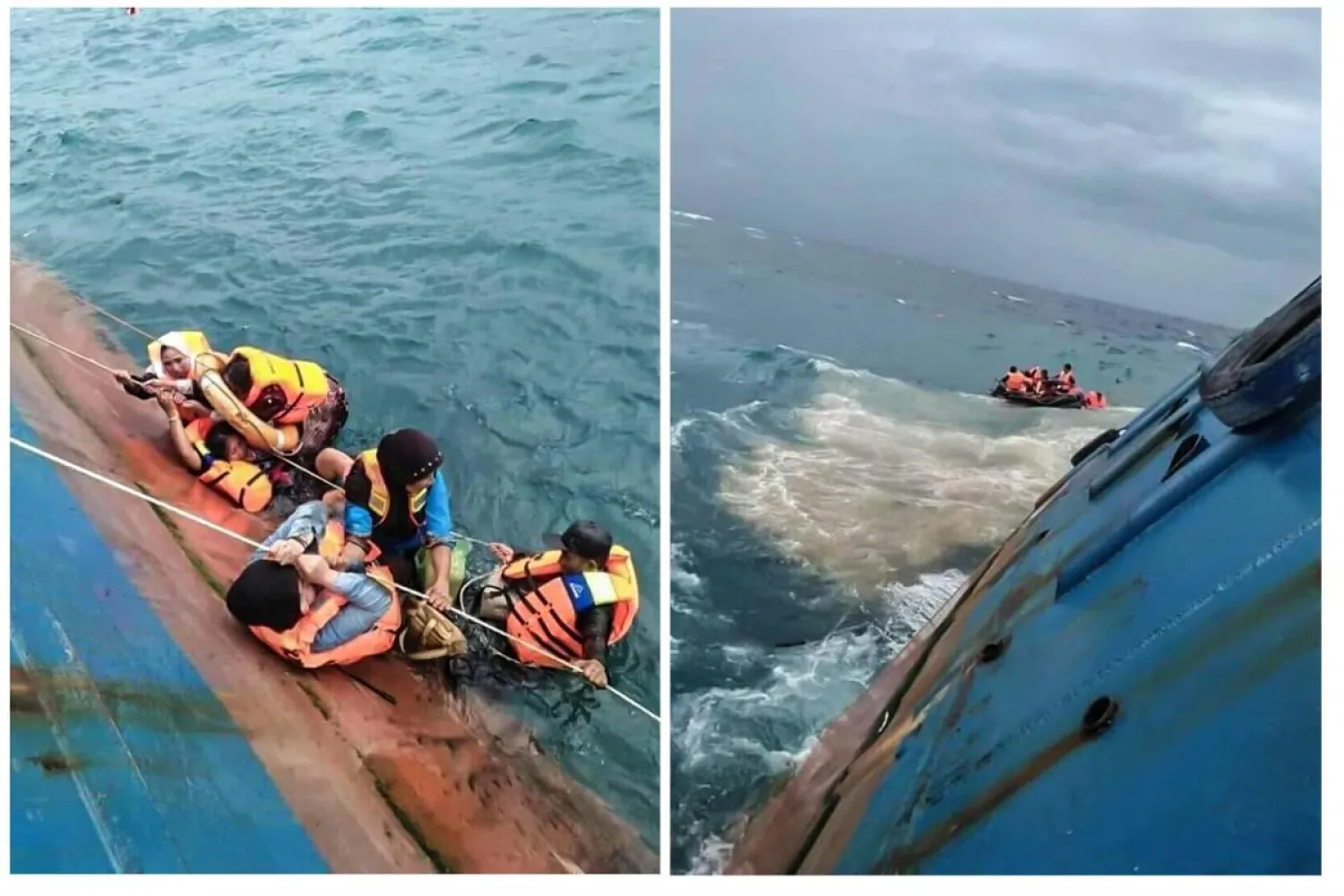
A combination picture shows survivors of KM Lestari Maju boat in the waters of Selayar island, South Sulawesi province, Indonesia, July 3, 2018. Antara Foto/Handout/RelawanBNPB/via REUTERS
TT

Dozens Die in Indonesia Ferry Incident, Search Goes On

A combination picture shows survivors of KM Lestari Maju boat in the waters of Selayar island, South Sulawesi province, Indonesia, July 3, 2018. Antara Foto/Handout/RelawanBNPB/via REUTERS

At least 31 people have died and three more are missing and believed drowned after a ferry sank Tuesday off the island of Sulawesi. Passengers were trapped for a night before they were rescued early Wednesday, officials said.

The captain managed to steer his ship onto a reef to enable the evacuation of more than 100 passengers as the vessel foundered in stormy seas.

The latest ferry disaster in Indonesia, which happened on Tuesday near Sulawesi island, came two weeks after an overcrowded ferry sank on Lake Toba in Sumatra, one of the world’s deepest volcanic lakes, with the death of more than 200 people.

The national search and rescue agency said the boat that ran into trouble near Sulawesi had been carrying 164 passengers and crew. Three passengers were missing but 130 had been rescued, a transport ministry official said.

“The captain ran it onto a reef so it wouldn’t sink and to make the evacuation of passengers easier,” Agus H. Purnomo, the director general of sea transportation, said in a statement.

“The captain and the owner of the ship were the last two people to come down from the passenger ship,” he added.

Photos released by National Disaster Mitigation Agency on Tuesday showed passengers clinging to the listing vessel as others descended into the heavy seas using ropes hung over its side. Most appeared to be wearing lifejackets.

Purnomo credited the captain's actions with helping to save lives.

Indonesia, a vast archipelago made up of more than 17,000 islands, suffers frequent boat accidents, with basic safety rules often flouted and vessels overloaded.

After last month’s sinking in Sumatra, one of the deadliest in nearly a decade, a two-week search and rescue effort found the vessel at a depth of 450 m (1,500 ft) with victims trapped inside, but technical and logistical challenges forced the recovery to be called off.


US Military Strikes Iranian Coastal Surveillance Radar as Iran Attempts to Attack Kuwait, Bahrain

A US Air Force F-15E Strike Eagle fighter jet takes off from a base in the Middle East last January (US Military)
TT

US Military Strikes Iranian Coastal Surveillance Radar as Iran Attempts to Attack Kuwait, Bahrain

A US Air Force F-15E Strike Eagle fighter jet takes off from a base in the Middle East last January (US Military)

The US military said it shot down Iranian ballistic missiles and drones launched toward the Strait of Hormuz and Gulf states on Friday, while striking some of Iran’s coastal surveillance radar sites in response.

US Central Command said on social media Friday night that Iran fired seven ballistic missiles toward Kuwait and Bahrain, with US forces intercepting six of the missiles and a seventh failing to reach its target. The military said there were no reports of harm to US personnel.

The ballistic missiles were fired after the US earlier in the day shot down four Iranian drones that were launched toward Strait of Hormuz.

“The attack drones posed an immediate threat to regional maritime traffic,” US Central Command said on social media.

Kuwaiti’s military said forces were intercepting missiles and drones attacking the country, while Bahrain activated air raid sirens and told residents to move to the nearest safe location and follow official instructions.

The US military is enforcing a blockade on Iranian ports in response to Tehran’s chokehold on the crucial corridor for global oil and natural gas shipments.

US Central Command said it hit the radar sites, including an island in the strait, “to defend against further attacks.”

It was the latest in back-and-forth attacks that have strained the tenuous ceasefire in the war and efforts to reach a deal to extend that truce.

Despite the attacks raising new concerns that the ceasefire could collapse, US President Donald Trump told reporters Friday that “the situation with Iran seems to be going quite well.”

“We’re going to come out of Iran very quickly and it’s going to be very strong one way or the other, whether it’s a piece of paper or the very tough way,” Trump said at an event with farmers in Wisconsin. “The very tough way is maybe the easier way, but we’re going to come out, and your fertilizer prices are going to go way down, just like they were four months ago.”


US Issues New Iran-Linked Sanctions

US Treasury Department (Reuters)
TT

US Issues New Iran-Linked Sanctions

US Treasury Department (Reuters)

The United States on Friday imposed sanctions on a network allegedly exporting Liquefied Petroleum Gas (LPG) from Iran to South and Eastern Asia, the Treasury said.

The network used front companies in the United Arab Emirates and China and a "shadow fleet" of vessels, according to a Treasury statement.

The system, designed to evade existing US sanctions, moved LPG worth hundreds of millions of dollars, it added, according to AFP.

The United States has tightened sanctions on Iran since it jointly launched its war on the country with Israel in late February.

In addition, Washington on Friday also sanctioned an Iranian currency exchange house and individuals associated with it for allegedly helping Iran facilitate billions in financial transactions.

"These sanctions are part of the Administration's Economic Fury campaign, which maintains maximum pressure on the Iranian regime and disrupts its ability to generate revenue for weapons development, support for terrorist proxies, and regional aggression," said US State Department spokesperson Tommy Pigott.


Report: Israel Sent Troops to Azerbaijan During Iran War

Azerbaijan’s capital, Baku (X)
TT

Report: Israel Sent Troops to Azerbaijan During Iran War

Azerbaijan’s capital, Baku (X)

Israel secretly deployed elite military and intelligence units to Azerbaijan during the war with Iran as part of a network of covert sites across the Middle East to facilitate operations against Iran, four sources familiar with the matter told CNN on Friday.

The forces operated out of several locations in southern Azerbaijan, two of the sources said, adjacent to Iran’s northern border and, at its closest point, only about 60 miles from the Iranian city of Tabriz, which Israel struck during the war.

Special commando units were also deployed to the location and carried out intelligence-gathering missions and drone operations, the other two sources said, giving Israel a valuable perch from which to see into northern Iran during the war.

The secret deployment to Azerbaijan, reported by CNN for the first time, was one of several military positions Israel maintained across the Middle East that gave its military unprecedented reach, highlighting the role Iran’s neighbors played in facilitating operations against Tehran and becoming entangled in the conflict.

Together, the deployments described by the sources placed Israeli forces along Iran’s southern, western, and northern periphery during the war, extending the military’s range by hundreds of miles, deep into Iranian territory.

The Azerbaijan operation consisted of several dozen troops, including members of Israel’s special operations forces, its elite heliborne combat and rescue force, and Mossad personnel, one of the sources said.

In return, a spokesperson for the Azerbaijani embassy in the United States said in a statement to CNN, “We firmly reject unfounded claims regarding the alleged use of Azerbaijan’s territory for operations against third countries.”

Israel has long viewed Azerbaijan as a strategic partner in its fight against Iran, and the preparations began weeks before the opening strikes of the war.

In mid-January, as Iran crushed wide-scale protests with the mass killing of demonstrators, Israel prepared a covert mission along the Azerbaijan-Iran border, two of the sources familiar with the plans told CNN.

Israel was planning to execute the operation under cover of what were to be the opening strikes of the war in mid-January. But US President Donald Trump called off the strikes at the last minute, saying that Iran had agreed to stop the killing of demonstrators. Israel proceeded on its own.

The Israeli Air Force used stealth jets and special forces as part of the operation to install the devices, as Israel’s political leadership believed negotiations between the US and Iran were doomed to fail.

The intelligence-gathering site became another means by which Israel could collect information on Iranian military movements and facilities, as well as potentially providing early warning of missile launches.

Joint Operations

One of the key operations launched from Azerbaijan, one of the sources said, was the killing on March 4 of Rahman Moghaddam, who led the Revolutionary Guard Corps’ (IRGC) intelligence division and who Israel said was responsible for planning an assassination attempt against Trump in 2024.

Israel and Azerbaijan maintain close ties around commercial and military interests. Baku provides Israel with a large share of its oil. In return, Israel sells Azerbaijan advanced weaponry.

“Israeli strategy in Azerbaijan remains deliberately low-profile, relying on arms transfers, intelligence cooperation, and long-term technological interdependence in the security sector,” wrote Gershon Kogan, a specialist on Iran at the Begin-Sadat Center for Strategic Studies, before the Iran war began.

The relationship also gives Azerbaijan access to a critical diplomatic resource, according to Joshua Kucera, a senior analyst for the Crisis Group, allowing Baku to utilize Israel’s lobby in Washington, DC.