
Trump’s Trade Dares Have Vaporized the Dow’s Gains for 2018

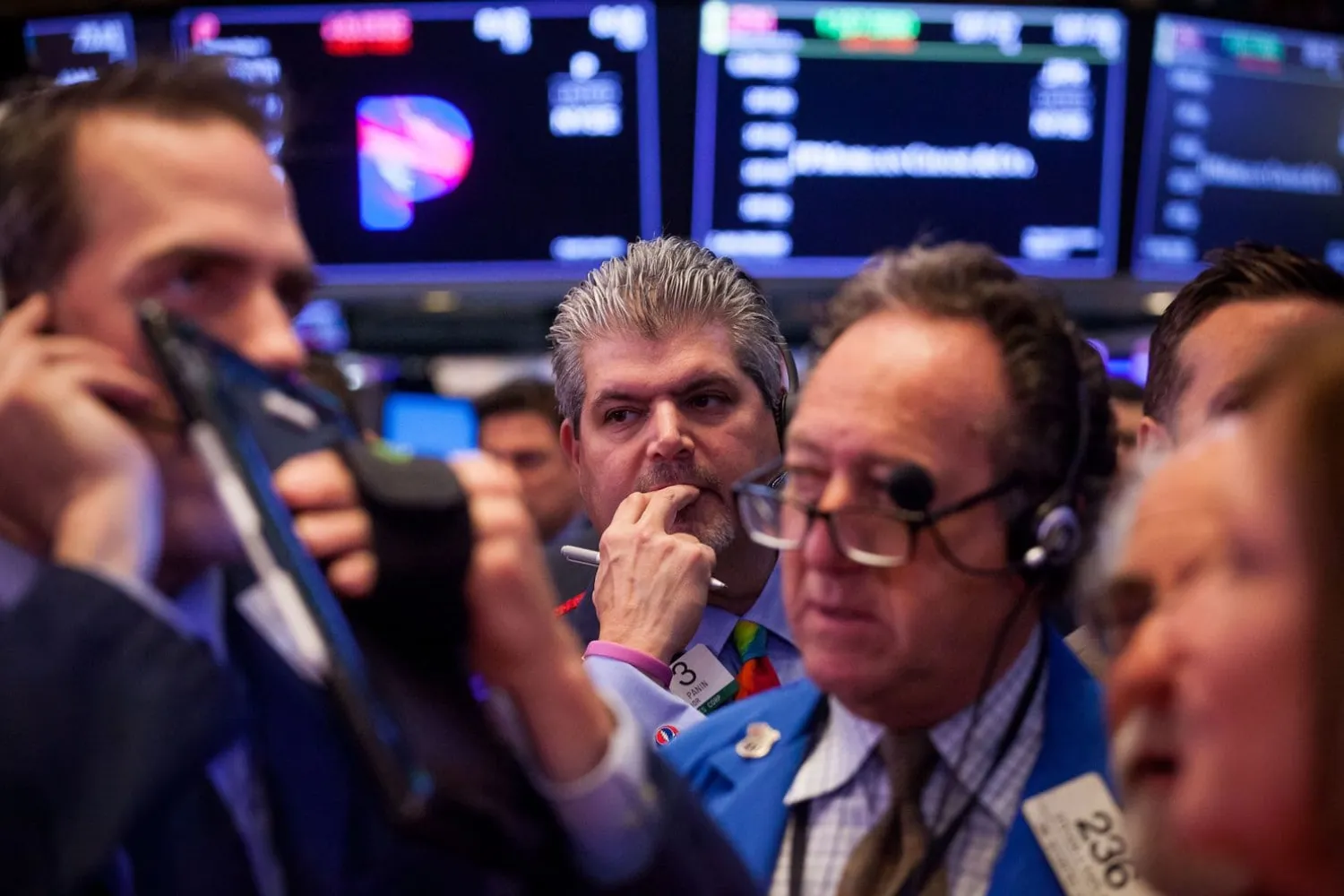
Traders work on the floor of the New York Stock Exchange on June 22. (Michael Nagle/Bloomberg)
TT

Trump’s Trade Dares Have Vaporized the Dow’s Gains for 2018

Traders work on the floor of the New York Stock Exchange on June 22. (Michael Nagle/Bloomberg)

The calm predictability that was the signature of the 2017 stock market has been replaced by the turbulence of the first half of 2018, with investors frazzled by the drum of trade threats between the United States and China.

The once-preening Dow Jones industrial average has erased all of its 2018 gains and is bobbing close to 10 percent correction territory, compared with its Jan. 26 high.

Some would see the pullback as a buying opportunity, especially given that the economy is otherwise robust. The gross domestic product is cresting at $20 trillion any day. What’s an investor to do? Stay the course. Stick to your plan. Look long term.

But the “headline risk” of presidential tweets, White House pronouncements and breathless policy leaks made for a pretty rocky second quarter. If not for the tariff talk, Steve Forbes said on Fox Business “Mornings with Maria” a few days ago, the Dow would probably leap thousands of points.

The major indexes rallied Friday and notched slight gains as the quarter closed. The blue-chip Dow rebounded toward the end of a turbulent week, up 55 points at Friday’s close.

The Standard & Poor’s 500-stock index and tech-heavy Nasdaq composite index were positive in Friday trading, with the Nasdaq finishing up more than 6 percent for the second quarter.

Most market watchers place blame for the bumpiness squarely on President Trump, who ups the ante on tariff threats almost daily.

“It’s all him,” said Ed Yardeni of Yardeni Research. “His tax cuts boosted earnings dramatically. But, on the other hand, his protectionism is a possible threat to the economy.”

Despite relatively blue skies, there’s plenty of other economic threats feeding into investors’ existing anxieties. Layered on top of the trade talk are the price of oil at multiyear highs, a strengthening U.S. dollar, the Federal Reserve foreshadowing interest rate increases, and Europe’s economies slowing.

Even the halo over technology shares was shaky the last week of June, with the Nasdaq working through one of its worst weeks of the quarter. Throw in a national donnybrook expected over an empty Supreme Court seat, as well as a looming midterm election, and you have a nervous “investorate.”

Wednesday’s markets are a case in point. The Dow swung 441 points on mixed messages bouncing out of the White House.

Trump’s trade adviser Peter Navarro told CNBC on Monday that “there’s no plans to impose investment restrictions on any countries that are interfering in any way with our country.” Treasury Secretary Steven Mnuchin followed with a statement that the administration would seek legislative redress through the Committee on Foreign Investment in the United States, instead of more direct methods to curtail theft of vital U.S. technology by rival countries (Pssst. We mean China.)

“If there are mixed messages, again, that’s something that’s unfortunate,” Mnuchin said on CNBC, responding to a question about inconsistencies from co-anchor Andrew Ross Sorkin. The Dow at first responded favorably to Mnuchin’s comments, running 285 points upward.

But by day’s end, the benchmark had given all that up and more, to close 165 points in the red.

“I don’t think anybody knows how serious the president is or isn’t about trade,” said Michael Farr, a Washington investment manager. “I heard someone say, ‘Most people pause when they shoot themselves in the foot. The president wants to reload.’ ”

The S&P 500 is staying above water at about 2 percent year to date as of Friday but was down about 5 percent off the Jan. 26 high. The hardest-hit sectors have been the industrials and materials sectors, which stand to lose the most in a tariff war. Industrials were down 3.6 percent in June and down more than 5.8 percent on the year as of Thursday’s close.

The Chinese are feeling the pain, too. The benchmark Shanghai composite index fell 0.9 percent to 2,786.90 on Thursday, its lowest finish in more than two years.

The president has money in the bank to play with if he wants to keep poking the Chinese on trade. The S&P 500 is up 26.96 percent since his election Nov. 8, 2016. That number grows to 31.18 percent if you include stock dividends.

Analysts say the president cares too much about the stock market to blow it, especially with the crucial midterm elections four months off.

“There is a limit to how far the president may take the trade battle if stocks fall enough,” John Lynch, chief investment strategist for LPL Financial, said in a recent report titled “Trade Tensions Playbook.”

“President Trump has a track record of starting a negotiation from an extreme position and then moving toward compromise. We expect resolution with China on trade, and only minimal economic damage to the U.S. and abroad,” Lynch said.

Howard Silverblatt, a senior index analyst with S&P Dow Jones Indices, suggests market wags stop trying to read the tea leaves and wait for whatever action Trump takes.

“The difference is rhetoric versus what I am actually doing,” Silverblatt said. “Pay no attention to the man behind the curtain,” he said in a nod to “The Wizard of Oz.”

Tariff talk has been brewing for months, but the threats elevated after Trump left the Group of Seven summit in Quebec in early June. He left Canada refusing to sign a joint communique and then followed up by referring to Canadian Prime Minister Justin Trudeau as “very dishonest & weak.”

On June 14, Trump broadened the trade dispute with an announcement that he would impose a 25 percent tariff on $50 billion of Chinese products. China responded in kind, and the market slid lower.

Trump then upped the ante with a $200 billion salvo lobbed toward China, which was followed by retaliatory tariffs from India, a profit warning from a European automaker blaming tariffs, and Trump’s call for a 20 percent tariff on automobile imports from the European Union.

Then came reports that Trump wants to ban Chinese investment in U.S. technology as a way to protect our advances. Yet another report surfaced Friday on Axios that Trump wants to pull out of the World Trade Organization, which could send global trade into a spin. Mnuchin called the report “an exaggeration.”

Investors reacted, even as Trump’s economic team scrambled to calm fears.

“As much as the government wants to tell you we are having a trade dispute, Wall Street is saying we are having a trade war,” Farr said.

The technology sector, whose FAANG — Facebook, Amazon.com, Apple, Netflix, Google-parent Alphabet — stalwarts have carried much of the bull market in recent months, showed its vulnerability, even though it is up more than 500 percent since the bear market low of March 9, 2009. (Amazon CEO Jeffrey P. Bezos owns The Washington Post.)

The chatter during the week was that the turbulence and selling are because of a confluence of factors, including investors taking quarterly profits and typical seasonal weakness as the summer kicks off.

“While President Trump’s continued dialogue on tariffs seem to be leading stocks down, investors shouldn’t be too surprised that markets are experiencing weakness, given seasonal considerations,” said Wayne Wicker, chief investment officer at ICMA Retirement. “This is an election year, which typically provides additional challenges for markets. Historically, the fourth quarter provides a bit of a relief rally, which investors might keep in mind.”

Jamie Cox of Harris Financial Group said markets have been selling off because some companies have been warning that tariffs are going to hurt quarterly earnings, due in July.

“If earnings are going to be less than what people expect them to be, stocks are going to have to re-price,” Cox said.

That means things might get worse before they get better. Whatever happens, expect more volatility.

“If he had just given us the tax cut and watched Fox News until the midterm elections,” Yardeni said, “the market would be a heck of a lot higher today.”

The Washington Post


Saudi Arabia, Syria Sign Joint Airline and Telecoms Deals

Officials pose after signing a framework agreement for developmental cooperation and the launch of 45 development initiatives between the Syrian Development Fund and Saudi Arabia's Development Committee at the People's Palace in Damascus, Syria, Saturday, Feb. 7, 2026. (AP)
TT

Saudi Arabia, Syria Sign Joint Airline and Telecoms Deals

Officials pose after signing a framework agreement for developmental cooperation and the launch of 45 development initiatives between the Syrian Development Fund and Saudi Arabia's Development Committee at the People's Palace in Damascus, Syria, Saturday, Feb. 7, 2026. (AP)

Syria and Saudi Arabia signed deals Saturday that include a joint airline and a $1-billion project to develop telecommunications, officials said, as Syria seeks to rebuild after years of war.

The new authorities in Damascus have worked to attract investment and have signed major agreements with several companies and governments.

Syrian Investment Authority chief Talal al-Hilali announced a series of deals including "a low-cost Syrian-Saudi airline aimed at strengthening regional and international air links".

The agreement also includes the development of a new international airport in the northern city of Aleppo, and redeveloping the existing facility.

Hilali also announced an agreement for a project called SilkLink to develop Syria's "telecommunications infrastructure and digital connectivity".

Syrian Telecommunications Minister Abdulsalam Haykal told the signing ceremony that the project would be implemented "with an investment of around $1 billion".

For decades, Syria was unable to secure significant investments because of Assad-era sanctions.

But the United States fully removed its remaining sanctions on Damascus late last year, paving the way for the full return of investments.

Syria and Saudi Arabia also inked an agreement on water desalination and development cooperation on Saturday.

At the ceremony, Saudi Investment Minister Khalid Al-Falih announced the launch of an investment fund for "major projects in Syria with the participation of the (Saudi) private sector".

The deals are part of "building a strategic partnership" between the two countries, he said.

Syria's Hilali said the agreements targeted "vital sectors that impact people's lives and form essential pillars for rebuilding the Syrian economy".

Syria has begun the mammoth task of trying to rebuild its shattered infrastructure and economy.

In July last year, Riyadh signed investment and partnership deals with Damascus valued at $6.4 billion to help rebuild the country's infrastructure, telecommunications and other major sectors.

A month later, Syria signed agreements worth more than $14 billion, including investments in Damascus airport and other transport and real estate projects.

This week, Syria signed a preliminary deal with US energy giant Chevron and Qatari firm Power International to explore for oil and gas offshore.


India’s Modi Lauds Interim Trade Pact After US Tariff Rollback

Indian Prime Minister Narendra Modi addresses the media before the budget session of Parliament at Parliament House in New Delhi, India, 29 January 2026. (EPA)
TT

India’s Modi Lauds Interim Trade Pact After US Tariff Rollback

Indian Prime Minister Narendra Modi addresses the media before the budget session of Parliament at Parliament House in New Delhi, India, 29 January 2026. (EPA)

Indian Prime Minister Narendra Modi on Saturday hailed an interim trade agreement with the United States, saying it would bolster global growth and deepen economic ties between the two countries.

The pact cuts US "reciprocal" duties on Indian products to 18 percent from 25 percent, and commits India to large purchases of US energy and industrial goods.

US President Donald Trump, while announcing the deal Tuesday, had said Modi promised to stop buying Russian oil over the war in Ukraine.

The deal eases months of tensions over India's oil purchases -- which Washington says fund a conflict it is trying to end -- and restores the close ties between Trump and the man he describes as "one of my greatest friends."

"Great news for India and USA!" Modi said on X on Saturday, praising US President Donald Trump's "personal commitment" to strengthening bilateral ties.

The agreement, he said, reflected "the growing depth, trust and dynamism" of their partnership.

Modi's remarks came hours after Trump issued an executive order scrapping an additional 25 percent levy imposed over New Delhi's purchases of Russian oil, in a step to implement the trade deal announced this week.

Modi, who has faced criticism at home about opening access of Indian agricultural markets to the United States and terms on oil imports, did not mention Russian oil in his statement.

"This framework will also strengthen resilient and trusted supply chains and contribute to global growth," he said.

It would also create fresh opportunities for Indian farmers, entrepreneurs and fishermen under the "Make in India" initiative.

In a separate statement, Commerce Minister Piyush Goyal said the pact would "open a $30 trillion market for Indian exporters".

Goyal also said the deal protects India's sensitive agricultural and dairy products, including maize, wheat, rice, soya, poultry and milk.

Other terms of the agreement include the removal of tariffs on certain aircraft and parts, according to a separate joint statement released Friday by the White House.

The statement added that India intends to purchase $500 billion of US energy products, aircraft and parts, precious metals, tech products and coking coal over the next five years.

The shift marks a significant reduction in US tariffs on Indian products, down from a rate of 50 percent late last year.

Washington and New Delhi are expected to sign a formal trade deal in March.


Gold Bounces Back on Softer Dollar, US-Iran Concerns; Silver Rebounds

Gold and silver bars are stacked in the safe deposit boxes room of the Pro Aurum gold house in Munich, Germany, January 10, 2025. REUTERS/Angelika Warmuth
TT

Gold Bounces Back on Softer Dollar, US-Iran Concerns; Silver Rebounds

Gold and silver bars are stacked in the safe deposit boxes room of the Pro Aurum gold house in Munich, Germany, January 10, 2025. REUTERS/Angelika Warmuth

Gold rebounded on Friday and was set for a weekly gain, helped by bargain hunting, a slightly weaker dollar and lingering concerns over US-Iran talks in Oman, while silver recovered from a 1-1/2-month low.

Spot gold rose 3.1% to $4,916.98 per ounce by 09:31 a.m. ET (1431 GMT), recouping losses posted during a volatile Asia session that followed a fall of 3.9% on Thursday. Bullion was headed for a weekly gain of about 1.3%.

US gold futures for April delivery gained 1% to $4,939.70 per ounce.

The US dollar index fell 0.3%, making greenback-priced bullion cheaper for the overseas buyers.

"The gold market is seeing perceived bargain hunting from bullish traders," said Jim Wyckoff, senior analyst at Kitco Metals.

Iran and the US started high-stakes negotiations via Omani mediation on Friday to try to overcome sharp differences over Tehran's nuclear program.

Wyckoff said gold's rebound lacks momentum and the metal is unlikely to break records without a major geopolitical trigger.

Gold, a traditional safe haven, does well in times of geopolitical and economic uncertainty.

Spot silver rose 5.3% to $74.98 an ounce after dipping below $65 earlier, but was still headed for its biggest weekly drop since 2011, down over 10.6%, following steep losses last week as well.

"What we're seeing in silver is huge speculation on the long side," said Wyckoff, adding that after years in a boom cycle, gold and silver now appear to be entering a typical commodity bust phase.

CME Group raised margin requirements for gold and silver futures for a third time in two weeks on Thursday to curb risks from heightened market volatility.

Spot platinum added 3.2% to $2,052 per ounce, while palladium gained 4.9% to $1,695.18. Both were down for the week.