Khamenei’s New Poem: Pure Wine and Deadly Poisonhttps://english.aawsat.com/home/article/1325736/khamenei%E2%80%99s-new-poem-pure-wine-and-deadly-poison
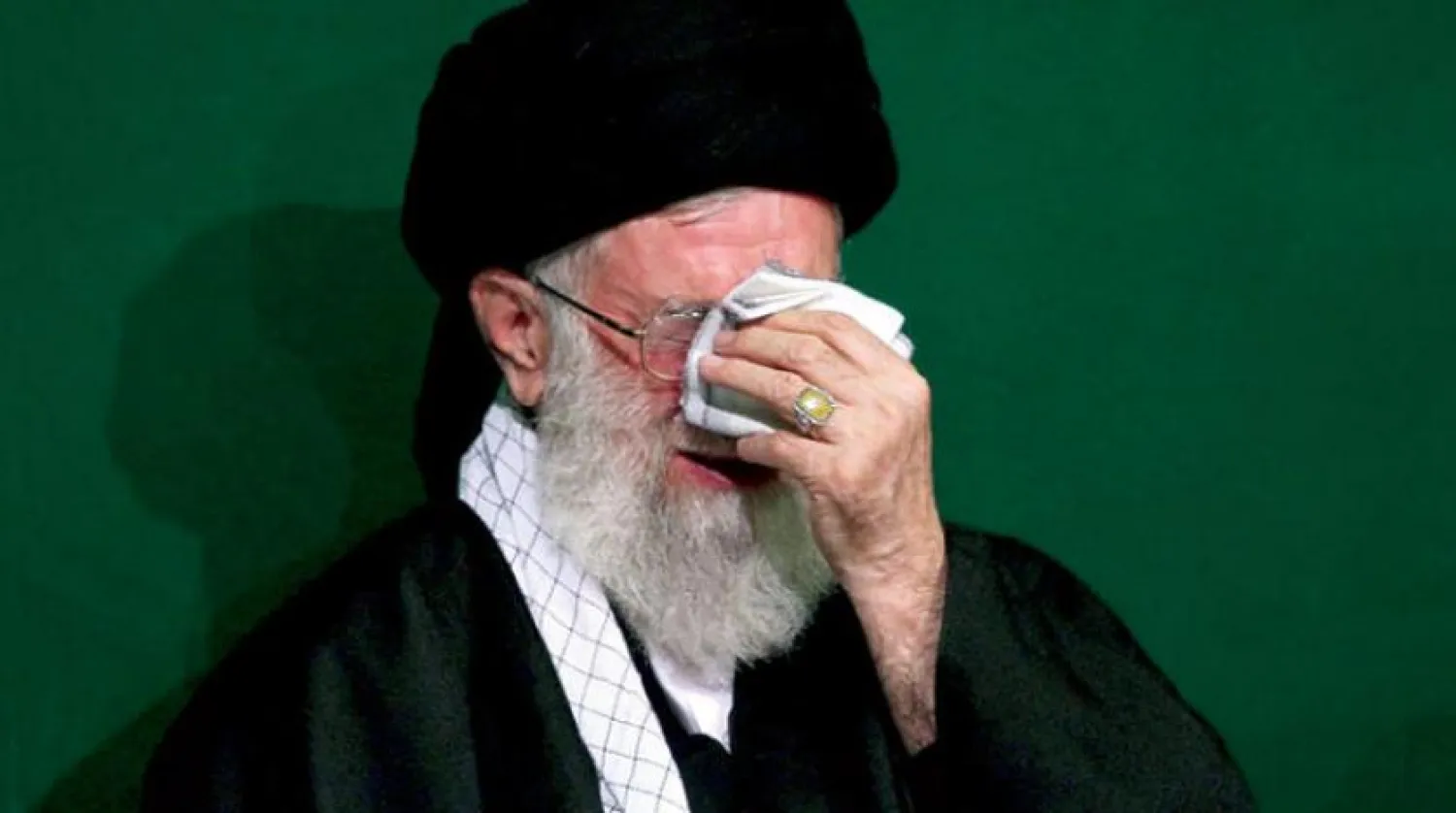
The annual poetry congress in Tehran, held last Monday, included what state-owned controlled media have described as an “historic literary event” which, according to one establishment literary commentator, Muhammad-Ali Mojahedi, electrified those present.
The “event” was the public reading of a new ghazal (sonnet) by the Supreme Guide Ayatollah Ali Khamenei whose poetical ambitions date back to his early youth more than 60 years ago. He has often said that he wished he had spent more time and energy on his poetry rather than on politics and in anecdotal accounts of his life has depicted himself as a disciple of such great contemporary poets as Amiri Firuz-Kuhi and Muhammad Qahreman.
However, still unsure of how the public might receive his poetry, Khamenei, who uses “Amin” as his literary sobriquet (takhallos in Arabic) has always shied away from publishing a diwan or even reciting his poems in public. But because few poets could resist the temptation of reading his work to others, the “Supreme Guide” holds occasional private recitals of his poetry for a handful of confidants who have sworn never to reveal to others what they have heard.
Thus last Monday was a rare occasion when Khamenei overcame his fear of not pleasing an audience agreed to have his latest work recited to an audience of fellow poets and aspiring poets.
To be sure, Khamenei isn’t the first political leader to harbor poetical ambitions. Both Josef Stalin and Mao Zedong wrote poetry. And Iran’s own Nassereddin Shah spent more time committing poetry than running the country.
But how good is Khamenei’s new ghazal?
To start with, by classical standards it is one line (beyt) short. The standard classical ghazal consists of a minimum of seven lines (abyat) and a maximum of 13. Khamenei has stopped at six lines. Next, Khamenei’s work moves away from the classical ghazal’s thematic unity in diversity in which each line seems to have an independent content while indirectly linked to the content of other lines.
Here, Khamenei geos for a very modern introspective style in which all the lines (abyat) come together to depict the poet’s mood at a certain moment in time.
But what is this mood? As you would see in the translation of the poem which follows, the ghazal depicts the poet as a disturbed person, divided against himself and struggling with the pull of events.
Khamenei has chosen one of the favorite meters (owzan in Arabic) of the great Persian Sufi poet Molawi (known in the West as Roumi), originally developed by Arab poets of the pre-Islamic era including Labid, Zuhair Ibn Abi-Salma and the black slave warrior Antar Ibn Shaddad. This meter is extremely rhythmic and pre-Islamic (Jahiliyyah) poets regarded it as suitable for war poetry being recited with the beating of drums.
In contrast, Molwai and other Persian poets, for example Athireddin Akhsikati and Khaju Kermani used it to accompany Sufi-style dance that includes gyration to the beat of a small drum (tablah). The meter (wazn) is the double alternation of one long and one short syllable: mufta’alan mufta’al, mufta’alan mufta’al, perfect for inciting warriors to combat or inspiring Sufis to gyrate.
In his ghazal, Khamenei has gone for an interesting rhyming scheme usually used by Persian poets to evoke sorrow.
The rhyme in question uses words that contain the Arabic letter M (mim) twice like two wings of a wounded bird, inspiring a sense for forlornness. At the same time because the letter “mim” isn’t a loud one it helps create an atmosphere of intimacy, as if the poet was whispering his sufferings in your ear. However, the poet cannot keep up the chosen rhyme scheme, as for example, Amiri- Firuzkuhi or Hushang Ebtehaj would, all through the ghazal. Thus three of the six lines (abyat) stick to the scheme while three others offer words that contain only one “mim”. In two lines the Arabic letter L (lam) replaces the letter “mim”.
Such imperfections, however, don’t do much damage to the ghazal as a whole which is well crafted in terms of prosody. The poem also evokes some of the classical concerns of the Sufis as to how to liberate oneself from one’s earthly reality in the hope of reaching for a greater transcendental truth.
Khamenei uses many clichés of classical Persian poetry, including being “drunk, utterly gone”, “pure wine”, and “the skirt of love.”
Reading too much politics in this short ghazal may be out of order. However, one cannot ignore the fact that the man currently ruling Iran appears unsure of his impact on life, feels he is the victim of some unspecified injustice and sees a schizophrenic “Id” (in the Freudian sense) that is “sometimes pure wine, sometimes deadly poison.”
He craves after purity but sees himself as a “synthetic mix” which makes him cry. At times, this divided “Id” plants his claws into his own “bleeding heart”. At other times it attacks his “own flock like a wolf.”
All in all, I liked the ghazal, maybe because I am a sucker for classical Persian styles of poetry.
But, here is the translation of the ghazal by the” Supreme Guide”, judge for yourself:
I am disturbed by the cacophony in me
I wish I could get out of self-absorption
Pulls me this way and that like a straw
Obsession with this and that, capriciousness of the self
I have plunged my claws into my bleeding heart
Like a wolf I have attacked my own flock
At times I am pure wine, at others deadly poison
I cry out of the synthetic mix that I am
I am a child, resting my head on the skirt of love
Hoping that lullaby will release me from my ego.
I am drunk, utterly gone, Amin, heedless of was and is
From whom can I seek redress for the injustice done to me?
Scars from Oct. 7 Fuel Deep Divisions Over Netanyahu Ahead of Israeli Electionhttps://english.aawsat.com/features/5327173-scars-oct-7-fuel-deep-divisions-over-netanyahu-ahead-israeli-election
People walk past an election billboard showing Israeli Prime Minister Benjamin Netanyahu with the Hebrew phrase "We will not surrender" in Tel Aviv, Israel, 06 October 2026. (EPA)
TT
TT
Scars from Oct. 7 Fuel Deep Divisions Over Netanyahu Ahead of Israeli Election
People walk past an election billboard showing Israeli Prime Minister Benjamin Netanyahu with the Hebrew phrase "We will not surrender" in Tel Aviv, Israel, 06 October 2026. (EPA)
As Israel gears up for its first elections since the Hamas-led Oct. 7, 2023 attack, Prime Minister Benjamin Netanyahu and his opponents are putting it at the heart of their campaigns.
Nearly every poster, stump speech or televised debate seems to reference the attack, which has scarred the country and remains fresh in the minds of voters. Three years on, the worst security failure in Israel’s history now threatens to end the career of its longest-serving prime minister.
“October 7 is kind of a framework for the entire political discussion that is going on,” said Tamar Hermann, an expert on Israeli public opinion at the Israel Democracy Institute, a Jerusalem think tank. “All of us are post-traumatic in a way.”
Netanyahu’s opponents want him to pay for the failures that led to the deadliest day in Israel’s 78-year history and plunged the country into a series of inconclusive wars. His defenders say Netanyahu was betrayed by the military establishment and that he has led Israel through a dramatic rebound from its darkest hour.
A loss in the Oct. 27 election would likely end the career of the soon-to-be 77-year-old Netanyahu. A victory would mark the greatest turnaround yet for a man who has defied naysayers for three decades.
A deadly day that has shaken an entire region
On the morning of Oct. 7, Hamas militants fired several thousand rockets into Israel and thousands of fighters attacked through holes blown in the border fence or with boats or motorized paragliders. Some 1,200 people were killed and 251 others taken hostage.
Israel responded with a military offensive that has killed over 74,000 Palestinians in the Gaza Strip, according to local health authorities, left the territory in ruins and sparked an ongoing humanitarian catastrophe. Israel later went to war against Hezbollah in Lebanon, seized a chunk of Syria, attacked targets in Yemen and joined the US in two wars against Iran.
Hundreds of Israelis, mostly young soldiers, have died, and nearly every household has been touched by the violence. Netanyahu promised “total victory,” but Hamas, Hezbollah and Iran’s theocratic government all remain intact.
Israel’s international standing has plummeted, a number of foreign governments have accused it of genocide — a charge it vehemently rejects — and Netanyahu is now wanted by the International Criminal Court.
After a string of resignations by top security officials, Netanyahu is the only senior figure from Oct. 7 still in office, making this month’s election in many ways a referendum on his leadership.
It's the focus of the campaign for both sides Netanyahu and his opponents have put Oct. 7 at the forefront of their campaigns — for different reasons.
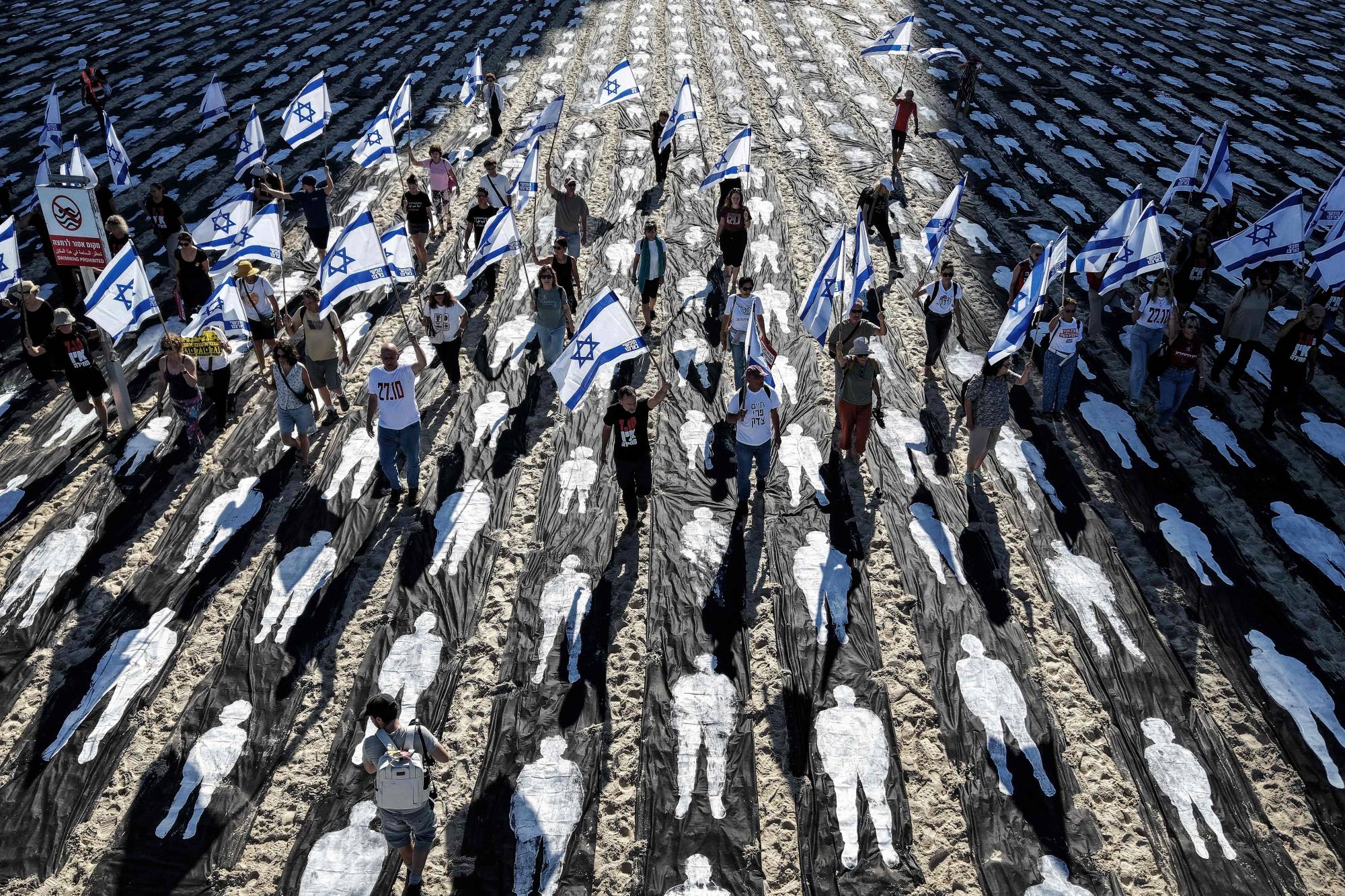
An aerial view shows people waving Israeli flags as they stand on a commemorative installation set up on the beach to mark the third anniversary of Hamas's October 7 attack on Israel, in Tel Aviv on October 7, 2026. (AFP)
His opponents — from across the political spectrum — call his outgoing coalition “the massacre government,” a reference to the Oct. 7 attack occurring on their watch. Netanyahu says he has led a “war of redemption.”
His chief rival is Gadi Eisenkot, a former military chief whose son and nephew were killed in battle in Gaza. The opponents have pledged to form a government of “repair and reconstruction” — beginning with the formation of an official commission of inquiry into Oct. 7.
They also have vowed to end draft exemptions for ultra-Orthodox religious men, a long-standing policy that has outraged the secular majority at a time of war, and accuse Netanyahu of threatening Israel's democratic institutions.
“The most fateful elections in the history of the State of Israel are between evasion and enlistment,” Eisenkot wrote on X. “Between taking responsibility and fleeing from responsibility.”
Netanyahu has repeatedly rejected calls for a commission of inquiry while trying to shift the blame to security officials. He recently accused the then-head of the Shin Bet security service, Ronen Bar, of withholding information ahead of the attack. Bar has vowed to file a defamation lawsuit.
Netanyahu insists the country is stronger than ever.
“Our enemies expected us to collapse,” he said in a recent address to the United Nations. “Well, we didn’t collapse. Instead, we rose and fought like lions.”
Oct. 7 victims are seeking seats in parliament
Eisenkot’s new Yashar party list includes two parents who lost children on Oct. 7. Netanyahu’s Likud party also includes two grieving parents, among them the mother of a policeman killed in battle on Oct. 7 whose remains were the last to be returned to Israel as part of a ceasefire. Another Likud candidate lost both legs while serving in Gaza.
The leader of the dovish Democrats party, Yair Golan, is a retired general who put on his uniform and rushed to the southern border to fight on Oct. 7. The centrist Together party’s list has another former general, Noam Tibon, who also battled militants as he rescued his son’s family, and the mother of a soldier killed that day.
Other parties have also added people directly impacted by the attack.
Organizers, including victims' relatives, say they are keeping politics out of a mass memorial service in Tel Aviv on Wednesday. But they have hardly concealed their anger at the country’s leadership.
“We will not let anyone evade responsibility,” Yonatan Shamriz, whose brother was taken hostage and mistakenly killed by Israeli soldiers after escaping captivity, said in a radio interview.
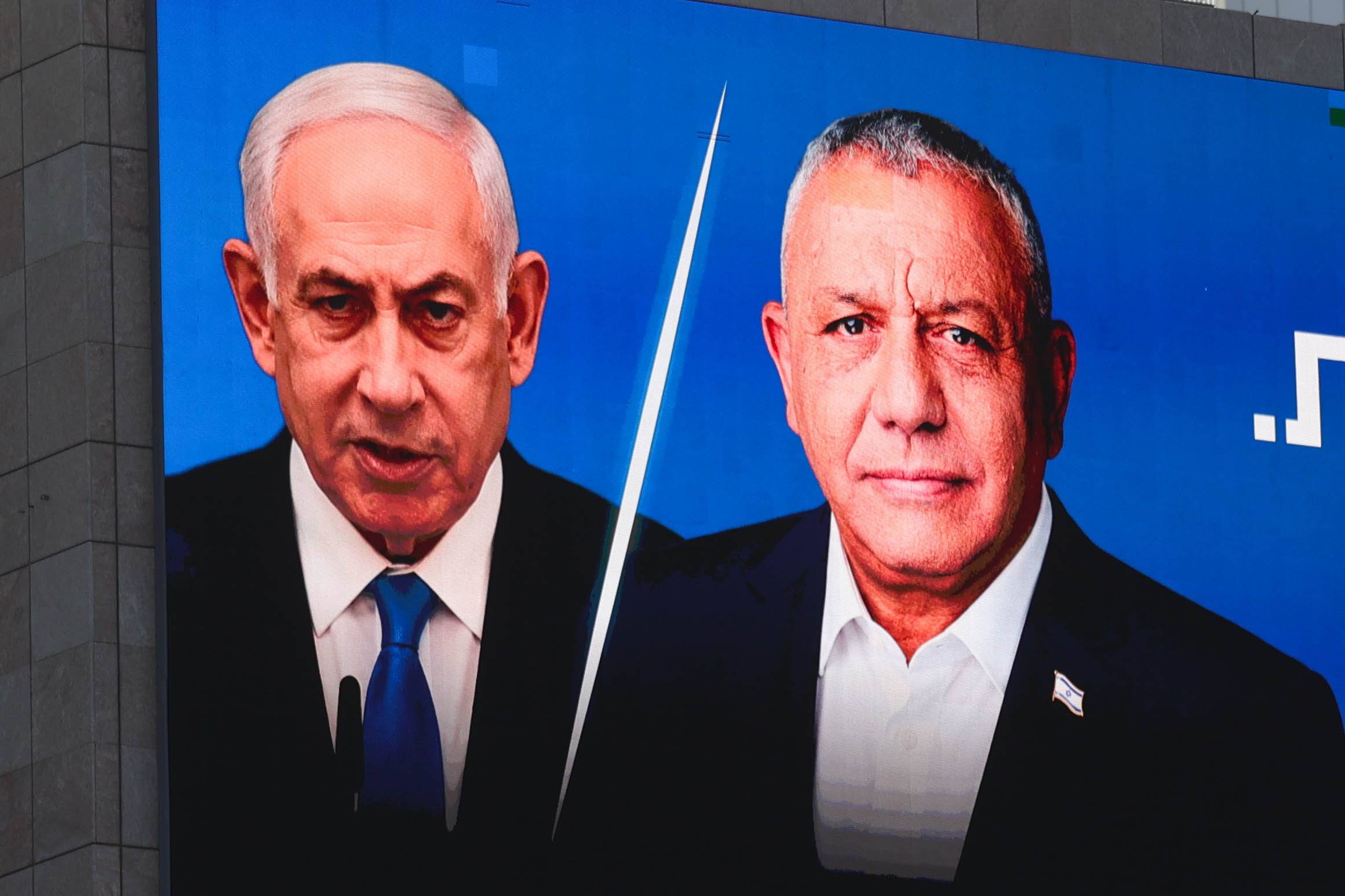
A large election billboard shows Israeli Prime Minister Benjamin Netanyahu (C-L) and leader of the Yashar party, Gadi Eisenkot (C-R), in Tel Aviv, Israel, 06 October 2026. (EPA)
There is little discussion of the Palestinians
Largely missing from the Israeli public discourse is any discussion of the dire situation in Gaza or the fate of the Palestinians.
Israeli leaders have said little about the unprecedented death toll in Gaza, the humanitarian catastrophe and the lack of reconstruction. Instead, they have focused largely on the country’s pain over Oct. 7.
There is almost no mention of peace talks, and even Netanyahu’s challengers largely oppose the establishment of a Palestinian state alongside Israel, the international community's preferred solution for the decades-old conflict.
When a pair of Israeli filmmakers released a documentary last month about civilian deaths in Gaza, party leaders across the spectrum, including Eisenkot, accused them of treason.
Oct. 7 has hardened the bitter split over Netanyahu
Polling suggests a close race between Netanyahu and his chief rival, Eisenkot, with an uncertain outcome.
According to the Israel Democracy Institute, over 60% of Israelis say their attitudes toward Oct. 7 are a central factor in whom to vote for. That number jumps to 68% among the Jewish majority; Arab voters are most concerned with a crime wave in their communities.
But Hermann, the IDI polling expert, said this doesn’t necessarily mean bad news for Netanyahu. She says the past three years have hardened attitudes on both sides.
Just because everyone says Oct. 7 is important, she said, “doesn’t mean that they will come out with the same conclusion.”
Satellite Photos Show How Israeli Forces Have Erased Gaza Townshttps://english.aawsat.com/features/5327169-satellite-photos-show-how-israeli-forces-have-erased-gaza-towns
A Palestinian walks amid the rubble of buildings destroyed during the war in Gaza City, October 7, 2026. (Reuters)
TT
TT
Satellite Photos Show How Israeli Forces Have Erased Gaza Towns
A Palestinian walks amid the rubble of buildings destroyed during the war in Gaza City, October 7, 2026. (Reuters)
It’s perhaps the most dramatic wound inflicted on the Gaza Strip by Israel’s military campaign over the past three years: The city of Rafah, once home to a quarter million people, has been erased.
Satellite imagery shows the Israeli military has systematically razed the southern city and other towns and districts to the ground and in some places plowed away the rubble. Demolition, using bulldozers and explosives, has continued unabated since the Israel-Hamas ceasefire deal reached a year ago, as the military solidifies its hold on just over 60% of the territory that it still controls.
Gaza’s mangled landscape is just one of the wounds on top of wounds that the enclave's 2 million Palestinians have endured since Israel launched its campaign to destroy Hamas after the fighters’ Oct. 7, 2023, attack on southern Israel.
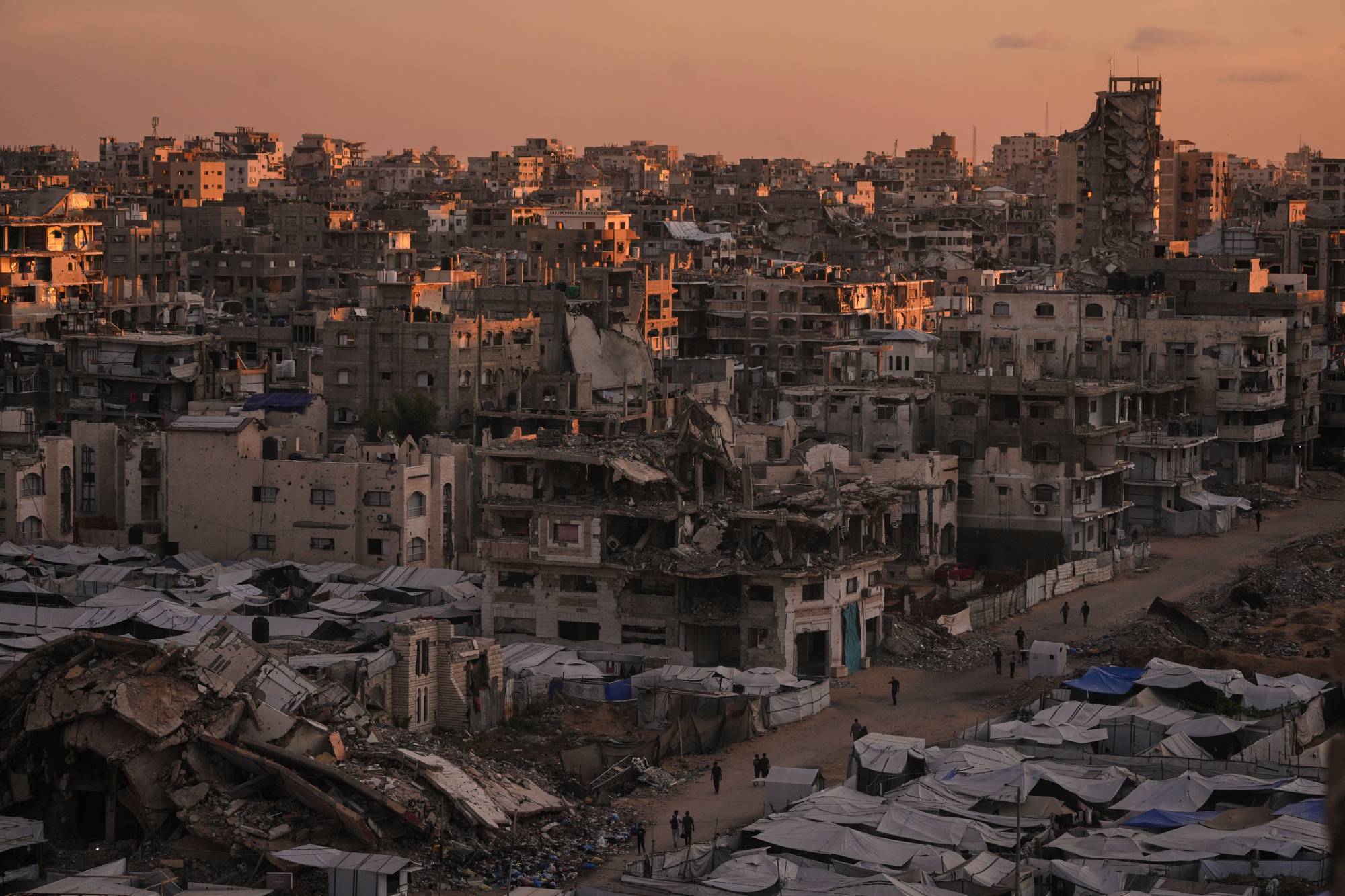
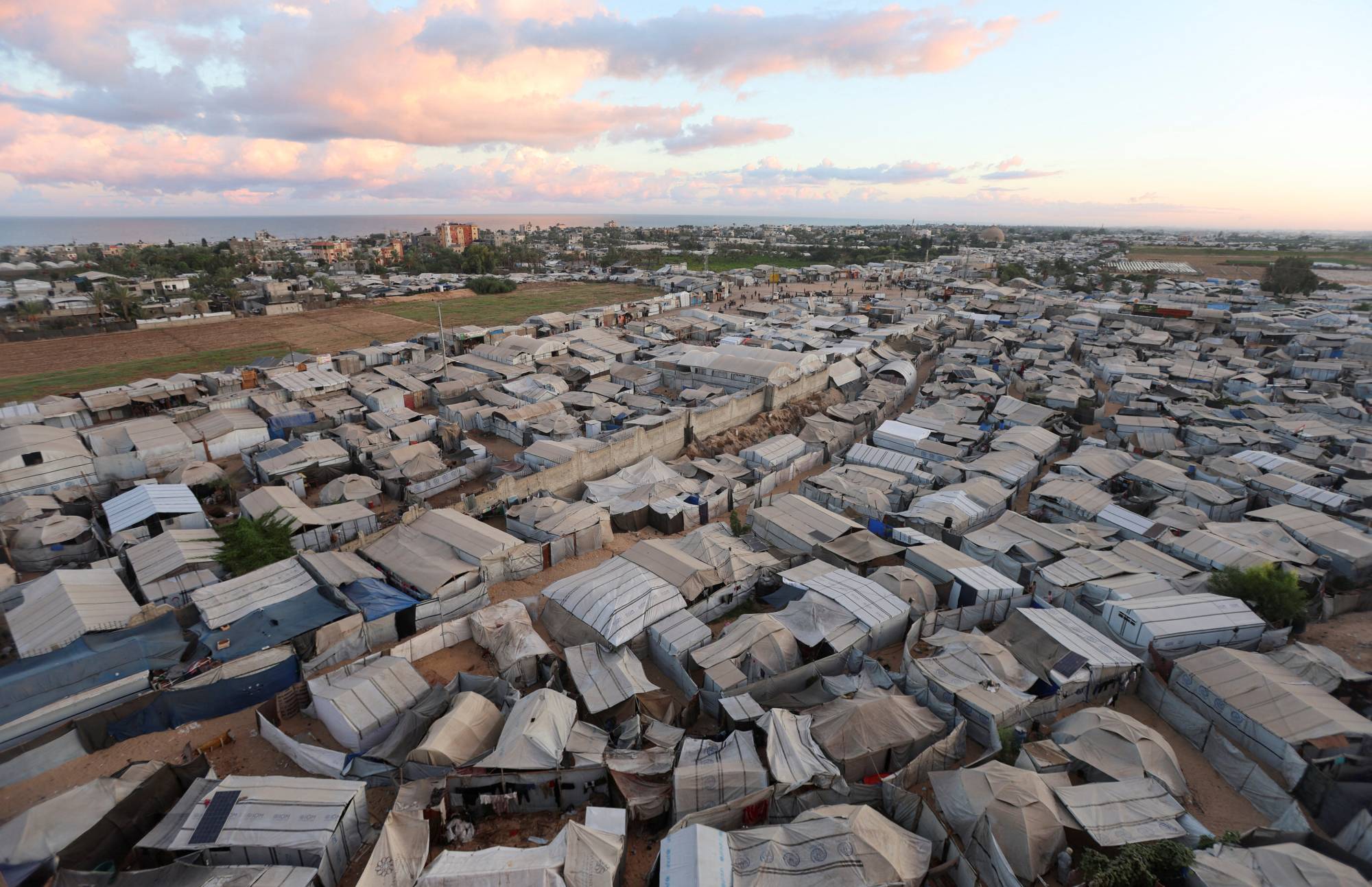
More than one out of every 10 people from Gaza’s prewar population has been killed or wounded by Israeli fire. While nearly every family mourns dead or cares for wounded, most also had to move multiple times to escape fighting and Israeli evacuation orders. With almost the entire population homeless, the coastal territory is now effectively one of the world's most populated tent cities. Ramshackle canvas and nylon shelters blanket beaches and former agricultural lands and fill empty lots.
Little is likely to change for the foreseeable future. While the ceasefire deal stopped the offensives and heaviest bombardment, Israel hits tents, cars and buildings almost daily in strikes that it says target Hamas members — but that regularly kill women, children and other family members.
People no longer have to flee from place to place, but few can rebuild homes because Israel bars most construction material from entering Gaza. The ceasefire agreement’s plan for the large-scale reconstruction of Gaza has never gotten off the ground because Israel and Hamas have failed to reach a deal on disarming the group.
Palestinians walk along a street surrounded by buildings destroyed in Israeli military strikes during the Israel-Hamas war in Gaza City, Tuesday, Oct. 6, 2026. (AP)
In the meantime, Palestinians wrestle with tragedy
Najwa Abu Eita lost her 7-year-old daughter when Israeli forces struck her home in the central refugee camp of Nuseirat in September 2024, and her three other children were injured in the attack. Abu Eita lost an eye, her face remains heavily damaged and scarred, and she has trouble breathing.
A hairdresser before the war, she now has no work, living in a tent by the ruins of her home. Worst of all, she says, her children are frightened by her face and avoid looking at her.
“My 4-year-old son tells me, ‘Momma, I’ll give you one of my eyes.’ And inside, I’m weeping,” she said.
On the Israeli-held side, destruction continues Gaza’s population is squeezed into about 40% of the tiny territory, and Israel’s military controls the rest. Satellite imagery by Planet Labs PBC shows that the vast majority of buildings in the Israel-held part have been bulldozed or exploded down to piles of rubble, much of it after major fighting ended a year ago.
The Israeli military says it demolishes buildings to prevent their use by Hamas or to destroy the group’s tunnel networks.
But a UN-appointed expert said in a February report that the scale of destruction of civilian housing and infrastructure in Gaza “is unprecedented even by the terrible standards of modern warfare since the 20th century.”
The report warned that it could constitute a crime against humanity or reach the level of genocide, which under international law includes “deliberately inflicting conditions of life calculated to bring about physical destruction.”
Israel rejects accusations of genocide, saying it targets Hamas fighters and their infrastructure that are interwoven with civilian areas.
The Planet Labs imagery shows at least 50 Israeli military outposts built throughout the Israeli-held part of Gaza, at least 18 of them constructed since the ceasefire began. Many have been put on top of former neighborhoods where the rubble of demolished buildings nearby has been cleared away.
Most of Rafah was razed before the ceasefire, but images show that troops continue to demolish the few remaining buildings. Several abandoned UN buildings have been spared, as well as a municipal sports field that now appears to contain a military base.
A new base also stands on what was once the main intersection of the southern town of Bani Suheila. Leveled over the past year, the town is now a wasteland intersected by a spiderweb of dirt paths that were once streets.
In Jabaliya in the north, most of the al-Awda Hospital Complex was reduced to rubble in recent months, as were a number of UN-run school buildings, satellite images show. Jabaliya was once home to the Gaza Strip’s biggest refugee camp, home to some 120,000 refugees and tens of thousands of other residents in a densely built urban district.
Now one of the few buildings still standing is the octagonal-shaped Indonesian Hospital, empty since troops shut it down in June 2025. The Israeli military built a new base nearby.
Similarly, most of Beit Hanoun, once a town of some 70,000 people in Gaza's far northeast corner, and Shijaiya, a Gaza City neighborhood founded 800 years ago, are now block after block of leveled houses and apartment towers.
A tent camp sheltering displaced Palestinians in Al-Mawasi, Khan Younis in the southern Gaza Strip, October 7, 2026. (Reuters)
Gaza’s economy has been wrecked
An increased flow of aid and commercial products brought Gaza back from famine that arose in some areas last year under a monthslong Israeli ban on food and other goods. But most of the population remains dependent on international relief. Jobs are few, mostly connected to selling in the market.
Shadi Barawi lost his father early in the war. Soon after that, Barawi was hit by shrapnel from a strike near his home in Gaza City, and his leg was amputated — one of some 6,000 amputees left by the war.
After losing his leg, “I lost all hope in life,” the 35-year-old said. But he was the sole support, he said, for his own family of six and his five sisters.
A barber before the war, he returned to giving haircuts to earn some money. With no prosthetic limb, he balances on his crutches as he works in the same tent where he lives.
“I’m working in tough circumstances,” he said. “I’m on one leg. I might do cuts for three customers, then I get tired and stop and rest, but then I keep going,” he said.
Others still search for their dead
Thousands of bodies remain buried under buildings smashed by Israeli strikes. Since the ceasefire, Gaza authorities have slowly been going from site to site to try to find them.
Last week, a search team finally came to the Gaza City home of Haneen al-Khodari. When her building was hit in December 2023, al-Khodari was thrown into a nearby tree, and after weeks in the hospital, she was told her parents, siblings and many of her cousins were killed, she said. The bodies of 17 of them remained trapped under wreckage ever since.
But after eight hours digging through the ruins, the team only recovered the remains of a small child and two bones. The search for the rest was called off.
Al-Khodari sat on the pavement, her hopes dashed. “We had been waiting for this moment for three years,” she said.
A plastic sheet on the ground in front of her contained what they’d found, labeled with the words, “Mixed bones.”
From ‘Ahmed the Japanese’ to ‘Sinwar’s Flood’: A Tale of Torment and a River of Graveshttps://english.aawsat.com/features/5327125-%E2%80%98ahmed-japanese%E2%80%99-%E2%80%98sinwar%E2%80%99s-flood%E2%80%99-tale-torment-and-river-graves
From ‘Ahmed the Japanese’ to ‘Sinwar’s Flood’: A Tale of Torment and a River of Graves
Okamoto stands before his two comrades’ graves during a commemoration of the 50th anniversary of the Lod Airport attack in 2022. (AFP)
The cemetery caretaker was kind and friendly. Perhaps he was glad that those whose graves he tended had not slipped into total oblivion, that someone still visited or asked about them. He led me through Beirut’s Cemetery of the Martyrs of the Palestinian Revolution.
Many names stopped me, including Balqis, the wife of poet Nizar Qabbani, killed in a bombing at the Iraqi Embassy in Beirut. Lines from his searing elegy adorned her grave.
Chance sometimes decides destinies. Stories can begin with an unintended spark. Here are two such coincidences.
Hazem Jawad, who led Iraq’s Baath Party to power in 1963, told me a revealing story. In 1959, a group within the party leadership decided to assassinate Iraqi leader Abdul Karim Qasim.
They selected a team, but one member withdrew after agreeing to take part. Short of time, the leadership asked a party official whether he knew a young replacement. He gave them a name: Saddam Hussein.
Saddam joined the failed assassination attempt and was wounded in the leg. He fled to Syria, where he met party founder Michel Aflaq. Impressed by the young man, Aflaq gave him opportunities a few years later to climb the party ranks.
Around the same time, associates of Palestinian leader Dr. Wadie Haddad told me of another coincidence. Haddad was planning the Lod Airport attack, carried out on May 30, 1972, which killed dozens of people, most of them tourists.
According to their account, a young man due to take part drowned while swimming off Beirut’s Raouche district. Intelligence services overlooked the incident and the dead man’s role. Haddad, however, decided to accelerate the operation.
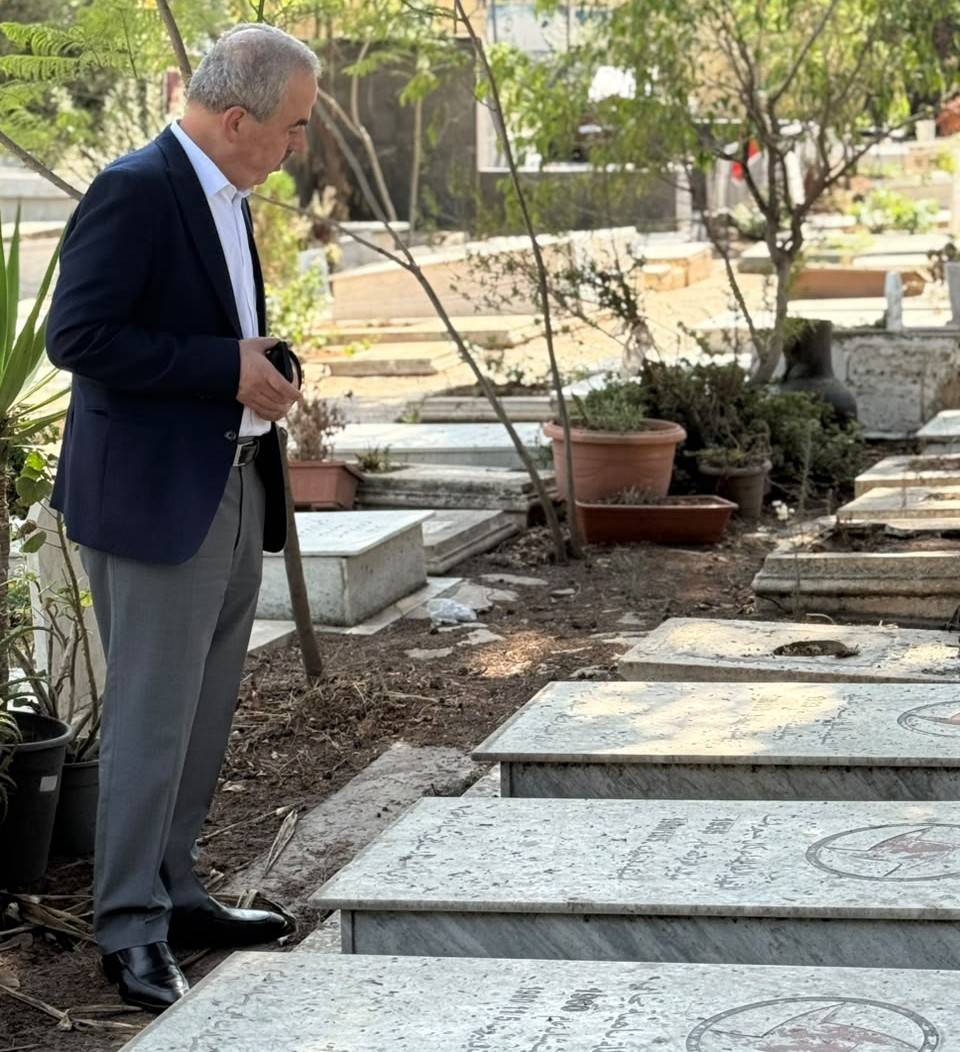
Ghassan Charbel among the graves at the Palestinian Revolution Cemetery (Asharq Al-Awsat)
Together with the Japanese Red Army group, he sought a replacement. They chose Kozo Okamoto, known as “Ahmed the Japanese” within the Popular Front for the Liberation of Palestine’s external operations branch.
Haddad met the team and gave them instructions after their training in Baalbek, in Lebanon’s Bekaa Valley. They left Beirut for a European stopover, then traveled to Rome and boarded an Air France flight to Israel’s Lod Airport.
It was a suicide mission. None of the attackers was expected to survive. Chance intervened: two were killed; Okamoto was wounded and captured.
For years, he grieved “because he had been unable to leave his body in the soil of Palestine” and “because he had not become a star in the sky like his two comrades,” in keeping with his Japanese beliefs.
Okamoto endured unprecedented torture in his Israeli prison. He was confined in a dog cage, his hands bound. For years, he had to wait for a dog to howl, then howl back before a soldier brought him food. The soldier never asked him a question or spoke a word.
In that deadly isolation, he lost the ability to use his hands, or even to think of using them. Perhaps he expected to grow old and die there. Then an event changed his life.
The Popular Front for the Liberation of Palestine-General Command, led by Ahmed Jibril, was holding three Israeli soldiers after Israel’s 1982 invasion of Lebanon.
In the mid-1980s, the group entered arduous indirect negotiations with Israel, helped by Austrian Chancellor Bruno Kreisky. The talks lasted about two years. Jibril insisted that the exchange include prominent prisoners in Israeli jails.
The deal was ready. The exchange took place on May 20, 1985. My profession brought me there. Our plane left Damascus for Geneva, carrying one of the three Israeli soldiers. After the successful exchange, it flew us to Tripoli. Jibril also wanted to dedicate the victory to Col. Muammar Gaddafi, who had supported him generously in every way.
Among the most prominent prisoners released were Sheikh Ahmed Yassin, the leader of Hamas; Ziad al-Nakhalah, who later became secretary-general of Islamic Jihad; and the well-known Palestinian leader Jibril Rajoub. The fourth was Okamoto. A different chapter of his life began.
After a brief stay in Libya, he went to Syria. He most likely slipped into Lebanon around 1987 and lived with comrades in the Bekaa Valley, changing residences from time to time. In 1997, Lebanese authorities arrested a group of Japanese nationals there. Okamoto was sentenced to three years for entering the country illegally.
The group was released in 2000. But he could not return to Japan, where he was wanted.
The Popular Front for the Liberation of Palestine organized protests with several parties and public figures to secure permission for him to stay in Beirut. Salim al-Hoss was prime minister, Maj. Gen. Jamil al-Sayyed headed General Security, and Gen. Emile Lahoud was president.
In an unprecedented step, Lebanese authorities granted Okamoto political refugee status, on condition that he undertake no activities on Lebanese soil.
The Popular Front took it upon itself to repay the Japanese fighter, covering his living expenses, medical treatment and rehabilitation. His only public activity was laying an annual wreath at the memorial to those killed carrying out the Lod attack, in the martyrs’ cemetery.
He renewed his pledge to his two comrades to become a star in the sky.
Okamoto left his Israeli prison shattered.
He resembled “the remains of a man.” His back was bent, his hands unusable. He ate directly with his mouth, without using his hands. He did not know how to bathe or make coffee.
He dared not switch off the light.
He did not want to revisit the Lod attack. His caregivers avoided discussing it in ways that might reopen his wounds.
Trusted doctors helped him. From 2008 to 2021, Samih Rizk cared for him, becoming “a father, brother, friend and comrade.”
After Samih died, Fouad Daher, who oversaw the Popular Front’s social work in Lebanon, took over. His friendship with Okamoto had begun during Samih’s lifetime.
Okamoto loved the sea at Tyre. His caregivers took him there. He regained a measure of normal life. He liked fish, meat and chicken, and sometimes fancied a glass of wine or a bottle of beer. Occasionally, he asked for a falafel or shawarma sandwich. His Arabic was poor. So was his English.
His movements were never announced in advance. His caregivers saw no sign that Israel had tried to reach him again. Years earlier, the United States had announced a $5 million reward for information on his whereabouts. The Popular Front did not tell him.
In his final years, he lived with a family he loved and who loved him. He never married, had no girlfriend and showed no interest in either. No relative in Japan tried to visit or write to him.
“Okamoto is part of something larger,” Fouad Daher says.
“Yesterday, I visited the graves of the martyrs of the Palestinian revolution. I told someone I met there that the cemetery reflects the international character of the Palestinian cause, which embraces different nationalities and religions.”
“There are Japanese, French, Turkish, Italian, Iranian and Iraqi people buried there. Go to the caretaker and he will show them to you. The grave of Kamal Nasser, a Christian, is next to those of Mohammed Youssef al-Najjar and Kamal Adwan.”
Last July, Okamoto’s health deteriorated. On July 23, he died at Al-Rassoul Al-Aazam Hospital.
His story stirred me. I decided to visit the martyrs’ cemetery. I walked among the graves of Ghassan Kanafani, Abu Hassan Salameh, Kamal Nasser and Balqis, the wife of poet Nizar Qabbani. I also saw the graves of the “foreign martyrs.”
Chance played its part. I had not planned to write about Okamoto. I visited Beirut’s Mar Elias refugee camp to gauge the mood on the eve of the third anniversary of “Sinwar’s Al-Aqsa Flood.” I saw the misery of life in the camp. Then I spotted Okamoto’s photograph on a wall, and the story took another turn.
The caretaker led me to Ghassan Kanafani’s grave. A member of the Popular Front for the Liberation of Palestine’s political bureau, he was assassinated in direct connection with the Lod Airport attack and what Okamoto and his two comrades had done.
He was the official spokesman for the Popular Front, which claimed responsibility.
Haddad’s associates told me they had feared for Kanafani. They urged him to change his residence and car. He refused, “because he feared being accused of behaving like a bourgeois.”
Mossad soon reached him. On July 8, 1972, a bomb exploded in his car, killing him and his niece, 17-year-old Lamis Najm. The titles of his novels came to mind: “Umm Saad,” “Men in the Sun” and “Returning to Haifa.”
In this quiet place lies a man who lived loudly: Abu Hassan Salameh. Born into a wealthy family, he followed his father’s example in resisting occupation. He loved the struggle, life, women and late nights.
Beirut was long captivated by his marriage to Georgina Rizk, Miss Lebanon and Miss Universe. He founded Force 17, the military unit charged with protecting Yasser Arafat. He was close to the leader’s office and heart.
Salameh helped oversee overseas operations against Israeli interests. After a long pursuit, Israel’s Mossad assassinated him in Beirut on Jan. 22, 1979. Many stories surrounded the “Red Prince,” including that he was killed over his connection to the attack on the Israeli team at the 1972 Munich Olympics.
He had no part in conceiving or carrying out that attack, Mohammed Oudeh, known as Abu Daoud, told me. Oudeh brought the attackers into the Olympic Village with weapons Salah Khalaf, known as Abu Iyad, had personally brought to Munich.
Others believe Salameh, whom a Mossad operative had managed to approach, was killed “because he succeeded in opening a channel to the CIA, which caused Israel grave concern.”
We passed the grave of Palestinian leader and writer Majed Abu Sharar.
Mossad booby-trapped his bed in a Rome hotel, where he was staying while attending a conference in solidarity with the Palestinian people alongside the great poet Mahmoud Darwish.
I recalled Mahmoud’s poem “Good Morning, Majed,” which opens: “Rise, recite the surah of the returning one, and hasten toward a country we lost in a traffic accident.”
Nationalities lie side by side here, the caretaker said. So do religions.
He pointed to the grave of Kamal Nasser, the Christian Palestinian leader, beside those of Kamal Adwan and Abu Youssef al-Najjar. Nasser, a poet, had been “envious” of Kanafani’s funeral. “How magnificent,” he said.
“This is what a martyred writer’s wedding should be.”
Nasser, Adwan and Najjar were assassinated on April 10, 1973, in the Israeli army’s nighttime raid on Beirut known as the Verdun operation. One of the officers who took part in the three assassinations was disguised as a woman. His name was Ehud Barak. He would later become prime minister.
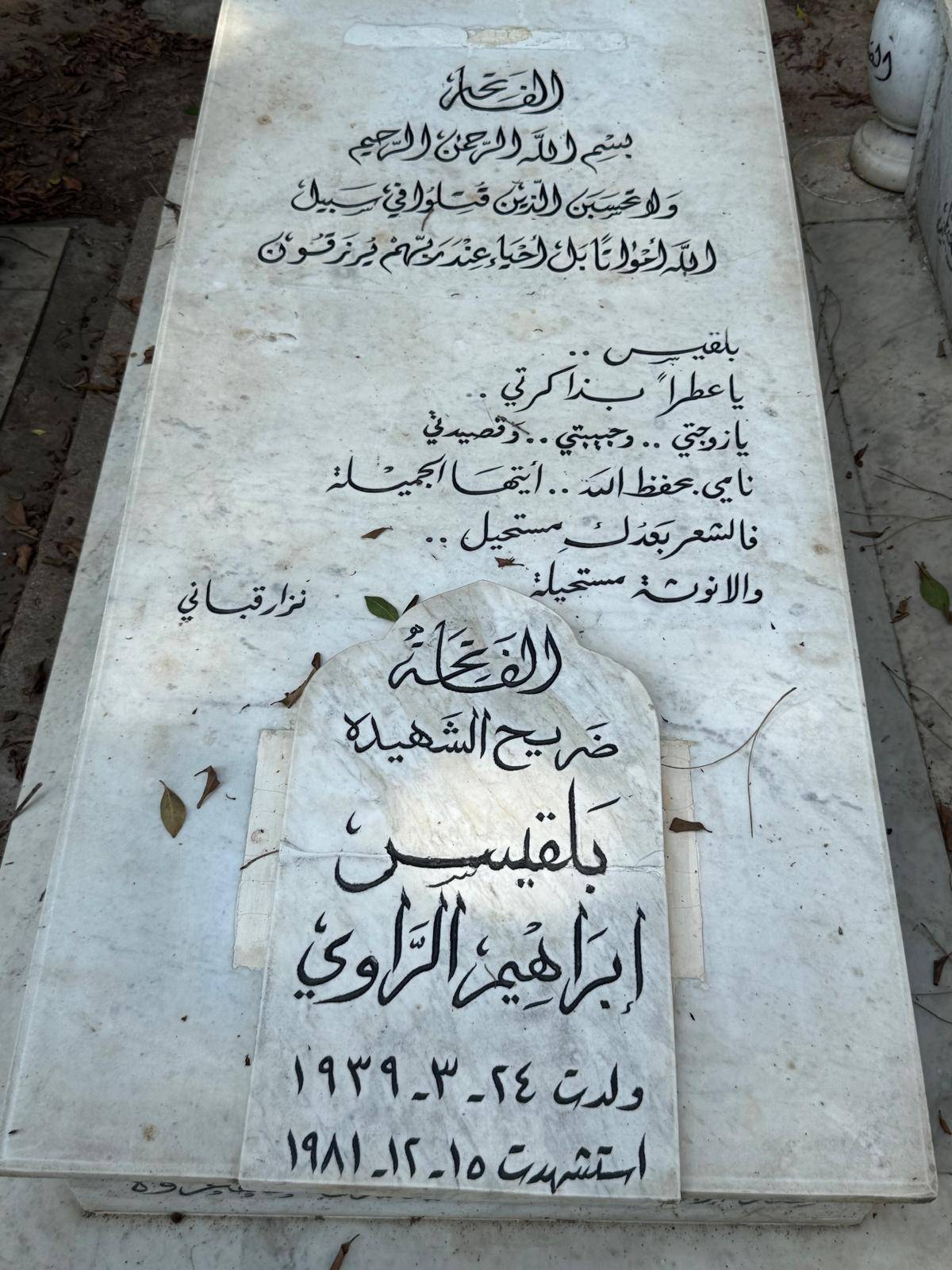
Another grave was no less painful. On Dec. 15, 1981, a car bomb rammed into the Iraqi Embassy in Beirut. Among the dead was diplomat Balqis al-Rawi, the wife of the great poet Nizar Qabbani. A passage from his poem adorned her grave:
Balqis...
O fragrance in my memory,
my wife... my beloved... my poem.
Sleep in God’s keeping,
my beautiful one.
For after you, poetry is impossible...
and femininity is impossible.
Nizar Qabbani’s verses on Balqis’s tombstone (Asharq Al-Awsat)
The caretaker wanted no photograph and no words. “I am only a caretaker,” he said. “The story belongs to those who lie in these graves.” I asked who paid his salary. Fatah, he replied.
On the way back, I remembered Mahmoud Darwish, who defies forgetting. I remembered Yasser Arafat, too, and his dream of a grave in a free Palestine. I returned weighed down by a “river of graves.”
لم تشترك بعد
انشئ حساباً خاصاً بك لتحصل على أخبار مخصصة لك ولتتمتع بخاصية حفظ المقالات وتتلقى نشراتنا البريدية المتنوعة