South America’s World Cup Is Over but Uruguay Are an Example to Everyone

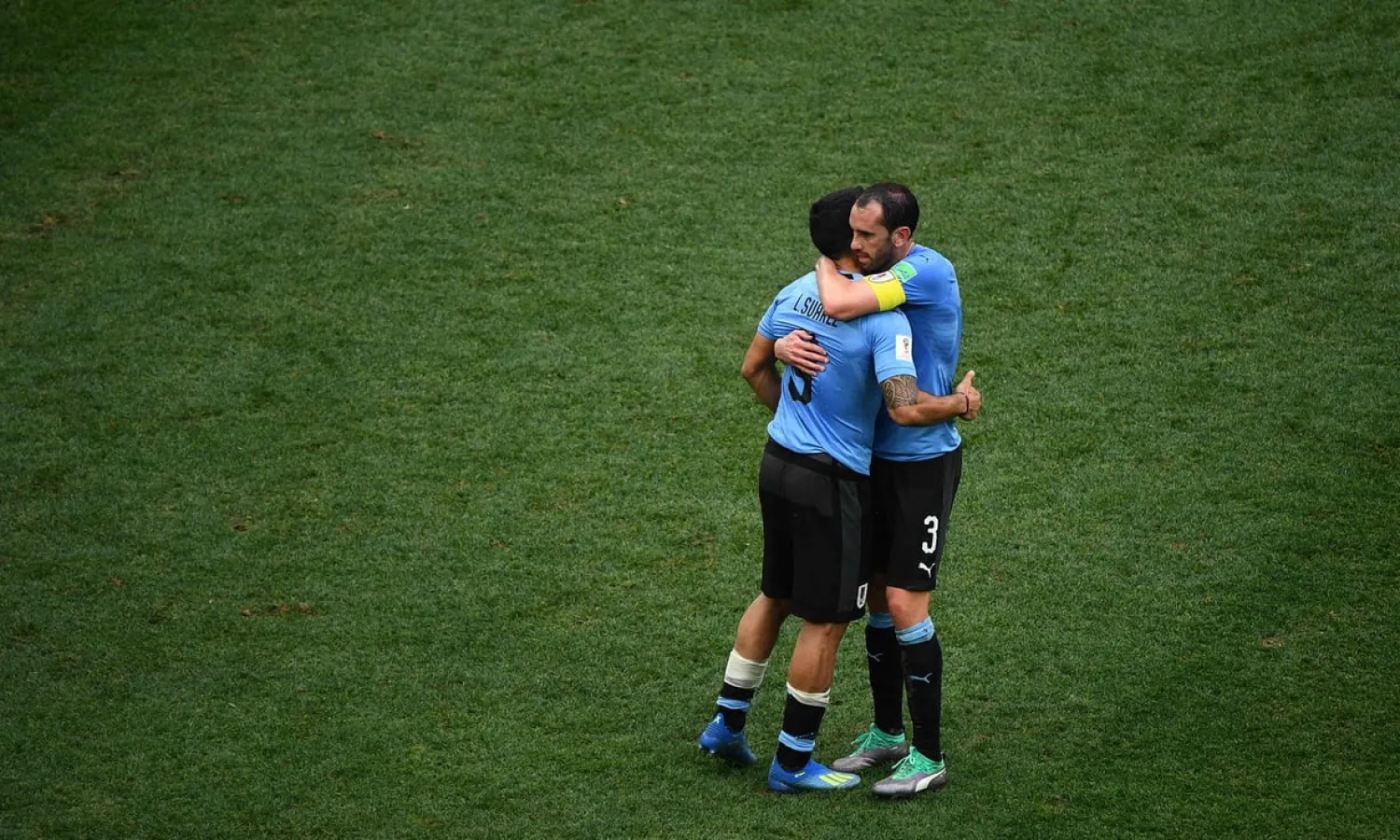
Luis Suárez, left, and Diego Godín react embrace after the defeat to France in the World Cup quarter-final. Photograph: Johannes Eisele/AFP/Getty Images
TT

South America’s World Cup Is Over but Uruguay Are an Example to Everyone

Luis Suárez, left, and Diego Godín react embrace after the defeat to France in the World Cup quarter-final. Photograph: Johannes Eisele/AFP/Getty Images

It was Italia 90 and I was in Milan for the World Cup. I had been there for three weeks and my head was full of football. I needed a moment’s peace and a double espresso, so I ducked into a small café. There were few customers and, at one end, a television showing football in black and white. I turned my back on it all and waited for my coffee in silence, thinking about nothing in particular. Suddenly, a piercing scream scared the life out of me. Something had happened. I turned around and realized that the noise was the most decontextualized goal celebration I had heard in my life. Still in shock, I saw him shouting – the “goal” not yet over. It had to be some madman. Only, it wasn’t … or perhaps it was.

A Uruguayan was cheering Alcides Ghiggia’s goal from the 1950 World Cup final on the television. When he had finally finished, he approached with that Uruguayan austerity I admire so much and said to me: “Sorry, it’s just that every time I see a Uruguay goal I celebrate as if it was the first.” His name was Mario, I never forgot that half an hour we spent together and I remember him every time Uruguay score a goal on the television. He came to mind again this weekend, watching Uruguay get knocked out by France. Perhaps more importantly, he came to mind watching Brazil get beaten too.

I adore Uruguayan football and those expressions of love for a game that always feels like an amateur pursuit with them, even if they’re lifting the World Cup. The achievements of Uruguayan football take on a glorious dimension. The names of the stages on which they wrote their history echo in the memory like a drum on a battlefield: “Colombes”, “Centenario”, “Maracanã”. Just recalling the names of heroes such as José Nasazzi and Obdulio Varela builds statutes in shorts.

But let’s bring Obdulio down from his plinth so that we can see what these heroes are made of.

When the most epic moment of Uruguayan football came, the famous Maracanazo, his figure took on heroic proportions. “There are 11 of them and 11 of us too” he told his teammates in the tunnel, adding: “they’re made of wood”. Outside were 200,000 Brazilians who had no doubt that glory awaited them that day. But glory awaits no one. You have to go and find it. Legend has it that in the silence after Uruguay scored, Obdulio could be heard asking for “more blood”. Given that every time we talk about Uruguay we talk about Garra Charrúa, that warrior spirit, it is appropriate to clarify here that the blood he demanded was that of his team-mates, not his opponents.

In the midst of that surreal atmosphere, described as the “Waterloo of the tropics”, Ghiggia scored the goal that my friend Mario celebrated, for the umpteenth time. Obdulio was the incarnation of a great player. To define what it is that makes a great team, you need only hear the story of Jorge Fucile during the 2010 quarter-final when Uruguay played Ghana. Fucile offered to sacrifice himself, volunteering to take the place of condemned man and cause celebre Luis Suárez. You will remember it: in the last second of the game, Suárez reached out with his hand to make a save on the goalline. Penalty, red card. With swift reflexes sharpened over thousands of games on the street, Fucile approached the referee and said: “You’re right, sir. It was me: send me off.” It didn’t work but that’s not really the point. The theory says that to be a true team-mate, you have to be prepared to subsume your individuality into that of the group, to put yourself at the service of the collective. Fucile did something that goes well beyond that: he was prepared to sacrifice the natural desire for glory that every footballer feels at a World Cup because he understood that Suárez was more necessary than he was in that battle and, if it came to it, in the next battle too. Ghana missed the penalty and Uruguay went through.

In 2018, Uruguay are still Uruguay. At this World Cup, they were the same collective they always were, a lesson in life and in defeat too. They appeared at the team hotel in shorts and flip flops, drinks of mate in hand. I feel admiration every time I see the first team to encounter footballing glory living with such extraordinary normality. Extraordinary and normality might seem mutually contradictory terms, but in this case and in these times they go together because remaining so normal having reached a footballing level this high is an almost heroic feat. And this is a subject worth pursuing. Given that more than one team departed the World Cup because of the sin of frivolity, afflicted by something approaching vanity, Uruguay pose a question: could it be that humility is more important than we think?

They have departed now, it is true. But they did so on the same day as Brazil – a nation of three million against a country of 208 million. None of the countries in the Americas that dwarf them outlasted them. This is a loss, yes. But it is a lesson too. Uruguay are different, unique. They may lack the resources that others on the continent have in abundance, but they have something that those nations do not, that the rest could benefit from embracing. That allows Uruguay to compete, yet it goes beyond the pitch. It is lasting.

The first person raising the flag of normality is Maestro Tabárez, a likable leader. When he finds himself before a group of players, rather than an exhibition of power, the only means of leadership acceptable to him is one founded upon knowledge and a strict sense of justice. And justice can only be imparted through meritocracy. Tabárez is the embodiment of the typical Uruguayan and he knows the human and professional qualities of his players like no one else after 12 years in charge. Tabárez is as concerned with educating the man as he is with educating the player. He never over-acts, never seeks to create a scene: the best example of that are his words after defeat to France: “this dream is over, others will come.” Football in its rightful place in society.

This Uruguay is the proud daughter of its footballing history and its way of understanding the game. They departed having given everything: that may not be enough to win, but it is enough to know that there is no regret and no reproach. They fought for every centimeter of turf; killed for every ball; never felt like visitors anywhere.A real team, with class and spirit, which showed a superior talent and warrior’s ambition in both areas. In their own, Diego Godín and José María Giménez defended as if the area was sacred territory; in the opposition’s, Suárez and Edinson Cavani invaded as if conquered territory was the gateway to paradise.

Cavani’s absence in the quarter-final left them blind in one eye but there was not one complaint, not a single lament. I have named two centre-backs and two centre forwards but the bad news, the very bad news, for their opponents is that the other seven players are also Uruguayan. And when they went, Uruguay left something. A lesson. They are footballers and they are people and they got there with their play and their personality too, the history and character that built them. The identity that Mario celebrated that day and every day. If England had made the grand final against Uruguay, I have no idea what the score would have been, but I know one thing: at the end of the game they would have regretted teaching that lot how to play football.

(The Guardian)


Irish Boxer Lee Reeves Dies at Age 31, Three Months after Dublin Title Fight Injury

Irish boxer Lee Reeves. Reuters
TT

Irish Boxer Lee Reeves Dies at Age 31, Three Months after Dublin Title Fight Injury

Irish boxer Lee Reeves. Reuters

Irish boxer Lee Reeves has died more than three months after being injured during a fight in Dublin, promoter Queensberry said Tuesday. He was 31.

"Everyone at Queensberry is devastated to learn of the passing of Lee Reeves," Queensberry Promotions said in a statement.

Reeves was hospitalized after being knocked out by compatriot Gary Cully in the 10th and final round of their Boxing Union of Ireland Celtic super-lightweight title fight on Aug. 1.

Reeves was carried from the ring on a stretcher after receiving initial treatment.

Queensberry had said after the fight that his condition was critical but stable.

“Lee was an immensely talented boxer, as well as a true role model and inspiration to his community,” the statement added Tuesday, according to The Associated Press. “Our deepest condolences go to Lee’s family, friends and all those who loved him. We ask that their privacy be respected at this incredibly difficult time. Rest in peace, Lee.”


Alonso to Enter Dakar Rally with Loeb and Aston Martin Team

November 5, 2026 Aston Martin's Fernando Alonso during a press conference ahead of the F1 Sao Paulo Grand Prix. (Reuters)
TT

Alonso to Enter Dakar Rally with Loeb and Aston Martin Team

November 5, 2026 Aston Martin's Fernando Alonso during a press conference ahead of the F1 Sao Paulo Grand Prix. (Reuters)

Double Formula One champion Fernando Alonso will compete in next January's Dakar Rally in an Aston Martin Dreadnought entry run by engineering partner Prodrive.

The 45-year-old Spaniard, a 32-time Grand Prix winner and two-time Le Mans 24 Hours winner, will be racing in the annual event for the second time after competing with Toyota in 2020, finishing 13th.

France's nine-time world rally champion Sebastien Loeb and Brazil's reigning world rally-raid champion Lucas Moraes will be his teammates in a three-car entry.

The 49th edition of the Dakar Rally will ‌be held in ‌Morocco from January 9 to 23, with a prologue and first ‌stage ⁠in Portugal, after ⁠being moved from Saudi Arabia due to security concerns.

The 24-round Formula One season is due to start in Bahrain in March after testing in late February.

Alonso, who will again have compatriot and five-time motorcycle Dakar winner Marc Coma as co-driver, is racing in the Las Vegas Grand Prix this weekend. He said he had turned his thoughts to Dakar after deciding to continue in Formula One with Aston Martin.

“In the end, the decision became simple. I wanted to embrace ⁠the challenge completely and take on both Formula One and the ‌Dakar Rally in the same year," he explained in ‌a statement.

"In 2020, Dakar was one of the most challenging and enjoyable experiences of my career. ‌I have enormous respect for this race and the specialists who have mastered it.

"Formula One ‌remains my priority. But I am a racing driver, and challenges like this are why I love competing. I’m looking forward to seeing what we can achieve."

LOEB CHASES FIRST DAKAR WIN

In October, Alonso told reporters at the Singapore Grand Prix that he felt the desert endurance race would be physically ‌incompatible with his Formula One commitments.

Loeb, 52, will also be chasing a first Dakar win after 10 previous attempts that have brought ⁠him 28 stage ⁠wins to date.

“Winning the Dakar is very important to me,” said the Frenchman, who will be partnered by Belgian Fabian Lurquin. “We have come close several times, and the motivation is there to keep working until we achieve it."

The Dreadnought is a digital-only tactical SUV created exclusively for gamers playing "Call of Duty: Modern Warfare 4" that will now be brought into the real world by Prodrive, Aston Martin's partners in endurance GT racing.

The Dakar will be Aston Martin Racing’s debut in the world rally-raid championship.

"Aston Martin's ambition for this program has been clear from the outset: to create a car capable of competing at the front of the world's toughest motorsport event," said Prodrive Chairman David Richards.

"By combining Aston Martin's vision with Prodrive's experience in rallying, endurance racing and Dakar competition, we have built a strong foundation. With an exceptional driver line-up and a highly capable engineering team, we look forward to seeing Dreadnought take on this remarkable challenge."


Owono Does Not Deserve 12-Match Ban Over De Miguel Death, Says Andorra Owner Pique

Equatorial Guinea's goalkeeper #01 Jesus Owono leaves the pitch at half time during the Africa Cup of Nations (CAN) Group E football match between Equatorial Guinea and Algeria at Moulay Hassan Stadium in Rabat on December 31, 2025. (AFP)
TT

Owono Does Not Deserve 12-Match Ban Over De Miguel Death, Says Andorra Owner Pique

Equatorial Guinea's goalkeeper #01 Jesus Owono leaves the pitch at half time during the Africa Cup of Nations (CAN) Group E football match between Equatorial Guinea and Algeria at Moulay Hassan Stadium in Rabat on December 31, 2025. (AFP)

FC Andorra owner Gerard ‌Pique said goalkeeper Jesus Owono did not deserve the 12-match suspension he received following the challenge that led to the death of Tenerife forward Jesus de Miguel.

Owono and De Miguel collided during a Spanish second-tier match on November 2. De Miguel was taken to intensive care and died the following day.

The disciplinary committee of the Spanish football federation (RFEF) banned Owono for violent conduct which resulted in serious ‌injury last week.

"Players, ‌former players, coaches, goalkeepers, everyone has ‌called ⁠it an accident," ⁠Pique said in a video posted on social media late on Monday.

"I truly believe that imposing the maximum sanction on Jesus for this action puts him in a situation he does not deserve, because he is not to blame for all of ⁠this having happened."

Former Barcelona player Pique ‌pointed to the three-match ‌ban handed to Albacete's Jose Corpas for accidentally kicking Sabadell ‌player Quadri Liameed in the head during a ‌recent match in Spain.

"Fortunately Quadri is fine, the consequences in this case were not fatal, and the committee decided to sanction Corpas with three matches," Pique added.

"With ‌all this, my reflection is: what is being sanctioned, the action or the ⁠consequences?"

The RFEF ⁠did not immediately respond to a request for comment outside regular business hours in Spain.

Owono, 25, has withdrawn from Equatorial Guinea's squad for Africa Cup of Nations qualifiers against Zimbabwe this month and Pique said it was unlikely the goalkeeper would return to action as soon as his suspension is up.

"Jesus is going to need far more than 12 matches before he is available and able to compete," he added. "No sanction is going to bring Demi (De Miguel) back to us."