

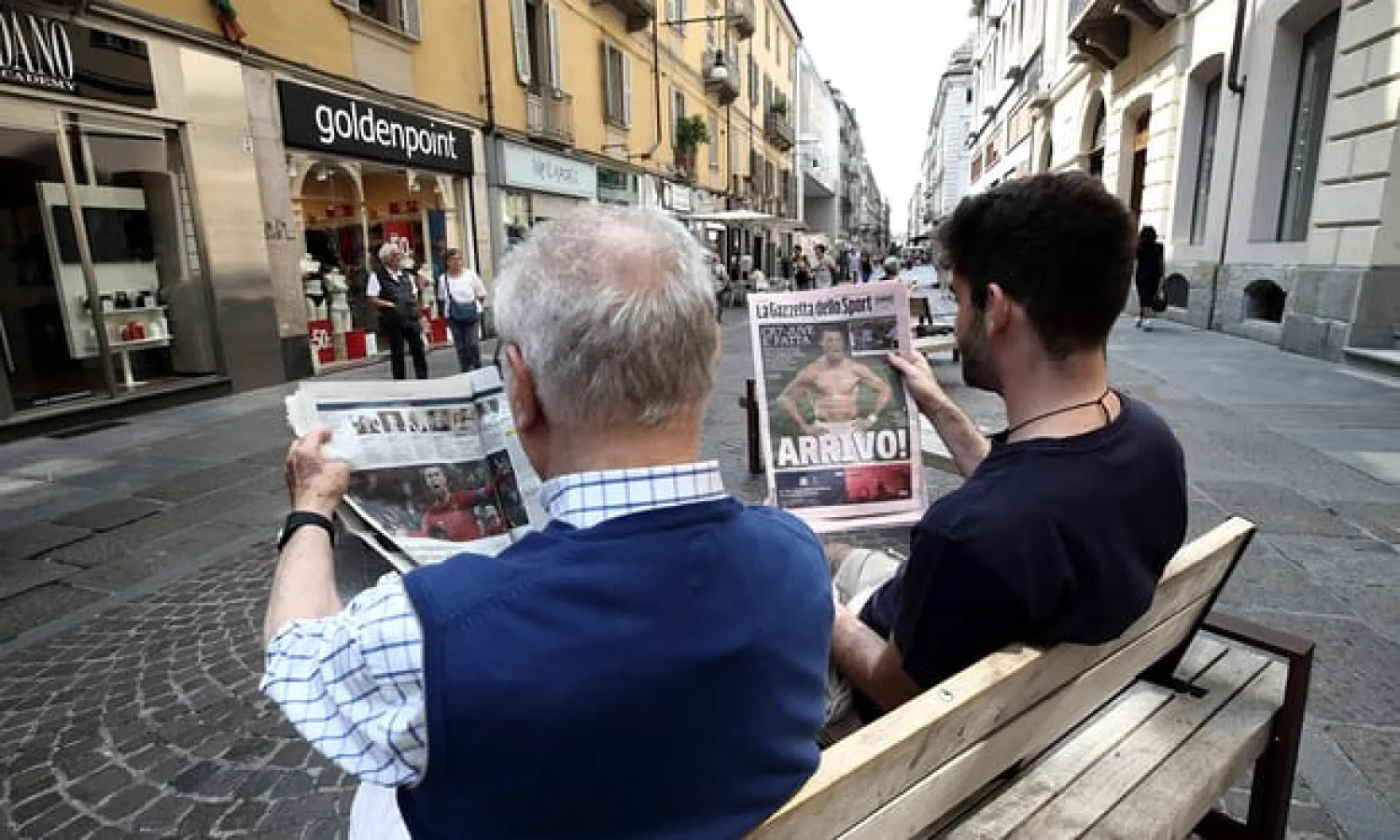

More Historic Italian Clubs Go Bust...While Juventus Sign Cristiano Ronaldo

 Cristiano Ronaldo is big news in Turin but too many fans across Italy have to read the financial pages. Photograph: Isabella Bonotto/AFP/Getty Images
Cristiano Ronaldo is big news in Turin but too many fans across Italy have to read the financial pages. Photograph: Isabella Bonotto/AFP/Getty Images
TT

More Historic Italian Clubs Go Bust...While Juventus Sign Cristiano Ronaldo

 Cristiano Ronaldo is big news in Turin but too many fans across Italy have to read the financial pages. Photograph: Isabella Bonotto/AFP/Getty Images
Cristiano Ronaldo is big news in Turin but too many fans across Italy have to read the financial pages. Photograph: Isabella Bonotto/AFP/Getty Images

While Juventus and Real Madrid finessed the details of Cristiano Ronaldo’s transfer, a distant funeral bell tolled for three historic Italian clubs – a scenario that accentuated the disparity between those at the top of Italian football and those a few rungs down the ladder. Ronaldo’s arrival has been hailed as a coup for the Italian game. Apparently he will raise the profile of Serie A to a level not seen since the 1990s and everyone will reap the benefits. But few fans outside Turin subscribe to this “trickle-down” theory.

The news that Bari and Cesena of Serie B, as well as AC Reggiana of Serie C, have all been denied licences for the upcoming season due to financial issues will hardly come as a surprise to anyone who follows Italian football. Since Fiorentina went bankrupt in 2002, 153 Italian clubs have refounded, merged with other clubs or disappeared altogether. Three clubs have dropped from Serie B to Serie D this summer due to financial problems even though none of them finished in the relegation zone.

One way or another, most of these clubs return. New legal entities are formed, new owners are found and the clubs begin again in the lower leagues. Some rise from the ashes and thrive. Napoli were refounded in 2004 and nearly won Serie A last season. Parma completed their comeback to the top flight in May, just three seasons after the third rebirth in their history. But the resurrection process can be long and painful for fans. This is a new experience for Bari, who were founded in 1908, and Cesena, who have been meandering through the professional leagues since 1940. That’s 188 years of football history signed away with a stroke of a pen.

How did it come to this for Bari, the club of Gordon Cowans and David Platt? In May 2014, after three decades in the hands of the Matarrese family, Bari found new owners, with former referee Gianluca Paparesta the public face of a group who paid €4.8m for the club in a bankruptcy auction. The Matarreses had effectively washed their hands of the club in 2011, leaving the club to stagnate for three years and amass debts of €30m.

Bari-born Paparesta looked to put the club on an even keel and in 2016 he appeared to have found a wealthy investor. Malaysian businessman Noordin Ahmad had a preliminary agreement to buy a 50% share of the club, while local tycoon Cosmo Giancaspro, who acquired a 5% share in December 2015, was announced as the new president. The whole setup appeared little more than a coup, with Giancaspro eventually securing Paparesta’s stake and Noordin disappearing into thin air.

From then on, the atmosphere around the club changed. Redevelopment plans for the San Nicola stadium were rejected, with Bari’s mayor Antonio Decaro refusing to commit any money from taxpayers. The club were offered a long-term lease and the freedom to develop the ground but, with no funds available, the plans were shelved and the San Nicola was left to quietly crumble, poignantly reflecting the situation behind the scenes.

By January 2018, rumours surfaced of wages not being paid, prompting fines from the tax office. In March, it was confirmed that the club was €16m in debt. With no assets to raise funds, promotion was their only hope. The players made it to the play-offs but a two-point penalty for financial irregularities gave them a tougher draw and they failed to reach Serie A.

The stadium’s water supply was cut last month due to an unpaid bill of €6,000. At the same time, the club were trying to raise €5m to pay outstanding wages, pension contributions and the registration fee required to compete in Serie B this season. Talks with Leeds United owner Andrea Radrizzani collapsed and Giancaspro, now under investigation for financial irregularities, walked away from the club.

Life outside the top flight has always been a strain for Bari. Their architecturally acclaimed stadium – known as the “Spaceship” – was originally built for Italia 90 and has long been a drain on resources, with neither the club nor the council able to find a sustainable solution. The playing squad always came second to the stadium and sustaining top-flight football proved an impossible task. It’s a similar tale across the peninsula as clubs struggle to maintain municipal stadiums. Even Juventus could not fill the Stadio delle Alpi, the ground thrust upon them in 1990, eventually replacing it with the smaller and more cost-effective Juventus Stadium.

The last few years have been exhausting for Bari fans. Issues around the stadium, the revolving door of coaches and players, and a hike in ticket prices during the Giancasparo era have all eroded enthusiasm. The club that attracted 50,000 to the Serie B play-off against Latina in 2014 could only sell 20,000 tickets for their play-off against Novara in 2016. When demotion finally came last week the city’s mayor, Antonio Decaro, declared it “a day of defeat, which burns 1,000 times more than any defeat on the pitch.”

Yet this will hopefully not be the end. Revival plans began on Friday as Decaro spoke in front of 4,000 fans at the club’s old ground, the Stadio della Vittoria, where they will likely return. The mayor wants the football authorities to give Bari a place in Serie C in light of their sporting heritage, but that idea is unlikely to fly. New investors have emerged, but details remain vague.

Jeremy Bowling, a season-ticket holder at the club since 2009, sums up the mood: “The city, the province and the Tifosi are devastated – us Brits too, who were taken in and welcomed. I am not sure how I am going to fill the void. A city that can send 50,000 to a play-off game deserved better stewardship than this.” Mark Neale, who has been following the club for 35 years, was also stunned: “As the deadline passed, everything was silent. Then fans on Facebook were doing live videos with tears in their eyes.”

“The cockerel has failed, 110 years of red and white history has failed, says lifelong Bari fan Alfred Ricci. “When you kill the rooster, when you cut off his head, he lives on for a while. Bari never dies. The people of Bari never die. The resurrection will start again from Serie D. We will be there with our scarves, singing, honouring today, yesterday and forever the white and red colours.”

Bari and Cesena will draw inspiration from clubs such as Napoli and Fiorentina who have risen again after suffering similar fates, while Reggiana will try to avoid the mistakes they made after they last refounded in 2005. There may be new names, new stadiums, new opponents and new owners, but the fans remain constant. No amount of accounting, investigating and legal reporting can take away the passion of those who will continue to give life to a club, even after the obituaries have been written.

The Guardian Sport


Grealish’s Season Over After Undergoing Foot Surgery

 Football - Premier League - Aston Villa v Everton - Villa Park, Birmingham, Britain - January 18, 2026 Everton's Jack Grealish shoots at goal as Aston Villa's Lamare Bogarde and Ezri Konsa react. (Action Images via Reuters)
Football - Premier League - Aston Villa v Everton - Villa Park, Birmingham, Britain - January 18, 2026 Everton's Jack Grealish shoots at goal as Aston Villa's Lamare Bogarde and Ezri Konsa react. (Action Images via Reuters)
TT

Grealish’s Season Over After Undergoing Foot Surgery

 Football - Premier League - Aston Villa v Everton - Villa Park, Birmingham, Britain - January 18, 2026 Everton's Jack Grealish shoots at goal as Aston Villa's Lamare Bogarde and Ezri Konsa react. (Action Images via Reuters)
Football - Premier League - Aston Villa v Everton - Villa Park, Birmingham, Britain - January 18, 2026 Everton's Jack Grealish shoots at goal as Aston Villa's Lamare Bogarde and Ezri Konsa react. (Action Images via Reuters)

Everton midfielder Jack Grealish has confirmed his season is over after undergoing surgery on ​a stress fracture in his foot, dealing a major blow to his hopes of making England's squad for the World Cup.

The 30-year-old, who is on loan from Manchester City, suffered the ‌injury during ‌Everton's 1-0 Premier ‌League ⁠win ​against ‌Aston Villa last month.

Grealish made 22 appearances in all competitions for Everton this season, scoring twice and providing six assists, and his form had prompted suggestions he could ⁠earn a recall to the national ‌side.

"Didn't want the season ‍to end like ‍this but that's football, gutted," ‍he posted on social media.

"Surgery done and now all focus on getting back fit. I know for sure ​I will come back fitter, stronger and better than before."

Grealish, ⁠who won three Premier League titles, the Champions League and the FA Cup with City, made his last appearance for England in October 2024 under caretaker manager Lee Carsley.

The World Cup will take place from June 11 to July 19 in Canada, Mexico, ‌and the United States.


Robot Dogs to Help Mexican Police at 2026 World Cup

This handout picture released by Municipality of Guadalupe shows robot dogs designed to help Mexican police tackle crime during the World Cup, unveiled by the city council of Guadalupe, Nuevo Leon state, Mexico on February 9, 2026.  (Handout / Municipality of Guadalupe / AFP) 
TT

Robot Dogs to Help Mexican Police at 2026 World Cup

This handout picture released by Municipality of Guadalupe shows robot dogs designed to help Mexican police tackle crime during the World Cup, unveiled by the city council of Guadalupe, Nuevo Leon state, Mexico on February 9, 2026.  (Handout / Municipality of Guadalupe / AFP) 

A pack of robot dogs will help Mexican police tackle crime during the 2026 World Cup this summer, authorities said Monday.

The four-legged robots are designed to enter dangerous areas and broadcast live video back to security forces, who can watch before taking action during the football tournament.

The global spectacle, which will take place from June 11 to July 19, is being hosted by Mexico alongside the United States and Canada.

The animaloid robots were acquired for 2.5 million pesos ($145,000) by the city council of Guadalupe, part of the Monterrey metro area, which will host one of the World Cup venues.

A video released by the local government shows one of the robots walking on four legs through an abandoned building and climbing stairs, though with some difficulty.

The robo-hound can be seen transmitting live images to a group of police officers walking stealthily behind it.

In the demonstration the canine robot encounters an armed man and orders him to drop his gun using a loudspeaker.

The purpose of the robot dogs is "to support police officers with initial intervention... to protect the physical safety of officers," said Guadalupe mayor Hector Garcia.

They will be deployed "in case of any altercation," he added.

BBVA Stadium, which will be known as Estadio Monterrey during the tournament, will host four matches.


Serena Williams Listed as Eligible to Return to Tennis on February 22

Tennis - US Open - Flushing Meadows, New York, United States - September 2, 2022 Serena Williams of the US after losing her third round match against Australia's Ajla Tomljanovic. (Reuters)
TT

Serena Williams Listed as Eligible to Return to Tennis on February 22

Tennis - US Open - Flushing Meadows, New York, United States - September 2, 2022 Serena Williams of the US after losing her third round match against Australia's Ajla Tomljanovic. (Reuters)

Serena Williams has been listed as eligible to return to ​tennis from February 22 by the sport's drug-testing body (ITIA), though it remains unclear whether the 23-times Grand Slam champion will make a ‌stunning comeback ‌to the ‌women's ⁠tour.

The ​44-year-old ‌raised eyebrows late last year after rejoining the tennis anti-doping testing pool, though she denied at the time the move ⁠signaled she was preparing to ‌return to the ‍sport she ‍dominated for nearly two ‍decades.

She reignited speculation last month when she deflected questions about a possible return ​during an appearance on NBC's "Today" show.

The Women's Tennis ⁠Association did not immediately respond to a request for comment outside normal business hours.

Williams, who won her last Grand Slam singles title in 2017, has not competed since the 2022 US Open.
