


How Alex Ferguson Snatched Roy Keane out of Blackburn’s Hands

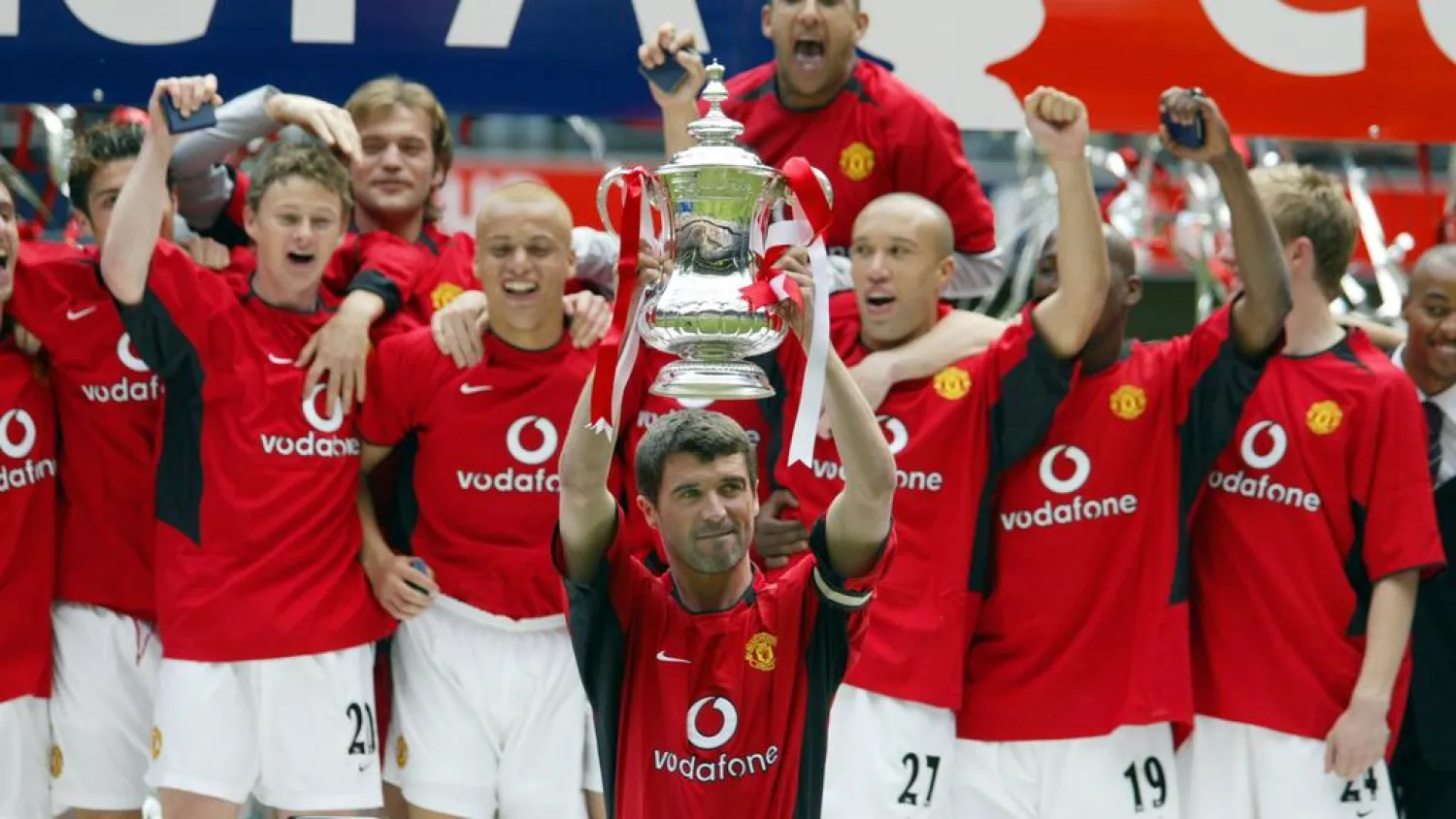
Manchester United's captain Roy Keane, center, lifts the FA Cup after his team's 3-0 win over Millwall in the 2004 final. (AFP)
TT

How Alex Ferguson Snatched Roy Keane out of Blackburn’s Hands

Manchester United's captain Roy Keane, center, lifts the FA Cup after his team's 3-0 win over Millwall in the 2004 final. (AFP)

Historic moments usually have an epic quality. But sometimes all it takes to change the world is for a few office staff to get that Friday feeling. Exactly 25 years ago – in the summer of 1993 – the world of football changed forever because the admin team at Ewood Park clocked off on time. If somebody had stayed late in the office, Roy Keane would have become a Blackburn Rovers player. Instead, Alex Ferguson was given the chance to oversee one of his most important injury-time winners.

United had just won their first title for 26 years but even they could not match the financial power of Blackburn, who had Jack Walker’s money to burn. They had beaten United to Alan Shearer a year earlier, and looked set to do so again when Keane announced he would leave Nottingham Forest after their relegation.

The Blackburn manager, Kenny Dalglish, met Keane at the end of the season. At that stage Keane did not even have an agent and was instead accompanied by the PFA’s Brendon Batson. He liked Dalglish – “his obvious intelligence and cool persona impressed me” – and though he asked for £500,000 a year, the same as Shearer, he eventually accepted £400,000. Those few hours of bargaining were crucial: when Dalglish phoned Ewood Park to see if somebody could prepare the contract, everyone had gone home. He shook hands on the deal with Keane and said they could sort the contract on Monday.

If Blackburn had not quibbled over £100,000 a year, their equivalent of four pence down the back of the sofa, or if somebody had stayed behind until they had a clear in-tray, Keane would have signed there and then. Instead he went back to the family home in Cork the following day and celebrated as approximately 100 percent of 21‑year‑olds would in such circumstances. He awoke on the Sunday morning with an intrusive hangover when his older brother Pat told him Ferguson was on the phone.

Ferguson tracked Keane down after reading about his talks with Blackburn in the tabloids. While some papers thought he had other targets – a couple said Carlton Palmer was his first choice – Ferguson and his staff had decided Keane was the only player they wanted to add to the title-winning squad. The United manager had been obsessed with Keane since September 1990, when he dominated in Forest’s 1-0 win at Old Trafford.

Ferguson says his apparently laissez-faire attitude was simply because he had promised Forest’s new manager, Frank Clark, that he would wait for official permission to speak to Keane. When he did get hold of the player, Ferguson asked whether anything had been signed with Blackburn. Keane, his United-loving family all gawping excitedly at him, mumbled that he hadn’t, so Ferguson casually suggested they meet for a chat. “From that moment,” said Keane in his first autobiography, “I was never going to sign for any other club.”

The following day, Ferguson picked Keane up at Manchester airport and went back to his house for a game of snooker. “I liked him straight away,” Keane said. “He was unaffected, funny and reassuringly human. He was also clearly hungry for more trophies.” And new ones. Ferguson matter-of-factly told Keane that, with or without him, United were going to dominate English football but that with Keane they could also win the European Cup. “He was,” remembers Keane, “pushing at an open door.” Whether it was a neat sales pitch or something more meaningful, Ferguson’s comment was eerily prescient: six years later, Keane drove United to the Treble and got to them to the European Cup final with that astonishing performance against Juventus.

Keane earned 25 percent less at United than he would have done at Blackburn. They were also offering Forest more money, which meant United had to wait another six weeks to complete the transfer. Ferguson told Keane that, if both parties held their nerve, the move would eventually happen. With that, both men went off on their summer holidays. Ferguson had lost players before while on his summer break, most notably Paul Gascoigne, but he was relaxed about Keane. “When he looked me in the eye, I knew I was talking to a footballer who would not break his word.”

Except that is precisely what he had done to Dalglish, who reacted with volcanic fury when Keane phoned him. “Nobody does this to Kenny Dalglish,” he said. “You’re a wee bastard and you won’t get away with this.” Keane felt uneasy breaking his word but rationalized it with the knowledge that there was no honor of football. Most people realize that towards at the end of their careers; Keane was 21.

Dalglish even threatened to hunt Keane down in Ayia Napa, where he was going with three friends for a lads’ holiday. “I had a fabulous time,” he said later. “No one in Cyprus knew or cared who we were or who we thought we were. Happy, innocent days.”

In a sense they were the last innocent days, because Keane’s life changed when he became a Manchester United player. For his first season he was desperately insecure about his technical ability. A chat with Bryan Robson, who encouraged him to trust his passing range, was the start of his development from a box‑to‑box hurricane to holding midfielder with a seriously underrated passing ability.

Given his ability and influence, as a demander of the highest standards, it is natural to wonder how different English football might have been had both he and peak Shearer been at the same club. Instead he became the most irreplaceable player in the greatest Manchester United team of all – and a reminder that, even in multi-million‑pound industries, the strangest details can change the world.

The Guardian Sport


Chelsea Injuries up 44% After Club World Cup but Report Says Event Has Had ‘Minimal’ Impact

Chelsea's Reece James, center, lifts the trophy following the Club World Cup final soccer match between Chelsea and PSG at MetLife Stadium in East Rutherford, N.J., Sunday, July 13, 2025. (AP)
TT

Chelsea Injuries up 44% After Club World Cup but Report Says Event Has Had ‘Minimal’ Impact

Chelsea's Reece James, center, lifts the trophy following the Club World Cup final soccer match between Chelsea and PSG at MetLife Stadium in East Rutherford, N.J., Sunday, July 13, 2025. (AP)

Chelsea suffered a 44% spike in injuries after competing in the supersized Club World Cup this year, according to findings published on Tuesday.

But the newly expanded tournament has so far had a “minimal impact” on injuries overall, the latest edition of the Men’s European Football Injury Index found.

There was fierce opposition to FIFA's new flagship club event when it was confirmed in 2023 that it would increase from seven to 32 teams, with players' unions warning of physical and mental burnout of players due to an ever expanding match schedule. But FIFA pressed ahead and staged the tournament in the United States in June-July.

Chelsea went on to win the inaugural competition, receiving the trophy from US President Donald Trump at MetLife Stadium and taking home prize money of around $125 million. But, according to the Index, from June-October, Chelsea picked up more injuries — 23 — than any of the nine clubs from Europe's top leagues that participated in the Club World Cup.

They included star player Cole Palmer, and was a 44% increase on the same period last year.

While Chelsea, which played 64 games over the entire 2024-25 season, saw an increase in injuries, the Index, produced by global insurance firm Howden, found that overall there was a decrease.

“In principle you would expect this increased workload to lead to an increase in the number of injuries sustained, as a possible rise in overall injury severity,” the Index report said, but added: “The data would suggest a minimal impact on overall injury figures.”

Despite the figures, the authors of the report accept it was too early to assess the full impact of the Club World Cup, with the findings only going up to October.

“We would expect to see the impact to spike in that sort of November to February period,” said James Burrows, Head of Sport at Howden. “What we’ve seen previously is that’s where the impact is seen from summer tournaments."

Manchester City has sustained 22 since the tournament, which is the highest among the nine teams from Europe's top leagues — England, Spain, Italy, Germany and France.

Those teams have recorded 146 injuries from June-October, which is down on the previous year's figure of 174.

From August-October that number is 121, the lowest for that three-month period in the previous six years of the Index.


Sunderland Worst Hit by Losing Players to African Cup of Nations 

14 December 2025, United Kingdom, London: Sunderland's Habib Diarra (L) and Leeds United's Gabriel Gudmundsson battle for the ball during the English Premier League soccer match between Brentford and Leeds United at the Gtech Community Stadium. (dpa)
TT

Sunderland Worst Hit by Losing Players to African Cup of Nations 

14 December 2025, United Kingdom, London: Sunderland's Habib Diarra (L) and Leeds United's Gabriel Gudmundsson battle for the ball during the English Premier League soccer match between Brentford and Leeds United at the Gtech Community Stadium. (dpa)

Premier League Sunderland will have to do without six players over the next few weeks and are the club worst hit as the Africa Cup of Nations takes its toll on European clubs competing over the holiday season.

Sunderland, eighth in the standings, had four of their African internationals in action when they beat Newcastle United on Sunday, but like 14 other English top-flight clubs will now lose those players to international duty.

The timing of the African championship, kicking off in Morocco on Sunday and running through to January 18, has long been an irritant for coaches, with leagues in Belgium, France, Germany, Italy, Netherlands, Portugal, and Spain also affected.

Hosting the tournament in the middle of the season impacts around 58% of the players at the Cup of Nations, though the Confederation of African Football did try to mitigate the impact by moving the start to before Christmas, so it is completed before the next round of Champions League matches.

The impact on European clubs was also lessened by allowing them to release players seven days, rather than the mandatory 14 days, before the tournament, meaning they could play for their clubs last weekend.

Sunderland's Congolese Arthur Masuaku and Noah Sadiki, plus full back Reinildo (Mozambique), midfielder Habib Diarra (Mali), and attackers Chemsdine Talbi (Morocco) and Bertrand Traore (Burkina Faso) have now departed for Morocco.

Ironically, Mohamed Salah’s absence from Liverpool to play for Egypt should lower the temperature at the club after his recent outburst against manager Arne Slot, but Manchester United will lose three players in Noussair Mazraoui, Bryan Mbeumo and Amad Diallo, who scored in Monday’s 4-4 draw with Bournemouth.

France is again the country with the most players heading to the Cup of Nations, and with 51 from Ligue 1 clubs. But their absence is much less impactful than previously as Ligue 1 broke after the weekend’s fixtures and does not resume until January 2, by which time the Cup of Nations will be into its knockout stage.

There are 21 players from Serie A clubs, 18 from the Bundesliga, and 15 from LaLiga teams among the 24 squads at the tournament in Morocco.


Rodgers Takes Charge of Saudi Team Al-Qadsiah After Departure from Celtic 

Then-Celtic head coach Brendan Rodgers greets supporters after a Europa League soccer match between Red Star and Celtic at Rajko Mitic Stadium in Belgrade, Serbia, Sept. 24, 2025. (AP)
TT

Rodgers Takes Charge of Saudi Team Al-Qadsiah After Departure from Celtic 

Then-Celtic head coach Brendan Rodgers greets supporters after a Europa League soccer match between Red Star and Celtic at Rajko Mitic Stadium in Belgrade, Serbia, Sept. 24, 2025. (AP)

Brendan Rodgers has returned to football as the coach of Saudi Arabian club Al-Qadsiah, six weeks after resigning from Scottish champion Celtic.

Al-Qadsiah, whose squad includes Italian striker Mateo Retegui and former Real Madrid defender Fernandez Nacho, is in fifth place in the Saudi Pro League in its first season after promotion.

Rodgers departed Celtic on Oct. 27 and has opted to continue his managerial career outside Britain for the first time, having previously coached Liverpool, Leicester and Swansea.

In its statement announcing the hiring of Rodgers on Tuesday, Al-Qadsiah described him as a “world-renowned coach” and said his arrival “reflects the club’s ambitious vision and its rapidly growing sporting project.”

Aramco, the state-owned Saudi oil giant, bought Al-Qadsiah in 2023 in a move that has helped to transform the club’s status.

“This is a landmark moment for the club,” Al-Qadsiah chief executive James Bisgrove said. “The caliber of his experience and track record of winning reflects our ambition and long-term vision to establish Al-Qadsiah as one of Asia’s leading clubs.”

Rodgers is coming off winning back-to-back Scottish league titles with Celtic, where he won 11 major trophies across his two spells. He also won the FA Cup with Leicester.

Al-Qadsiah's last two coaches were former Liverpool striker Robbie Fowler and former Spain midfielder Michel.
