


'Icon of Syrian Revolution' Laid to Rest in Paris

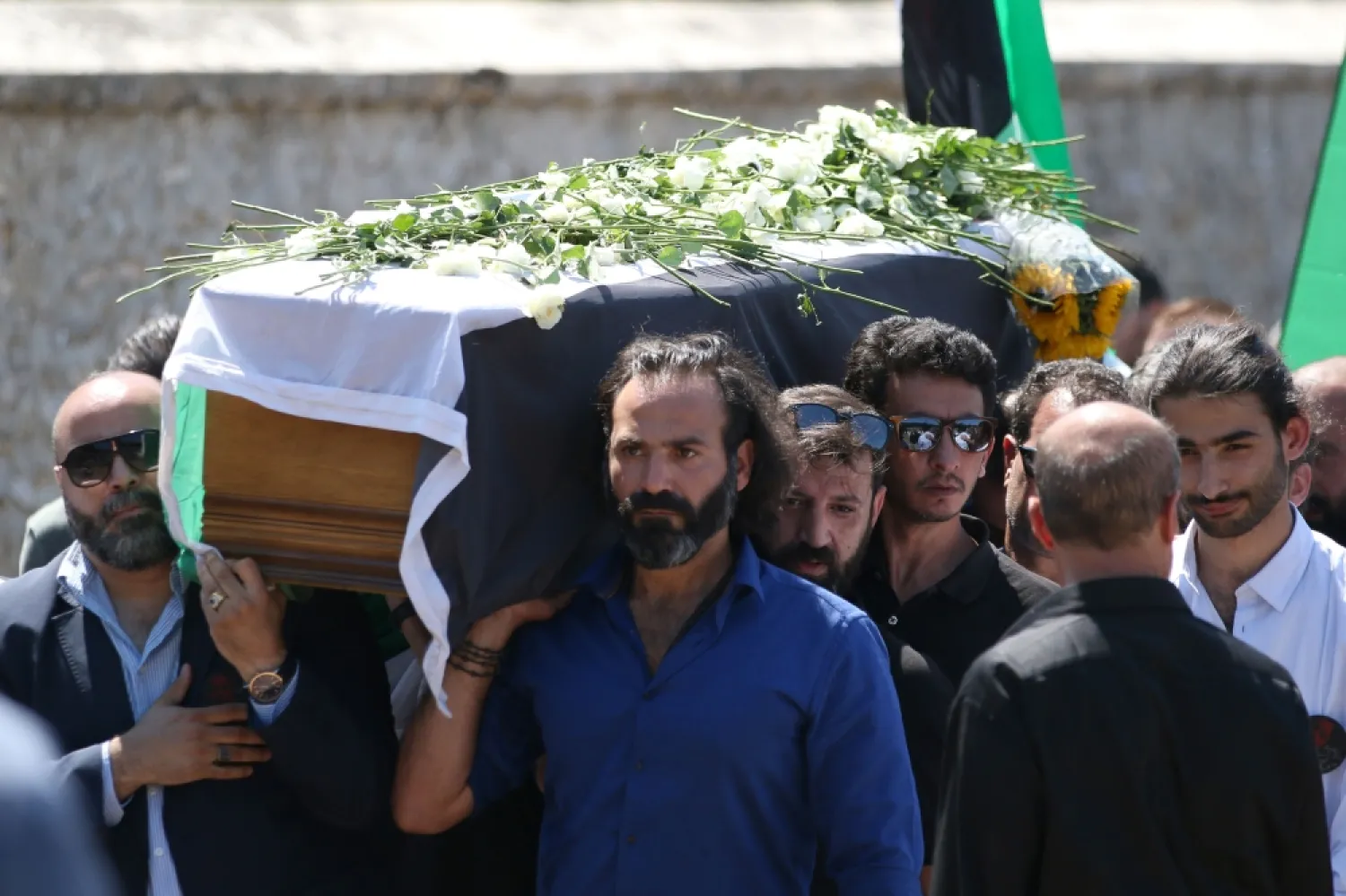
Syrian actor Jala Al-Tawil, front, helps carry the coffin of Syrian actress and democracy activist exiled by the regime, May Skaf, along with her son Joud Al-Zobi, right, in Dourdan, a southwestern Paris suburb, on Friday. — AFP
TT

'Icon of Syrian Revolution' Laid to Rest in Paris

Syrian actor Jala Al-Tawil, front, helps carry the coffin of Syrian actress and democracy activist exiled by the regime, May Skaf, along with her son Joud Al-Zobi, right, in Dourdan, a southwestern Paris suburb, on Friday. — AFP

Prominent Syrian actress May Skaf was temporarily buried Friday in Dourdan, France.

Skaf, 49, was an outspoken critic of Assad’s regime after the uprising began in 2011 and often dubbed as the “icon of the revolution.” She was among the few artists who supported the Syrian revolution since its outset.

The activist was found dead July 23 at her home in Paris, where she had been living with her son, Joud. Medical reports indicate she died following a stroke in one of her brain’s arteries. She also suffered from a ruptured aneurysm.

A number of friends, relatives, and Syrian activists, including Syrian actor Fares El- Helou attended the funeral.

Joud said his mother's grave in France is a temporary resting place, "until we all return to Syria after its liberation from the Assad regime."

“May became a star because she refused any glory, she refused to earn money or work with people who exploited her,” her son added.

He added that his mother was sad about the situation in Syria and her psychological condition worsened during the last four months, which affected her health and nerves. In her last days, May lived in tension, anxiety, sadness and frustration, added Joud, pointing out that he did not expect her to pass away so unexpectedly.

Syrian writer and novelist Dima Wannous, described May’s death as “a loss for all of Syria.”

She told Arab.net that the late actress had been very frustrated over the last four months because of recent events in Syria, Iranian-Russian occupation of her country, and the increased number of victims who die every day by the Assad militias, Hezbollah, Russia and Iran.

“I will never lose hope, I will never lose hope. It’s the majestic Syria, not Assad’s Syria,” she wrote in her last Facebook post.



Israel Defense Minister Says Struck Iran's Largest Petrochemical Facility

A satellite image shows a closer view of the Natanz Nuclear Facility with new building damage, amid the US-Israeli conflict with Iran, near Natanz, Iran, March 2, 2026. (Vantor/Handout via Reuters)
TT

Israel Defense Minister Says Struck Iran's Largest Petrochemical Facility

A satellite image shows a closer view of the Natanz Nuclear Facility with new building damage, amid the US-Israeli conflict with Iran, near Natanz, Iran, March 2, 2026. (Vantor/Handout via Reuters)

Defense Minister Israel Katz said Monday that Israel had conducted a "powerful strike" on Iran's largest petrochemical complex, after Iranian media reported multiple explosions at the site.

The military "just carried out a powerful strike on Iran's largest petrochemical facility, located in Asaluyeh -- a central target responsible for about 50 percent of the country's petrochemical production", Katz said in a video statement.

Israel carried out a similar strike on the Mahshahr Petrochemical Special Zone in southwest Khuzestan province on Saturday, a local Iranian official said, adding that five people were killed, AFP reported.

"At this point, the two facilities, which together account for roughly 85 percent of Iran's petrochemical exports, have been taken out of operation and are no longer functioning," Katz said.

"This represents a severe economic blow amounting to tens of billions of dollars to the Iranian regime."

Israel also carried out strikes last month on gas facilities at the South Pars Special Economic Zone in Asaluyeh.

The South Pars/North Dome mega-field -- the largest known natural gas reserve in the world -- is shared between Iran and Qatar.

In recent days, Israel has targeted key industrial sectors as part of the ongoing military campaign against Iran.

On Friday, Israeli Prime Minister Benjamin Netanyahu said Israeli strikes had destroyed around 70 percent of Iran's steel production capacity, significantly undermining Tehran's ability to manufacture weapons.

Steel is a strategically important material used in industrial and military production, including for missiles, drones and ships.

Katz said he and Netanyahu had ordered the military "to continue striking with full force Iran's national infrastructure".


Israel Says to Boost Production of Arrow Missile Interceptors

Emergency personnel carry a body at the site of a projectile impact, as the US-Israeli conflict with Iran continues, in Haifa, Israel, April 6, 2026. REUTERS/Shir Torem
TT

Israel Says to Boost Production of Arrow Missile Interceptors

Emergency personnel carry a body at the site of a projectile impact, as the US-Israeli conflict with Iran continues, in Haifa, Israel, April 6, 2026. REUTERS/Shir Torem

Israel's defense ministry on Monday said it plans to accelerate production of Arrow missile interceptors, as it fights a war with Iran.

The announcement came after questions emerged in the international media over how long Israel's interceptor stocks would last, with some analysts pointing to shortages of Arrow interceptors in particular.

Israel has a multi-layered air defense array, with a variety of systems intercepting threats at different altitudes.

The top tier consists of the anti-ballistic missile Arrow systems, with Arrow 2 operating both within the Earth's atmosphere and in space and Arrow 3 intercepting above the Earth's atmosphere.

"The Ministerial Committee for Procurement has approved the Israel Ministry of Defense (IMOD) plan for a major additional acceleration of Arrow interceptor production," AFP quoted a defense ministry statement as saying.

It added that the plan would enable "a significant increase in both the production rate and stockpile of Arrow interceptors as part of preparations for the evolving campaign".

Defense Minister Israel Katz was quoted in the statement as saying that "Israel has sufficient interceptors to protect its citizens, and this initiative is designed to ensure continued freedom of action and the sustained operational endurance we require."

Each Arrow 2 interceptor costs an estimated $1.5 million, with Arrow 3s around $2 million.


Iran Says US Airman Rescue May Have Been Cover to ‘Steal Enriched Uranium’

A still image purporting to show smoke rising from the site of the US aircraft destroyed during the US mission to find a stranded airman in Iran, the Revolutionary Guards said according to Iranian media, amid the US-Israeli conflict with Iran, in Isfahan, Iran, released on April 5, 2026. (Social Media/via Reuters)
TT

Iran Says US Airman Rescue May Have Been Cover to ‘Steal Enriched Uranium’

A still image purporting to show smoke rising from the site of the US aircraft destroyed during the US mission to find a stranded airman in Iran, the Revolutionary Guards said according to Iranian media, amid the US-Israeli conflict with Iran, in Isfahan, Iran, released on April 5, 2026. (Social Media/via Reuters)

Iran's foreign ministry said on Monday that a US operation to rescue a downed airman may have been a cover to "steal enriched uranium" from the country.

On Sunday, President Donald Trump said the US recovered a second crew member of an F-15E that went down over Iran on Friday in what he called a "daring" search and rescue operation.

Iran's military has called it "a deception and escape mission", insisting it was "completely foiled".

On Monday, Iran's foreign ministry spokesman Esmaeil Baqaei said there were "many questions and uncertainties" about the operation.

"The area where the American pilot was claimed to be present in Kohgiluyeh and Boyer-Ahmad Province is a long way from the area where they attempted to land or wanted to land their forces in central Iran," Baqaei said.

"The possibility that this was a deception operation to steal enriched uranium should not be ignored at all."

He added that the operation was "a disaster" for the United States.

Iran's military said several US aircraft had to "make emergency landings" in southern Isfahan province after being hit during the mission, with the US "forced to heavily bombard the downed aircraft" as a result.