


Iran: Military, Mullahs Join Protests With Hidden Agendas

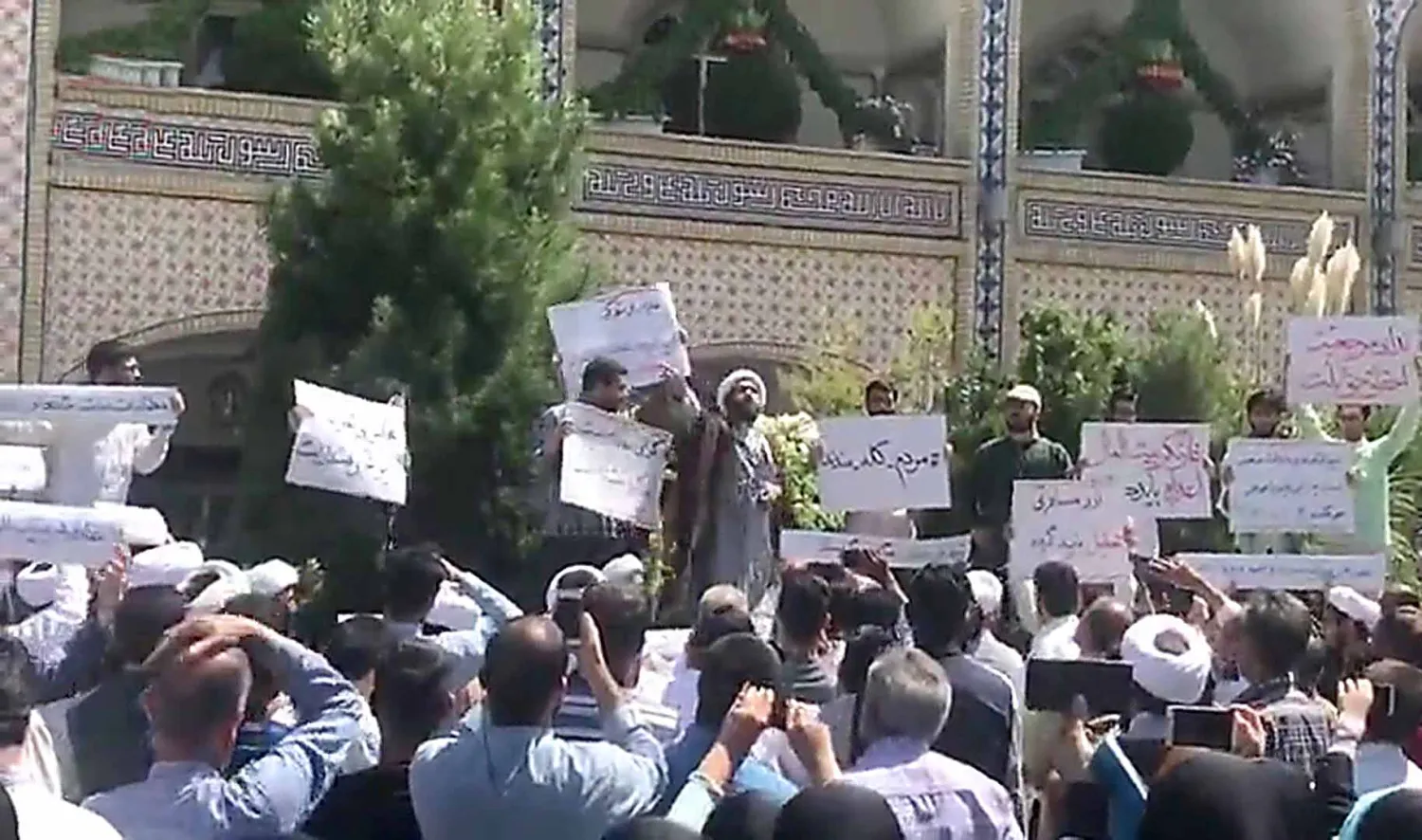
A cleric addresses a crowd of demonstrators in Iran's second city of Mashhad on August 3, 2018 as protests proliferated over the government's handling of the tough new policy from the US (AFP Photo/-)
TT

Iran: Military, Mullahs Join Protests With Hidden Agendas

A cleric addresses a crowd of demonstrators in Iran's second city of Mashhad on August 3, 2018 as protests proliferated over the government's handling of the tough new policy from the US (AFP Photo/-)

“We, too, are angry, very angry!” This was the mantra that a surprise uninvited guest brought to a protest gathering the other day in the “holy” city of Mash’had, northeast Iran. The protest, one of hundreds held throughout Iran these days, had expected the usual police crackdown when the uninvited guest arrived accompanied by a dozen armed men. The uninvited guest was General Muhammad Nazari Commander of the Imam Reza Division of the Islamic Revolutionary Guard based close to the “holy” city.

As the protesters tried to absorb their shock the general made a brief speech claiming that the military shared the grievances expressed in thousands of protest marches since last December.

“We, too, can no longer tolerate widespread corruption, crippling inflation and injustice at all levels,” he said.

Had the general acted on an impulse to buy some kudos for himself? Maybe.

However, his bizarre intervention was soon reported by at least four official news agencies run by the IRGC, including FARS. Moreover, his little number was praised as “an act of solidarity with the suffering people” by Ayatollah Alam al-Hoda, the Supreme Guide’s Special Representative in the “holy” city. A few hours later appeared Ayatollah Ibrahim Raisi, the man who had run for President against Hassan Rouhani in 2017. Today, Raisi heads the Imam Reza Foundation- Iran’s second-biggest enterprise after the National Oil Company.

A sign that the military, or at least the IRGC, are reluctant to get sucked into a nationwide protest movement on the wrong side came last December when Chief of Staff Gen. Muhammad Hussein Baqeri announced that his men would not carry weapons in public except on specific missions related to national security. It was up to the ordinary police to deal with such issues as crowd control.

Gen. Baqeri’s colleagues, notably Gen. Muhammad-Ali Aziz-Jaafari, have gone further by adopting an oppositional profile against Rouhani, especially as far as his rapprochement with the United States under President Barack Obama is concerned.

In the past few days, the incident in Mash’had has been repeated in a number of other cities where IRGC officers have turned up at protest gatherings to express their “understanding and sympathy”, at times coupled with virulent attacks on President Hassan Rouhani and his team.

This looks like the traditional Iranian children’s game known as ‘Who was it? It wasn’t me!’ in which players are blindfolded and, running around, hit each other. The trick is for the one who is hit to guess the hitter whose goal is to remain unidentified.

The “Who was it? It wasn’t me!” game has also spread to the Shiite clergy, starting with “Supreme Guide” Ali Khamenei himself. He has encouraged his entourage to spread the message that Khamenei was never hot on Rouhani and did not really support the “nuke deal” concocted by Obama.

“The Supreme Guide always told us not to trust the Americans,” the daily Kayhan keeps saying in its editorials.

Last week, it was the turn of the traditional clergy, not linked to the regime, to also put some blue water between itself and the ruling mullahs. At a ceremony inaugurating a new boulevard in the “holy” city of Qom, Grand Ayatollah Alavi Borujerdi, one of the top candidates for succeeding Grand Ayatollah Ali Muhammad Sistani as the “Supreme Marja’a” of Shiism said he prays for the voice of the suffering people to be heard so that justice could be done.

On Saturday, Ayatollah Hadi Ghaffari, the man who founded the Hezbollah in 1975, broke a long silence to implicitly urge talks with the US. He claimed that the late Ayatollah Khomeini had not been opposed to negotiations with Washington and that " the peace of Imam Hassan", the second Imam of Shiism, could serve as a model for any future dialogue with the Trump administration. He said " wise heads" should intervene to prevent Iran from sharing the fate of Libya.

More interestingly, according to well-placed sources, the top ayatollahs of Najaf and Qom have ignored a demand by Khamenei to call for an end to protests.

Yesterday, some mullahs went even further by holding their own protest gathering in Tehran. The gathering, held at the Marwi Theological School, attracted an estimated 300 mullahs and students of theology and was addressed by Ayatollah Ali-Akbar Esrahd, the theologian who heads the Shiite seminary (howzah) in the capital.

In his sermon (khotbah), Ershad claimed that theologians and students of theology were “among the poorest strata in our society”. He then called for “corrupt officials” to be executed in accordance with “revolutionary principles.”

Among theologians carried and chanted by the mullahs were “Plunderers of public treasure must be put to death!” and “clergy are on the side of the people.”

On Friday, a similar message came from Ayatollah Imami Kashani who led the mass prayer gathering in Tehran: the core of the regime is sound, what is needed is a change of administrators, which means ending Rouhani’s tenure!

Scapegoating Rouhani for the economic meltdown, diplomatic isolation and looming American sanctions is not confined to the military and the clergy.

“Rouhani is finished,” says Adullah Nasseri who was chief adviser to former President Muhammad Khatami.

Last week Khatami himself broke a long silence to also implicitly brand Rouhani as a spent force.

In its latest issue, the periodical Iranian Diplomacy, published by a close relative of Khamenei, has also published an article describing Rouhani’s presidency as a failure. The writer, Sadeq Maleki, is a former senior diplomat close to Khatami.

Completing the circle has been former President Mahmoud Ahmadinejad. In a statement posted on social media, he claims that he, too, is on the side of the protesters and calls on Rouhani as well as Ali Ardeshir Larijani, Speaker of the Islamic Majlis, and his brother Sadeq, the Chief Justice, to resign.

While the hardline military and clerical factions believe that presenting Rouhani’s head on a platter might calm down the simmering popular turmoil, the president and the diminishing number of his supporters hope to keep him in place amid a fog of speculation about a putative meeting with US President Donald Trump in New York in September on the margins of the UN General Assembly.

Rouhani has said he is ready to talk to Trump without any preconditions provided but would need some sign of goodwill.

“The Tehran leadership is divided and confused,” says Nasser Zamani, a Tehran analyst. “As always in the past four decades, what the US does could have a determining effect on what happens in the power struggle in Tehran.

“Usually successive US administrations backed factions they regarded as moderate, and each time they lost. This time it seems trump wouldn’t do so as he is looking for anyone who could deliver what he wants.”



Back From Iran, Pakistani Students Say They Heard Gunshots While Confined to Campus

 A Pakistani medical student Arslan Haider waits at the airport after arriving from Tehran on a commercial flight amid the ongoing nationwide protests in Iran, in Islamabad, Pakistan, January 15, 2026. (Reuters)
A Pakistani medical student Arslan Haider waits at the airport after arriving from Tehran on a commercial flight amid the ongoing nationwide protests in Iran, in Islamabad, Pakistan, January 15, 2026. (Reuters)
TT

Back From Iran, Pakistani Students Say They Heard Gunshots While Confined to Campus

 A Pakistani medical student Arslan Haider waits at the airport after arriving from Tehran on a commercial flight amid the ongoing nationwide protests in Iran, in Islamabad, Pakistan, January 15, 2026. (Reuters)
A Pakistani medical student Arslan Haider waits at the airport after arriving from Tehran on a commercial flight amid the ongoing nationwide protests in Iran, in Islamabad, Pakistan, January 15, 2026. (Reuters)

Pakistani students returning from Iran on Thursday said they heard gunshots and stories of rioting and violence while being confined to campus and not allowed out of their dormitories in the evening.

Iran's leadership is trying to quell the worst domestic unrest since its 1979 revolution, with a rights group putting the death toll over 2,600.

As the protests swell, Tehran is seeking to deter US President Donald Trump's repeated threats to intervene on behalf of anti-government protesters.

"During ‌nighttime, we would ‌sit inside and we would hear gunshots," Shahanshah ‌Abbas, ⁠a fourth-year ‌student at Isfahan University of Medical Sciences, said at the Islamabad airport.

"The situation down there is that riots have been happening everywhere. People are dying. Force is being used."

Abbas said students at the university were not allowed to leave campus and told to stay in their dormitories after 4 p.m.

"There was nothing happening on campus," Abbas said, but in his interactions with Iranians, he ⁠heard stories of violence and chaos.

"The surrounding areas, like banks, mosques, they were damaged, set on fire ... ‌so things were really bad."

Trump has repeatedly ‍threatened to intervene in support of protesters ‍in Iran but adopted a wait-and-see posture on Thursday after protests appeared ‍to have abated. Information flows have been hampered by an internet blackout for a week.

"We were not allowed to go out of the university," said Arslan Haider, a student in his final year. "The riots would mostly start later in the day."

Haider said he was unable to contact his family due to the blackout but "now that they opened international calls, the students are ⁠getting back because their parents were concerned".

A Pakistani diplomat in Tehran said the embassy was getting calls from many of the 3,500 students in Iran to send messages to their families back home.

"Since they don't have internet connections to make WhatsApp and other social network calls, what they do is they contact the embassy from local phone numbers and tell us to inform their families."

Rimsha Akbar, who was in the middle of her final year exams at Isfahan, said international students were kept safe.

"Iranians would tell us if we are talking on Snapchat or if we were riding in a cab ... ‌that shelling had happened, tear gas had happened, and that a lot of people were killed."


Bomb Hoax Forces Turkish Airlines to Make Emergency Landing in Barcelona

A Turkish Airlines aircraft after landing at El Prat airport, in Barcelona, northeastern Spain, 15 January 2026, after Spanish security forces where alerted due to a bomb threat on board the aircraft. (EPA)
TT

Bomb Hoax Forces Turkish Airlines to Make Emergency Landing in Barcelona

A Turkish Airlines aircraft after landing at El Prat airport, in Barcelona, northeastern Spain, 15 January 2026, after Spanish security forces where alerted due to a bomb threat on board the aircraft. (EPA)

A false bomb threat delivered via an onboard mobile connection caused a Turkish Airlines flight from Istanbul to make an emergency landing at Barcelona's El Prat Airport on Thursday, Spanish police and the airline ‌said.

A Turkish ‌Airlines spokesperson ‌said ⁠earlier that ‌the plane had landed after crew detected that a passenger had created an in-flight internet hotspot which was named to include a bomb threat as the aircraft approached ⁠Barcelona.

Spain's Guardia Civil police force said ‌in a statement ‍that following a ‍thorough inspection of the aircraft ‍after its passengers had disembarked, the alert had been deactivated and no explosives had been found. Spanish airport operator AENA said El Prat was operating normally.

Police have launched ⁠an investigation to determine who was behind the hoax, the statement added.

Türkiye's flag carrier has faced previous incidents of hoax threats, usually made via written messages, that led to emergency landings over the years.


US Sanctions Iranian Officials Over Protest Crackdown

 Treasury Secretary Scott Bessent watches as President Donald Trump speaks to reporters on the South Lawn at the White House, Tuesday, Jan. 13, 2026, in Washington. (AP)
Treasury Secretary Scott Bessent watches as President Donald Trump speaks to reporters on the South Lawn at the White House, Tuesday, Jan. 13, 2026, in Washington. (AP)
TT

US Sanctions Iranian Officials Over Protest Crackdown

 Treasury Secretary Scott Bessent watches as President Donald Trump speaks to reporters on the South Lawn at the White House, Tuesday, Jan. 13, 2026, in Washington. (AP)
Treasury Secretary Scott Bessent watches as President Donald Trump speaks to reporters on the South Lawn at the White House, Tuesday, Jan. 13, 2026, in Washington. (AP)

The United States imposed sanctions Thursday on Iranian security officials and financial networks, accusing them of orchestrating a violent crackdown on peaceful protests and laundering billions in oil revenues.

Treasury Secretary Scott Bessent announced the measures in the wake of the biggest anti-government protests in the history of the republic, although the demonstrations appear to have diminished over the last few days in the face of repression and an almost week-long internet blackout.

"The United States stands firmly behind the Iranian people in their call for freedom and justice," Bessent said in a statement, adding that the action was taken at President Donald Trump's direction.

Among those sanctioned is Ali Larijani, secretary of Iran's Supreme Council for National Security, whom Washington accused of coordinating the crackdown and calling for force against protesters.

Four regional commanders of Iran's Law Enforcement Forces and Revolutionary Guard were also sanctioned for their roles in the crackdown in Lorestan and Fars provinces.

Security forces in Fars "have killed countless peaceful demonstrators" with hospitals "so inundated with gunshot wound patients that no other types of patients can be admitted," the Treasury said.

The Treasury additionally designated 18 individuals and entities accused of operating "shadow banking" networks that launder proceeds from Iranian oil sales through front companies in the UAE, Singapore and Britain.

These networks funnel billions of dollars annually using cover companies and exchange houses, as Iranian citizens face economic hardship, according to the Treasury.

The sanctions freeze any US assets of those designated and prohibit Americans from doing business with them. Foreign financial institutions risk secondary sanctions for transactions with the designated entities.

The action builds on the Trump administration's "maximum pressure" campaign against Iran. In 2025, the Treasury sanctioned more than 875 persons, vessels and aircraft as part of this effort, it said.