
This New Museum Doesn’t Want Instagram or Crowds

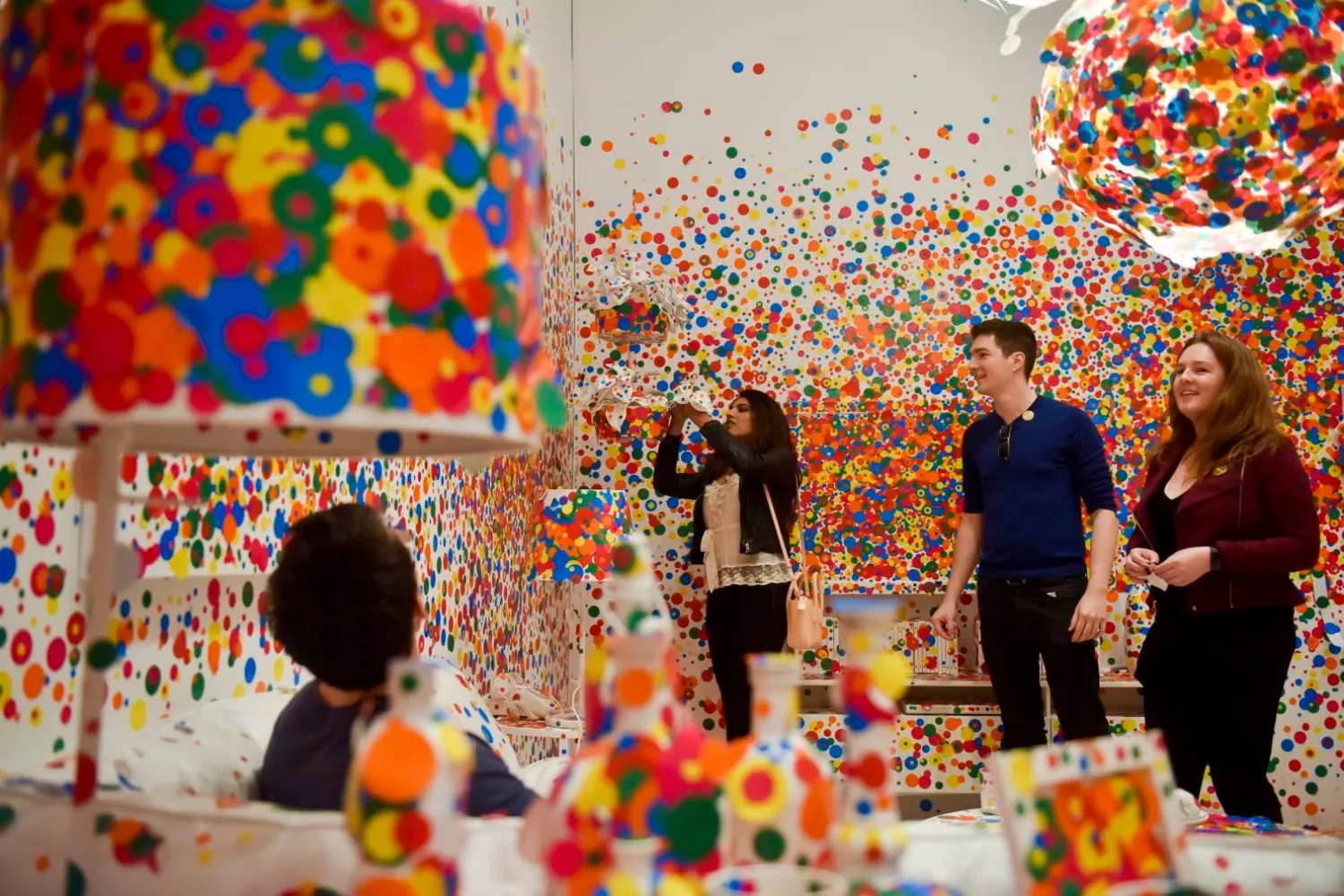
Some of the last visitors to Hirshhorn Museum’s “Obliteration Room” by Yayoi Kusama apply stickers to the wall of the installation last May. (Jahi Chikwendiu/The Washington Post)
TT

This New Museum Doesn’t Want Instagram or Crowds

Some of the last visitors to Hirshhorn Museum’s “Obliteration Room” by Yayoi Kusama apply stickers to the wall of the installation last May. (Jahi Chikwendiu/The Washington Post)

There are contemporary museums harder to get to and more isolated than Glenstone, including one on a lonely island in Japan and another in a remote town in Texas. Some museums are invitation-only and function almost like private clubs. And there are several prominent institutions that focus on integrating culture with nature, inviting visitors not just to look at art, but luxuriate in landscape. But when Glenstone opens its new facility to the public next month in Potomac, Md., the art museum will do so at a moment when something new is stirring in the art world: a powerful sense that too many museums have become a victim of their own success, and a new paradigm for experiencing art is desperately needed.

Glenstone is the creation of Mitch and Emily Rales, wealthy art collectors who opened a gallery on the grounds of their Maryland estate in 2006. On Oct. 4, the couple will inaugurate a greatly expanded arts campus, with more than five times the exhibition space in a building called the Pavilions, a gathering of interconnected galleries built around a pool, set into a gentle hill. Made from gray, cast concrete and full of natural light, the Pavilions feels minimalist, monastic and somehow ancient at the same time.

The new Glenstone will open its doors a bit wider than the old one, allowing more people to visit through its online reservation system. And those who do will see, finally, the full realization of the Raleses’ ambition to create one of the largest, richest and most ambitious new cultural organizations in the world. But the 230-acre Glenstone compound, with a cafe, an entry pavilion, rotating exhibits, and access to outdoor art installations and trails throughout the site, has been designed around visitor experience rather than maximizing the number of visitors who cross its threshold.

It is self-consciously a museum built in the spirit of the nascent “slow art” movement, which is a reaction to larger forces afoot in the art market, democratic culture and the age of Instagrammable art. Emily Rales anticipates that Glenstone will accommodate about 400 people a day without compromising the contemplative sense of escape from the world that is fundamental to the founders’ vision. By contrast, the Phillips Collection, which operates on a small, landlocked site in the center of Washington, sees a bit more than 500 visitors a day, on average, while the Hirshhorn, which is centrally located, receives about 2,500 visitors a day.

The 'Mona Lisa' moment

“We’ve all had the ‘Mona Lisa’ moment,” says Thomas Phifer, the architect who worked closely with the Raleses to design the 204,000-square-foot Pavilions. The “Mona Lisa” moment is a sense of despair at the impossibly crowded galleries of the Louvre in Paris, where the room devoted to the Mona Lisa is a scene of pure chaos as tour groups jostle and throng and sometimes shove one another in hopes of getting close enough to snap a cellphone picture of the world’s most famous painting. “You walk into that room and you’re with 400 of your closest friends and maybe you can get a glimpse of the Mona Lisa,” Phifer says of a pervasive and frustrating experience that is becoming more common at museums around the world.

The Mona Lisa moment can be had in the galleries of New York’s Museum of Modern Art, which has become so crowded that serious art lovers now avoid it, or in special exhibitions such as last year’s Kusama show at the Hirshhorn, which was so popular that visitors were monitored by stopwatch and allowed only a few seconds each in the Japanese artist’s specially built “infinity” rooms. The problem isn’t just crowds, or noise or distraction; it is the annihilation of one of the essential components for viewing art, which is extended individual contemplation.

Yet reengineering the contemporary museum to preserve a meaningful experience is complicated, forcing museum designers, and patrons such as the Raleses, to confront deeply embedded cultural assumptions about access, elitism and the public value of the art experience. In the late 19th- and throughout much of the 20th century, museums stood as temples of art, delivering lessons about the “civilizing” value of culture. In the middle of the last century, new generations of museum leadership began to stress more populist ideas of openness and equality in the gallery experience. That second age of American museums — the Age of Access — has bred the seeds of its own destruction, generating a cultural experience that attracts enormous crowds, but without giving them any substantial engagement with the materiality or cultural complexity of the art itself.

The Age of Access offered cafes, Internet connectivity, social communion and the delight of feeling part of a larger social milieu, and it measured its success in numbers of visitors. In his 2017 book, “Slow Art,” the critic Arden Reed proposed looking at an alternative history of art that ran counter to ideas of speed, commerce and consumption. Slow art, he argued, is a practice, a relationship, a historical way of looking, that emerged in opposition to many of the values that undergird the modern art museum: “As culture sped up and sacred aesthetic practices waned, slow art came to satisfy our need for downtime by producing works that require sustained attention in order to experience them.”

A contemplative experience
“Our whole premise is based on the idea that one needs to have quiet and an optimal experience of art,” Emily Rales says. So while thinking about the new Pavilions building, she and her husband visited and studied other museums, including ones that handle an enormous volume of foot traffic. At the Guggenheim in New York, she says, each visitor has an average of about 32 square feet of space to move around in, which felt too crowded. So they have designed Glenstone to offer about 300 square feet of space to the viewer. In the galleries, there will be no barriers between people and the art, but that means controlling visitor flow so that large crowds don’t inadvertently bump into and damage the works. “We strongly believe that we should not have any stanchions, or barriers, but that limits the number of people in the room,” she says.

The Washington Post



Saudi National Center for Wildlife, Soudah Development Company Release Birds of Prey

The release comes as part of reintroduction programs aimed at enhancing ecological balance and restoring biodiversity in one of the Kingdom’s most prominent mountainous environmental zones - SPA
TT

Saudi National Center for Wildlife, Soudah Development Company Release Birds of Prey

The release comes as part of reintroduction programs aimed at enhancing ecological balance and restoring biodiversity in one of the Kingdom’s most prominent mountainous environmental zones - SPA

Saudi Arabia's National Center for Wildlife (NCW), in cooperation with Soudah Development Company, has released a number of birds of prey in Al-Soudah Park, including three griffon vultures, a black kite, an Arabian scops owl, and an Eurasian sparrowhawk, after rehabilitating them at shelter centers.


The release comes as part of reintroduction programs aimed at enhancing ecological balance and restoring biodiversity in one of the Kingdom’s most prominent mountainous environmental zones, SPA reported.

This release followed the completion of rehabilitation and environmental acclimatization stages to ensure the birds’ readiness and ability to adapt to the nature of the area, contributing to the stability of local species and boosting their ecological roles within mountain ecosystems, particularly in regulating food chains and preserving the health of natural habitats.

The NCW noted that this step falls within its ongoing programs to breed and reintroduce threatened wildlife species, rehabilitate ecosystems, and enrich biodiversity across various regions of the Kingdom, in cooperation with national partners and in line with the objectives of the Saudi Green Initiative and the National Environment Strategy, which support the environmental development goals of the Saudi Vision 2030.

Specialized teams will continue to monitor the released birds and track their movements and ecological behavior using dedicated tools and technologies, supporting the evaluation of the program’s success and the improvement of its outcomes in the future in accordance with the best global environmental practices.


Ariane 6 Lifts Off with 2 European Navigation Satellites

The European Space Agency (ESA) Ariane 6 rocket carrying two Galileo satellites for the the EU's Global Navigation Satellite System (GNSS) launches at the Guiana Space Center in Kourou, on the French overseas department of Guiana, on December 17, 2025. (Photo by Ronan LIETAR / AFP)
TT

Ariane 6 Lifts Off with 2 European Navigation Satellites

The European Space Agency (ESA) Ariane 6 rocket carrying two Galileo satellites for the the EU's Global Navigation Satellite System (GNSS) launches at the Guiana Space Center in Kourou, on the French overseas department of Guiana, on December 17, 2025. (Photo by Ronan LIETAR / AFP)

A European Ariane 6 rocket blasted off from France's Kourou space base in French Guiana early Wednesday, carrying two Galileo global navigation satellites, according to an AFP correspondent.

Lift-off was at 2:01 am local time (0501 GMT) for the fourth commercial flight of the Ariane 6 launch system since the expendable rockets came into service last year.

The rocket was carrying two more satellites of the European Union's Galileo program, a global navigation satellite system that aims to make the bloc less dependent on the US's Global Positioning System (GPS).

The two satellites were set to be placed in orbit nearly four hours after lift-off.

They will bring to 34 the number of Galileo satellites in orbit and "will improve the robustness of the Galileo system by adding spares to the constellation to guarantee the system can provide 24/7 navigation to billions of users. The satellites will join the constellation in medium Earth orbit 23, 222 km (14,429 miles) above Earth’s surface," according to the European Space Agency (ESA) which oversees the program.

Previous Galileo satellites were primarily launched by Ariane 5 and Russian Soyuz rockets from Kourou.

After Russia's invasion of Ukraine, Europe halted space cooperation with Moscow.

Before the Ariane 6 rocket entered into service in July 2024, the EU contracted with Elon Musk's SpaceX to launch two Galileo satellites aboard Falcon 9 rockets in September 2024 from the Kennedy Space Center in Florida.


Delhi Restricts Vehicles, Office Attendance in Bid to Curb Pollution

Children ride a bicycle across a field on smoggy winter morning in New Delhi on December 17, 2025. (Photo by Arun SANKAR / AFP)
TT

Delhi Restricts Vehicles, Office Attendance in Bid to Curb Pollution

Children ride a bicycle across a field on smoggy winter morning in New Delhi on December 17, 2025. (Photo by Arun SANKAR / AFP)

Authorities in India's capital Delhi rolled out strict measures on Wednesday in an attempt to curb pollution, including a ban on vehicles not compliant with latest emission control norms and regulating attendance in private and government offices.

The air quality index (AQI) in the Delhi region, home to 30 million people, has been in the 'severe' category for the past few days, often crossing the 450-mark. In addition, shallow fog in parts of the city worsened visibility that impacted flights and trains.

This prompted the Commission for Air Quality Management to invoke stage four, the highest level, of the Graded Response Action Plan for Delhi and surrounding areas on Saturday.

The curbs ban the entry of older diesel trucks into the city, suspend construction, including on public projects, and impose hybrid schooling, Reuters reported.

Kapil Mishra, a minister in the local government, announced on Wednesday that all private and government offices in the city would operate with 50% attendance, with the remaining working from home.

Additionally, all registered construction workers, many of them earning daily wages, will be given compensation of 10,000 rupees ($110) because of the ban, Mishra said at a press conference in Delhi.

On Tuesday, the government enforced strict anti-pollution measures for vehicles in the city, banning vehicles that are not compliant with the latest emission control standards.

"Our government is committed to providing clean air in Delhi. We will take strict steps to ensure this in the coming days," Delhi's Environment Minister Manjinder Singh Sirsa said late on Tuesday.

Pollution is an annual winter problem in Delhi and its suburbs, when cold, dense air traps emissions from vehicles, construction sites and crop burning in neighboring states, pushing pollution levels to among the highest in the world and exposing residents to severe respiratory risks.

The area, home to 30 million people, gets covered in a thick layer of smog with AQI touching high 450-levels. Readings below 50 are considered good.