


Baghdadi Reportedly Reached Afghanistan Via Iran

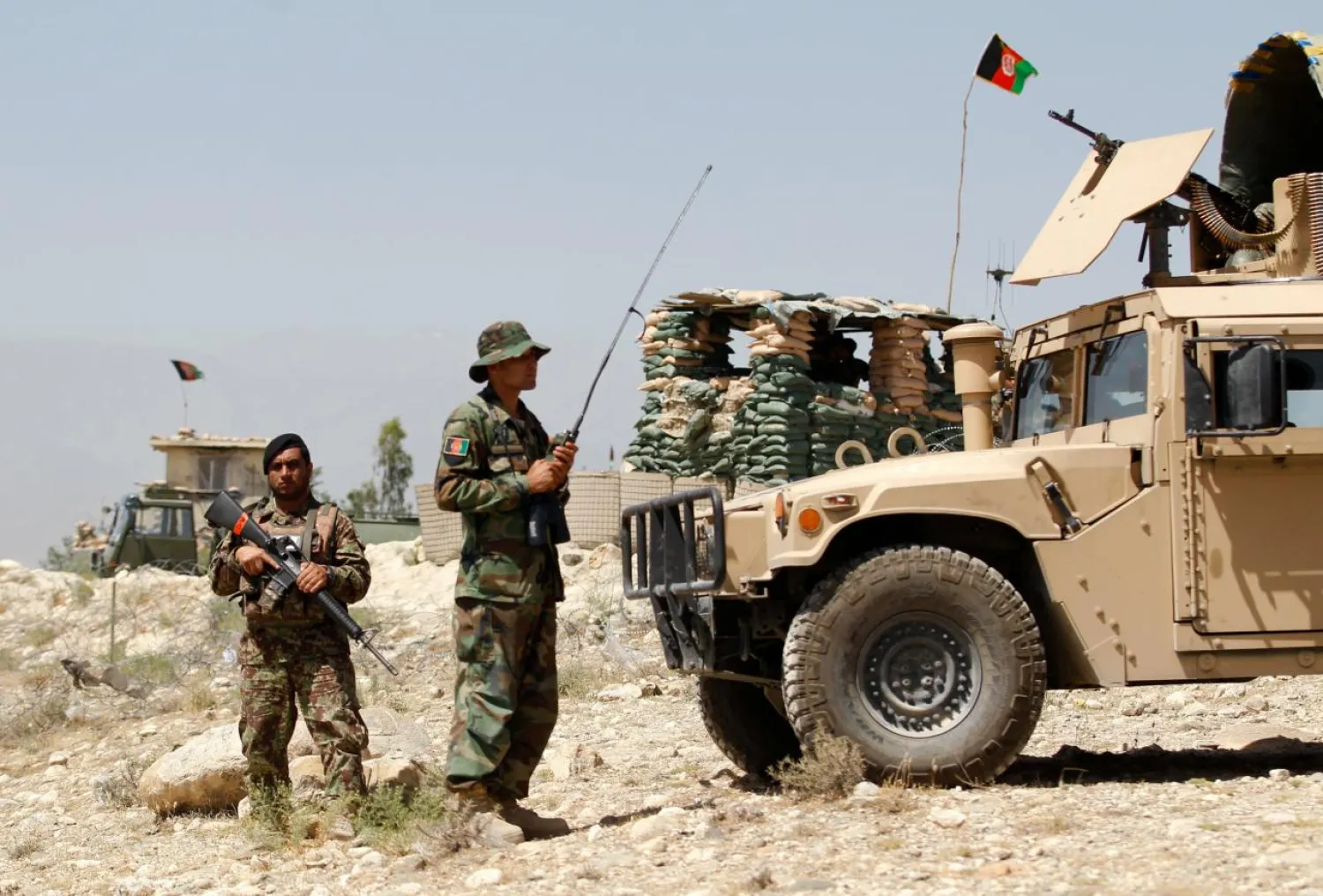
Afghan National Army (ANA) keep watch at a check post in Chaparhar district of Nangarhar province, Afghanistan May 24, 2017. REUTERS/Parwiz
TT

Baghdadi Reportedly Reached Afghanistan Via Iran

Afghan National Army (ANA) keep watch at a check post in Chaparhar district of Nangarhar province, Afghanistan May 24, 2017. REUTERS/Parwiz

The leader of ISIS terrorist group, Abu Bakr al-Baghdadi, has reached eastern Afghanistan via Iran, Pakistani security and other extremist group sources said.

Baghdadi arrived in Nangarhar Province after crossing Iranian territories in eastern Iran’s Zahedan city, said the sources, who spoke on condition of anonymity.

According to the sources, ISIS manages a location to host its fighters in Zahedan in cooperation with the Revolutionary Guard Corps (IRGC).

News of Baghdadi’s arrival in Afghanistan comes as the US-backed Kurdish-Arab alliance launched Operation Roundup last week, the third phase of a year-old operation to clear southeastern Syria of its last ISIS holdouts, in an area around the Euphrates extending around 50 kilometers into Syria.

Meanwhile, the deaths of Afghan journalist Samim Faramarz and his cameraman Ramiz Ahmadi on September 5 took the number of journalists and media workers killed in Afghanistan this year to 14, making the country the deadliest in the world for the media. 

Moments after Faramarz wrapped up his live report on a suicide attack in Kabul, a car bomb exploded just meters away, killing him and Ahmadi.

Their colleagues at Tolo News choked back tears as they reported the deaths live on air -- cracking open a divisive debate on how Afghan journalists should operate in such a dangerous environment. 

The losses have devastated the tight-knit community that faces the real prospect of tragedy every time they go to work. 

"When we leave our homes we don't know whether we will go back alive," said 1TV reporter Hamid Haidary, who keeps a photo shrine of fallen journalists on a shelf above his desk.
 
Haidary had gone to the scene of the explosion that killed Faramarz and Ahmadi, but returned to his office minutes before the second bomb detonated.

"It is already too much for us," agreed Lotfullah Najafizada, director of Tolo, which is Afghanistan's largest private broadcaster. 

As security in Afghanistan continues to deteriorate, the fear and anxiety is ever-present, he added.

"It is not just about the blast site, it is going to a province, it is coming to the office or being in the office -- they all are attached to risks and it is difficult sometimes to minimize all of them to zero."

Sixty journalists and media workers have been killed in Afghanistan since the US-led invasion in 2001 that toppled the Taliban regime and enabled independent media to blossom in its wake -- an average of around three a year, according to Reporters Without Borders (RSF).

Afghan media support group NAI gave an even higher toll of 95. 

But the departure of NATO combat troops at the end of 2014 marked a turning point, RSF figures show: 39 journalists and media workers -- over half of the total -- have been killed since then as a resurgent Taliban and the newly-emerged ISIS terrorize the country.

Media outlets have already scaled back coverage on the battlefield. But until this year, suicide attacks in urban centers remained a staple for newsrooms. 

A double bomb attack in the Afghan capital on April 30 changed that.  

Nine journalists, including Agence France-Presse chief photographer Shah Marai, were killed in the twin blasts -- the most lethal attack on the media since the fall of the Taliban.

Much of the blame for the journalist deaths has been heaped on the Afghan government and its beleaguered security forces for failing to protect them. 

But media outlets also have been criticized for repeatedly putting their staff in danger.  

"Losing journalists in similar events one after another and not learning from the mistakes is bad management both on the part of the media organizations and the government," said Sayed Ikram Afzali, executive director of Afghan advocacy group Integrity Watch.

Militants make headlines for killing civilians, security forces and first responders, including journalists.

But a total ban on covering suicide attacks "would be disrespecting the fallen", said BBC bureau chief Shoaib Sharifi.

The British broadcaster goes to great lengths to minimize the risks. "We literally evaluate and monitor every step outside the office," he said.

For now Afghan broadcaster 1TV, which has had several people killed or wounded in this year's bombings, will continue to go to the scene of suicide attacks, said head of news and current affairs Abdullah Khenjani.

"I think people deserve to know what is happening in their country," he added.

But they no longer rush to be the first at the scene, and wearing flak jackets and helmets is mandatory.



Israel Says Haifa Residential Building Suffers Direct Hit in Iran Attack

 Israeli security forces and rescue teams work amid the rubble of a residential building struck by an Iranian missile in Haifa, Israel, Sunday, April 5, 2026. (AP)
Israeli security forces and rescue teams work amid the rubble of a residential building struck by an Iranian missile in Haifa, Israel, Sunday, April 5, 2026. (AP)
TT

Israel Says Haifa Residential Building Suffers Direct Hit in Iran Attack

 Israeli security forces and rescue teams work amid the rubble of a residential building struck by an Iranian missile in Haifa, Israel, Sunday, April 5, 2026. (AP)
Israeli security forces and rescue teams work amid the rubble of a residential building struck by an Iranian missile in Haifa, Israel, Sunday, April 5, 2026. (AP)

The Israeli military and medics said on Sunday that a missile fired from Iran hit a residential building in the northern city of Haifa, injuring four people.

The building was hit by a "direct impact of a missile", the military told AFP. When asked if it was a missile fired from Iran, it said: "Yes."

The strike occurred minutes after the military warned it had detected a new round of missiles fired from Iran.

In a separate statement, Israel's emergency service, Magen David Adom, said four people were wounded when a seven-storey building sustained a direct hit.

Images and footage published by MDA show smoke rising from the remains of a flattened building in a densely populated area, and stretchers laid on the road by rescuers for casualties.

The injured included an 82-year-old man, MDA said, adding that he was in a "serious condition".

He was "wounded by a heavy object and the blast", the MDA said, adding that the other three suffered shrapnel and blast injuries.

MDA paramedic Shevach Rothenshtrych quoted residents saying that there were casualties trapped under the rubble on the lower floors, and the 82-year-old was rescued after first responders "managed to move large pieces of concrete with our hands".

His colleague Tal Shustak said that when emergency calls were received, "we were dispatched in large forces to the scene and saw extensive destruction, including glass, smoke and concrete scattered across the ground".


China Ready to Cooperate With Russia to Ease Middle East Tension, Foreign Minister Says

 Russian Foreign Minister Sergei Lavrov speaks during a joint news conference with Egyptian Foreign Minister Badr Abdelatty following their meeting in Moscow, Russia April 3, 2026. (Pavel Bednyakov/Pool via Reuters)
Russian Foreign Minister Sergei Lavrov speaks during a joint news conference with Egyptian Foreign Minister Badr Abdelatty following their meeting in Moscow, Russia April 3, 2026. (Pavel Bednyakov/Pool via Reuters)
TT

China Ready to Cooperate With Russia to Ease Middle East Tension, Foreign Minister Says

 Russian Foreign Minister Sergei Lavrov speaks during a joint news conference with Egyptian Foreign Minister Badr Abdelatty following their meeting in Moscow, Russia April 3, 2026. (Pavel Bednyakov/Pool via Reuters)
Russian Foreign Minister Sergei Lavrov speaks during a joint news conference with Egyptian Foreign Minister Badr Abdelatty following their meeting in Moscow, Russia April 3, 2026. (Pavel Bednyakov/Pool via Reuters)

China is willing to continue to cooperate with Russia at the UN Security Council and make efforts to cool down the Middle East situation, Foreign Minister Wang Yi told his Russian counterpart Sergei Lavrov in a phone call on Sunday. 

Wang said the fundamental way to resolve navigation issues in the Strait of Hormuz is to achieve a ‌ceasefire as soon ‌as possible, adding that China has ‌always ⁠advocated political settlement of ⁠hotspot issues through dialogue and negotiation. 

The foreign ministers' call came ahead of a UN Security Council vote next week on a Bahraini resolution to protect commercial shipping in and around the Strait of Hormuz. 

As permanent ⁠UNSC members, China and Russia ‌should "adopt an objective and balanced ‌approach and seek to win greater understanding and ‌support from the international community," Wang told Lavrov, ‌according to a statement from his ministry. 

A Russian Foreign Ministry statement said the ministers discussed ways to achieve a rapid ceasefire and "launch a political-diplomatic dialogue." 

"Satisfaction ‌was expressed at the coincidence in Russia's and China's approaches on most ⁠issues ⁠on the global agenda, including the situation around Iran, related to the unprovoked aggression of the US and Israel against that country," it said. 

China has repeatedly called for a ceasefire in the Gulf region and Middle East, urging an end to the fighting that has run for more than a month and largely closed the Strait of Hormuz, a critical shipping artery for oil and gas. 


Migrants Missing after Mediterranean Capsize: NGOs

Hellenic coast guard performs SAR operation, following migrant's boat collision with coast guard off the Aegean island of Chios, near Mersinidi, Greece, February 4, 2026. REUTERS
TT

Migrants Missing after Mediterranean Capsize: NGOs

Hellenic coast guard performs SAR operation, following migrant's boat collision with coast guard off the Aegean island of Chios, near Mersinidi, Greece, February 4, 2026. REUTERS

Dozens of people are missing after a migrant boat capsized in the central Mediterranean, the NGOs Mediterranea Saving Humans and Sea-Watch said Sunday on social media.

Two people died and 32 were rescued from the boat, which had left Libya on Saturday afternoon with around 105 people on board, according to Mediterranea Saving Humans, AFP reported.

"Tragic Easter shipwreck. 32 survivors, two bodies recovered and more than 70 people missing," the NGO wrote on X, adding that the boat capsized in a search-and-rescue zone handled by Libyan authorities.

Sea-Watch said two commercial ships saved the survivors and took them to the Italian island of Lampedusa.

An aerial video it posted showed two men clinging to the hull of the capsized vessel, and the approach of one of the commercial ships.

Mediterranea Saving Humans said the accident was "the consequence of policies by European governments that refuse to open safe and legal pathways" for migrants.

Lampedusa is a key entry point for migrants crossing the Mediterranean from North Africa to Europe.

Since the start of 2026, at least 683 migrants have lost their lives or gone missing on attempts to cross the sea, according to the UN's migration agency IOM.

According to the Italian government, 6,175 migrants arrived on Italian territory over the same period.