


Football League Clubs Balk at Loan Deals That Have Too Many Strings

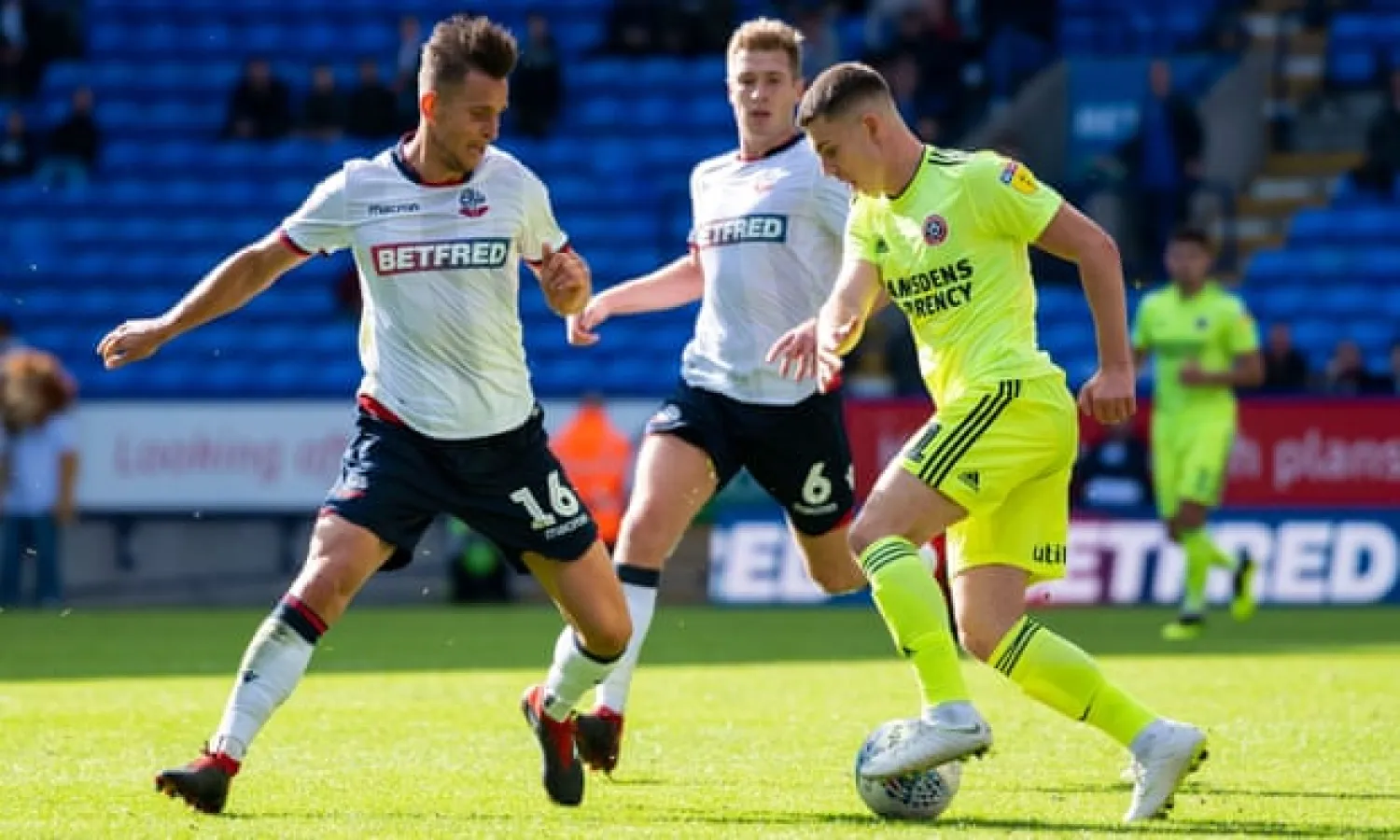
 Ben Woodburn, right, is on loan at Sheffield United from Liverpool, whose deals with a borrowing club can include sanctions if the player does not play or is not used in his favourite position. Photograph: James Fearn/Frozen in Motion/Rex/Shutterstock
Ben Woodburn, right, is on loan at Sheffield United from Liverpool, whose deals with a borrowing club can include sanctions if the player does not play or is not used in his favourite position. Photograph: James Fearn/Frozen in Motion/Rex/Shutterstock
TT

Football League Clubs Balk at Loan Deals That Have Too Many Strings

 Ben Woodburn, right, is on loan at Sheffield United from Liverpool, whose deals with a borrowing club can include sanctions if the player does not play or is not used in his favourite position. Photograph: James Fearn/Frozen in Motion/Rex/Shutterstock
Ben Woodburn, right, is on loan at Sheffield United from Liverpool, whose deals with a borrowing club can include sanctions if the player does not play or is not used in his favourite position. Photograph: James Fearn/Frozen in Motion/Rex/Shutterstock

“You can get a player, an 18-year‑old who’s on 10 grand a week, and you do a deal with the club on his wages,” says Darragh MacAnthony. “Then they not only want the wages, they want you to pay for his accommodation. They’re then on you all the time about ‘Why is he playing?’, ‘Why is he not playing?’ They’re on at you every day. If the player then has an attitude issue and we go and complain they say: ‘Get on with it, you’re not sending him back, you’ve agreed a contract, pay his wages.’”

Forthright opinions, such as the one above, are hardly unusual for MacAnthony, but the Peterborough United chairman is not alone in being disgruntled with football’s loan system. This summer, EFL clubs struck a total of 254 loan deals, making up about one in seven of all players in the Football League. Last season, over the course of the year, 458 temporary arrangements were made. It is a crucial process within the English football pyramid but after the loan window came to an end last week smaller clubs are increasingly asking whether the system is working for them.

The case for loans is straightforward and urgently made: young English players need to play competitive men’s football. There is a consensus that club academies (at least those in category one and largely affiliated to Premier League clubs) are producing players able to flourish at the highest level. They need practice, however, to achieve their potential. This is something not only the Football Association and Premier League agree on, but the EFL, too. For the loaning clubs’ part, they get access to players whose talents ought to be above a level they could acquire permanently. The debate, however, is on how best to give players experience and whether arrangements made are fair to all parties.

MacAnthony’s complaints are felt by many clubs but are only part of the problem. Increasingly, loan deals not only include an upfront fee and a share of the player’s wages being paid by the loan club but also include sanctions should the player either fail to play regularly or appear in something other than his favoured position. Liverpool is one club that pursues such measures, especially with coveted young talents such as Ben Woodburn now at Sheffield United for the season. This is necessary, parent clubs argue, as they are unable to insist contractually that their players get game time (this would be seen as undue influence over another club). They also argue that each deal is arranged on its own merits, and more punitive clauses reflect the level of demand for a player. For those clubs trying to recruit, especially lower down the pyramid however, it is sometimes difficult to see where their leverage comes in such an arrangement.

Tranmere Rovers have struck six loan deals this summer. According to the League Two club’s chairman, the former FA chief executive Mark Palios, the role lower-league clubs play in developing players remains vital. “The ability to play proper football in front of a paying crowd is missing at the top end of the game,” he says of the situation for younger players. “Proper use of experience in the football pyramid is essential and beneficial if managed properly. Not many others have a pyramid like ours and we’re fans of using it.”

While Palios sees the greater good of the loan system, the list of complications are just as clear “Loans where a club insists the player plays are wrong from every point of view,” he says. “It’s wrong for the player – they have to earn their place as part of a learning process. For the club, it damages the dynamic in dressing room. Finally, from a fan’s perspective, there’s a sense that you’re basically relinquishing your independence if loanees are going to play come what may.”

Palios says Tranmere don’t do such deals but have made arrangements whereby the loan club would pay a higher percentage of the player’s wages if he doesn’t play. He believes the game is not yet at a stage where parent clubs hold undue influence over those lower down the pyramid. “Nobody forces you to take a loan player; every club is entitled to do what it wants and what fits within its budget,” he says, but he acknowledges that the landscape is changing. “I think you can find clubs become dependent on it,” he says. “It’s hard to put a finger on it but you lose that sense of identity, that willingness to play for the club.”

If lower-league sides are integral to the development of young players, the argument that they should not be penalised for doing so is growing in volume. Whereas the chairman of Peterborough’s League One rivals Bradford City, Edin Rahic, has recently said he would be in favour of transforming lower-league teams into feeder clubs for the top flight, others such as MacAnthony argue for imposing limits on loan fees. The EFL’s chief executive, Shaun Harvey, is sympathetic to the latter idea. “I think the Championship is a different beast to League One and League Two,” he says. “Some Championship sides are taking players in order to try to reach the Premier League. In Leagues One and Two it’s much more about development. I think if I could carve out some position where players went to those leagues on terms that were generally agreed to be acceptable, I think that would be a step forward.”

Crystal Palace recently wrote to League One, Two and National League clubs offering to loan their players for free – the proviso being that the players have to play; if they are not in the team a proportion of their wages must be covered. The EFL is believed to have encouraged other clubs to follow Palace’s lead. There remains, however, the possibility that lowering the cost of loans will only further ingrain the system whereby lower-league clubs act as a finishing school for big club talent, rather than developing their own. “It’s always their way or the highway”, says MacAnthony ruefully. “I think that’s something we need to change massively.”

The Guardian Sport


Tottenham Hotspur Sack Head Coach Thomas Frank

(FILES) Tottenham Hotspur's Danish head coach Thomas Frank gestures on the touchline during the English Premier League football match between Burnley and Tottenham Hotspur at Turf Moor in Burnley, north-west England on January 24, 2026. (Photo by Oli SCARFF / AFP)/
TT

Tottenham Hotspur Sack Head Coach Thomas Frank

(FILES) Tottenham Hotspur's Danish head coach Thomas Frank gestures on the touchline during the English Premier League football match between Burnley and Tottenham Hotspur at Turf Moor in Burnley, north-west England on January 24, 2026. (Photo by Oli SCARFF / AFP)/

Thomas Frank was fired by Tottenham on Wednesday after only eight months in charge and with his team just five points above the relegation zone in the Premier League.

Despite leading Spurs to the round of 16 in the Champions League, Frank has overseen a desperate domestic campaign. A 2-1 loss to Newcastle on Tuesday means Spurs are still to win in the league in 2026.

“The Club has taken the decision to make a change in the Men’s Head Coach position and Thomas Frank will leave today,” Tottenham said in a statement. “Thomas was appointed in June 2025, and we have been determined to give him the time and support needed to build for the future together.

“However, results and performances have led the Board to conclude that a change at this point in the season is necessary.”

Frank’s exit means Spurs are on the lookout for a sixth head coach in less than seven years since Mauricio Pochettino departed in 2019.


Marseille Coach De Zerbi Leaves After Humiliating 5-0 Loss to PSG 

Marseille's Italian coach Roberto De Zerbi looks on from the technical area during the French Cup round of 32 football match between FC Bayeux and Olympique de Marseille (OM) at the Michel-d'Ornano Stadium in Caen on January 13, 2026. (AFP) 
TT

Marseille Coach De Zerbi Leaves After Humiliating 5-0 Loss to PSG 

Marseille's Italian coach Roberto De Zerbi looks on from the technical area during the French Cup round of 32 football match between FC Bayeux and Olympique de Marseille (OM) at the Michel-d'Ornano Stadium in Caen on January 13, 2026. (AFP) 

Marseille coach Roberto De Zerbi is leaving the French league club in the wake of a 5-0 thrashing at the hands of PSG in French soccer biggest game.

The nine-time French champions said on Wednesday that they have ended “their collaboration by mutual agreement.”

The heavy loss Sunday at the Parc des Princes restored defending champion PSG’s two-point lead over Lens after 21 rounds, with Marseille in fourth place after the humiliating defeat.

De Zerbi's exit followed another embarrassing 3-0 loss at Club Brugge two weeks ago that resulted in Marseille exiting the Champions League.

De Zerbi, who had apologized to Marseille fans after the loss against bitter rival PSG, joined Marseille in 2024 after two seasons in charge at Brighton. After tightening things up tactically in Marseille during his first season, his recent choices had left many observers puzzled.

“Following consultations involving all stakeholders in the club’s leadership — the owner, president, director of football and head coach — it was decided to opt for a change at the head of the first team,” Marseille said. “This was a collective and difficult decision, taken after thorough consideration, in the best interests of the club and in order to address the sporting challenges of the end of the season.”

De Zerbi led Marseille to a second-place finish last season. Marseille did not immediately announce a replacement for De Zerbi ahead of Saturday's league match against Strasbourg.

Since American owner Frank McCourt bought Marseille in 2016, the former powerhouse of French soccer has failed to find any form of stability, with a succession of coaches and crises that sometimes turned violent.

Marseille dominated domestic soccer in the late 1980s and early 1990s. It was the only French team to win the Champions League before PSG claimed the trophy last year. It hasn’t won its own league title since 2010.


Olympic Fans Hunt for Plushies of Mascots Milo and Tina as They Fly off Shelves 

Fans take selfies with the Olympic mascot Tina at the finish area of an alpine ski, slalom portion of a women's team combined race, at the 2026 Winter Olympics, in Cortina d'Ampezzo, Italy, Tuesday, Feb. 10, 2026. (AP)
TT

Olympic Fans Hunt for Plushies of Mascots Milo and Tina as They Fly off Shelves 

Fans take selfies with the Olympic mascot Tina at the finish area of an alpine ski, slalom portion of a women's team combined race, at the 2026 Winter Olympics, in Cortina d'Ampezzo, Italy, Tuesday, Feb. 10, 2026. (AP)

For fans of the Milan Cortina Olympic mascots, the eponymous Milo and Tina, it's been nearly impossible to find a plush toy of the stoat siblings in Milan and Cortina d’Ampezzo.

Many of the official Olympics stores in the host cities are already sold out, less than a week into the Winter Games.

“I think the only way to get them is to actually win a medal,” Julia Peeler joked Tuesday in central Milan, where Tina and Milo characters posed for photos with fans.

The 38-year-old from South Carolina is on the hunt for the plushies for her niece. She's already bought some mascot pins, but she won't wear them on her lanyard. Peeler wants to avoid anyone trying to swap for them in a pin trade, a popular Olympic pastime.

Tina, short for Cortina, is the lighter-colored stoat and represents the Olympic Winter Games. Her younger brother Milo, short for Milano, is the face of the Paralympic Winter Games.

Milo was born without one paw but learned to use his tail and turn his difference into a strength, according to the Olympics website. A stoat is a small mustelid, like a weasel or an otter.

The animals adorn merchandise ranging from coffee mugs to T-shirts, but the plush toys are the most popular.

They're priced from 18 to 58 euros (about $21 to $69) and many of the major official stores in Milan, including the largest one at the iconic Duomo Cathedral, and Cortina have been cleaned out. They appeared to be sold out online Tuesday night.

Winning athletes are gifted the plush toys when they receive their gold, silver and bronze medals atop the podium.

Broadcast system engineer Jennifer Suarez got lucky Tuesday at the media center in Milan. She's been collecting mascot toys since the 2010 Vancouver Games and has been asking shops when they would restock.

“We were lucky we were just in time,” she said, clutching a tiny Tina. “They are gone right now.”

Friends Michelle Chen and Brenda Zhang were among the dozens of fans Tuesday who took photos with the characters at the fan zone in central Milan.

“They’re just so lovable and they’re always super excited at the Games, they are cheering on the crowd,” Chen, 29, said after they snapped their shots. “We just are so excited to meet them.”

The San Franciscan women are in Milan for the Olympics and their friend who is “obsessed” with the stoats asked for a plush Tina as a gift.

“They’re just so cute, and stoats are such a unique animal to be the Olympic mascot,” Zhang, 28, said.

Annie-Laurie Atkins, Peeler's friend, loves that Milo is the mascot for Paralympians.

“The Paralympics are really special to me,” she said Tuesday. “I have a lot of friends that are disabled and so having a character that also represents that is just incredible.”
