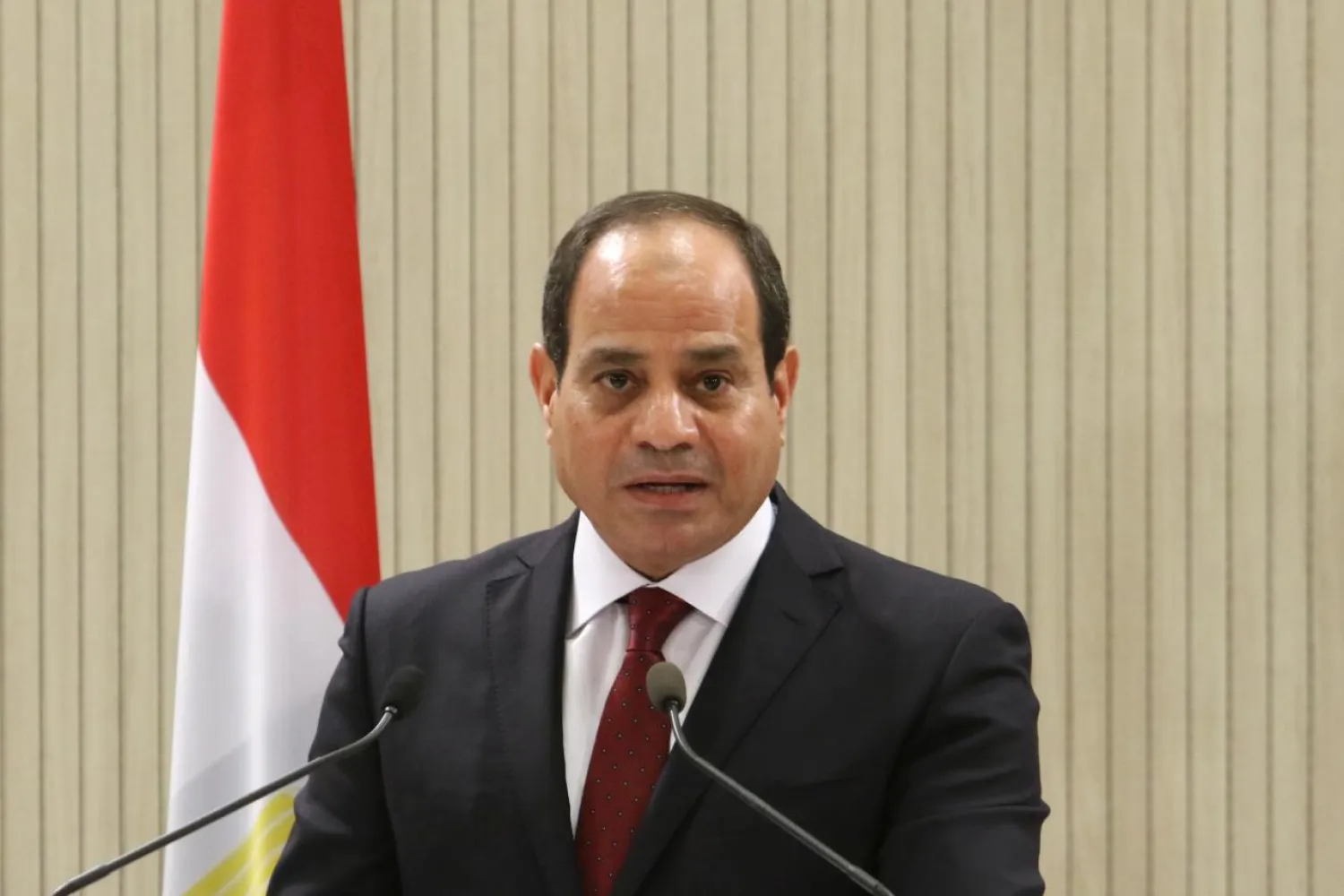
Egyptian President: We Have Overcome Turbulent Phase in Region

Egyptian President Abdul Fattah al-Sisi. (Reuters)
TT

Egyptian President: We Have Overcome Turbulent Phase in Region

Egyptian President Abdul Fattah al-Sisi. (Reuters)

Egyptian President Abdul Fattah al-Sisi stressed on Saturday that his country was able to overcome the turbulence that was witnessed in the region in recent years.

“Egypt has proven that itself at times of peace and at times of war,” he declared during a speech marking the 45th anniversary of the victory in the October 6 war.

“Maintaining peace is a task that is no less challenging than fighting,” he continued.

“The past four decades have proven that this people and this nation can withstand challenges and hardships. They managed to recapture their lands during times of peace and war.”

“They succeeded in imposing regional balances on the basis of peace, not war and destruction,” stated Sisi.

“The challenges of life are endless and great peoples are destined to confront and destroy them,” he added.

“Here in Egypt, we have confronted the hardest of challenges in recent years. This is the challenge of preserving our state and preventing its collapse,” he said.

He highlighted Egypt’s perseverance against terrorism and chaos, adding that this demonstrates that the October 6 victory was not a fluke, “but that the spirit of victory is deep-rooted in our great country.”


British Army: Guards on Cargo Ship off Yemen’s Aden Exchange Fire with Gunmen in Small Boat

27 January 2024, Yemen, Gulf of Aden: The Marlin Luanda vessel on fire in the Gulf of Aden after it was reportedly struck by an anti-ship missile fired from a Houthi controlled area of Yemen. (Indian Navy via ZUMA Wire/dpa)
TT

British Army: Guards on Cargo Ship off Yemen’s Aden Exchange Fire with Gunmen in Small Boat

27 January 2024, Yemen, Gulf of Aden: The Marlin Luanda vessel on fire in the Gulf of Aden after it was reportedly struck by an anti-ship missile fired from a Houthi controlled area of Yemen. (Indian Navy via ZUMA Wire/dpa)

Guards on board a cargo ship off the coast of Yemen in the Gulf of Aden exchanged fire Wednesday with gunmen in a small boat on Wednesday, the British military said.

The British military’s United Kingdom Maritime Trade Operations center said the guards managed to drive the gunmen off.

No group immediately claimed responsibility for the attack.

Yemen’s Iran-backed Houthi militants have said they will resume their attacks against Israel-affiliated ships moving through the Red Sea. Meanwhile, Somali pirates have also become more active in the region.


‘Storing Weapons, Not Surrendering Them’: Gaza Factions and Mediators Reach Consensus

A child searches for plastic at a garbage dump in Gaza City (AP)
TT

‘Storing Weapons, Not Surrendering Them’: Gaza Factions and Mediators Reach Consensus

A child searches for plastic at a garbage dump in Gaza City (AP)

Three Palestinian sources said Tuesday that representatives of Gaza’s factions meeting in Cairo and mediators from Egypt, Qatar, and Türkiye have agreed on what they described as “acceptable wording” to resolve key outstanding issues, particularly those related to weapons.

The sources said the understanding calls for all provisions to be implemented simultaneously as part of a comprehensive agreement rather than through a phased process.

A Hamas source and two officials from other factions told Asharq Al-Awsat that the agreed text “clearly refers to restricting and storing weapons, not handing them over.”

Under the proposal, weapons would be placed under the care of a Palestinian body to be agreed upon, rather than transferred to any external party.

The arrangement would be monitored by the mediating countries and a representative of an international stabilization force.

The sources said discussions also addressed tunnels and weapons-production sites, resulting in mechanisms intended to prevent their future use while establishing alternative verification measures.

According to the sources, implementation would proceed in stages based on a timetable tied primarily to Israel’s withdrawal and fulfillment of obligations it has yet to carry out. The agreement is also linked to the rapid deployment of a technocratic committee to administer Gaza, assume governance responsibilities, dismantle armed gangs, and implement the comprehensive humanitarian protocol associated with the first phase of the ceasefire framework.

The sources said no formal announcement would be made until consultations are completed with Israel and the US administration, a task currently being handled by the mediators, who have intensified their efforts since Saturday.

Asharq Al-Awsat has learned that US President Donald Trump's Board of Peace envoy for Gaza Nikolay Mladenov may arrive in Cairo on Wednesday amid what sources described as consensus between the mediators and Palestinian factions over the proposed roadmap.


War Fears Cloud Iraq’s Drive to Bring Arms Under State Control

Members of Asaib Ahl al-Haq take part in a Quds Day march in Baghdad on July 1, 2016. (AP)
TT

War Fears Cloud Iraq’s Drive to Bring Arms Under State Control

Members of Asaib Ahl al-Haq take part in a Quds Day march in Baghdad on July 1, 2016. (AP)

The issue of weapons outside state control has returned to the center of Iraq’s political and security scene after Akram al-Kaabi, secretary-general of Harakat Hezbollah al-Nujaba, rejected any understandings with what he called “international forces backing Israel” and reaffirmed his movement’s commitment to “force and weapons.”

His comments came as the Iraqi government presses on with efforts to confine arms to the state, despite complex political and military challenges.

Kaabi’s remarks were made in a statement issued on Tuesday after recent regional developments and the military escalation between Iran and Israel.

He praised Iran’s missile strike against Israel earlier this week, calling it “discipline for the Zionist entity,” and commended Yemen’s Houthis for also firing at Israel, saying they delivered “a surprise slap to the enemy.”

Nujaba is an Iran-aligned Iraqi armed faction and one of the main pillars of an alliance of factions calling itself the Islamic Resistance in Iraq, which became directly involved in regional escalation after Hamas’ Oct. 7, 2023, attack on Israel.

Iraqi sources had said the government contacted leaders of armed factions to prevent them from joining the latest escalation, drawing on support from several factions for its plan to confine weapons to the state.

Kaabi said his movement was warning “anyone who imagines that Iraq can reach understandings with the supporters of” Israel and the United States.

“The logic of force and weapons” was the only option in dealing with them and that the movement “will never deviate from it,” he vowed.

The remarks come as debate grows in Iraq over the future of armed factions and whether all armed formations can be brought under state authority, now one of the most main issues tackled by Prime Minister Ali al-Zaidi's government.

The government has repeatedly said it is committed to the rule of law and to confining weapons to official institutions.

Influential cleric Moqtada al-Sadr announced on May 27 the integration of his military wing, Saraya al-Salam, into the state and called on the Popular Mobilization Forces factions to hand over their weapons. Asaib Ahl al-Haq and Kataib al-Imam Ali later also announced their separation from the PMF.

Split over mechanism

Figures close to armed factions rejected proposals to hand over weapons, saying they were driven by external pressure.

Abdul al-Rahman al-Jazairi, a leader in the PMF, said in remarks carried by local media that “the decision to confine weapons is not an individual decision,” calling for legislative authority to have a say over the “fateful” matter.

The remarks reflect the split over how to handle the armed factions file, which has grown more complicated after years in which armed groups expanded their influence, built military arsenals and secured independent funding sources.

Shakhawan Abdullah, head of the Kurdistan Democratic Party bloc, cited further obstacles to any disarmament plan, saying some weapons held by factions are not directly under their control.

He said one problem was that some factions “may decide to hand over their weapons, but the weapons originally belong to a regional state that considers them its property.” He added that those states may refuse to surrender such weapons, including drones.

Abdullah said some groups could transfer weapons to other formations rather than hand them over to the state. He said about 30% of armed groups fall under the PMF, while the rest are outside its framework.

Observers say the weapons file is not only a security issue. It also intersects with the economic and political interests of armed factions that have built networks of influence and their own financial institutions in recent years, making disarmament more complicated than legislation or government decisions.

Analysts say weapons for many factions are not only a military tool, but also a guarantee of political influence and a source of economic protection. That makes any response to calls for surrendering them limited unless they are paired with broader political and security arrangements.