How Does Athletic Bilbao's Academy Manage to Produce 85% of Their Team?

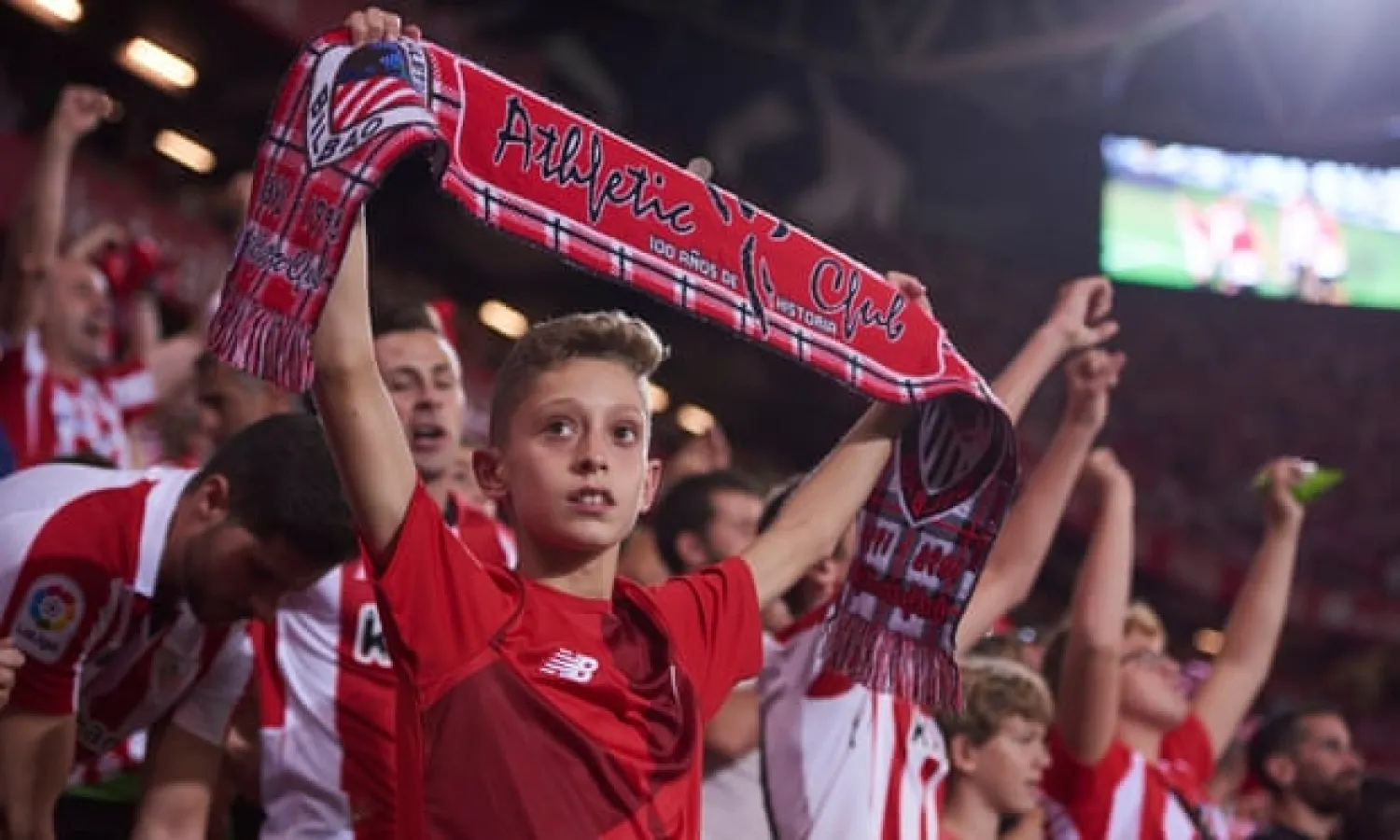
 A young Athletic fan watches his side host Real Madrid at the San Mamés stadium in Bilbao. Photograph: Icon Sportswire/Icon Sportswire via Getty Images
A young Athletic fan watches his side host Real Madrid at the San Mamés stadium in Bilbao. Photograph: Icon Sportswire/Icon Sportswire via Getty Images
TT

How Does Athletic Bilbao's Academy Manage to Produce 85% of Their Team?

 A young Athletic fan watches his side host Real Madrid at the San Mamés stadium in Bilbao. Photograph: Icon Sportswire/Icon Sportswire via Getty Images
A young Athletic fan watches his side host Real Madrid at the San Mamés stadium in Bilbao. Photograph: Icon Sportswire/Icon Sportswire via Getty Images

The sleepy town of Lezama sits 10km outside of Bilbao and is home to just 2,400 people, but it also accommodates one of the most unusual football clubs in the world: Athletic Bilbao. Just 14 years after being founded, Athletic were accused of fielding ineligible foreign players in the 1911 Copa del Rey, so decided they would only ever pick players who were born in the Basque Country or “formed locally”. More than a century later, that policy remains in place and they are still one of three clubs who have never been relegated from the top tier of Spanish football, alongside Barcelona and Real Madrid.

The club’s reliance on local talent starts at their training ground in Lezama, which was opened in 1971 and now hosts the first team, the women’s teams and their various academy sides. There are eight pitches, a gymnasium, a press room and medical room in Lezama, but it is the iconic arch – which was relocated here from the old San Mamés stadium – that gives the place the feeling of a great institution.

“This football club becomes part of our identity from the second we’re born,” says Jon Solaun, who played for the club and now coaches their Under-16 team. “Any boy born within a 60km radius of here is showered with Athletic balloons and gifts; maternity wards are plastered in red and white. I was born in Bilbao and to put on this tracksuit and represent this club is everything to me. I know the boys feel the same pride. We all feel like a piece of history here as a family.

“It’s incredible for the kids to be around one another and watch each other grow through the categories as both people and players. When a Lezama kid pulls on the red and white in San Mamés, we all feel a great sense of triumph.”

For the past five years running at least two academy players have graduated to the first team, which is a source of great pride for sporting director José Amorrortu. “Eighty-five percent of first-team players came through this academy and the average stay here before reaching the first team is seven years,” he says. “We take them as young boys and mould them. These figures are just a consequence of our work.”

Amorrortu played for Athletic – even representing them against Juventus in the 1977 Uefa Cup final – before managing both the youth team and the first team, so he understands the culture as well as anyone. “We have 20 scouts around the Biscay area and we also have 150 brother clubs in the region that monitor the progress of youngsters and send them to Lezama if they feel they possess the qualities to play here. We trust our coaches and local clubs to develop the kids so much that we don’t even start our academy programme until they are under-10s. Just last year we had 1,500 nine-year-olds train here. It’s not difficult to find players.”

Amorrortu says his coaches want to see players with “cognitive skills”. “We want to know how they think and make decisions on the pitch, and then see how they act off it.” The 65-year-old uses the word “values” a lot. “Kids will have roles and responsibilities as soon as they enter the building; whether it’s sorting the kit, cleaning the dressing room or carrying equipment. There’s a rota.

“I’ve worked at Atlético Madrid and other elite clubs, but nobody has what we have. We have a culture here, an identity. It’s our job to create good people as well as good players, and nobody does that like we do. Family is everything for Basque people and we want to do right by our own people. There’s no greater sense of pride for a boy than playing football for this club.”

The former Spain international scurries to his office and returns with a sheet of paper. “It’s important they have more means to life than football. Careers are short and they’re one bad tackle away from it all being over,” he says as he hands me a team-sheet. “Our third team is made up of 21 kids between the ages of 18 and 19; 13 of the 21 are currently doing degrees at university. Yet, we don’t force anything on them, we just encourage good values. Especially in today’s game and society, our boys are an example.”

The first team have completed their work and gone home, so now the youngsters have their chance to train below the picturesque Basque hills. The standard is exceptional. “Very technical,” says Amorrortu. “We drive technique, technique, technique.”

The youngsters move the ball back and forth with various touches and turns, as the coach constantly reminds them of “Three key points: 1. Posture: keep your back upright while bending your knees. 2. Vision: check your surroundings for space and people. 3. Change of rhythm and direction.”

Following 30 minutes of technical work, the importance of strategy and shape is drilled home to each individual. There’s an earnestness around the place and standards are extremely high, so much so that two lackadaisical under-14s are sent out of the session, ordered to stand at the side and watch with their hands behind their backs.

“Every single individual here has to be a representation of the club and the people,” says under-18s head coach Iban Fuentes. “As soon as a kid takes it easy, he needs to be reminded that there are others desperate to be in his place. This is the nature of the game and we must provide them with a sporting education as well.

“Society is changing and the model professional isn’t what it was 20 years ago. We work hard to keep the boys focused, but there are difficult moments. However, they tend to reach an age where they understand that money can’t buy what we have here at Athletic. That’s where the hard work from everyone pays off. This club is like no other. We train alongside the first team and the boss ensures there are no barriers between us and them. They will stop and chat to the kids when passing by and they always follow the development and growth of their own.

“We’re all living the dream. Every person in this complex has a season ticket. If the first-team play away, the kids will train then go home and put on their Athletic pyjamas to watch the game with their family. The coaches have a meeting point in town where we watch the games together. We’re all members of the Athletic family and have our own culture and identity.”

The Guardian Sport


Irish Boxer Lee Reeves Dies at Age 31, Three Months after Dublin Title Fight Injury

Irish boxer Lee Reeves. Reuters
TT

Irish Boxer Lee Reeves Dies at Age 31, Three Months after Dublin Title Fight Injury

Irish boxer Lee Reeves. Reuters

Irish boxer Lee Reeves has died more than three months after being injured during a fight in Dublin, promoter Queensberry said Tuesday. He was 31.

"Everyone at Queensberry is devastated to learn of the passing of Lee Reeves," Queensberry Promotions said in a statement.

Reeves was hospitalized after being knocked out by compatriot Gary Cully in the 10th and final round of their Boxing Union of Ireland Celtic super-lightweight title fight on Aug. 1.

Reeves was carried from the ring on a stretcher after receiving initial treatment.

Queensberry had said after the fight that his condition was critical but stable.

“Lee was an immensely talented boxer, as well as a true role model and inspiration to his community,” the statement added Tuesday, according to The Associated Press. “Our deepest condolences go to Lee’s family, friends and all those who loved him. We ask that their privacy be respected at this incredibly difficult time. Rest in peace, Lee.”


Alonso to Enter Dakar Rally with Loeb and Aston Martin Team

November 5, 2026 Aston Martin's Fernando Alonso during a press conference ahead of the F1 Sao Paulo Grand Prix. (Reuters)
TT

Alonso to Enter Dakar Rally with Loeb and Aston Martin Team

November 5, 2026 Aston Martin's Fernando Alonso during a press conference ahead of the F1 Sao Paulo Grand Prix. (Reuters)

Double Formula One champion Fernando Alonso will compete in next January's Dakar Rally in an Aston Martin Dreadnought entry run by engineering partner Prodrive.

The 45-year-old Spaniard, a 32-time Grand Prix winner and two-time Le Mans 24 Hours winner, will be racing in the annual event for the second time after competing with Toyota in 2020, finishing 13th.

France's nine-time world rally champion Sebastien Loeb and Brazil's reigning world rally-raid champion Lucas Moraes will be his teammates in a three-car entry.

The 49th edition of the Dakar Rally will ‌be held in ‌Morocco from January 9 to 23, with a prologue and first ‌stage ⁠in Portugal, after ⁠being moved from Saudi Arabia due to security concerns.

The 24-round Formula One season is due to start in Bahrain in March after testing in late February.

Alonso, who will again have compatriot and five-time motorcycle Dakar winner Marc Coma as co-driver, is racing in the Las Vegas Grand Prix this weekend. He said he had turned his thoughts to Dakar after deciding to continue in Formula One with Aston Martin.

“In the end, the decision became simple. I wanted to embrace ⁠the challenge completely and take on both Formula One and the ‌Dakar Rally in the same year," he explained in ‌a statement.

"In 2020, Dakar was one of the most challenging and enjoyable experiences of my career. ‌I have enormous respect for this race and the specialists who have mastered it.

"Formula One ‌remains my priority. But I am a racing driver, and challenges like this are why I love competing. I’m looking forward to seeing what we can achieve."

LOEB CHASES FIRST DAKAR WIN

In October, Alonso told reporters at the Singapore Grand Prix that he felt the desert endurance race would be physically ‌incompatible with his Formula One commitments.

Loeb, 52, will also be chasing a first Dakar win after 10 previous attempts that have brought ⁠him 28 stage ⁠wins to date.

“Winning the Dakar is very important to me,” said the Frenchman, who will be partnered by Belgian Fabian Lurquin. “We have come close several times, and the motivation is there to keep working until we achieve it."

The Dreadnought is a digital-only tactical SUV created exclusively for gamers playing "Call of Duty: Modern Warfare 4" that will now be brought into the real world by Prodrive, Aston Martin's partners in endurance GT racing.

The Dakar will be Aston Martin Racing’s debut in the world rally-raid championship.

"Aston Martin's ambition for this program has been clear from the outset: to create a car capable of competing at the front of the world's toughest motorsport event," said Prodrive Chairman David Richards.

"By combining Aston Martin's vision with Prodrive's experience in rallying, endurance racing and Dakar competition, we have built a strong foundation. With an exceptional driver line-up and a highly capable engineering team, we look forward to seeing Dreadnought take on this remarkable challenge."


Owono Does Not Deserve 12-Match Ban Over De Miguel Death, Says Andorra Owner Pique

Equatorial Guinea's goalkeeper #01 Jesus Owono leaves the pitch at half time during the Africa Cup of Nations (CAN) Group E football match between Equatorial Guinea and Algeria at Moulay Hassan Stadium in Rabat on December 31, 2025. (AFP)
TT

Owono Does Not Deserve 12-Match Ban Over De Miguel Death, Says Andorra Owner Pique

Equatorial Guinea's goalkeeper #01 Jesus Owono leaves the pitch at half time during the Africa Cup of Nations (CAN) Group E football match between Equatorial Guinea and Algeria at Moulay Hassan Stadium in Rabat on December 31, 2025. (AFP)

FC Andorra owner Gerard ‌Pique said goalkeeper Jesus Owono did not deserve the 12-match suspension he received following the challenge that led to the death of Tenerife forward Jesus de Miguel.

Owono and De Miguel collided during a Spanish second-tier match on November 2. De Miguel was taken to intensive care and died the following day.

The disciplinary committee of the Spanish football federation (RFEF) banned Owono for violent conduct which resulted in serious ‌injury last week.

"Players, ‌former players, coaches, goalkeepers, everyone has ‌called ⁠it an accident," ⁠Pique said in a video posted on social media late on Monday.

"I truly believe that imposing the maximum sanction on Jesus for this action puts him in a situation he does not deserve, because he is not to blame for all of ⁠this having happened."

Former Barcelona player Pique ‌pointed to the three-match ‌ban handed to Albacete's Jose Corpas for accidentally kicking Sabadell ‌player Quadri Liameed in the head during a ‌recent match in Spain.

"Fortunately Quadri is fine, the consequences in this case were not fatal, and the committee decided to sanction Corpas with three matches," Pique added.

"With ‌all this, my reflection is: what is being sanctioned, the action or the ⁠consequences?"

The RFEF ⁠did not immediately respond to a request for comment outside regular business hours in Spain.

Owono, 25, has withdrawn from Equatorial Guinea's squad for Africa Cup of Nations qualifiers against Zimbabwe this month and Pique said it was unlikely the goalkeeper would return to action as soon as his suspension is up.

"Jesus is going to need far more than 12 matches before he is available and able to compete," he added. "No sanction is going to bring Demi (De Miguel) back to us."