


On Anniversary of its Founding, Iraqis Divided on Role of Army

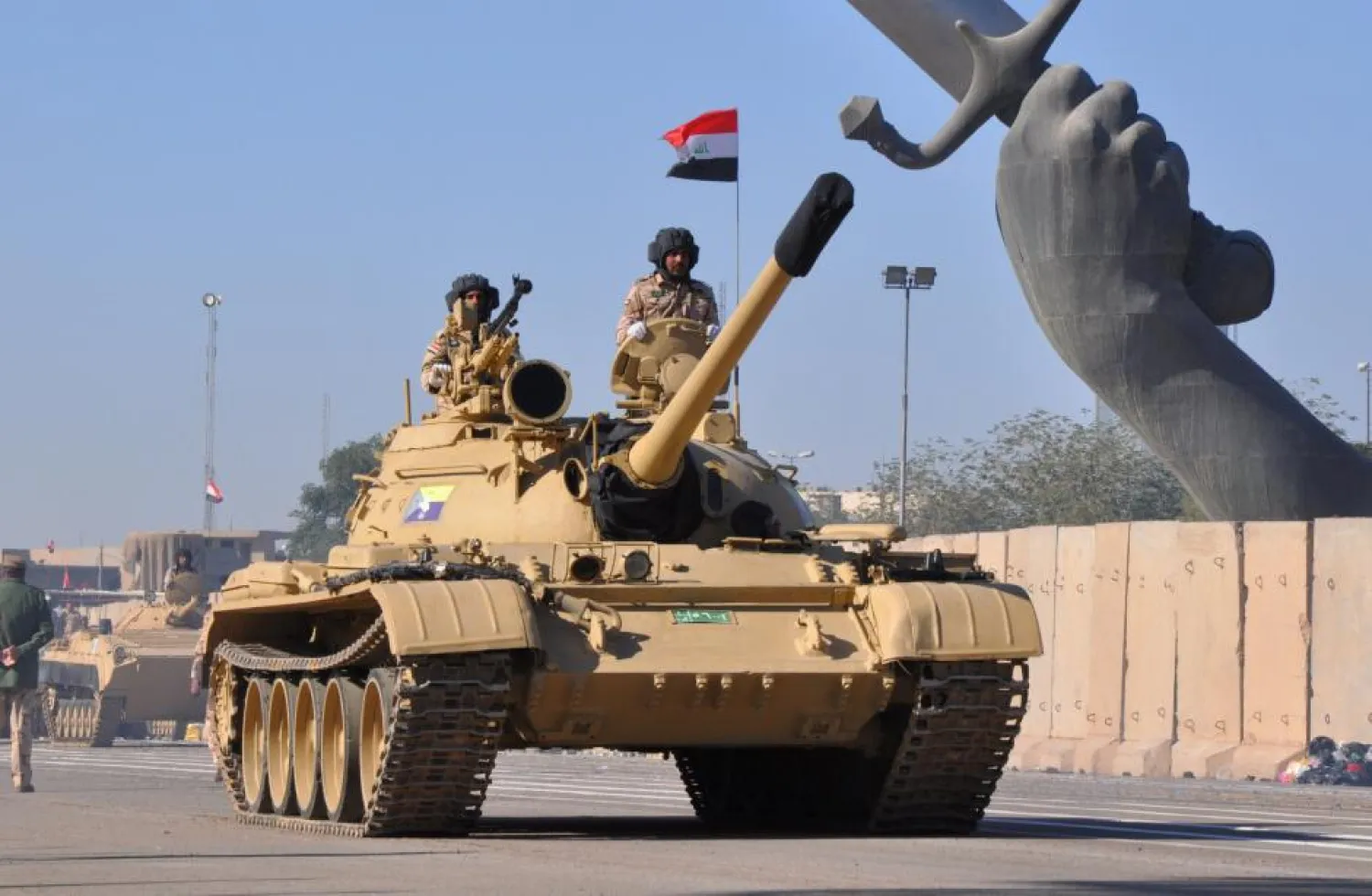
Tanks of Iraqi army are seen during an Iraqi military parade in Baghdad's fortified Green Zone, Iraq December 10, 2017. (Reuters)
TT

On Anniversary of its Founding, Iraqis Divided on Role of Army

Tanks of Iraqi army are seen during an Iraqi military parade in Baghdad's fortified Green Zone, Iraq December 10, 2017. (Reuters)

Iraq celebrated on Sunday the 98th anniversary of the founding of its army amid divisions among the people despite the heroics the military has waged in recent years against armed and terrorist groups.

Sunday’s anniversary was celebrated in the absence of a defense minister as Prime Minister Adil Abdul Mahdi grapples with ongoing bickering between political blocs on the distribution of portfolios in his still-incomplete cabinet.

It is the norm for the position of defense minister to go to a Sunni figure, however, an agreement over a candidate often stumbles at Shiite and Kurdish objections.

During a ceremony at the military academy in Baghdad, Abdul Mahdi, who also serves as armed forces commander, congratulated the army on its anniversary.

“The Iraqi military has produced generations of officers and commanders,” he said during a speech.

“The brave army will continue to belong to all Iraqis and it is the protector of coexistence and diversity,” he stressed.

“It has succeeded in its mission to defend and liberate Iraq” and has achieved great feats in its battle against terrorism, he continued.

The ceremony was was attended by a number of officials, military commanders, lawmakers and representatives of civil society groups.

Iraq had in December 2017 declared victory against the ISIS terrorist group that had in 2014 swept across swathes of the country.

President Barham Salih meanwhile laid a wreath at the monument of the unknown soldier in central Baghdad.

Parliament Speaker Moahmmed al-Halbousi also addressed a message to the military, hailing it for defeating ISIS and “presenting a unique example of sacrifice and courage in performing its duties.”

Despite the celebrations and congratulatory statements, divisions still remain over the role the military has played throughout its long history.

This was reflected in the Iraqi Kurdistan Region government decision to sit out from Sunday’s commemorations. This marked the first time that it does not take part in the celebrations.

The Kurds view the Iraqi army as the side that had inflicted the most damage against its forces during their struggle for independence over the decades. They also hold it responsible for the military offensives that late ruler Saddam Hussein had waged against their villages, as well as the chemical attack against them in 1988.

Besides the Kurds, many Iraqis launched scathing criticism against the military, accusing it of serving ruling governments, especially under the Baath rule. It is also accused of leading a coup against the monarchy in 1958 and involving Iraq in dozens of costly internal and foreign battles.

Other Iraqis, however, view the military in a different light and consider it a victim of political disputes.

Throughout the recent decades, the army waged dozens of internal and foreign battles, notably nearly 50 years of conflict with Kurds. It was also embroiled in the Iraqi-Iranian war of 1980-88, the invasion of Kuwait in 1990 and the third Gulf war that led to the toppling of Saddam’s regime in 2003. Moreover, it was involved in the majority of Arab wars against Israel and waged its fiercest and most complex battle – the war on terrorism – in the post-2003 period.

Head of the parliamentary security and defense committee Adnan al-Assadi said that the discrepancy in support and criticism of the military was “understandable.”

“People must realize that the current political system determines the nature and duties of the army,” he told Asharq Al-Awsat.

He explained that the “dictatorial nature of the previous regime forced the army to become involved in battles against its own people.”

“I believe it had no choice but to abide by the strict military orders that were imposed at the time. It would have faced execution had it not complied,” he added.

“The situation is different now. We have seen how the officers defended the people and the military suffered grave losses in its war on terrorism, such as al-Qaeda and ISIS,” said Assadi.

The military boasts some 250,000 members, he continued, and they are better equipped now than they have ever been.

“It is, however, still being sidetracked from its main mission of defending the country because it it still embroiled in restoring security in cities. The army should be withdrawn from cities, rehabilitated and retrained,” he suggested.
Egyptian Official to Asharq Al-Awsat: Syria Nominates New Ambassador Instead of Al-Ahmad, Approval Under Way

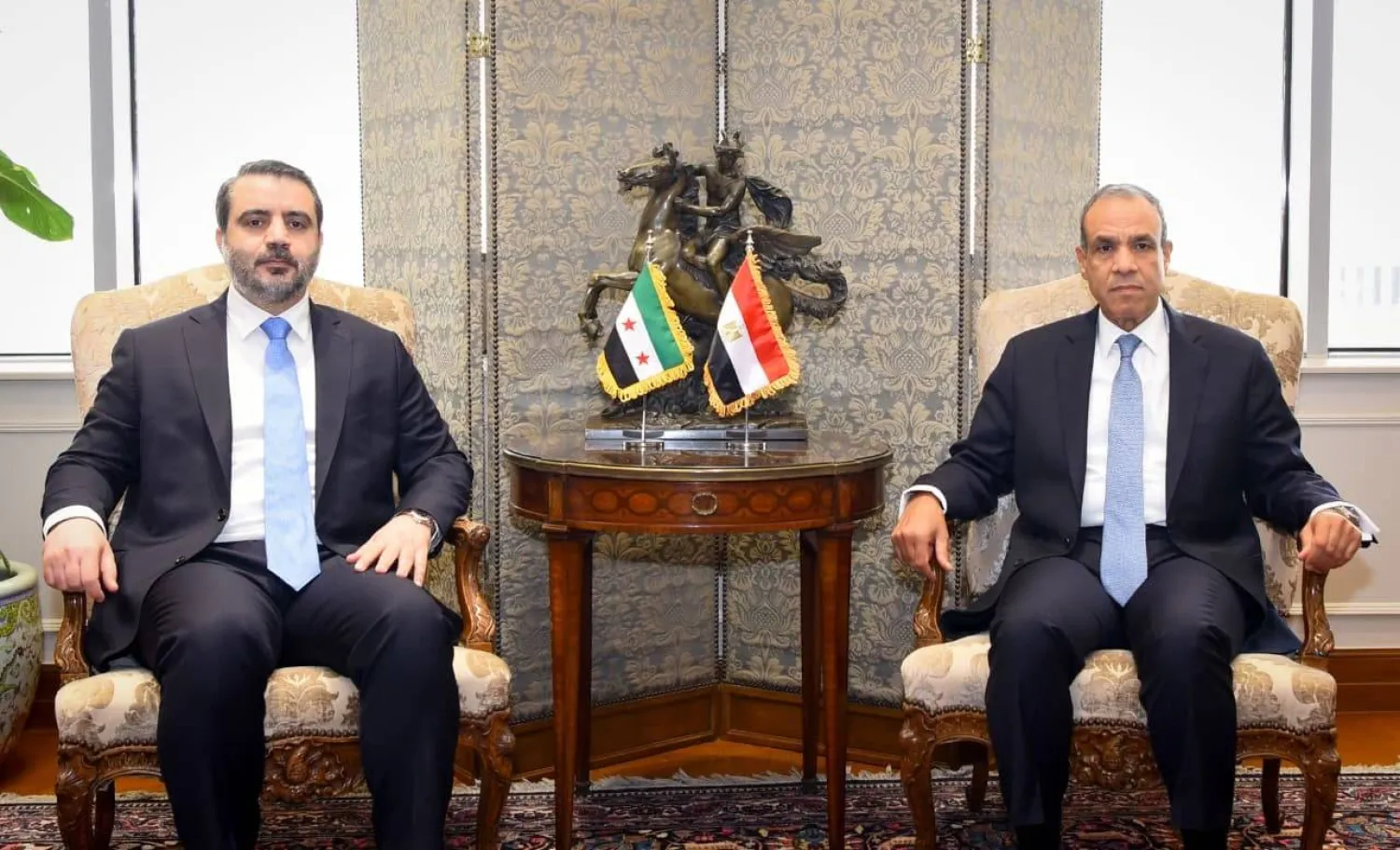
Egyptian Foreign Minister and his Syrian counterpart during a previous meeting in Cairo. (Egyptian Foreign Ministry)
TT

Egyptian Official to Asharq Al-Awsat: Syria Nominates New Ambassador Instead of Al-Ahmad, Approval Under Way

Egyptian Foreign Minister and his Syrian counterpart during a previous meeting in Cairo. (Egyptian Foreign Ministry)

The crisis surrounding Syria's nomination of Mohammad Taha Al-Ahmad as its ambassador to Egypt, first revealed in an Asharq Al-Awsat report published on June 1, appears to be heading toward a resolution. An Egyptian official source told Asharq Al-Awsat that Cairo has received the name of a new nominee from the Syrian side and is in the process of approving him.

Asharq Al-Awsat previously published a widely discussed report on what it described as "Egyptian reservations" that had delayed Cairo's acceptance of several members of the Syrian diplomatic mission. At the time, an informed source told Asharq Al-Awsat that there were objections to some members of the delegation, including Egypt's refusal to approve Syria's nominee for ambassador to Cairo.

The source explained in the June 1 report that the Syrian government had formally nominated Mohammad Taha Al-Ahmad as ambassador to Egypt. While the Egyptian government did not explicitly reject the nomination, it conveyed unofficial messages indicating that it did not consider him an acceptable candidate because of his political background.

Mohammad Taha Al-Ahmad currently serves as director of the Arab Affairs Department at Syria's Ministry of Foreign Affairs and Expatriates. He earned a bachelor's degree in agricultural engineering from the University of Aleppo in 2007, a master's degree in the financial and economic evaluation of agricultural projects from Cairo University in 2012, and a doctorate in agricultural development from the University of Idlib in 2020.

He held several ministerial positions in the Syrian Salvation Government before being appointed to his current position at the Foreign Ministry in May 2025. The following month, he was appointed head of the People's Assembly election committee.

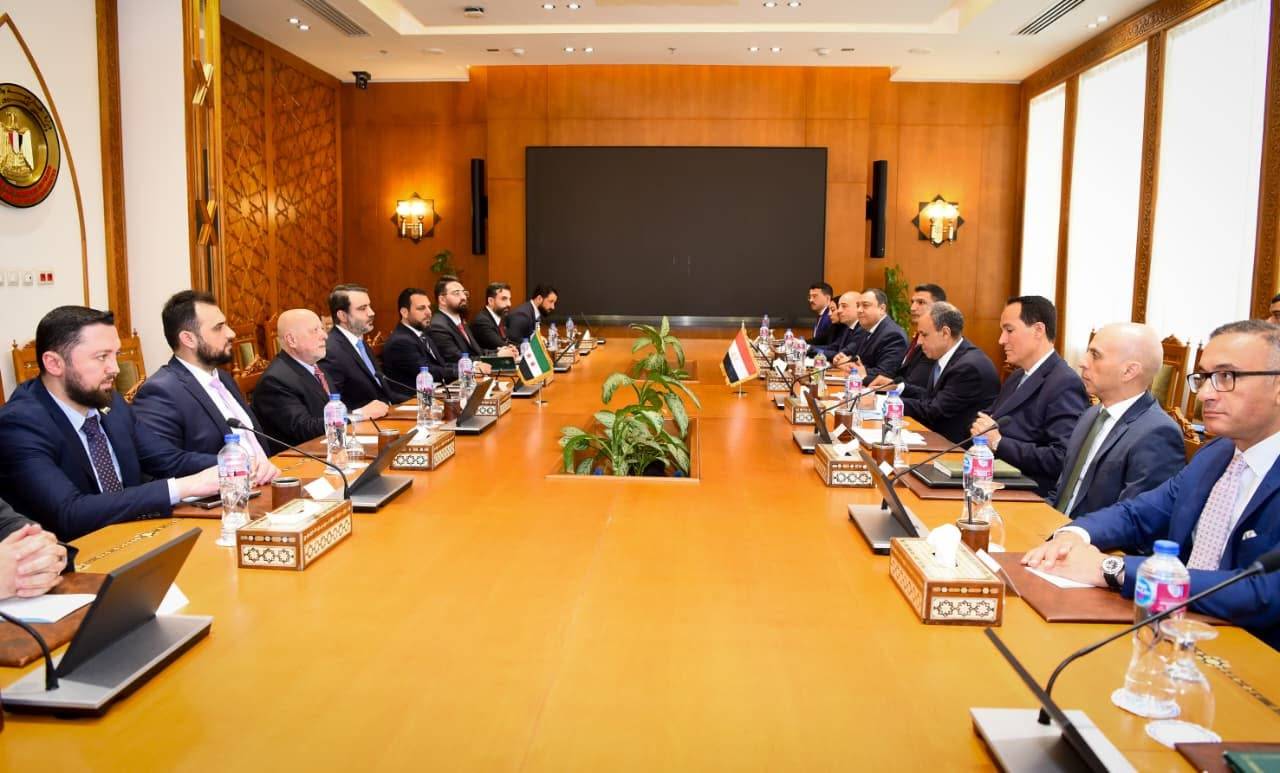
The Syrian foreign minister during talks in Cairo last month. (Egyptian Foreign Ministry)

Another Nominee

An Egyptian official source told Asharq Al-Awsat that "the Syrian government has submitted another nominee to head the Syrian diplomatic mission in Cairo," noting that "the process is moving toward approval of the new nominee by the Egyptian authorities."

The source said that "matters are proceeding normally and positively with the Syrian side," without disclosing the nominee's identity.

Since the fall of Bashar Al-Assad, Egyptian-Syrian relations have been marked by cautious bilateral engagement, driven by Cairo's concerns over the issue of armed groups, before gradually shifting toward economic cooperation.

In late April, Egyptian President Abdel Fattah El-Sisi met Syrian President Ahmed Al-Sharaa on the sidelines of the Arab-European Consultative Summit in Cyprus. Media outlets in both Cairo and Damascus reported at the time that the two presidents held a "cordial discussion" on regional developments and ways to strengthen cooperation.

While the Egyptian source declined to reveal the name of the new nominee to head Syria's diplomatic mission in Cairo, Firas Al-Khalidi, coordinator of the Cairo Platform, a member of Syria's Constitutional Committee and a member of the Syrian Negotiations Commission, said that "the Syrian side has nominated Yahya Diab, a former diplomat who defected from Bashar Al-Assad's regime, as ambassador to Cairo."

Al-Khalidi told Asharq Al-Awsat that "the Egyptian side has accepted Diab's nomination to head the Syrian mission in Cairo."

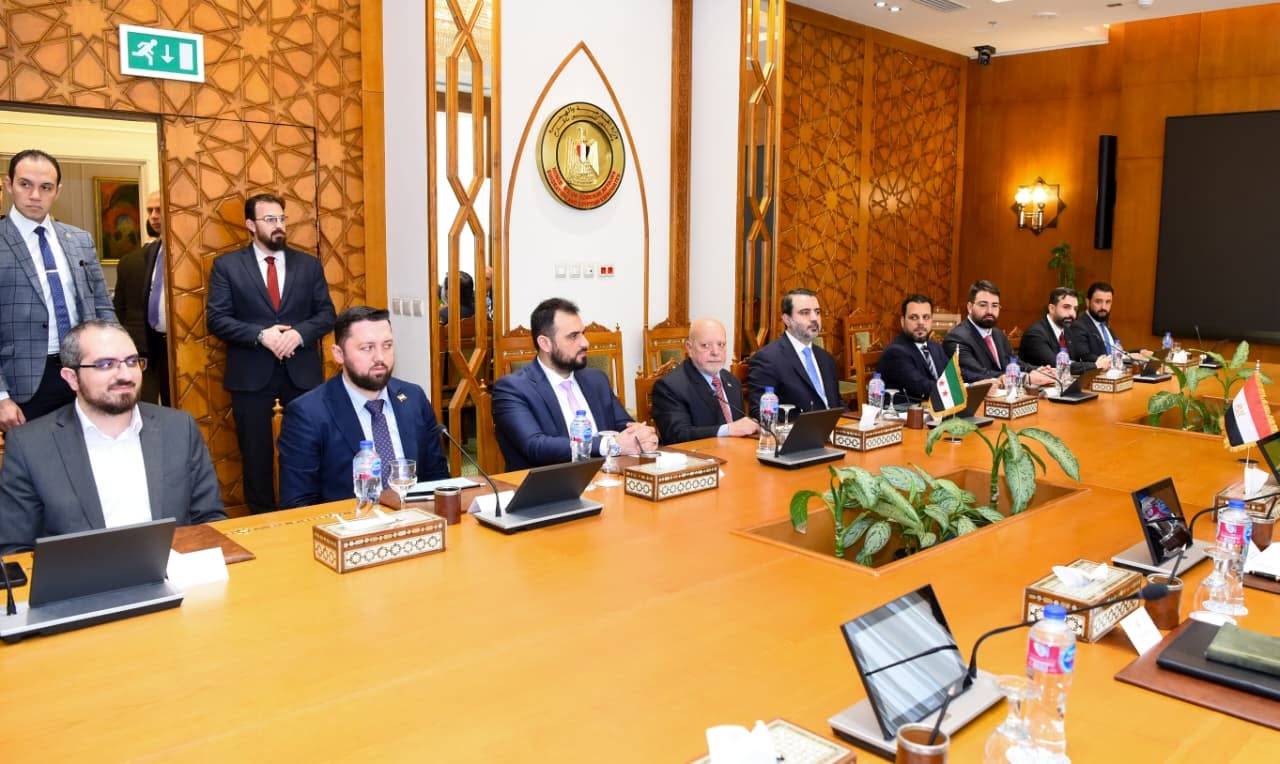
The crisis over Syria's ambassadorial nomination to Cairo appears to be heading toward a resolution. (Egyptian Foreign Ministry)

Cautious Relations

Former Egyptian assistant foreign minister Ambassador Hussein Haridy said that "the Egyptian government has the right to reject any nominee to head a diplomatic mission, or any other diplomat, if it possesses information indicating that the nominee engaged in activities affecting its national security."

Haridy told Asharq Al-Awsat that "the Syrian side publicly announced Mohammad Taha Al-Ahmad's nomination to the embassy in Cairo before obtaining Egypt's approval," describing the move as contrary to established diplomatic practice.

In Haridy's view, "relations between Cairo and Damascus will remain cautious given the background of the current Syrian government."

He said that "the Egyptian side distinguishes between the historic people-to-people relationship between the two countries and its channels of communication with Syria's current government. There remain areas for cooperation between Cairo and Damascus, particularly at the economic level."

In January, Damascus hosted the first Egyptian-Syrian Economic and Investment Forum, with the participation of 26 leaders from Egyptian chambers of commerce and business organizations. The event aimed to build effective partnerships between the two countries' commercial chambers and explore opportunities for cooperation in trade, industry, services, infrastructure and reconstruction.

At the time, the Federation of Egyptian Chambers of Commerce said that the forum sought to create Syrian-Egyptian-European alliances through the Union of Mediterranean Chambers and to promote Syrian exports to Africa through the Federation of African Chambers.


Lebanon Launches Rehabilitation of its Second Airport

An aerial view from the window of a Lebanese Middle East Airlines (MEA) airplane shows smoke rising, after Israeli strikes following an escalation between Hezbollah and Israel, amid the US-Israeli conflict with Iran, in the southern suburbs of Beirut, Lebanon, March 12, 2026. (Reuters)
TT

Lebanon Launches Rehabilitation of its Second Airport

An aerial view from the window of a Lebanese Middle East Airlines (MEA) airplane shows smoke rising, after Israeli strikes following an escalation between Hezbollah and Israel, amid the US-Israeli conflict with Iran, in the southern suburbs of Beirut, Lebanon, March 12, 2026. (Reuters)

Lebanon launched the rehabilitation of its second airport on Saturday, in preparation for an opening within months, at a time when the country faces constant fighting between Hezbollah and Israel.

Lebanon currently has one international airport, in Beirut next to the capital's southern suburbs, a Hezbollah stronghold that has been subjected to heavy Israeli bombardment during successive wars.

The new airport, in the town of Qlayaat in Lebanon's northernmost province of Akkar, near the border with Syria, has been used as a military base by the Lebanese army for decades, according to AFP.

Lebanese Minister of Transport and Public Works Fayez Rasamny inaugurated the airport on Saturday "after more than fifty years of promises, delays and waiting".

"Today we are moving from promise to execution," Rasamny said, adding that the goal is for the airport to be "operational in a few weeks" to serve travellers to Mersin, Istanbul and Dubai, adding there are plans to expand the destinations to Saudi Arabia, Cairo and Athens at a later stage.

Lebanon is also in contact with low-cost airlines, such as Ryanair and Pegasus, he said.

Rehabilitation is due to begin next week and will take at least three months, going through a pilot phase before the airport is put into full service in November 2026, according to local media.

The work is being carried out by the Lebanese company Sky Lounge, which on Saturday posted on its Instagram page a video of a test flight between Beirut airport and Qlayaat airport.

In a speech during the opening ceremony, the company's chairman, Ziad Munla, said, the passenger terminal will be completed "within 90 days after completing the required approvals and licenses".

The airport will be able to handle about 114,000 passengers in its first year, rising to more than 600,000 by its fourth year, he said.

The opening of the airport aims to create jobs in Akkar, one of Lebanon's poorest governorates with a high unemployment rate.

Rene Mouawad Airport, named after a former Lebanese president who was elected in the 1980s, was built by the French army as an airstrip in the 1930s.

It was used for civilian purposes in the 1960s and was bombed by Israel during an earlier war between Israel and Hezbollah in 2006.

Beirut airport has continued to operate despite during the Israel-Hezbollah war that began on March 2, and an earlier war in 2023 and 2024.

Lebanon has been forced to repeatedly pursue international guarantees that Israel will not target Beirut airport, which it has previously accused Hezbollah of using to transport money and weapons.

Lebanese authorities have repeatedly denied the Israeli allegations.


Araghchi Urges Lebanon President to Save Country From 'Real Foe'

FILED - 27 April 2026, Russia, Saint Petersburg: FILE PHOTO - Iranian Foreign Minister Abbas Araghchi arrives for a meeting in Saint Petersburg. Photo: -/Kremlin/dpa
TT

Araghchi Urges Lebanon President to Save Country From 'Real Foe'

FILED - 27 April 2026, Russia, Saint Petersburg: FILE PHOTO - Iranian Foreign Minister Abbas Araghchi arrives for a meeting in Saint Petersburg. Photo: -/Kremlin/dpa

Iranian Foreign Minister Abbas Araghchi on Saturday urged Lebanese President Joseph Aoun to save Lebanon from its "real foe," Israel, a day after Aoun called on Tehran to stop interfering in his country's affairs.

"Based on Mr. Aoun's comments, one would think it's Iran that has occupied one-fifth of Lebanon, displaced one-quarter of its population and is bombing the country on a daily basis," Araghchi wrote on X.

"If Lebanon were a bargaining chip for Iran, we would have reached an agreement long ago. Save Lebanon from your real foe, Mr. President," he added.

Aoun, in an interview broadcast Friday by CNN, called on Iran to stop "interfering" in Lebanon's affairs following the collapse of a new truce announced by Washington between Israel and the Iran-backed Hezbollah movement.

"This is not your country. It is our country, our responsibility, and your role is not to interfere in our affairs," Aoun said.

"It is our people who are being killed, and our homes that are being destroyed," he added.

The Lebanese president has faced opposition from Hezbollah and segments of Lebanese public opinion since the launch of direct negotiations with Israel, the first such talks between the two countries in decades. Lebanon and Israel do not maintain diplomatic relations.

Prime Minister Nawaf Salam also urged Iran to stop using Lebanon as a "card" to improve its negotiating position in talks with the United States.

Tehran has demanded that any agreement with Washington to end the war that began on Feb. 28 with a US-Israeli bombing campaign include a ceasefire on the Lebanese front and the withdrawal of Israeli forces.

The conflict in Lebanon erupted on March 2 after Hezbollah launched rockets at Israel in response to the killing of Iran's Supreme Leader, Ali Khamenei, in the initial US-Israeli strikes on Iran. Israel responded with a broad campaign of air strikes and ground incursions in southern Lebanon.

According to the latest official figures cited by AFP, Israeli strikes on Lebanon have killed more than 3,560 people since the conflict began. On the Israeli side, 27 soldiers and one civilian contractor have been killed in Lebanon.
