

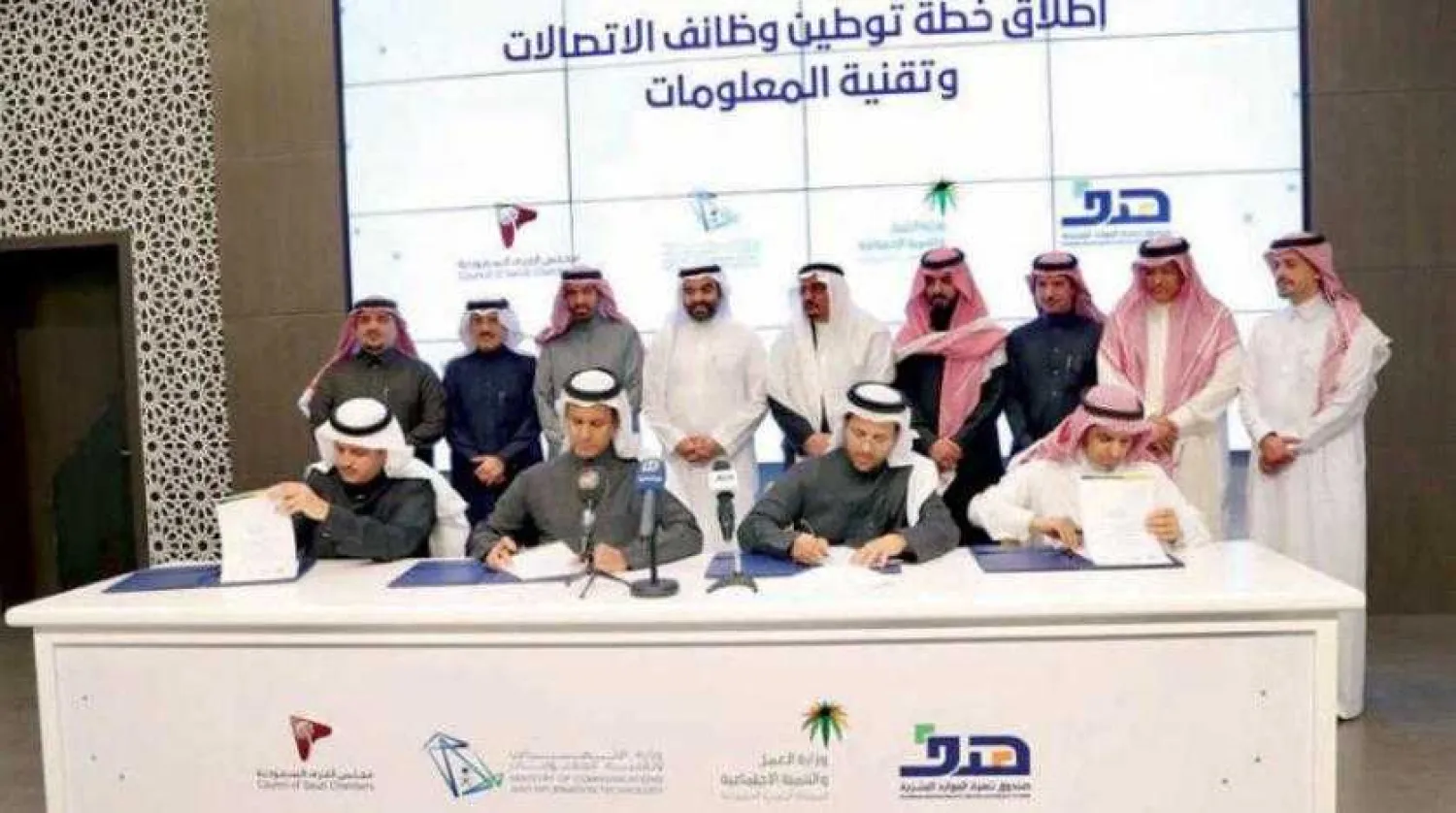

Saudi Arabia Launches Plan to Localize 15,000 Telecom Jobs

During the launching ceremony of the plan to localize telecom jobs (Asharq Al-Awsat)
TT

Saudi Arabia Launches Plan to Localize 15,000 Telecom Jobs

During the launching ceremony of the plan to localize telecom jobs (Asharq Al-Awsat)

Saudi Arabia launched Wednesday a plan to localize jobs and professions in the Information and Communication Technology (ICT) sector.

The plan aims to reach more than 15,000 jobs by 2020, after the rate of localzed jobs increased from 37 percent to 43 percent between 2016 and 2018.

The plan is the result of a partnership between the Ministry of Communications and Information Technology, the Ministry of Labor and Social Development, the Human Resources Development Fund (Hadaf) and the Council of Saudi Chambers. It is also one of the outcomes of the Memorandum of Understanding (MoU) signed earlier between both ministries.

Minister of Communications and Information Technology Abdullah al-Swaha said that the plan to localize the ICT sector is aimed at enabling national cadres of obtaining qualitative employment opportunities and use their abilities to support the digital transformation process in all sectors.

He stressed that Saudi Arabia is witnessing a digital transformation in all sectors and that the ministry is seeking to create an attractive and stimulating environment for the development and growth of the ICT sector.

Swaha pointed out that due to the efforts of both ministries through the National Transition Program 2020 (NTP), localization rose from 37 percent in 2016 to 43 percent by the end of 2018.

Women's participation in the ICT sector also increased from 11 percent in 2016 to 13 percent in 2018.

Minister of Labor and Social Development Ahmed al-Rajhi indicated that the plan to localize the ICT sector will have the positive impact of increasing the number of Saudi women and men in the sector.

The ministries will provide a package of intensive vocational training and programs to train young men and women.

This also includes leadership development programs, programs to support women's empowerment, and specialized training programs in modern technologies such as artificial intelligence, data, data security, robotics, blockchains, and a number of programs in traditional technologies.

Hadaf will support the ICT sector to achieve localization goals by providing training and employment support programs for targeted occupations.


TikTok Signs Deal to Sell US Entity to American Investors

FILE – In this July 21, 2020 file photo, a man opens social media app ‘TikTok’ on his cell phone, in Islamabad, Pakistan. (AP Photo/Anjum Naveed, File) 
TT

TikTok Signs Deal to Sell US Entity to American Investors

FILE – In this July 21, 2020 file photo, a man opens social media app ‘TikTok’ on his cell phone, in Islamabad, Pakistan. (AP Photo/Anjum Naveed, File) 

TikTok's Chinese owner ByteDance signed binding agreements to form a joint venture that will hand control of operations of TikTok's US app to American and global investors, according to a memo by TikTok CEO Shou Zi Chew seen by Reuters.

The deal, set to close on January 22, would end years of efforts to force ByteDance to divest its US business over national security concerns.

According to an internal memo cited by Bloomberg and Axios, TikTok CEO Shou Chew told employees that the social media company as well as its Chinese owner ByteDance had agreed to the new entity, with Oracle, Silver Lake and Abu Dhabi-based MGX on board as major investors.

Oracle’s executive chairman and founder Larry Ellison is a longtime ally of US President Donald Trump.

Chew said that ByteDance will retain around 20% of the new joint venture — the maximum ownership allowed for a Chinese company under the law.

The deal largely confirms a September announcement by the White House that said the new venture would meet the requirements of a 2024 law that threatened to ban the wildly popular app in the United States if ByteDance stayed majority owner.

The new set-up for TikTok is in response to a law passed under Trump’s predecessor, Joe Biden, that has forced ByteDance to sell TikTok’s US operations or face a ban in its biggest market.

US policymakers, including Trump in his first presidency, have warned that China could use TikTok to mine data from Americans or exert influence through its state-of-the-art algorithm.

Chew said the US joint venture would operate as an independent entity with authority over “US data protection, algorithm security, content moderation and software assurance.”

Trump in September had specifically named Oracle boss Ellison, one of the world’s richest men, as a major player in the arrangement.

Ellison has returned to the spotlight through his dealings with Trump, who has brought his old friend into major AI partnerships with OpenAI.

Ellison has also financed his son David’s recent takeover of Paramount and is involved in his son’s bidding war with Netflix to take over Warner Bros.


Canada, US to Launch Formal Talks to Review Free Trade Agreement in Mid-January

Canada's Prime Minister Mark Carney takes part in a press conference on Parliament Hill in Ottawa, Ontario, Canada December 18, 2025. REUTERS/Blair Gable
TT

Canada, US to Launch Formal Talks to Review Free Trade Agreement in Mid-January

Canada's Prime Minister Mark Carney takes part in a press conference on Parliament Hill in Ottawa, Ontario, Canada December 18, 2025. REUTERS/Blair Gable

Canada and the US will launch formal discussions to review their free trade agreement in mid-January, the office of Canadian Prime Minister Mark Carney said.

The prime minister confirmed to provincial leaders that Dominic LeBlanc, the country’s point person for US-Canada trade relations, “will meet with US counterparts in mid-January to launch formal discussions," Carney’s office said in a statement late Thursday.

The United States-Mexico-Canada trade pact, or USMCA, is up for review in 2026. US President Donald Trump negotiated the deal in his first term and included a clause to possibly renegotiate the deal in 2026.

Carney met with the leaders of Canada’s provinces on Thursday to give them an update on trade talks with the US.

Canada is one of the most trade-dependent countries in the world, and more than 75% of Canada’s exports go to the country's southern neighbor. But most exports to the US are currently exempted by USMCA.

Trump cut off trade talks to reduce tariffs on certain sectors with Carney in October after the Ontario provincial government ran an anti-tariff advertisement in the US. That followed a spring of acrimony, since abated, over Trump’s insistence that Canada should become the 51st US state.

Carney said earlier Thursday that Canada and the US were close to an agreement at the time on sectoral tariff relief in multiple areas, including steel and aluminum. Tariffs are taking a toll on certain sectors of Canada's economy, particularly aluminum, steel, auto and lumber.

Carney also said trade irritants flagged this week by US Trade Representative Jamieson Greer are elements of a “much bigger discussion” about continental trade. Greer said a coming review of the Canada-US-Mexico trade deal will hinge on resolving US concerns about Canadian policies on dairy products, alcohol and digital services.

Carney and the provincial premiers agreed to meet in person in Ottawa early in the new year.

Canada is the top export destination for 36 US states. Nearly $3.6 billion Canadian (US$2.7 billion) worth of goods and services cross the border each day.

About 60% of US crude oil imports are from Canada, as are 85% of US electricity imports.

Canada is also the largest foreign supplier of steel, aluminum and uranium to the US and has 34 critical minerals and metals that the Pentagon is eager for and investing in for national security.

Carney said US access to Canada’s critical ministers is not a certainty.

“It’s a potential opportunity for the United States, but it’s not an assured opportunity for the United States. It’s part of a bigger discussion in terms of our trading relationship, because we have other partners around the world, in Europe for example, who are very interested in participating,” Carney said earlier Thursday.


ADNOC Lands $11 Billion Financing for Future Gas Output in Abu Dhabi

ADNOC secures landmark structured financing of up to $11 billion for Hail & Ghasha gas development
TT

ADNOC Lands $11 Billion Financing for Future Gas Output in Abu Dhabi

ADNOC secures landmark structured financing of up to $11 billion for Hail & Ghasha gas development

Abu Dhabi National Oil Company (ADNOC), along with its partners Eni and PTT Exploration and Production (PTTEP), has signed a structured financing agreement of up to 40.4 billion dirhams ($11 billion).

The financing will be used to monetize future midstream gas production from the Hail and Ghasha project.

ADNOC said the deal, part of the Ghasha concession, will enable responsible energy production needed to meet the growing demands of local industries, supporting the UAE’s gas self-sufficiency ambitions. The Ghasha concession, located offshore Abu Dhabi, is set to produce 1.8 billion standard cubic feet per day (bscfd) of gas.

Over 60% of the investment value of the entire project will flow back into the UAE’s economy under ADNOC’s In-Country Value (ICV) program, reinforcing ADNOC’s commitment to ensuring more economic value remains in the country from the contracts it awards, the company said.

Concerning sustainability, ADNOC noted that Hail and Ghasha project is also the world’s first gas development that aims to operate with net-zero emissions.

The project will capture 1.5 million tons per year (mtpa) of carbon dioxide, equivalent to removing over 300,000 fuel-powered cars off the road every year, and aims to deploy fully unmanned offshore operations.

Dr. Sultan Ahmed Al Jaber, Minister of Industry and Advanced Technology and ADNOC Managing Director and Group CEO, said: “This landmark transaction builds on ADNOC’s successful track record of global energy partnerships and unlocks capital to drive progress at Hail and Ghasha, one of the world’s most ambitious offshore gas projects.”

He said the exceptional demand from over 20 leading global and regional financial institutions reinforces confidence in ADNOC’s value creation strategy, innovative approach to financing, and proven track record in delivering mega projects.

“Hail and Ghasha,” he added, “is an important contributor to ADNOC’s gas strategy and is on track to generate significant value for ADNOC, our partners, and the UAE, while unlocking important new gas resources for our customers.”

ADNOC said the non-recourse financing transaction, unique for an energy project of this scale and complexity, enables the company to realize upfront value for its products at competitive rates.

In addition to providing immediate access to capital, it noted that the financing structure introduces an innovative commercial model that ring-fences midstream facilities and operations, which enables ADNOC and its partners to raise low-cost funding while retaining strategic and operational control of the assets.

This transaction is the latest in a series of pioneering infrastructure development partnerships that ADNOC has executed over the past decade, including the $4.9 billion (18 billion dirhams) oil pipeline partnership, and the $10.1 billion (37.1 billion dirhams) gas pipeline agreement, with some of the world’s leading global infrastructure and institutional investors.

It also includes pioneering BOOT (build-own-operate-transfer) projects such as the $3.8 billion (14 billion dirhams) project to power and decarbonize offshore operations and the $2.2 billion (8.3 billion dirhams) project to deliver sustainable water supplies to onshore operations.