Tunisia Plans to Increase Its Phosphate Production

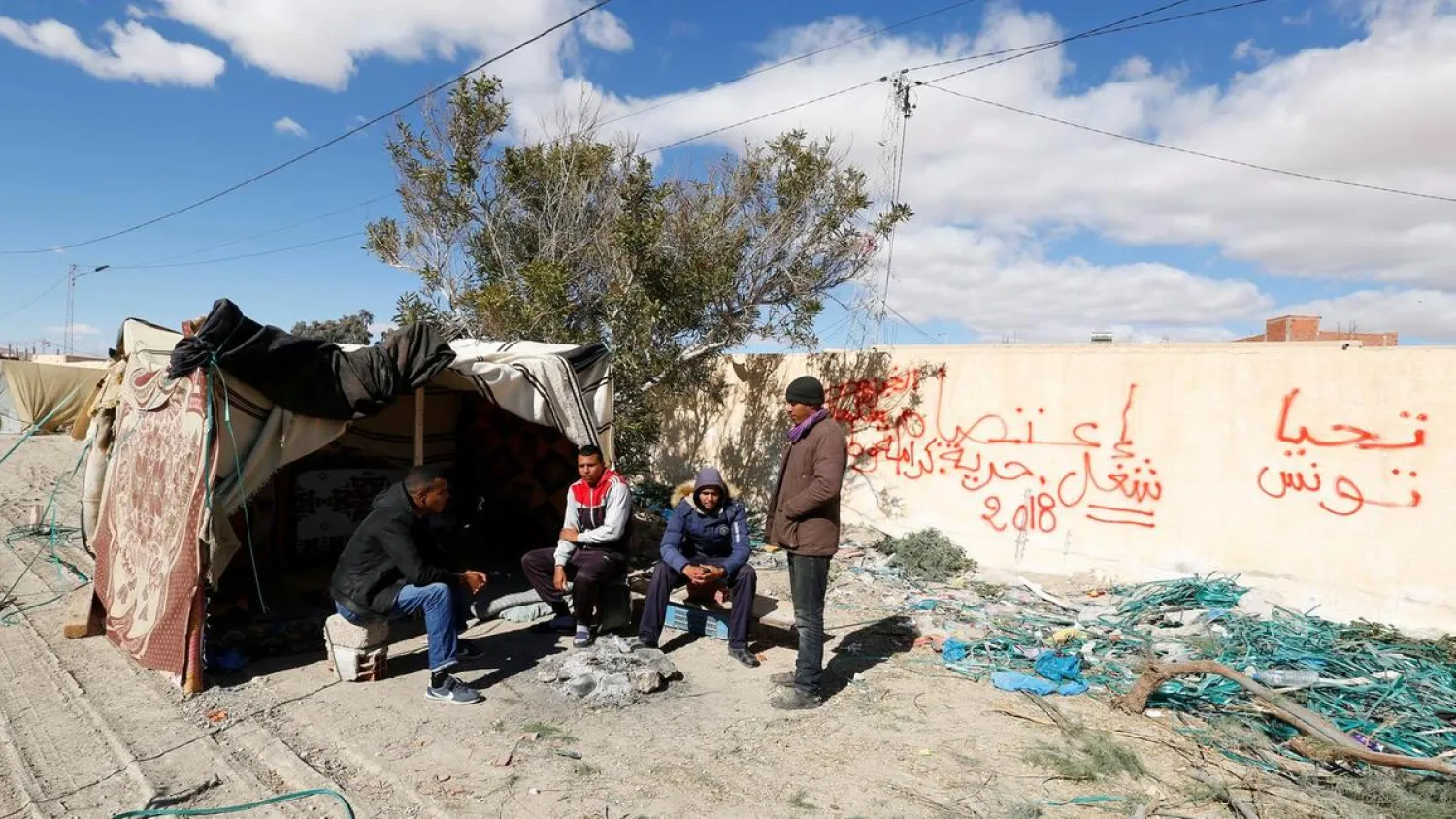
Protesters sit outside a tent near the entrance of the phosphate mine in Umm al-arais, Tunisia February 15, 2018. (File photo: Reuters)
TT

Tunisia Plans to Increase Its Phosphate Production

Protesters sit outside a tent near the entrance of the phosphate mine in Umm al-arais, Tunisia February 15, 2018. (File photo: Reuters)

The Tunisian government is looking to raise revenues from mining activities, mainly the strategic phosphate sector, and plans to reach about 5 million tons of crude phosphate production during the current year, of at least a 30 percent increase in production.

Tunisia is expected to allocate about $47.1 dollars of investments for the phosphate sector only, in order to complete the technical studies of “Tozeur – Nefta” project and complete projects Meknassy and Umm al-Khashab, all of which are new phosphate mines that may contribute in the coming years to supporting local production and restoring Tunisia’s status in global markets.

In this regard, the government-run National Institute of Statistics confirmed that the production of strategic phosphates in Tunisia has decreased over the past year. It pointed out that mining and phosphate production fell 13.9 percent, recording 4 million tons in 2018 compared to 3.9 million tons during 2017.

Tunisia's production of phosphate was about 8 million tons in 2010, but the social problems experienced by production areas had a significant impact on the actual working days, negatively affecting production levels. As a result, Tunisia lost a number of global markets due to its inability to meet its obligations.

Tunisian government departments confirm the negative impact of the decline in phosphate exports on the Tunisian trade balance and the domestic stock of foreign exchange.

General Manager of Company of Phosphate Gafsa (CPG) Ramadan Suweid, has revealed the high volume of losses in the phosphate sector since 2011 as a result of the loss of a number of important foreign markets, adding that those losses are about $1.6 billion.

The government strategy depends on the production returning to its normal pattern after a series of social protests and strikes in the Gafsa basin, southwestern Tunisia. From there, it will launch a strategic study of the phosphate sector to ensure its sustainability and development until 2030.

In this regard, Tunisian geologist Habib Mahjoubi said Tunisia has the potential to produce about 15 million tons of phosphate if new mines that rely on external extraction of phosphate are used instead of the old mines that have been used for decades on the underground extraction.

Mahjoubi believes that old mines led to the high cost of production and made it difficult to compete with top phosphate producing countries.


Saudi Stocks Rebound 0.9%, Recouping Previous Session's Losses

An investor monitors stock market data on a screen at the Saudi Exchange (Tadawul) in Riyadh (Reuters)
TT

Saudi Stocks Rebound 0.9%, Recouping Previous Session's Losses

An investor monitors stock market data on a screen at the Saudi Exchange (Tadawul) in Riyadh (Reuters)

Saudi stocks closed higher on Monday, recovering some of the losses sustained in the previous session as heavyweight shares strengthened and the banking sector advanced.

The benchmark Tadawul All Share Index (TASI) rose 0.90% to close at 10,106 points, gaining 90 points. Total trading value reached approximately SAR 3.5 billion ($933 million).

The index had fallen 0.8% on Sunday amid selling pressure on heavyweight stocks.

Anaam International Holding Group, Fitaihi Holding Group and Raoom were among the session's top gainers, rising between 7% and 9% to close at SAR 11.93, SAR 2.11 and SAR 72.30, respectively.

On the losing side, Almunajem Foods led the declines, shedding 9.20% to SAR 49.94, followed by Saudi Paper Manufacturing Co., which fell 6.18% to SAR 48.88, and Alamar Foods, which dropped 4.63% to SAR 44.06.

At the sector level, banks led the gains, advancing 1.60%, supported by a 2.06% rise in Bank AlJazira shares, which closed at SAR 10.89.


Tesla to Refund Many Cybertruck Deposits as Demand Exceeds Production, Musk Says

Tesla Cybertruck electric vehicles sit parked in a storage lot in San Diego, California on April 11, 2025. (AFP)
TT

Tesla to Refund Many Cybertruck Deposits as Demand Exceeds Production, Musk Says

Tesla Cybertruck electric vehicles sit parked in a storage lot in San Diego, California on April 11, 2025. (AFP)

Tesla will have to refund Cybertruck deposits for many customers as orders far exceed production capacity, CEO Elon Musk said, following last week's announcement that the electric vehicle maker is winding down the pickup truck's production at its Texas factory.

"We will try ‌to make ‌as many as ‌possible ⁠before shutting down the ⁠line in about 8 months, but will have to return deposits for a lot of people," the billionaire said in a post on X on Monday.

The comments ⁠come after Musk said ‌Tesla would ‌add an extra production shift to fulfill outstanding ‌Cybertruck orders before dismantling the production ‌line next year to expand output of its Cybercab robotaxi.

The production winddown is slated for mid-2027, Musk announced on ‌Friday, with the resources being redirected to the Cybercab, a vehicle ⁠central ⁠to the automaker's autonomous-driving ambitions.

Tesla began delivering the Cybertruck in late 2023, but demand has fallen far short of Musk's expectations. US sales fell 48% to 20,237 units last year, according to Kelley Blue Book, well below Musk's earlier projection that annual Cybertruck sales could reach 250,000 vehicles.


China Extends Suspension of New Rare Earth Controls Until January

A mining machine is seen at the Bayan Obo mine containing rare earth minerals, in Inner Mongolia, China July 16, 2011. (Reuters)
TT

China Extends Suspension of New Rare Earth Controls Until January

A mining machine is seen at the Bayan Obo mine containing rare earth minerals, in Inner Mongolia, China July 16, 2011. (Reuters)

China on Monday announced a two-month extension of export-control waivers due to expire this month, preserving part of a wide-ranging deal struck after a summit between Presidents Xi Jinping and Donald Trump.

China introduced export controls on certain rare earths ‌in April 2025, ‌only to expand ‌them ⁠further in October ⁠of that year, dramatically widening their scope and also adding new controls on certain diamonds with industrial applications and lithium battery technology.

The measures were then ⁠paused for one year last ‌November after ‌a summit in South Korea ‌between Xi and Trump.

The Ministry of ‌Commerce said in a short statement on Monday that the pause would be extended for two months ‌until January 10. It gave no other details.

The extension ⁠is ⁠part of a broader suspension of trade countermeasures and tariffs announced by China on Monday as it negotiates with Washington over an enduring trade deal.

Trump is set to travel to Shenzhen in southern China later this month for an APEC leaders summit, where he is expected to meet with Xi.