


Yemeni Government Stresses Need to Fight Houthi Evasiveness with Prisoner Swap Deal

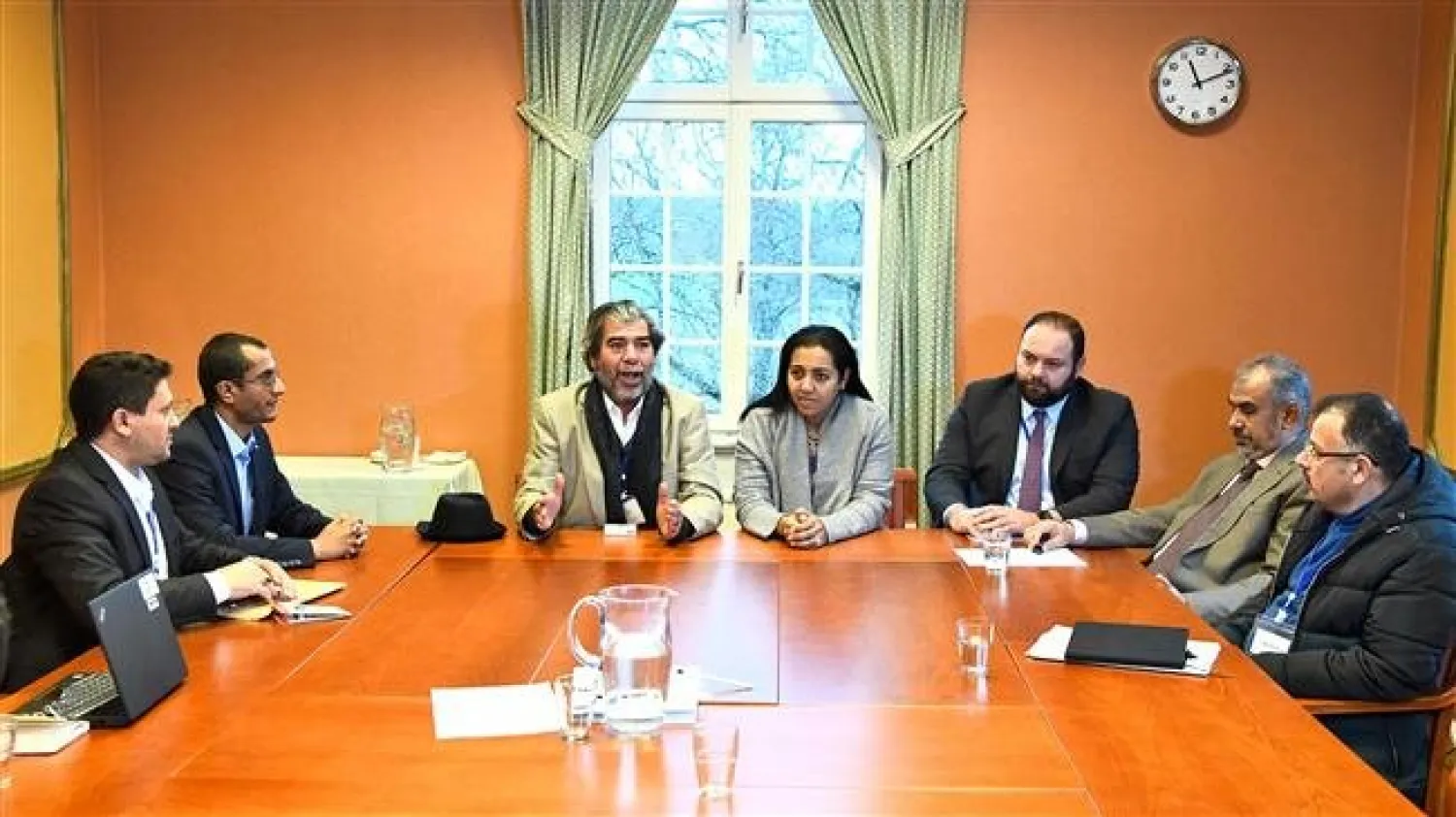
At left, Abdelqader al-Murtada and Saelem Mohammed Noman Al-Mughalles, representatives of the Ansar Allah delegation and at right, Askar Zaeil and Hadi al-Hayi representing the delegation of the Government of Yemen sit at the negotiating table together with representatives from the office of the U.N. Special Envoy for Yemen and the International Red Cross Committee (ICRC) when lists of prisoners are exchanged, a first step to implement the agreement to release all prisoners by the two parties, during the ongoing peace talks on Yemen held at Johannesberg Castle, in Rimbo, near Stockholm, Sweden, December 11, 2018. TT News Agency/Claudio Bresciani via REUTERS
TT

Yemeni Government Stresses Need to Fight Houthi Evasiveness with Prisoner Swap Deal

At left, Abdelqader al-Murtada and Saelem Mohammed Noman Al-Mughalles, representatives of the Ansar Allah delegation and at right, Askar Zaeil and Hadi al-Hayi representing the delegation of the Government of Yemen sit at the negotiating table together with representatives from the office of the U.N. Special Envoy for Yemen and the International Red Cross Committee (ICRC) when lists of prisoners are exchanged, a first step to implement the agreement to release all prisoners by the two parties, during the ongoing peace talks on Yemen held at Johannesberg Castle, in Rimbo, near Stockholm, Sweden, December 11, 2018. TT News Agency/Claudio Bresciani via REUTERS

Yemeni Foreign Ministry Khaled al-Yamani confirmed the government delegate, alongside Saudi and UAE representatives, has prepared and presented a strong letter criticizing violations committed by Iran-backed Houthi militiamen.

Houthis, despite signing to the UN-brokered Stockholm Agreement, have carried continued amassing fighters, building weapon capacities, digging trenches and looting humanitarian relief and exploiting it for the group’s apparently ongoing war effort.

“Coupists, given the group’s evasive behavior when it comes to the prisoner swap issue, seem to be practicing multi-faceted extortion against the international community,” al-Yamani told Asharq Al-Awsat on the eve of launching prisoner exchange talks in Amman, Jordan.

Yemen’s warring sides have started talks in the Jordanian capital about a deal to free thousands of prisoners as part of UN-led peace efforts.

The top diplomat said that the Yemeni government wishes for the international community and the humanitarian relief groups to weigh in and place pressure on Houthis so that they comply with commitments.

Houthis do not seem determined on fulfilling agreements, al-Yamani said while pointing out that the international community is well aware that the Iran-backed militia is unwilling to comply with peace efforts and doesn’t seriously want a solution for the conflict.

He went on to reaffirm the unquestionable support the internationally-recognized Yemeni government, headed by President Abdrabbuh Mansur Hadi, holds for UN-led peace efforts, saying that it stems from a conviction that diplomacy is the only solution to empower state institutions and to dismantle the detrimental agenda upheld by coupists.

According to al-Yamani, Houthis refusing to provide details on 232 detainees covered by the UN Security Council resolution 2216 is a grave violation that undermines confidence-building measures initiated by the Stockholm agreement.

Adressing questions on the arrival of a number of European ambassadors to Aden, al-Yamani said that this visit is meant to explore efforts undertaken by the legitimate Yemeni government.

The EU mission and a group of ambassadors will meet with the government in the interim capital of Aden.

Al-Yamani said that the visit restores clarity to confusion previously induced by understating positive efforts exerted by the Yemeni government.

The hard labors of the Yemeni government, according to al-Yamani, cannot be overlooked, especially as it first and foremost has the service of Yemenis at heart.

The Yemeni government works around the clock to strengthen the financial and administrative institutions to ensure that workers in all sectors of the country are paid, the diplomat said.

Backed by the Saudi-led Arab Coalition, al-Yamani said that the government is keen on restoring life in Yemen.



Rubio Says Both Lebanon, Israel Agree on Dismantling Hezbollah

Secretary of State Marco Rubio speaks at the State Department, Friday, April 24, 2026, in Washington. (AP Photo/Rod Lamkey, Jr.)
TT

Rubio Says Both Lebanon, Israel Agree on Dismantling Hezbollah

Secretary of State Marco Rubio speaks at the State Department, Friday, April 24, 2026, in Washington. (AP Photo/Rod Lamkey, Jr.)

US Secretary of State Marco Rubio said on Tuesday that both the Lebanese and the Israeli governments want the same thing: peace and Hezbollah gone.

In an interview with Fox News, Rubio said the Lebanese people are the victim of the pro-Iran organization, claiming that Israel has no territorial claims on Lebanon.

Asked about the Trump administration’s efforts to try and reach an agreement between Israel and Lebanon, the Secretary of State said the current ceasefire between the two nations “is very unique” because Lebanon and Israel are not at war.

“Israel’s problem is with Hezbollah. Unfortunately, Hezbollah happens to be inside of Lebanon conducting attacks against Israel,” he explained.

The top diplomat said both the Lebanese and the Israelis seek peace.

“They have no problem with one another. Israel has no territorial claims on Lebanon. There isn’t some part of Lebanon that Israel claims belongs to them.”

According to Rubio, the problem Israel has is not with Lebanon but with Hezbollah inside of Lebanon.

Also, he noted, the Lebanese have acknowledged that Hezbollah is a problem for them. “Not only is Israel the victim of Hezbollah, but so are the Lebanese.”

The US official noted that the efforts now focus on the ceasefire and to make sure that Israel has a right to defend itself from an imminent attack or an ongoing attack from Hezbollah elements, who will do everything they can to disrupt the ceasefire.

He said both sides agree that the answer is a Lebanese Armed Forces with the capability to go after and disarm and dismantle Hezbollah inside of their country.

“And that’s what we’re working towards establishing, is a system that actually works where vetted units within the Lebanese Armed Forces have the training, the equipment, and the capability to go after elements of Hezbollah and dismantle them so Israel doesn’t have to do it,” he added.

Rubio said US officials urged Israelis to measure themselves in their response, to make sure their responses are proportional and targeted, and so far that appears to be the case.

“I don’t know what’s happened since I’ve been in this room with you, but that’s so far the case because that’s important,” he said, adding that it’s acknowledged in the agreement that Israel has a right to deal with threats that Lebanon can’t deal with.

Asked whether he sees a scenario where Lebanon joins the Abraham Accords, Rubio said: “We’re not there yet.”

He added: “I mean, obviously that would be very promising, but we’re not at that point. I think what we perceive – and it’s pretty clear – is by and large there is no Lebanese-Israeli conflict per se.”

The Secretary of State said he thinks what needs to happen inside Lebanon is not just that the overwhelming majority of the country, the Sunnis and the Christians, say Hezbollah has been a nightmare for us, but even within the Shiite population that there be a rejection of Hezbollah.

“There should be one government, one armed forces inside of Lebanon, and it should belong to the Lebanese government. And that’s who we should be empowering,” he affirmed.


Who Is Iraq’s PM-Designate Al-Zaidi?


Iraq PM-designate Ali al-Zaidi (INA)
TT

Who Is Iraq’s PM-Designate Al-Zaidi?


Iraq PM-designate Ali al-Zaidi (INA)

Despite his close ties to Shiite party leaders in Baghdad and his extensive financial investments, premiership nominee Ali Faleh Kazem al-Zaidi remains largely unknown to most Iraqis outside political circles.

Informed sources say al-Zaidi has multiple financial partnerships with political and business figures both inside and outside the government.

Those familiar with his affairs describe him as “a young man who joined the ranks of the wealthy over the past decade,” noting that he spends generously on social aid and assistance.

Born in Baghdad in 1986, Al-Zaidi holds a law degree and is not known for seeking public attention.

This is despite the fact that he owns Dijlah TV, which he acquired from Jamal and Mohammed al-Karboli, two brothers who are leaders of a Sunni party that competed in elections between 2010 and 2014.

If al-Zaidi succeeds in forming a government, he would become the youngest prime minister to hold the post since 2004.

The Coordination Framework surprised most Iraqis by naming him its candidate for prime minister, even though his name had not appeared among those circulated during the roughly five-month political crisis and government-formation talks.

Financial activities

Asharq Al-Awsat has learned that al-Zaidi is the owner and chairman of Al-Janoob Islamic Bank for investment and finance, a publicly listed company on the Iraq Stock Exchange established in 2016 and operating in the banking sector.

He later stepped down as chairman, handing the role to one of his brothers, after the US State Department placed the bank on its sanctions list in February 2024 for money laundering, prompting the Central Bank of Iraq to block its access to US dollars, according to informed sources.

Al-Zaidi also owns Al-Oweis Group, which, according to its website, includes 15 companies operating across food trade, agricultural and livestock production, contracting, printing, security services, electronics and oil, though it does not disclose its owner or founding date.

Property registration data indicates the company was established in 2007, later dissolved and converted into a private joint stock company with capital of 99 billion Iraqi dinars, about $75 million. An oil services company was also established in 2018 with a capital of 2 billion dinars.

The Iraq Stock Exchange website lists 2016 as the founding year of Al-Janoob Islamic Bank alongside a financial transfer company with capital of 250 billion dinars, about $191 million, meaning the bank’s total capital is less than the cost of a single “food basket.”

The company’s website says its total investments amount to $500 million and that it is responsible for contracts to supply the Trade Ministry’s food basket, as well as contracts with the Defense Ministry to provide food for 300,000 soldiers daily.

It also opened a private university last year named Al-Shaab.

Sources close to al-Zaidi say he holds further investments in education and media, including Al-Shaab University, Ishtar Medical Institute and Dijlah TV.

Sources say the Trade Ministry contracted Al-Oweis, owned by al-Zaidi, to supply food basket items to around 40 million Iraqis, a program inherited from Saddam Hussein’s government under the oil-for-food agreement during the 1990s sanctions period.

Citizens often complain about poor food quality and delivery delays.

However, the sources say the program has been scaled down in recent years to cover 18 million people, citing the exclusion of higher-income groups.

Group of companies

According to additional data, company registration records show that al-Zaidi owns 15 companies registered in his name, with an initial capital exceeding 282 billion Iraqi dinars.

These companies operate across key sectors including general contracting and construction, real estate and tourism investment, oil, gas and electricity, food and glass industries, agricultural and livestock production, as well as higher education, medical and financial services.

Among the most prominent is Al-Oweis, which holds contracts to feed the Iraqi army and import food basket items, alongside Al-Shaab University.

Through Al-Oweis Trading, General Contracting, Food Supply and Food Industries Ltd., al-Zaidi implements multiple projects, including feeding the Iraqi army.

The company signed a partnership contract with the State Company for Foodstuff Trading to supply both dry and fresh rations, covering 41 items for a total of 300,000 personnel.

Another project is the food basket program, under which Al-Oweis signed a partnership contract with the State Company for Foodstuff Trading to supply seven food items to support around 40 million people.


Tunisia President Sacks Energy Minister Ahead of Renewable Energy Projects Vote

Tunisian ‌President Kais Saied. (AFP)
TT

Tunisia President Sacks Energy Minister Ahead of Renewable Energy Projects Vote

Tunisian ‌President Kais Saied. (AFP)

Tunisia’s ‌President Kais Saied dismissed Energy Minister Fatma Thabet on Tuesday, amid growing controversy over renewable energy projects set to be voted on in parliament.

Saied said he had appointed Housing and Infrastructure Minister Salah Eddine ‌Zouari to ‌temporarily oversee the ministry. ‌No ⁠detailed explanation was ⁠provided for the decision.

The move comes as Saied's government seeks to pass draft laws on renewable energy, which ⁠will be put to ‌a ‌vote in parliament later on Tuesday.

The ‌projects have a planned ‌capacity of 600 megawatts, with 500 million euros ($585 million) as total investment.

The projects are ‌part of Tunisia’s efforts to expand clean energy ⁠production. ⁠Some lawmakers and political parties oppose the projects, describing them as a form of "energy colonization."

They have criticized the exclusion of the state electricity company (STEG) from the contracts, which they say were awarded exclusively to foreign firms.