



Syria Farmer Turns Ferryman as River Engulfs Hometown

Bags of freshly baked pitta -- Abu Ihab provides free delivery to flood-stricken households unable to reach the shops | AFP
TT

Syria Farmer Turns Ferryman as River Engulfs Hometown

Bags of freshly baked pitta -- Abu Ihab provides free delivery to flood-stricken households unable to reach the shops | AFP

The alleyways of the Syrian town of Darkush are normally thronged with pedestrians but since the swollen Orontes River burst its banks, Abu Ihab's boat has provided the main way of getting around.

The 49-year-old farmer normally takes a well-earned rest in January when winter frosts turn his fields as hard as rock.

But this year, days of torrential rain in the mountains of Lebanon has sent a deluge downstream, submerging the streets of his hometown under as much as a meter and a half (five feet) of water.

So instead the father of four is working long hours each day paddling his boat around the streets helping stricken residents to get their children to school, do the shopping or check on relatives.

"In winter, I don't usually leave the house much as it is cold and it rains. But this year I felt that people needed me," he says as he provides yet another ferry ride to grateful fellow townspeople.

Abu Ihab normally uses his boat for summer fishing on the Orontes to supplement his farm produce.

He is one of the few in the town to own one so he offers his services for free, delivering fresh bread from the bakery or ferrying excited children on an unaccustomed school run by boat.

"Today, people are staying at home. They can't even get to the shops to buy food," he says, wearing a woolly hat and jacket against the cold.

It is not the first year that he has provided his free boat service. "Most years there are spates but this year is a really big one because of the torrential rains," he says.

The ground floors of houses close to the river have been inundated.

The mainly Sunni Arab town close the Turkish border lies in Idlib province which is largely under the control of jihadists led by Al-Qaeda's former Syria branch.

Across the province, the torrential rains have triggered flash floods that have caused widespread hardship, particularly in the vast tent cities set up for the displaced.

Civilians who have fled other parts of Syria recaptured by government forces make up around half of the resident population of Idlib and neighboring rebel-held areas.


Scientists Find New Species of Dragonfly, Grasshopper and a Fluorescent Spider

A crowned crab spider that fluoresces under UV light, discovered during a scientific expedition to Angola's remote Lisima plateau, is pictured in this handout image obtained by Reuters on June 3, 2026. (The Wilderness Project/Handout via Reuters)
TT

Scientists Find New Species of Dragonfly, Grasshopper and a Fluorescent Spider

A crowned crab spider that fluoresces under UV light, discovered during a scientific expedition to Angola's remote Lisima plateau, is pictured in this handout image obtained by Reuters on June 3, 2026. (The Wilderness Project/Handout via Reuters)

Wildlife ‌experts found eight new species of dragonfly, three unknown grasshoppers and some 60 new butterflies and moths in vivid hues during a trip to Angola's Lisima plateau in February, a conservation group said on Wednesday.

The Wilderness Project visited the waters that flow through the plateau and which feed four of Africa's major rivers: the Congo, Okavango, Zambezi and Cuanza.

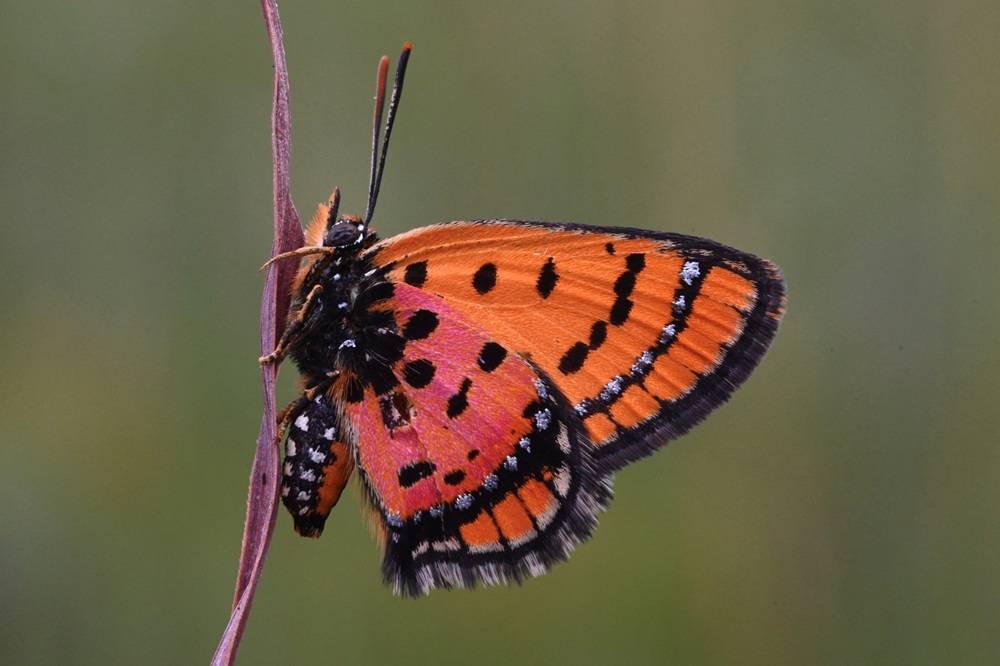
New species included an ‌armored, predatory ‌cricket, a previously undescribed species of ‌copper ⁠caterpillar and its adult ⁠butterfly, and a crowned crab spider that fluoresces under ultraviolet light.

Experts also found a new blood orange-hued species of ladybird orb-web spider which mimics ladybirds in signaling to predators with a bright color - normally a darker red - ⁠that it is too bitter or toxic.

"The ‌armored crickets are ‌very cool ... very fierce-looking," expedition leader Rob Taylor told ‌Reuters. "As a defense mechanism, they can actually squirt ‌fluid onto whoever's trying to attack them."

A new species of an adult butterfly, discovered during a scientific expedition to Angola's remote Lisima plateau, is pictured in this handout image obtained by Reuters on June 3, 2026. (The Wilderness Project/Handout via Reuters)

Scientists the world over are frantically trying to record species as they reckon with a global ecological crisis that ‌has put a million plant and animal species on the brink of extinction. ⁠

They ⁠estimate there are 8.7 million species in the world, of which science has identified only 1.5 million.

Many are fast disappearing because of human activity, with more than 800 animal species going extinct since around 1500.

Taylor said wildlife in the Lisima plateau was threatened by "tree-felling, deforestation and ... the artisanal diamond mining industry," as well as by slash-and-burn agriculture, which razes natural forests to use the soil for planting, only to see the nutrients wash away.


Storm Jangmi Dumps Torrential Rain on Tokyo

People commute in heavy rain brought by severe tropical storm Jangmi in Tokyo on June 3, 2026. (AFP)
TT

Storm Jangmi Dumps Torrential Rain on Tokyo

People commute in heavy rain brought by severe tropical storm Jangmi in Tokyo on June 3, 2026. (AFP)

A severe tropical storm brought torrential rain to Tokyo on Wednesday, swelling rivers, grounding flights and sparking calls to evacuate for hundreds of thousands of people across wide swathes of Japan.

Many trains were largely deserted in and around Tokyo, as commuters in the usually bustling megacity stayed home to escape Storm Jangmi's deluge.

Some railway services were delayed or cancelled in the country whose public transport system prides itself on on-the-dot punctuality.

The storm also forced school closures.

As Jangmi rolled in from southern Japan, authorities urged around 370,000 people from Tokyo to western Shikoku island to evacuate.

"Please continue to pay close attention to evacuation information from your local authorities, and if you feel even the slightest sense of danger, do not hesitate to take early action to protect your life," top government spokesman Minoru Kihara told a news conference Wednesday.

The storm has flooded streets, toppled trees, triggered landslides and closed some expressways, Kihara said, adding "approximately 60,000" power outages have been confirmed.

"Even in areas where the rain has subsided, the ground may have been loosened by previous rainfall and the risk of landslides remains," he cautioned.

Japan's two biggest airlines All Nippon Airways and Japan Airlines cancelled a combined 616 flights -- including 92 international flights -- scheduled for Wednesday.

At Tokyo's Haneda airport, large screens showed most international flights bound for cities like Sydney, Singapore, London and Bangkok had been either cancelled or delayed, an AFP reporter saw.

Torrential rain filled rivers in western and eastern Japan including in the Tokyo area, although the Japan Meteorological Agency lifted many of the flood warnings in place earlier in the day.

Around 0645 GMT, the storm appeared to be moving away from Japan, on an eastern trajectory towards the Pacific Ocean.

On Tuesday, the storm injured 15 people in the south of the country.


Indian Stars Push to End Elephants in Bollywood

A mahout rides an elephant along a street in  Ahmedabad on May 6, 2026. (Photo by Shammi MEHRA / AFP)
A mahout rides an elephant along a street in Ahmedabad on May 6, 2026. (Photo by Shammi MEHRA / AFP)
TT

Indian Stars Push to End Elephants in Bollywood

A mahout rides an elephant along a street in  Ahmedabad on May 6, 2026. (Photo by Shammi MEHRA / AFP)
A mahout rides an elephant along a street in Ahmedabad on May 6, 2026. (Photo by Shammi MEHRA / AFP)

Bollywood stars are campaigning to end the use of elephants in Indian films, saying that life-size robot replicas and AI-generated images do the job without cruelty.

Top directors, producers and actors have backed the campaign by animal rights group PETA India, which this month highlighted how the rise of slick AI images provide even less reason to use real animals.

"Elephants shouldn't suffer for our entertainment," said A-list actor and producer John Abraham, describing why he and more than two dozen stars were supporting the campaign.

"With today's technology, we can bring elephants to life beautifully through CGI (computer-generated imagery) and mechanical artistry, without confinement or cruelty."

There are fewer than 50,000 Asian elephants in the wild, according to the World Wildlife Fund -- the majority in India, with others in Sri Lanka and Southeast Asia.

There are more than 2,600 captive elephants in India, according to environment ministry estimates. They are used for tourism, entertainment, and in temples.

PETA told AFP captive elephants are "separated from their families, kept near-constantly chained and are controlled with weapons".

India's Animal Welfare Board must give permission for elephants to be used in films.

The number of real elephants being used have dropped dramatically since its 2021 order that it was "advisable" that special effects or animatronics be prioritized "to prevent unnecessary pain and suffering to animals".

Now PETA campaigners are highlighting how AI-generated images, showcased in a social media campaign this month, provide increasingly lifelike images.

"Elephants are highly intelligent, emotional animals who require living free in lush jungle homes for their mental and physical wellbeing," it said.

"In contrast, elephants used in films, shows and advertisements face extreme loneliness and severe cruelties."

Campaigners point to the use of CGI imagery by Richie Mehta in the 2024 series "Poacher", a Malayalam-language crime drama about ivory smuggling, and to a robotic elephant with flapping ears used in a dance routine for an advertisement by clothing company Ramraj Cotton.

Other high-profile hits who used CGI for elephants include 2020 historical action movie "Tanhaji: The Unsung Warrior" and the 2006 superhero film "Krrish".

That compares to times past when movies, such as 1971 hit "Haathi Mere Saathi" used multiple real elephants -- alongside tigers and lions -- in dance scenes.

Last month, the Malayalam-language film "Kattalan" -- about ivory-smuggling gangsters -- featured real elephants, producers told Indian media.

PETA has long campaigned for the end of elephants in Hindu temple ceremonies, where the animals are paraded through packed crowds with flashing lights, thumping drums and ear-splitting music.

It has donated more than 25 life-size robot elephants -- made of fibreglass and rubber -- to temples across India.

The models are motorised, so that they flap their ears, move tails and even spray water from rubber trunks.

In May, PETA and Shriya Saran -- one of the stars of 2022 hit "RRR", which won the Oscar for best original song -- gifted one to a Hindu temple in Kanpur, in the northern state of Uttar Pradesh.

Many followers of the elephant-headed Hindu deity Ganesh see the animals as sacred, and they have traditionally played an important role in ceremonies.

Saran said the mechanical version would "allow the temple to continue age-old traditions while allowing elephants, earthly representatives of Lord Ganesha, to thrive in their natural habitats".

Other Bollywood names, on a list of more than two dozen stars, include Richa Chadha, Farah Khan and Dia Mirza.

"Good cinema requires empathy," said actor Pooja Bhatt. "We can tell wonderful stories on screen without exploiting animals."
