Stocks Bask in Trade Optimism

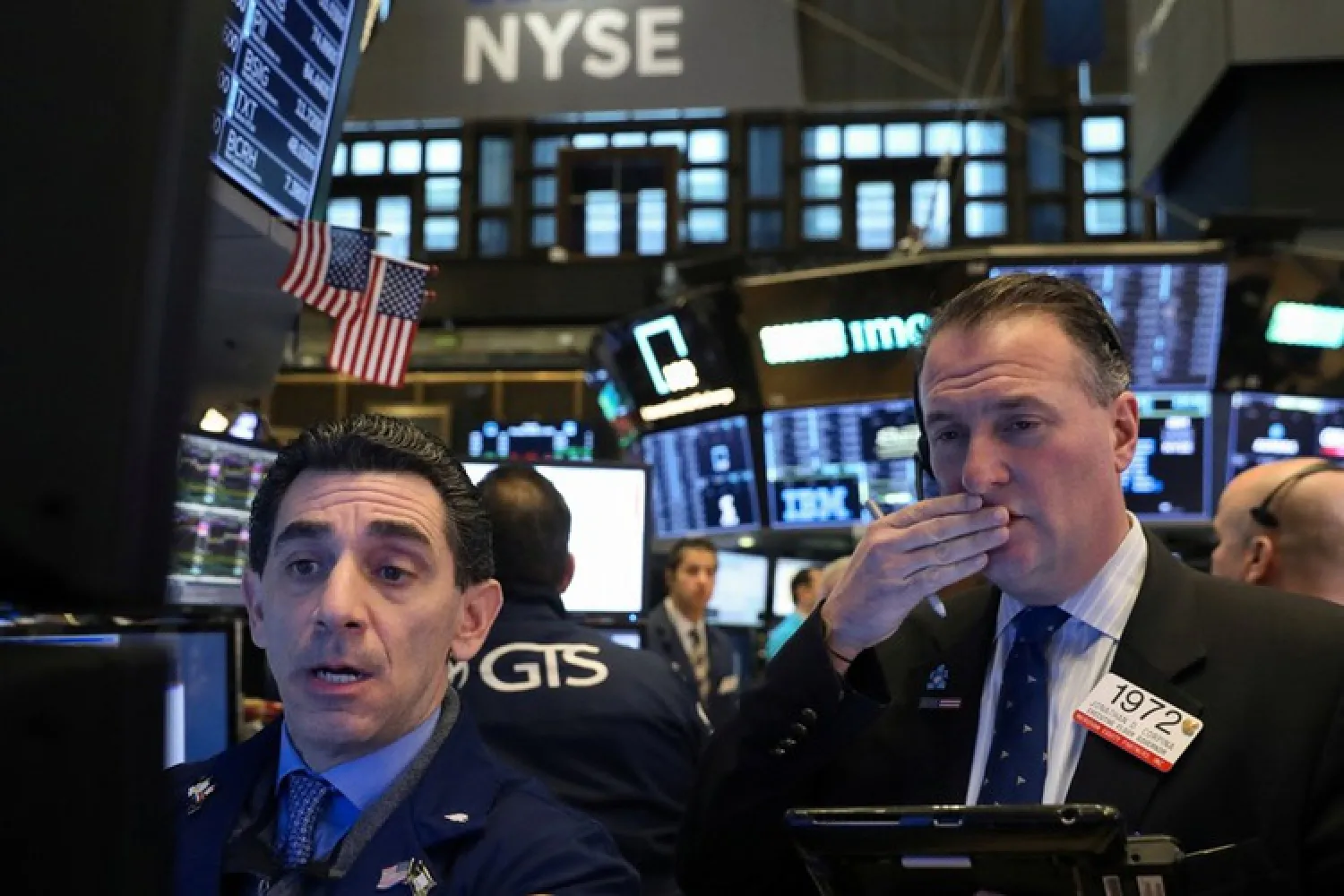
Traders work on the floor of the New York Stock Exchange (NYSE) in New York, US, January 17, 2019. REUTERS/Brendan McDermid
TT

Stocks Bask in Trade Optimism

Traders work on the floor of the New York Stock Exchange (NYSE) in New York, US, January 17, 2019. REUTERS/Brendan McDermid

Global stocks jumped to their highest in more than a month on Friday after a report suggested progress towards resolving the trade dispute between the United States and China.

E-mini futures for the S&P 500 index were up about 0.2 percent and Dow futures were up about 0.3 percent, indicating a higher open on Wall Street.

Trade-exposed indexes and stocks gained the most, with autos rising nearly 2 percent and Germany's exporter-heavy DAX up 1.5 percent.

The gains followed the lead of stocks in Asia overnight, which in turn took their cue from Wall Street's performance on Thursday.

The Wall Street Journal reported on Thursday that US Treasury Secretary Steven Mnuchin discussed lifting some or all tariffs imposed on Chinese imports and suggested offering a tariff rollback during trade discussions scheduled for Jan. 30.

US stocks rallied on the report but pared some of the gains after the Treasury denied Mnuchin had made any such recommendation. The Journal also reported that US Trade Representative Robert Lighthizer resisted Mnuchin's idea.

MSCI's broadest index of Asia-Pacific shares outside Japan added 0.75 percent. The index has gained 1.5 percent this week. The Shanghai Composite Index was up 1.4 percent.

Australian stocks rose half a percent, South Korea's KOSPI advanced 0.8 percent and Japan's Nikkei gained more than 1 percent to a one-month high.

The gains across regions helped lift the MSCI All-Country World Index to its highest in more than a month. The index, which tracks stocks across 47 countries, was set for its fourth straight weekly gain, its longest weekly winning streak in six months. It was last up almost half a percent.

Chinese Vice Premier Liu He will visit the United States on Jan. 30 and 31 for the latest round of trade talks aimed at resolving the dispute between the world's two largest economies.

Indicators released recently showed signs that the Chinese economy is losing momentum.

A report due on Monday is expected to show China's fourth-quarter economic growth slowed to its weakest since the global financial crisis, according to a Reuters poll, as demand faltered at home and abroad.

Against a basket of currencies, the dollar was set for its first weekly rise in five, though it was flat on the day.

The euro rose 0.1 percent to $1.14040. It was on track for a weekly loss of 0.7 percent.

The 10-year Treasury yield stood at 2.7716 percent, its highest in three weeks.

The pound was 0.4 percent lower at $1.2932, after climbing to a two-month peak of $1.3001 on hopes that Britain can avoid a no-deal Brexit.

British retail sales fell for the first time since March during the three months to December, confirming a slowdown in consumer spending as Brexit draws near.

Prime Minister Theresa May survived a vote of confidence this week, removing some political uncertainty for now. The longer-term prospects for Britain and its markets remained far from clear, though.

US crude oil futures extended Thursday's gains., adding 1.5 percent to $52.84 per barrel. Brent crude was up 1.3 percent at $61.99 per barrel and on track to gain roughly 2 percent on the week.

Elsewhere in commodities, palladium was 1.2 percent higher at $1,412.50 an ounce after rising to an all-time high of $1,434.50 overnight.

Demand has recently outstripped supply for the metal, used in emissions-reducing catalytic converters for cars. Palladium also appeared to get a boost from hopes for further government stimulus in China, the world's biggest auto market.

Spot gold was down half a percent at $1,285.03 an ounce, after relinquishing its spot as the most expensive precious metal to palladium early in December.


Saudi Stocks Rebound 0.9%, Recouping Previous Session's Losses

An investor monitors stock market data on a screen at the Saudi Exchange (Tadawul) in Riyadh (Reuters)
TT

Saudi Stocks Rebound 0.9%, Recouping Previous Session's Losses

An investor monitors stock market data on a screen at the Saudi Exchange (Tadawul) in Riyadh (Reuters)

Saudi stocks closed higher on Monday, recovering some of the losses sustained in the previous session as heavyweight shares strengthened and the banking sector advanced.

The benchmark Tadawul All Share Index (TASI) rose 0.90% to close at 10,106 points, gaining 90 points. Total trading value reached approximately SAR 3.5 billion ($933 million).

The index had fallen 0.8% on Sunday amid selling pressure on heavyweight stocks.

Anaam International Holding Group, Fitaihi Holding Group and Raoom were among the session's top gainers, rising between 7% and 9% to close at SAR 11.93, SAR 2.11 and SAR 72.30, respectively.

On the losing side, Almunajem Foods led the declines, shedding 9.20% to SAR 49.94, followed by Saudi Paper Manufacturing Co., which fell 6.18% to SAR 48.88, and Alamar Foods, which dropped 4.63% to SAR 44.06.

At the sector level, banks led the gains, advancing 1.60%, supported by a 2.06% rise in Bank AlJazira shares, which closed at SAR 10.89.


Tesla to Refund Many Cybertruck Deposits as Demand Exceeds Production, Musk Says

Tesla Cybertruck electric vehicles sit parked in a storage lot in San Diego, California on April 11, 2025. (AFP)
TT

Tesla to Refund Many Cybertruck Deposits as Demand Exceeds Production, Musk Says

Tesla Cybertruck electric vehicles sit parked in a storage lot in San Diego, California on April 11, 2025. (AFP)

Tesla will have to refund Cybertruck deposits for many customers as orders far exceed production capacity, CEO Elon Musk said, following last week's announcement that the electric vehicle maker is winding down the pickup truck's production at its Texas factory.

"We will try ‌to make ‌as many as ‌possible ⁠before shutting down the ⁠line in about 8 months, but will have to return deposits for a lot of people," the billionaire said in a post on X on Monday.

The comments ⁠come after Musk said ‌Tesla would ‌add an extra production shift to fulfill outstanding ‌Cybertruck orders before dismantling the production ‌line next year to expand output of its Cybercab robotaxi.

The production winddown is slated for mid-2027, Musk announced on ‌Friday, with the resources being redirected to the Cybercab, a vehicle ⁠central ⁠to the automaker's autonomous-driving ambitions.

Tesla began delivering the Cybertruck in late 2023, but demand has fallen far short of Musk's expectations. US sales fell 48% to 20,237 units last year, according to Kelley Blue Book, well below Musk's earlier projection that annual Cybertruck sales could reach 250,000 vehicles.


China Extends Suspension of New Rare Earth Controls Until January

A mining machine is seen at the Bayan Obo mine containing rare earth minerals, in Inner Mongolia, China July 16, 2011. (Reuters)
TT

China Extends Suspension of New Rare Earth Controls Until January

A mining machine is seen at the Bayan Obo mine containing rare earth minerals, in Inner Mongolia, China July 16, 2011. (Reuters)

China on Monday announced a two-month extension of export-control waivers due to expire this month, preserving part of a wide-ranging deal struck after a summit between Presidents Xi Jinping and Donald Trump.

China introduced export controls on certain rare earths ‌in April 2025, ‌only to expand ‌them ⁠further in October ⁠of that year, dramatically widening their scope and also adding new controls on certain diamonds with industrial applications and lithium battery technology.

The measures were then ⁠paused for one year last ‌November after ‌a summit in South Korea ‌between Xi and Trump.

The Ministry of ‌Commerce said in a short statement on Monday that the pause would be extended for two months ‌until January 10. It gave no other details.

The extension ⁠is ⁠part of a broader suspension of trade countermeasures and tariffs announced by China on Monday as it negotiates with Washington over an enduring trade deal.

Trump is set to travel to Shenzhen in southern China later this month for an APEC leaders summit, where he is expected to meet with Xi.