


Leeds’ Spying Should Be Treated as a Form of Entertainment, Not Cheating

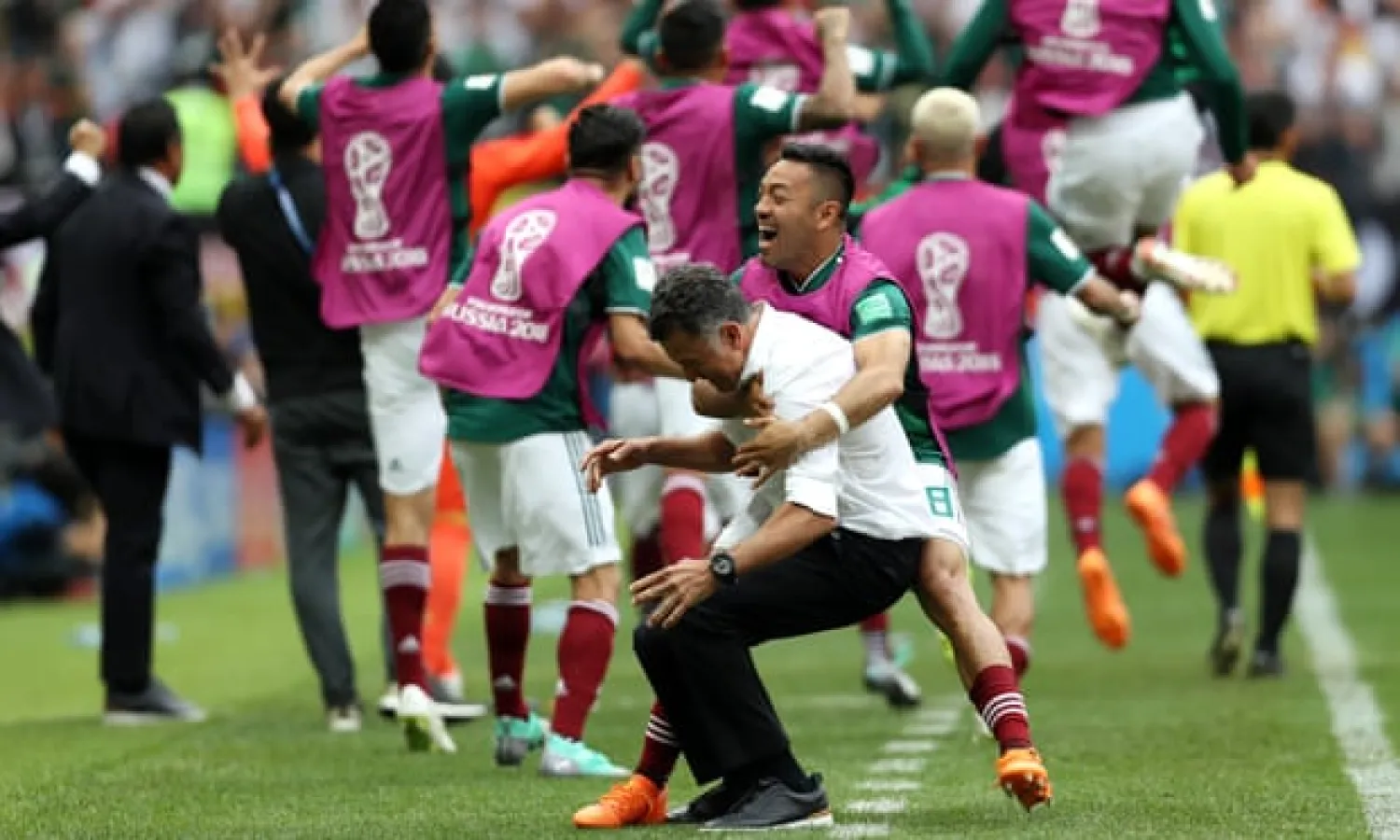
 Juan Carlos Osorio (centre) lived within sight of Liverpool’s Melwood training ground for two years. Last year his Mexico team reached the last 16 of the World Cup. Photograph: Clive Rose/Getty Images
Juan Carlos Osorio (centre) lived within sight of Liverpool’s Melwood training ground for two years. Last year his Mexico team reached the last 16 of the World Cup. Photograph: Clive Rose/Getty Images
TT

Leeds’ Spying Should Be Treated as a Form of Entertainment, Not Cheating

 Juan Carlos Osorio (centre) lived within sight of Liverpool’s Melwood training ground for two years. Last year his Mexico team reached the last 16 of the World Cup. Photograph: Clive Rose/Getty Images
Juan Carlos Osorio (centre) lived within sight of Liverpool’s Melwood training ground for two years. Last year his Mexico team reached the last 16 of the World Cup. Photograph: Clive Rose/Getty Images

One hopes Marcelo Bielsa does not get punished too severely after admitting that he spies on everyone. The Leeds United manager confessed immediately when caught blatantly watching Derby County training sessions, contacting Frank Lampard and taking responsibility for the stunt, and was reminded by his own club of Leeds’s “integrity and honesty”. That alone should have been enough to conclude this entertaining episode with the wry smile it deserved, although Bielsa gave it fresh impetus with his honesty offensive.

Such disarming frankness and willingness to cooperate with official investigations ought to be welcomed. It is certainly preferable to Lampard’s attempts to gain the moral high ground when he is aware that Chelsea used to do much the same thing under José Mourinho.

Perhaps Bielsa ought to have cottoned on a bit quicker to the possibility that what goes without comment in South America might be frowned on in England, but differences in custom and practice between footballing cultures are there to be enjoyed, not censured. Bielsa may well have acted against the spirit of the EFL clubs’ charter, whatever that is, but even if you could track such a document down you would not find anything specific about lurking in bushes to get a glimpse of rival preparations.

When the transgression was first discovered it was reported that the interloper was wearing camouflage gear and carrying bolt-cutters. That sounded exciting, borderline illegal in fact, though it was later toned down to sportswear and a pair of pliers. And the unnamed individual turned up in a Leeds United vehicle. Even more hilariously, Derby were able to work out he had done it before. A rustling in the undergrowth that had been noticed but not acted upon earlier in the season turned out to have taken place on the eve of Leeds’s 4-1 win at Pride Park back in August.

The Leeds manager should probably accept that such skulduggery is considered bad form in England, though it is worth remembering that the police who turned up at the latest incident did not make an arrest. No crime had been committed. Derby’s training ground is overlooked by private houses anyway. The Leeds spy was spotted by a resident rather than a member of the football club’s staff, and though Lampard is right to say he ought not to have to conduct a search of the perimeter fence before each training session, his point underlines the fact that not many training facilities are that private.

Manchester City, before they moved to the Etihad campus, a purpose-built city-centre location, were always complaining that they had no privacy at Carrington because a public footpath bordered their land. All any interested party – usually press but possibly opponents – would need was a stepladder or the ability to poke a lens through a hedge.

Liverpool’s Melwood training ground has a reasonably substantial wall around its perimeter, though it is hardly one of forbidding height. Again, the training ground is surrounded by private houses, and not only would residents rightly object were Liverpool to build prison-style walls around the place, those inside the facility would suffer a loss of light. Liverpool have plans to move out to a greenfield site on the outskirts eventually, but for now the sight of onlookers using wheelie bins and stepladders to gain a peek at the players in training is a familiar one during school holidays.

Just over 20 years ago in fact, a Colombian studying a degree course in football science at Liverpool’s John Moores university became so friendly with a family living alongside Melwood through borrowing a small table to see over the wall that he ended up moving in as a lodger. Juan Carlos Osorio stayed for two years, most of the time living in a bedroom that gave him an unrestricted view of Liverpool’s training routines. He is currently the manager of Paraguay but gained his greatest prominence last summer as coach of the Mexico team that defeated Germany in the World Cup in Russia.

There is an obvious difference between snooping to further one’s education and doing it to undermine an opponent in a competitive match, but the bottom line is that training grounds are not sacrosanct. If anyone wants to see what goes on badly enough, it can usually be managed, and when drone technology is developing at such a pace there is probably no point either in clubs investing in mountain hideaways with reinforced security.

Bielsa has been accused of cheating, though checking out the opposition in advance could just as easily be viewed as part of the game. Some will regard his actions more generously as obsessive attention to detail, a coach going about his work with a thoroughness that is rare. While this is clearly a grey area, at least until the EFL or the FA hands down some sort of protocol that everyone can sign up to, defenders of Bielsa might also point out that not every coach or manager would be able to interpret or act upon such snippets of information that might be gleaned from a drone or a spy in the bushes.

Equally, though some managers prefer to be as secretive as possible, others are relaxed about gameplans becoming public knowledge. Most clubs do not alter their playing styles that much from game to game, after all. A coach might adapt his formation for a particular game or opponent, switching to three at the back for instance or deploying a different striker, but he is not going to keep doing that week after week. Most gameplans are on very public view every Saturday afternoon, in front of thousands of paying spectators.

Perhaps rugby is a more straightforward game than football, but one of the best quotes on the overrated nature of gameplans came from John Monie, the Australian who was in charge of Wigan for four seasons in the early 90s and won the cup and league double in every one. “I’m sick of hearing about gameplans – ours isn’t a secret,” he said. “If any opponents are listening, I can tell you what we plan to do. We are going to run all over you for the first half hour then have a look and see what’s left.”

The Guardian Sport


Chelsea Injuries up 44% After Club World Cup but Report Says Event Has Had ‘Minimal’ Impact

Chelsea's Reece James, center, lifts the trophy following the Club World Cup final soccer match between Chelsea and PSG at MetLife Stadium in East Rutherford, N.J., Sunday, July 13, 2025. (AP)
TT

Chelsea Injuries up 44% After Club World Cup but Report Says Event Has Had ‘Minimal’ Impact

Chelsea's Reece James, center, lifts the trophy following the Club World Cup final soccer match between Chelsea and PSG at MetLife Stadium in East Rutherford, N.J., Sunday, July 13, 2025. (AP)

Chelsea suffered a 44% spike in injuries after competing in the supersized Club World Cup this year, according to findings published on Tuesday.

But the newly expanded tournament has so far had a “minimal impact” on injuries overall, the latest edition of the Men’s European Football Injury Index found.

There was fierce opposition to FIFA's new flagship club event when it was confirmed in 2023 that it would increase from seven to 32 teams, with players' unions warning of physical and mental burnout of players due to an ever expanding match schedule. But FIFA pressed ahead and staged the tournament in the United States in June-July.

Chelsea went on to win the inaugural competition, receiving the trophy from US President Donald Trump at MetLife Stadium and taking home prize money of around $125 million. But, according to the Index, from June-October, Chelsea picked up more injuries — 23 — than any of the nine clubs from Europe's top leagues that participated in the Club World Cup.

They included star player Cole Palmer, and was a 44% increase on the same period last year.

While Chelsea, which played 64 games over the entire 2024-25 season, saw an increase in injuries, the Index, produced by global insurance firm Howden, found that overall there was a decrease.

“In principle you would expect this increased workload to lead to an increase in the number of injuries sustained, as a possible rise in overall injury severity,” the Index report said, but added: “The data would suggest a minimal impact on overall injury figures.”

Despite the figures, the authors of the report accept it was too early to assess the full impact of the Club World Cup, with the findings only going up to October.

“We would expect to see the impact to spike in that sort of November to February period,” said James Burrows, Head of Sport at Howden. “What we’ve seen previously is that’s where the impact is seen from summer tournaments."

Manchester City has sustained 22 since the tournament, which is the highest among the nine teams from Europe's top leagues — England, Spain, Italy, Germany and France.

Those teams have recorded 146 injuries from June-October, which is down on the previous year's figure of 174.

From August-October that number is 121, the lowest for that three-month period in the previous six years of the Index.


Sunderland Worst Hit by Losing Players to African Cup of Nations 

14 December 2025, United Kingdom, London: Sunderland's Habib Diarra (L) and Leeds United's Gabriel Gudmundsson battle for the ball during the English Premier League soccer match between Brentford and Leeds United at the Gtech Community Stadium. (dpa)
TT

Sunderland Worst Hit by Losing Players to African Cup of Nations 

14 December 2025, United Kingdom, London: Sunderland's Habib Diarra (L) and Leeds United's Gabriel Gudmundsson battle for the ball during the English Premier League soccer match between Brentford and Leeds United at the Gtech Community Stadium. (dpa)

Premier League Sunderland will have to do without six players over the next few weeks and are the club worst hit as the Africa Cup of Nations takes its toll on European clubs competing over the holiday season.

Sunderland, eighth in the standings, had four of their African internationals in action when they beat Newcastle United on Sunday, but like 14 other English top-flight clubs will now lose those players to international duty.

The timing of the African championship, kicking off in Morocco on Sunday and running through to January 18, has long been an irritant for coaches, with leagues in Belgium, France, Germany, Italy, Netherlands, Portugal, and Spain also affected.

Hosting the tournament in the middle of the season impacts around 58% of the players at the Cup of Nations, though the Confederation of African Football did try to mitigate the impact by moving the start to before Christmas, so it is completed before the next round of Champions League matches.

The impact on European clubs was also lessened by allowing them to release players seven days, rather than the mandatory 14 days, before the tournament, meaning they could play for their clubs last weekend.

Sunderland's Congolese Arthur Masuaku and Noah Sadiki, plus full back Reinildo (Mozambique), midfielder Habib Diarra (Mali), and attackers Chemsdine Talbi (Morocco) and Bertrand Traore (Burkina Faso) have now departed for Morocco.

Ironically, Mohamed Salah’s absence from Liverpool to play for Egypt should lower the temperature at the club after his recent outburst against manager Arne Slot, but Manchester United will lose three players in Noussair Mazraoui, Bryan Mbeumo and Amad Diallo, who scored in Monday’s 4-4 draw with Bournemouth.

France is again the country with the most players heading to the Cup of Nations, and with 51 from Ligue 1 clubs. But their absence is much less impactful than previously as Ligue 1 broke after the weekend’s fixtures and does not resume until January 2, by which time the Cup of Nations will be into its knockout stage.

There are 21 players from Serie A clubs, 18 from the Bundesliga, and 15 from LaLiga teams among the 24 squads at the tournament in Morocco.


Rodgers Takes Charge of Saudi Team Al-Qadsiah After Departure from Celtic 

Then-Celtic head coach Brendan Rodgers greets supporters after a Europa League soccer match between Red Star and Celtic at Rajko Mitic Stadium in Belgrade, Serbia, Sept. 24, 2025. (AP)
TT

Rodgers Takes Charge of Saudi Team Al-Qadsiah After Departure from Celtic 

Then-Celtic head coach Brendan Rodgers greets supporters after a Europa League soccer match between Red Star and Celtic at Rajko Mitic Stadium in Belgrade, Serbia, Sept. 24, 2025. (AP)

Brendan Rodgers has returned to football as the coach of Saudi Arabian club Al-Qadsiah, six weeks after resigning from Scottish champion Celtic.

Al-Qadsiah, whose squad includes Italian striker Mateo Retegui and former Real Madrid defender Fernandez Nacho, is in fifth place in the Saudi Pro League in its first season after promotion.

Rodgers departed Celtic on Oct. 27 and has opted to continue his managerial career outside Britain for the first time, having previously coached Liverpool, Leicester and Swansea.

In its statement announcing the hiring of Rodgers on Tuesday, Al-Qadsiah described him as a “world-renowned coach” and said his arrival “reflects the club’s ambitious vision and its rapidly growing sporting project.”

Aramco, the state-owned Saudi oil giant, bought Al-Qadsiah in 2023 in a move that has helped to transform the club’s status.

“This is a landmark moment for the club,” Al-Qadsiah chief executive James Bisgrove said. “The caliber of his experience and track record of winning reflects our ambition and long-term vision to establish Al-Qadsiah as one of Asia’s leading clubs.”

Rodgers is coming off winning back-to-back Scottish league titles with Celtic, where he won 11 major trophies across his two spells. He also won the FA Cup with Leicester.

Al-Qadsiah's last two coaches were former Liverpool striker Robbie Fowler and former Spain midfielder Michel.
