

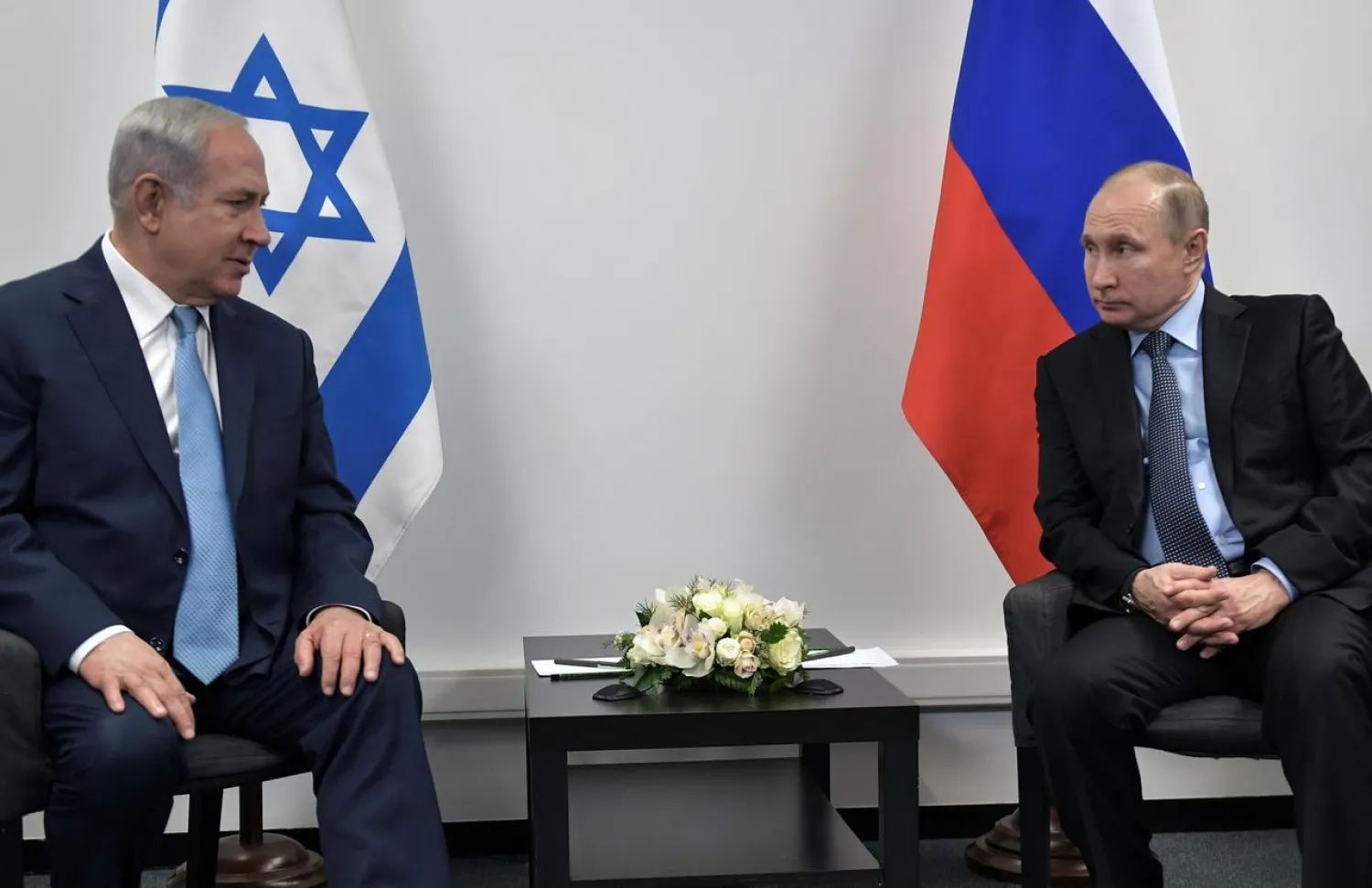

Russia, Israel Discuss Cooperation to Prevent Incidents in Syria

Russian President Vladimir Putin and Israeli Prime Minister Benjamin Netanyahu attend a meeting at the Jewish Museum and Tolerance Centre in Moscow, Russia January 29, 2018. Sputnik/Alexei Nikolsky/Kremlin via REUTERS
TT

Russia, Israel Discuss Cooperation to Prevent Incidents in Syria

Russian President Vladimir Putin and Israeli Prime Minister Benjamin Netanyahu attend a meeting at the Jewish Museum and Tolerance Centre in Moscow, Russia January 29, 2018. Sputnik/Alexei Nikolsky/Kremlin via REUTERS

Moscow has been stepping up its Syria mediation role, especially as a top Russian delegation tasked with handling Syria developments chatted with Israeli Prime Minister Benjamin Netanyahu. Talks focused on boosting cooperation to dodge conflict.

A Turkish army delegation has also set course to Moscow Thursday, with an agenda concerning Idlib, north Syria. Russian Foreign Minister Sergey Lavrov, for his part, met with his Iraqi counterpart Mohammad Ali Al-Hakeem and discussed Syria.

Netanyahu held a meeting Tuesday with Russian Special Presidential Envoy for Syria Alexander Lavrentyev and Deputy Foreign Minister Sergey Vershinin in Jerusalem. The sides discussed the situation in Syria, Iran’s activity in the conflict-torn state and security coordination mechanism between Israeli and Russian military.

“Among the issues discussed were Iran and the situation in Syria, and strengthening the security coordination mechanism between the militaries in order to prevent friction. The Russian representatives reiterated Russia’s commitment to the maintenance of Israel’s national security”, Netanyahu’s press service said in a statement published on Twitter.

Moscow-Tel Aviv relations were put to test following the fatal crash of the Russian IL-20 plane in September 2018 that the Russian Defense Ministry holds the Israeli Air Force responsible for.

Since that time, Russia and Israel have repeatedly discussed on different levels the operation of the bilateral communications channel between the Russian Hmeimim airbase in Syria and the Israeli Air Force to prevent incidents.

The visit by Vershinin and Lavrentyev came days after a high-level Russian military delegation arrived in Israel and held meetings in which they discussed the overall situation in Syria, especially the buildup of Iran troops, as well as improving the Russian-Israeli communication channel aimed at preventing friction between the two armies in Syrian airspace.

Meanwhile, a delegation from the Turkish Ministry of Defense has been sent to Moscow for talks with the Russian military on the deteriorating situation in Idlib.

Russian sources did not elaborate on the talks being held, but well-informed diplomats tied the visit to the agreement struck between President Vladimir Putin and his Turkish counterpart Recep Tayyip Erdogan on coordinating military operations to resolve the situation in Idlib.

The northern province has recently been overrun by extremist Syrian opposition factions, whom Turkey is backing in a buffer zone arrangement. However, Turkey failed to remove extremists from the area, which was a provision within the Putin-Erdogan deal, calling for a possible military campaign to regain control of the violence-ridden area.

Moscow has repeatedly expressed to the Turkish side, in recent weeks, its concern about the security situation in the province of Idlib.



EU to Slash Asylum Cases from 7 Nations Deemed Safe

FILE - A convoy of buses carry Syrian refugees who return home from Lebanon, arrive at the Syrian border crossing point, in Jdeidet Yabous, Syria, Tuesday, July 29, 2025. (AP Photo/Omar Sanadiki, File)
TT

EU to Slash Asylum Cases from 7 Nations Deemed Safe

FILE - A convoy of buses carry Syrian refugees who return home from Lebanon, arrive at the Syrian border crossing point, in Jdeidet Yabous, Syria, Tuesday, July 29, 2025. (AP Photo/Omar Sanadiki, File)

The European Union on Thursday said it would drastically reduce asylum claims from seven nations in Africa, the Middle East and Asia by considering them safe countries of origin, prompting widespread outrage from human rights groups on International Migrants' Day.

An agreement between European Parliament and the European Council, or the group of the 27 EU heads of state, said that the countries would be considered safe if they lack “relevant circumstances, such as indiscriminate violence in the context of an armed conflict.”

Asylum requests by people from Bangladesh, Colombia, Egypt, Kosovo, India, Morocco and Tunisia will be "fast-tracked, with applicants having to prove that this provision should not apply to them,” read the announcement of the agreement. “The list can be expanded in the future under the EU’s ordinary legislative procedure.”

In 2024, EU nations endorsed sweeping reforms to the bloc’s failed asylum system. The rules were meant to resolve the issues that have divided the 27 countries since well over 1 million migrants swept into Europe in 2015, most fleeing war in Syria and Iraq.

Under the Pact on Migration and Asylum, which goes into force in June 2026, people can be sent to countries deemed safe, but not to those where they face the risk of physical harm or persecution.

According to The Associated Press, Amnesty International EU advocate Olivia Sundberg Diez said the new measures were “a shameless attempt to sidestep international legal obligations" and would endanger migrants.

French MEP Mélissa Camara said the safe countries of origins concept and others agreed to by the Council and Parliament “opens the door to return hubs outside the EU’s borders, where third-country nationals are sometimes subjected to inhumane treatment with almost no monitoring” and “undoubtedly places thousands of people in exile in situations of danger.”

Céline Mias, the EU director of the Danish Refugee Council said that "we are deeply worried that this fast-track system will fail to protect people in need of protection, including activists, journalists and marginalized groups in places where human rights are clearly under attack.”

Alessandro Ciriani, an Italian MEP with the European Conservatives and Reformists group, said the designation sends a firm message that the EU has toughened its borders.

“Europe wants enforceable rules and shared responsibility. Now this commitment must become operational: effective returns, structured cooperation with third countries and real measures to support EU member states,” he said.

He said that clear delineations of safe and unsafe nations would rid the EU of “excessive interpretative uncertainty” that led to a kind of paralysis for national decision makers over border controls.

The measures also allows individual nations within the bloc to designate other countries safe for their own immigration purposes.


Rubio Says US Sanctioning ICC Judges for Targeting Israel

US Secretary of State Marco Rubio speaks to traveling journalists at the John C. Munro Hamilton International Airport in Hamilton, Ontario, on November 12, 2025 after the G7 foreign ministers meeting. (Photo by Mandel NGAN / POOL / AFP)
TT

Rubio Says US Sanctioning ICC Judges for Targeting Israel

US Secretary of State Marco Rubio speaks to traveling journalists at the John C. Munro Hamilton International Airport in Hamilton, Ontario, on November 12, 2025 after the G7 foreign ministers meeting. (Photo by Mandel NGAN / POOL / AFP)

US Secretary of State Marco Rubio said on Thursday that the US was sanctioning two judges of the International Criminal Court for targeting Israel.

"Today, I am designating two International Criminal Court (ICC) judges, Gocha Lordkipanidze of Georgia and Erdenebalsuren Damdin of Mongolia, pursuant to Executive Order 14203," Rubio said in a statement, referring to the order President Donald Trump signed in February sanctioning the ICC, Reuters reported.

"These individuals have directly engaged in efforts by the ICC to investigate, arrest, detain, or prosecute Israeli nationals, without Israel's consent," he said.

The United States and Israel are not members of the ICC.

The US sanctions in February include freezing any US assets of those designated and barring them and their families from visiting the United States.


US Imposes Sanctions on Vessels Linked to Iran, Treasury Website Says

A crew member raises the Iranian flag on Iranian oil tanker Adrian Darya 1, previously named Grace 1, as it sits anchored after the Supreme Court of the British territory lifted its detention order, in the Strait of Gibraltar, Spain, August 18, 2019. REUTERS/Jon Nazca
TT

US Imposes Sanctions on Vessels Linked to Iran, Treasury Website Says

A crew member raises the Iranian flag on Iranian oil tanker Adrian Darya 1, previously named Grace 1, as it sits anchored after the Supreme Court of the British territory lifted its detention order, in the Strait of Gibraltar, Spain, August 18, 2019. REUTERS/Jon Nazca

The United States imposed sanctions on Thursday on 29 vessels and their management firms, the Treasury Department said, as Washington continues targeting Tehran's "shadow fleet" it says exports Iranian petroleum and petroleum products, Reuters reported.

The targeted vessels and companies have transported hundreds of millions of dollars of the products through deceptive shipping practices, Treasury said.

Thursday's action also targets businessman Hatem Elsaid Farid Ibrahim Sakr, whose companies are associated with seven of the vessels cited, as well as multiple shipping companies.