


Sudan: Tear Gas Fired at Mosque in Omdurman, Mahdi Targeted

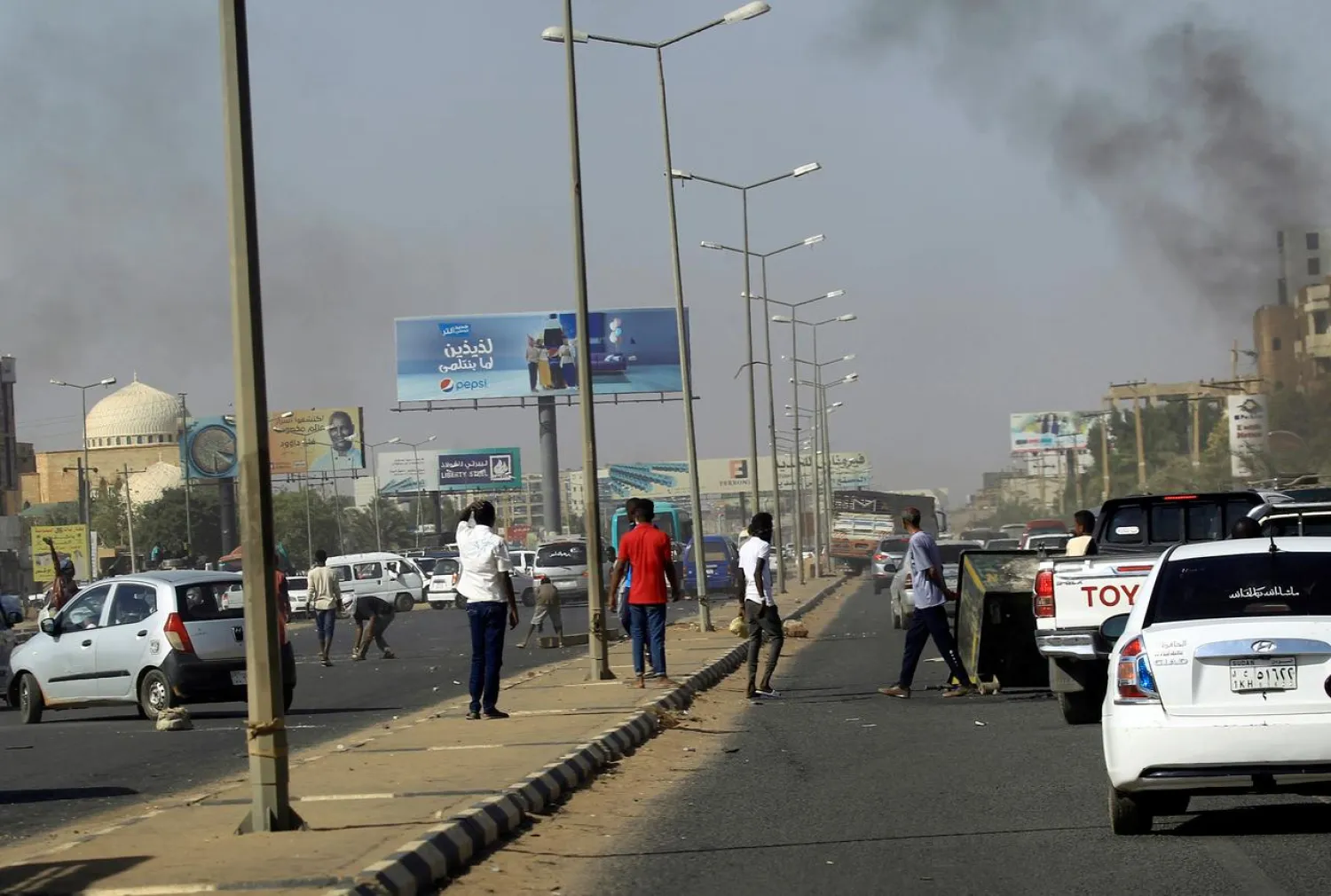
Cars block a road as Sudanese demonstrators stage an anti-government protests in Khartoum, Sudan January 25, 2019. (Reuters)
TT

Sudan: Tear Gas Fired at Mosque in Omdurman, Mahdi Targeted

Cars block a road as Sudanese demonstrators stage an anti-government protests in Khartoum, Sudan January 25, 2019. (Reuters)

Sudanese security forces fired tear gas at a landmark mosque in Khartoum on Friday after the Muslim noon prayers and targeted the car of religious and political leader Sadiq al-Mahdi.

The Umma party, led by Mahdi, said in a statement that security forces attacked worshippers soon after noon prayers, firing tear gas “extensively” into the courtyard of al-Sayed Abd al-Rahman al-Mahdi mosque, one of the capital’s main mosques.

“Firing at the mosque and the vehicle of Imam Sadiq al-Mahdi, beating worshippers, pointing guns in their faces and besieging the mosque... resulted in the wounding of several worshippers, while others suffered suffocation,” the statement said.

Protests and demonstrations continued after Friday prayers in a number of areas of the capital and other cities of the country, which the security services faced with tear gas.

Sudan’s Teachers Committee accused security agents of involvement in the assassination of teacher Ahmed al-Khair who died in Sudan’s southern province Kassala, in an incident that shook the country.

The committee said: "It has been proved that the teacher Ahmed al-Khair was exposed to severe beating on multiple areas on his body, causing bruises on the back, kidneys and leg," adding that the government is trying to accuse innocent persons of poisoning him and others.

The committee rejected any investigation not done by an “impartial” committee, adding that any investigation not done under the supervision of the government and state institutions is unreliable.

Khair was detained by Sudanese authorities after protests in the town of Khashm el-Girba in Kassala.

Meanwhile, Sudanese Professionals Association (SPA) issued a statement Friday announcing new demonstrations taking place across Khartoum after Friday prayers amid preparations for evening demonstrations in neighborhoods and cities.

A young demonstrator told Asharq Al-Awsat that they will continue to protest until, President Omar al-Bashir and his government, step down, asserting that they will not stop until their demands are achieved.

The Professionals Association also announced a protest on Sunday starting from the "women's prison" in Omdurman, in solidarity with women detainees.

It is noteworthy that many women and girls have been detained for three weeks. They were arrested during demonstrations or were taken from their homes and workplaces, along with leaders of political forces and civil society organizations, and other opposition activists.

The President admitted saying most protesters are females and young women.

Since December 19, the country has been witnessing continuous demonstrations and protests, which the security authorities have faced with excessive violence, killing 31 citizens according to official numbers, more than 50, as confirmed by the opposition National Umma Party. In addition, hundreds had been wounded and detained, as the government admitted that they were in the range of 800 detainees.

In related news, the “Enough” project strongly denounced the deadly violence the Sudanese regime has unleashed against peaceful protesters.

The Project called on the US government, European governments, the African Union, and international community to hold the Khartoum regime accountable as it attempts to silence the Sudanese peoples’ struggle for democracy and good governance.

Enough Project Director John Prendergast called to immediately suspend talks focused on further normalizing relations with Sudan, including any steps that would result in the possible removal of Sudan from the State Sponsors of Terrorism List.

In 1993, US enlisted Sudan on State Sponsor of Terrorism List., when it provided sanctuary to al-Qaeda leader Osama bin Laden between 1992 and 1996. Relations between the two countries deteriorated when the government launched a campaign to stop a rebellion in the western Darfur region.

Under former President Barack Obama, relations between the two improved and the US administration welcomed Khartoum's acceptance of South Sudan's independence in 2011, after decades of devastating wars.



EU Condemns Israel's West Bank Control Measures

The Israeli settlement of Har Homa, seen from the West Bank city of Bethlehem, Tuesday, Dec. 17, 2024. (AP)
TT

EU Condemns Israel's West Bank Control Measures

The Israeli settlement of Har Homa, seen from the West Bank city of Bethlehem, Tuesday, Dec. 17, 2024. (AP)

The European Union on Monday condemned new Israeli measures to tighten control of the West Bank and pave the way for more settlements in the occupied Palestinian territory, AFP reported.

"The European Union condemns recent decisions by Israel's security cabinet to expand Israeli control in the West Bank. This move is another step in the wrong direction," EU spokesman Anouar El Anouni told journalists.


Atrocities in Sudan's El-Fasher Were 'Preventable Human Rights Catastrophe'

Sudanese displaced people who left El Fasher after its fall, sit in the shade in Tawila at the Rwanda camp reception point on December 17, 2025. (Photo by AFP)
TT

Atrocities in Sudan's El-Fasher Were 'Preventable Human Rights Catastrophe'

Sudanese displaced people who left El Fasher after its fall, sit in the shade in Tawila at the Rwanda camp reception point on December 17, 2025. (Photo by AFP)

The atrocities unleashed on El-Fasher in Sudan's Darfur region last October were a "preventable human rights catastrophe", the United Nations said Monday, warning they now risked being repeated in the neighbouring Kordofan region.


"My office sounded the alarm about the risk of mass atrocities in the besieged city of El-Fasher for more than a year ... but our warnings were ignored," UN rights chief Volker Turk told the Human Rights Council in Geneva.


He added that he was now "extremely concerned that these violations and abuses may be repeated in the Kordofan region".


Arab League Condemns Israel's Decisions to Alter Legal, Administrative Status of West Bank

A general view shows the opening session of the meeting of Arab foreign ministers at the Arab League Headquarters (Reuters)
TT

Arab League Condemns Israel's Decisions to Alter Legal, Administrative Status of West Bank

A general view shows the opening session of the meeting of Arab foreign ministers at the Arab League Headquarters (Reuters)

The General Secretariat of the Arab League strongly condemned decisions by Israeli occupation authorities to impose fundamental changes on the legal and administrative status of the occupied Palestinian territories, particularly in the West Bank, describing them as a dangerous escalation and a flagrant violation of international law, international legitimacy resolutions, and signed agreements, SPA reported.

In a statement, the Arab League said the measures include facilitating the confiscation of private Palestinian property and transferring planning and licensing authorities in the city of Hebron and the area surrounding the Ibrahimi Mosque to occupation authorities.

It warned of the serious repercussions of these actions on the rights of the Palestinian people and on Islamic and Christian holy sites.

The statement reaffirmed the Arab League’s firm support for the legitimate rights of the Palestinian people, foremost among them the establishment of their independent state on the June 4, 1967 borders, with East Jerusalem as its capital.