


PSG's Long and Sometimes Successful Relationship with Brazilian Footballers

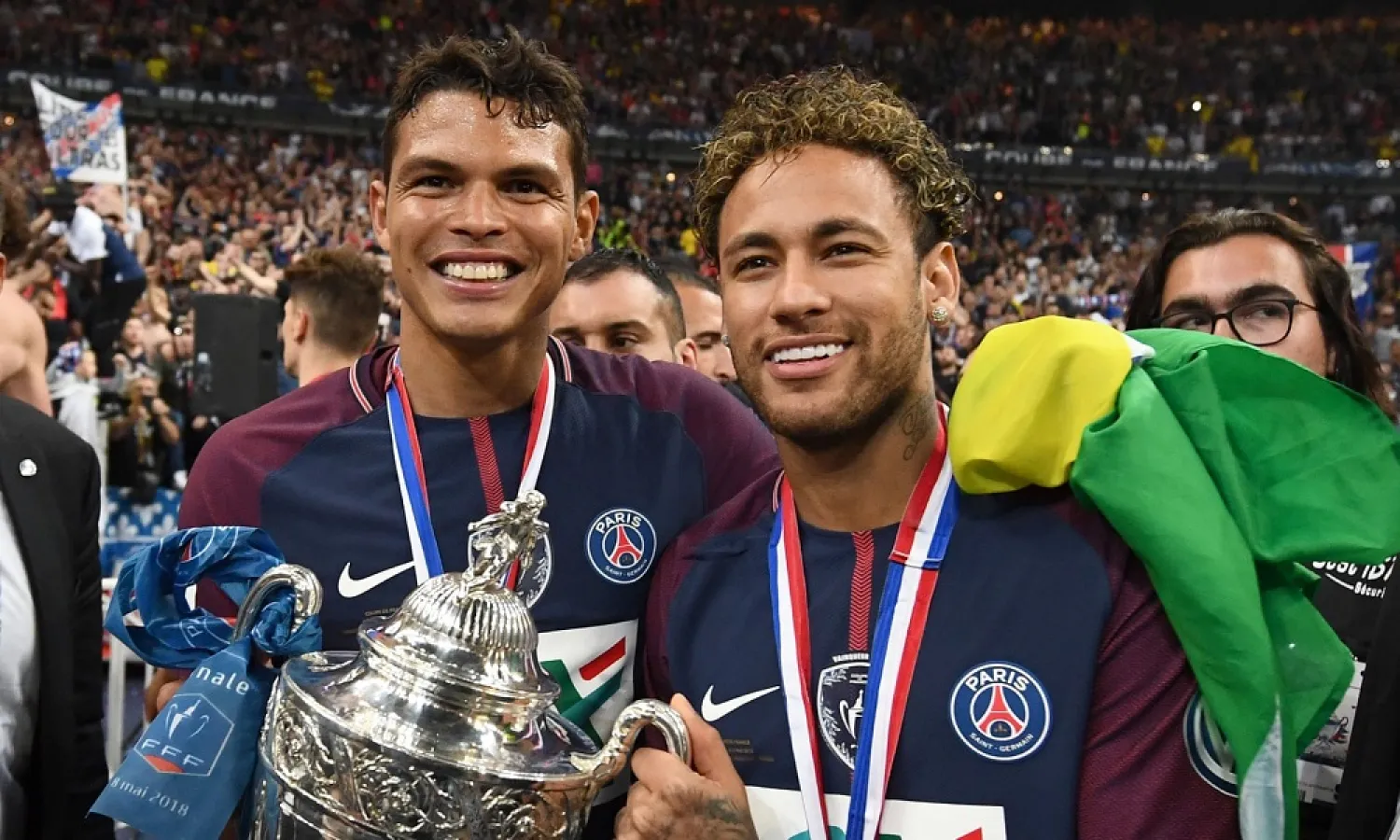
PSG captain Thiago Silva and Brazil captain Neymar celebrate after winning the Coupe de France in 2018. (Getty Images)
TT

PSG's Long and Sometimes Successful Relationship with Brazilian Footballers

PSG captain Thiago Silva and Brazil captain Neymar celebrate after winning the Coupe de France in 2018. (Getty Images)

The build-up to PSG’s tie against Manchester United in the Champions League was centered around a player who is unlikely to even set foot on the pitch in either leg. Such is life with Neymar, a continual source of histrionics wrapped up in a soap opera inside a melodrama. His latest metatarsal drama has inflicted a sense of angst on the PSG camp and perpetuated the creeping sense that, for all the club’s bountiful array of playing talent, they depend to an unhealthy degree on the availability of their precocious Brazilian star.

There is some precedent here as PSG have long had a symbiotic relationship with Brazilian footballers. Indeed, were Neymar more inclined towards reflecting on the long and fruitful association his compatriots have enjoyed with PSG than personal brand building, he would have chosen 33 as his squad number rather than the predictable 10. When he and Dani Alves arrived in the French capital in 2017, the pair became the 32nd and 33rd boys from Brazil to have worn a PSG shirt since the club’s formation in 1971.

The roots of this relationship lie in the complex historical nature of the typical Parisian football fan. This was a city that for decades thumbed a collective nose at run-of-the-mill league fixtures, yet would readily turn out in huge numbers for big European nights and cup finals. Beleaguered club owners came to understand that football was little different to show business for the Parisian footballing public, so to gain their fickle attentions you had to serve up big names and box-office attractions. And no footballer suggests glamour and exoticism like a Brazilian.

This long-running liaison between Paris and Brazil was not love at first sight. The first Brazilian to pitch up in Paris for the club’s debut season in Ligue 1 in 1971 was the World Cup-winning central defender Joel Camargo. It was a signing that proved terribly judged. A player of undoubted pedigree he might have been, but Joel spectacularly failed to adapt to a new country and culture. His performances were substantially affected and he made just two appearances before returning home a matter of months later.

Eight years elapsed before the club were brave enough to dip their toe into the Brazilian market again. The belated second signing was Abel Braga, a central defender with one cap who arrived at the club from Vasco da Gama and proved more dependable than his predecessor, playing regularly over the next two seasons.

After signing just a couple of central defenders during their first two decades of existence, PSG began to adopt a more determinedly Brazil-first transfer policy in the early 1990s – and with some success. In 1991, the club acquired a trio of Brazilians from Portuguese giants Porto and Benfica: the powerful center-back Geraldão, the elegant sweeper Ricardo Gomes (who now manages Bordeaux) and the skilled wide player Valdo. The difference this time was that all three players were already assimilated into European club football and PSG did not have to face the cultural issues encountered with Joel. Ricardo and Valdo would prove to be great successes in Paris.

Two years later the club pulled off something of a coup when they acquired midfield playmaker Raí from São Paulo. Serie A dominated the European game at the time and every Brazilian star wanted to play in Italy. PSG understood they would have to box clever and try to woo players who were not yet prominent on the radar of the traditional giants of the European game. This approach, allied to a willingness to meet the often onerous personal and financial demands made by Brazilian footballers and their coterie of hangers-on, was also particularly evident when they signed Ronaldinho in 2001.

Raí spent five hugely influential years at the club. He also won the USA 94 World Cup while on the books at PSG, although perhaps not in the way he would have planned it. Having started the tournament as Brazil captain and scored in their opening game, he was dropped for the knockout stages and watched as Dunga lifted the trophy in his place. Regardless, his time in France helped PSG establish a valuable relationship with São Paulo. Lucas Moura (now at Tottenham) and Gustavo Hebling (now at Portimonense) both followed this path, and Leonardo – who played for PSG in the mid-1990s and went on to serve as the club’s director of football – also had two spells at São Paulo before arriving in France.

The late-1990s and early 2000s were something of a lost decade for the relationship. Sixteen Brazilians arrived at PSG between 1997 and 2007, but most left having made no meaningful impact whatsoever. The exception was Ronaldinho and even his contributions were fairly fitful during his two seasons at the Parc des Princes, the football too often getting in the way of his party lifestyle. As his manager at the time, Luis Fernández, put it: “I don’t have a problem with him. Ronaldinho has a problem with himself. He doesn’t have the lifestyle of a top-level sportsman.”

Brazilians flooded in from all quarters: the failing “next-big-things” Adailton and Christian, the Serie A midfield liability Vampeta, the successes-in-Saint-Etienne-but-flops-in-Paris Alex Dias and Aloísio. Then there was a succession of anonymous names that even PSG supporters will struggle to recall: César Belli, Denilson (not the famous one or the Arsenal one), André Luiz, Souza, Reinaldo, Everton Santos and Edmilson. Unsurprisingly the club’s abject transfer failings in the Brazilian market mirrored their general failings on the field during this era.

In 2011 the club undertook a necessary reset in their relationship with Brazilians, something that would be further shaped by the huge influx of Qatari money flooding in the following year. The signings of Chelsea center-back Alex and Barcelona full-back Maxwell started a concerted push to install a sizable clique of Seleção players in the capital. Eight seasons later, their first team regularly has more Brazilian players than French players, with captain Thiago Silva, vice-captain Marquinhos, right-back Dani Alves and, of course, Neymar, taking key positions on the pitch and in the dressing room.

PSG’s power brokers clearly want to make the club the go-to European destination for Brazil’s brightest and best stars, so expect that total of 33 to rise sharply in the years to come.

The Guardian Sport


Tottenham Hotspur Sack Head Coach Thomas Frank

(FILES) Tottenham Hotspur's Danish head coach Thomas Frank gestures on the touchline during the English Premier League football match between Burnley and Tottenham Hotspur at Turf Moor in Burnley, north-west England on January 24, 2026. (Photo by Oli SCARFF / AFP)/
TT

Tottenham Hotspur Sack Head Coach Thomas Frank

(FILES) Tottenham Hotspur's Danish head coach Thomas Frank gestures on the touchline during the English Premier League football match between Burnley and Tottenham Hotspur at Turf Moor in Burnley, north-west England on January 24, 2026. (Photo by Oli SCARFF / AFP)/

Thomas Frank was fired by Tottenham on Wednesday after only eight months in charge and with his team just five points above the relegation zone in the Premier League.

Despite leading Spurs to the round of 16 in the Champions League, Frank has overseen a desperate domestic campaign. A 2-1 loss to Newcastle on Tuesday means Spurs are still to win in the league in 2026.

“The Club has taken the decision to make a change in the Men’s Head Coach position and Thomas Frank will leave today,” Tottenham said in a statement. “Thomas was appointed in June 2025, and we have been determined to give him the time and support needed to build for the future together.

“However, results and performances have led the Board to conclude that a change at this point in the season is necessary.”

Frank’s exit means Spurs are on the lookout for a sixth head coach in less than seven years since Mauricio Pochettino departed in 2019.


Marseille Coach De Zerbi Leaves After Humiliating 5-0 Loss to PSG 

Marseille's Italian coach Roberto De Zerbi looks on from the technical area during the French Cup round of 32 football match between FC Bayeux and Olympique de Marseille (OM) at the Michel-d'Ornano Stadium in Caen on January 13, 2026. (AFP) 
TT

Marseille Coach De Zerbi Leaves After Humiliating 5-0 Loss to PSG 

Marseille's Italian coach Roberto De Zerbi looks on from the technical area during the French Cup round of 32 football match between FC Bayeux and Olympique de Marseille (OM) at the Michel-d'Ornano Stadium in Caen on January 13, 2026. (AFP) 

Marseille coach Roberto De Zerbi is leaving the French league club in the wake of a 5-0 thrashing at the hands of PSG in French soccer biggest game.

The nine-time French champions said on Wednesday that they have ended “their collaboration by mutual agreement.”

The heavy loss Sunday at the Parc des Princes restored defending champion PSG’s two-point lead over Lens after 21 rounds, with Marseille in fourth place after the humiliating defeat.

De Zerbi's exit followed another embarrassing 3-0 loss at Club Brugge two weeks ago that resulted in Marseille exiting the Champions League.

De Zerbi, who had apologized to Marseille fans after the loss against bitter rival PSG, joined Marseille in 2024 after two seasons in charge at Brighton. After tightening things up tactically in Marseille during his first season, his recent choices had left many observers puzzled.

“Following consultations involving all stakeholders in the club’s leadership — the owner, president, director of football and head coach — it was decided to opt for a change at the head of the first team,” Marseille said. “This was a collective and difficult decision, taken after thorough consideration, in the best interests of the club and in order to address the sporting challenges of the end of the season.”

De Zerbi led Marseille to a second-place finish last season. Marseille did not immediately announce a replacement for De Zerbi ahead of Saturday's league match against Strasbourg.

Since American owner Frank McCourt bought Marseille in 2016, the former powerhouse of French soccer has failed to find any form of stability, with a succession of coaches and crises that sometimes turned violent.

Marseille dominated domestic soccer in the late 1980s and early 1990s. It was the only French team to win the Champions League before PSG claimed the trophy last year. It hasn’t won its own league title since 2010.


Olympic Fans Hunt for Plushies of Mascots Milo and Tina as They Fly off Shelves 

Fans take selfies with the Olympic mascot Tina at the finish area of an alpine ski, slalom portion of a women's team combined race, at the 2026 Winter Olympics, in Cortina d'Ampezzo, Italy, Tuesday, Feb. 10, 2026. (AP)
TT

Olympic Fans Hunt for Plushies of Mascots Milo and Tina as They Fly off Shelves 

Fans take selfies with the Olympic mascot Tina at the finish area of an alpine ski, slalom portion of a women's team combined race, at the 2026 Winter Olympics, in Cortina d'Ampezzo, Italy, Tuesday, Feb. 10, 2026. (AP)

For fans of the Milan Cortina Olympic mascots, the eponymous Milo and Tina, it's been nearly impossible to find a plush toy of the stoat siblings in Milan and Cortina d’Ampezzo.

Many of the official Olympics stores in the host cities are already sold out, less than a week into the Winter Games.

“I think the only way to get them is to actually win a medal,” Julia Peeler joked Tuesday in central Milan, where Tina and Milo characters posed for photos with fans.

The 38-year-old from South Carolina is on the hunt for the plushies for her niece. She's already bought some mascot pins, but she won't wear them on her lanyard. Peeler wants to avoid anyone trying to swap for them in a pin trade, a popular Olympic pastime.

Tina, short for Cortina, is the lighter-colored stoat and represents the Olympic Winter Games. Her younger brother Milo, short for Milano, is the face of the Paralympic Winter Games.

Milo was born without one paw but learned to use his tail and turn his difference into a strength, according to the Olympics website. A stoat is a small mustelid, like a weasel or an otter.

The animals adorn merchandise ranging from coffee mugs to T-shirts, but the plush toys are the most popular.

They're priced from 18 to 58 euros (about $21 to $69) and many of the major official stores in Milan, including the largest one at the iconic Duomo Cathedral, and Cortina have been cleaned out. They appeared to be sold out online Tuesday night.

Winning athletes are gifted the plush toys when they receive their gold, silver and bronze medals atop the podium.

Broadcast system engineer Jennifer Suarez got lucky Tuesday at the media center in Milan. She's been collecting mascot toys since the 2010 Vancouver Games and has been asking shops when they would restock.

“We were lucky we were just in time,” she said, clutching a tiny Tina. “They are gone right now.”

Friends Michelle Chen and Brenda Zhang were among the dozens of fans Tuesday who took photos with the characters at the fan zone in central Milan.

“They’re just so lovable and they’re always super excited at the Games, they are cheering on the crowd,” Chen, 29, said after they snapped their shots. “We just are so excited to meet them.”

The San Franciscan women are in Milan for the Olympics and their friend who is “obsessed” with the stoats asked for a plush Tina as a gift.

“They’re just so cute, and stoats are such a unique animal to be the Olympic mascot,” Zhang, 28, said.

Annie-Laurie Atkins, Peeler's friend, loves that Milo is the mascot for Paralympians.

“The Paralympics are really special to me,” she said Tuesday. “I have a lot of friends that are disabled and so having a character that also represents that is just incredible.”
