

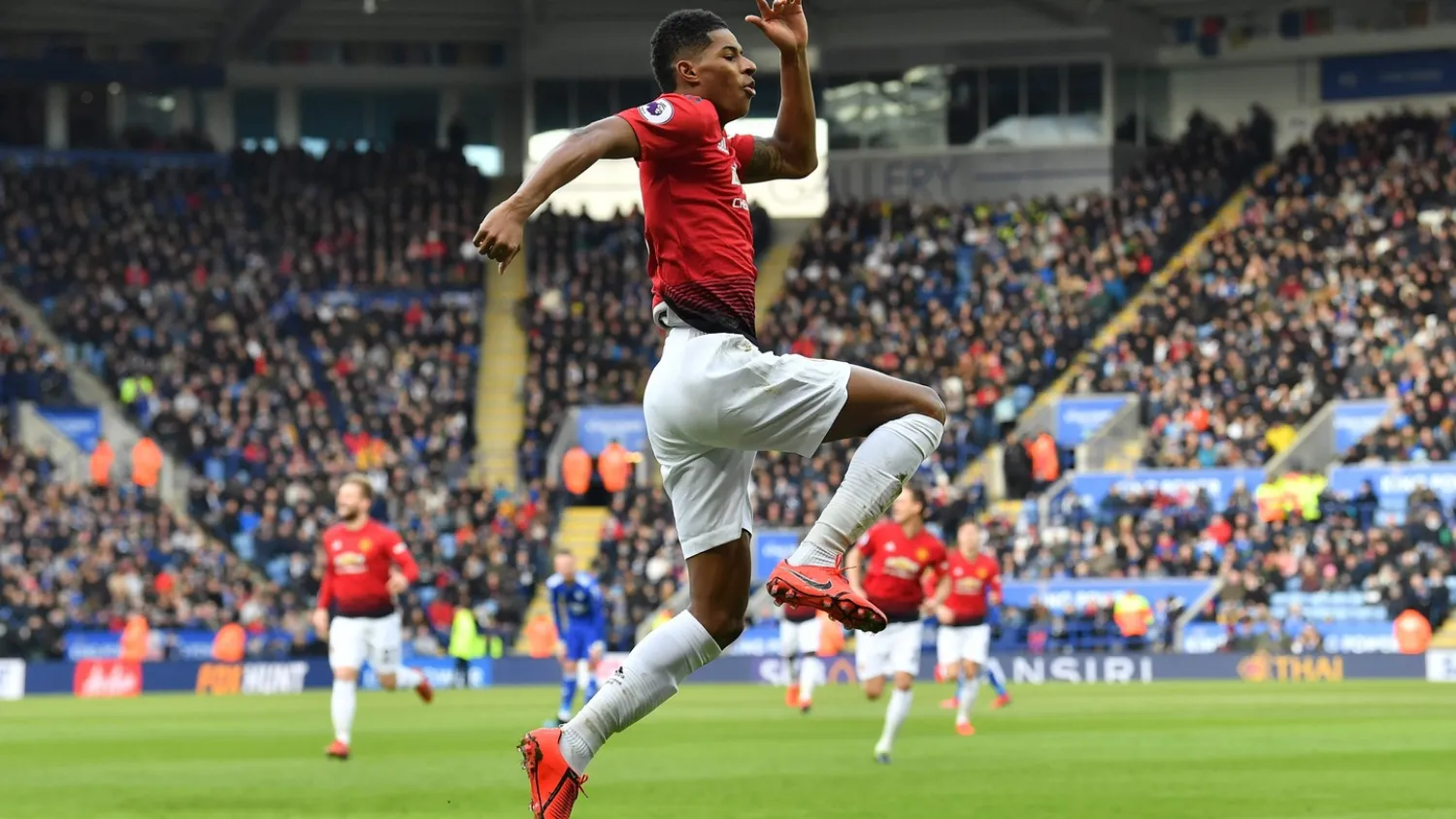

Manchester United’s Golden Child Marcus Rashford Finds his Lost Luster

Marcus Rashford celebrates opening the scoring for Manchester United against Leicester City earlier this month. (AFP)
TT

Manchester United’s Golden Child Marcus Rashford Finds his Lost Luster

Marcus Rashford celebrates opening the scoring for Manchester United against Leicester City earlier this month. (AFP)

There is a famous photo of Marcus Rashford lining up with his teammates before an England Under-16s fixture. Glancing down the row of likely lads you notice an adorably baby-faced Joe Gomez, the youthful Dominic Solanke, looking pretty much the same as the adult Dominic Solanke, and towards the far end a gap in the line where a face should be.

Except, look closer and there is someone there, almost blocked from view by the looming outline of the small girl standing in front of him. Yes, it’s Rashford. And yes, he’s tiny, peeping out between the schoolkids with the same sense of quiet poise that has carried him through the past three years, almost to the day, since his debut for Manchester United.

It is a personal anniversary that he marked on Sunday by another epic-looking engagement. Rashford made the starting lineup against Liverpool at Old Trafford, a match that ended in a stalemate and was blighted by a string of injuries in the Manchester squad. This is the kind of game he likes. There have been some barren scoring spells during those three years but also goals against Liverpool, Chelsea, Arsenal, Manchester City (twice) and Spurs, not to mention Spain home and away last year.

Plus, of course, Rashford is now United’s first-choice No 9, reward for his development under Ole Gunnar Solskjær and another stage ticked off for a player who has always seemed to be growing in one way or another. Both literally – an inch and a half in height since that debut against Midtjylland – and also as an inbetweener at this level, all talent and potential energy, just looking for a space to fit.

The influence of Solskjær, his fifth club and country manager, has been profound. As recently as October there was talk of Rashford needing to move away from Old Trafford to progress. Fast forward 10 weeks and such is the rush of post-José goodwill, the sense of a club rediscovering something of its own mythology for attacking play and on-brand homegrown youth, you could make a case that Rashford is now the single most important person at Manchester United.

He has had to cling to the rigging at times. Even that spectacular debut three years ago last week had its random elements. Rashford would not have been close to the squad if United had not had 14 players out injured. He would not have been there to take the call had United accepted a loan offer from Crewe shortly before. He would not have started had Anthony Martial not twanged a hamstring in the warm-up (Rashford told his mum not to even bother turning up, he was so unlikely to play). He might not have made any impression at all if Louis van Gaal had not sat him down at half‑time and told him to stop running so much, to linger more in front of goal.

Rashford listened, scored twice in the second half, then got two more against Arsenal three days later on his league debut. Still adjusting to playing centrally, still being urged to acquire “a real goal addiction” by his under-18s coach, Paul McGuinness, Rashford was flushed right out into the light, asked to complete his final growth spurt in public.

Since then it has been, as Louis would say, a process. Albeit one that takes in the false turns as well as the good times. Such is the rush to junk every part of the Mourinho regime it is often assumed he did nothing but obstruct Rashford’s progress. Take away the José years and Rashford has 12 goals in 31 games for United under his first and last managers.

But Mourinho is a big part of this story, if only as confirmation of Rashford’s ability to adapt and survive. He has never seemed disheartened at United, even when others have suggested he was being misused, even as Mourinho capered on to the touchline in cinematic rage at a missed chance, then spoke darkly afterwards about the poverty of his attack. Character is destiny in football. Sometimes simply refusing to go away is the greatest gift of all.

As ever the question is just how good he can become. A couple of weeks ago there was a timely reality check in the direct comparison at Old Trafford with Kylian Mbappé, another prodigious 20-year-old and the gold standard when it comes to universe-boss attacking potential.

It is not a fair match-up for anyone. Mbappé is ready-made, already out there streaking away from the pack. Rashford is just one of those chasing, helped now by the perfect fit between his own best qualities and Solskjær’s tactical blueprint, which alternates between an energetic high press and full‑throttle counterattack.

Rashford makes so many fine runs his presence has also been a natural catalyst in the blooming of Paul Pogba’s full range of passing. Encouraged to use the ball as a weapon rather than simply keep it or chase it, Rashford has begun to show off his own tricksiness and quick feet. For a while he would say he wanted to play like Neymar, to rove across the front line, to create as well as score. It seemed fanciful at times. But check his stats for the second half of the season and he is up there in all the metrics, offering goals, assists, passes, tackles, dribbles (everything except headers won: a man still growing into his own height).

The feeling with Rashford is always that there is more to give, more space to grow into. He has a Ronaldo-level dedication to training and breathtaking speed over longer distances. It was this ability to wait on the left wing and then make perfectly timed runs behind Trent Alexander‑Arnold that marked his best display under Mourinho, the 2-1 defeat of Liverpool almost a year ago.

Rashford has a clear run to the end of a season that has seen him linked (spuriously perhaps) with moves to Real Madrid and Barcelona but has provided above all confirmation of his importance to United.

There is an element of the golden child about this. Rashford has something redemptive about him, a quality that goes against the chaos and dissolution of the post-Fergie years. He rebuts, to a degree, the narrative of doom and decay, of a club being stripped away of all that is good; proof instead that good people are still present, and that a youth system so often compared unfavorably with Manchester City’s is still operational.

Despite the mongering of doom, the sense of drift and flux, Rashford remains the only academy product of genuine A-list quality to emerge since the class of 1992, and the first homegrown central striker of real quality since Mark Hughes. His presence provides a link to United’s best traditions, a focus in the short term of all that renewed goodwill; and, in the long term, perhaps something more, an attacking talent with no obvious ceiling, still looking to grow, to find its own peak.

The Guardian Sport


Sudan Dream of AFCON Glory as Conflict Rages at Home

 Sudan's players pose for the team picture before the Africa Cup of Nations group E soccer match between Algeria and Sudan in Rabat, Morocco, Wednesday, Dec. 24, 2025. (AP)
Sudan's players pose for the team picture before the Africa Cup of Nations group E soccer match between Algeria and Sudan in Rabat, Morocco, Wednesday, Dec. 24, 2025. (AP)
TT

Sudan Dream of AFCON Glory as Conflict Rages at Home

 Sudan's players pose for the team picture before the Africa Cup of Nations group E soccer match between Algeria and Sudan in Rabat, Morocco, Wednesday, Dec. 24, 2025. (AP)
Sudan's players pose for the team picture before the Africa Cup of Nations group E soccer match between Algeria and Sudan in Rabat, Morocco, Wednesday, Dec. 24, 2025. (AP)

When war broke out in Sudan in April 2023, Ammar Taifour was in a training camp with his club Al Merrikh in Khartoum.

"I just remember the surprise, the shock of the first gunshots. It was very surprising," the 28-year-old midfielder with the Sudan team at the Africa Cup of Nations tells AFP.

"Then in the days after that there were power cuts and constant gunshots. It was just unbelievable.

"I just pray for peace and for everyone who's in this situation to be safe and make it out."

Taifour, who was born in the United States, is among the lucky ones. He says he is "grateful and blessed" that family members in Sudan were able to leave the country.

Goalkeeper Mohamed Al Nour, meanwhile, had to deal with the anguish of his brother being taken prisoner by the paramilitary Rapid Support Forces.

"Luckily I have not lost any members of my family but my brother was taken prisoner for nine months by the RSF before being released," says Al Nour.

"We have experienced terror, people being killed. We just hope things improve."

The war that erupted close to three years ago between the country's army and its former allies the RSF has had a devastating impact on the population.

Tens of thousands of people have been killed and 11 million driven from their homes in what the UN has declared "the world's worst humanitarian disaster".

Despite that backdrop, Sudan's national football team qualified for the ongoing AFCON in Morocco and on Sunday they beat Equatorial Guinea 1-0 in Casablanca.

It was just their second win at the Cup of Nations in 18 matches across six tournament appearances since they lifted the trophy in 1970.

They play Burkina Faso in their final group game on Wednesday and do so with the pressure off because they are already assured of progressing to the last 16.

That is a remarkable achievement regardless of the current off-field context, given Sudan have only once made the knockout stages at an AFCON since 1970 -- they reached the quarter-finals in 2012.

- 'Big responsibility' -

"It's a big honor," says Taifour. "But also we have big expectations and we want to make it as far as possible and even to win the tournament, make our country happy."

"Obviously it's a big responsibility. I think each one of us as individuals, we know the situation that's going on, we all can relate to it, we all have someone involved.

"So whatever we can do to help, whatever we can do to bring some happiness, we try our best to do so."

Al Nour, also known by his nickname Abooja, adds: "Of course the team has been impacted. Everyone has just tried to get through this period but it has been difficult with the tension all over Sudan."

"In the end our results on the pitch are what make the people happy and boost their morale."

The impact of the conflict on Sudanese football has been enormous, leading to the domestic championship being halted and the country's two biggest clubs going into exile.

Al Hilal and Al Merrikh of Omdurman played in the Mauritanian league last season. A domestic elite league did make its return in July, but now the two rivals are playing in Rwanda.

Some players have moved to different countries like Taifour, who departed Al Merrikh for Libya and is now plying his trade in Tunisia.

Despite that the national team has flourished under Ghanaian coach Kwesi Appiah.

They qualified for the competition at the expense of Ghana and put in some good showings in their World Cup qualifying group, beating the Democratic Republic of Congo and drawing with Senegal en route to finishing third.

In August they got to the semi-finals of the African Nations Championship -- a competition for locally-based players -- and they also appeared at the recent FIFA Arab Cup in Qatar.

"We have tried to use every match as preparation and to build chemistry within the group," says Taifour.

Al Nour, meanwhile, describes Appiah as "an exceptional person. We have learned a lot thanks to him."

It has all led to this, with Sudan now building towards a Cup of Nations knockout tie this weekend and hoping to put smiles on the faces of supporters back home.


Prince Abdul Mohsin Airport Receives First Dakar Rally 2026 Arrivals

This comes as part of ongoing preparations to host the global sporting event - SPA
TT

Prince Abdul Mohsin Airport Receives First Dakar Rally 2026 Arrivals

This comes as part of ongoing preparations to host the global sporting event - SPA

Prince Abdul Mohsin bin Abdulaziz International Airport in Yanbu has received the first arrivals of competitors participating in the Dakar Rally 2026, as part of ongoing preparations to host the global sporting event.

Cluster2 Airports, the operator of Prince Abdul Mohsin bin Abdulaziz International Airport, stated that arrivals will continue from December 28 to December 31, with approximately 17 flights, both private and commercial, designated for the arrival of competitors and participating teams, SPA reported.

The process is being handled with a high level of operational readiness and full coordination among the relevant authorities.

Cluster2 Airports affirmed that operational and service preparations at the airports have been completed to ensure smooth passenger movement and the provision of high-quality services to participating delegations, reflecting the efficiency of the affiliated airports and their ability to accommodate major international events.


Knee Injury for Shaheen Shah Afridi Forces Early Exit from Big Bash League

Pakistan’s ODI’s team captain Shaheen Shah Afridi attends a press conference, in Rawalpindi, Pakistan, on Nov. 10, 2025. (AP Photo/Anjum Naveed, File)
TT

Knee Injury for Shaheen Shah Afridi Forces Early Exit from Big Bash League

Pakistan’s ODI’s team captain Shaheen Shah Afridi attends a press conference, in Rawalpindi, Pakistan, on Nov. 10, 2025. (AP Photo/Anjum Naveed, File)

A knee injury has forced fast bowler Shaheen Shah Afridi to return home after playing four games for Brisbane Heat in the Big Bash League.

“Due to an unexpected injury; I have been called back by the PCB and will have to take a rehab. Hopefully, I will be back in the fields soon,” Afridi wrote on X on Tuesday.

Afridi limped off the field when he picked up the injury on his right knee while bowling against Adelaide Strikers last Saturday, The AP news reported.

Apparently the Pakistan Cricket Board has called back Afridi as a precautionary step with T20 World Cup due to start from February 7.

“I’m massively thankful to the Brisbane Heat team and fans for showering me with immense love and support,” Aridi said, while adding: “Meanwhile, I will be cheering for the amazing team.”

Afridi had a challenging short stint at Brisbane Heat where he picked up just two wickets in four matches at an expensive economy rate of 11.19. In his first game of the season he was removed from the attack in the 18th over when he bowled to waist-high full tosses to Melbourne Renegades’ batters Tim Seifert and Oliver Peake.

It is not the first time that Afridi has hurt his right knee. He sustained an injury on that knee while fielding during a test match in Sri Lanka in 2022 that also ruled him out from the early stages of the T20 World Cup in Australia.

He returned at the later stages of the tournament, but again picked up injury on the same knee during the death overs of the final against England that let the title match slip away from Pakistan.

Pakistan didn’t name Afridi for next month’s three-match T20 series in Sri Lanka as a rotation policy, but he remains one of the key players for the T20 World Cup to be jointly hosted by Sri Lanka and India.
