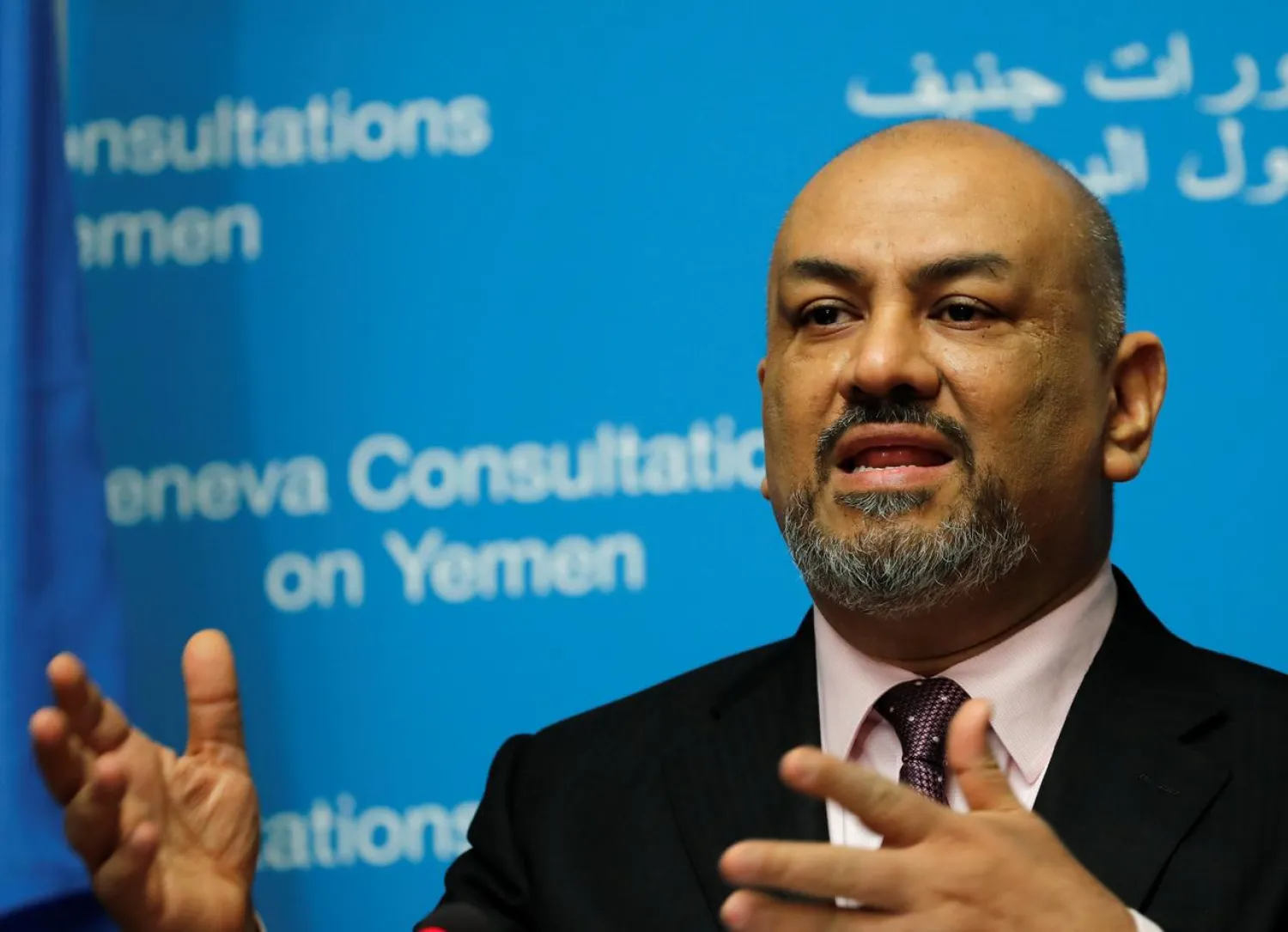
Exclusive - Yemen FM Calls for Increasing Pressure on Iran, Warns Europe from its Missiles

Yemeni Foreign Minister Khaled al-Yamani. (Reuters)
TT

Exclusive - Yemen FM Calls for Increasing Pressure on Iran, Warns Europe from its Missiles

Yemeni Foreign Minister Khaled al-Yamani. (Reuters)

Yemeni Foreign Minister Khaled al-Yamani called on European countries to exert pressure on Iran in order to stop its support for the Houthi militias.

He explained that Iran provides the group with all the tools to continue its war in Yemen, drain its strength in a battle that will not benefit any party, and pose a threat to security and peace in the vital Gulf of Aden and Red Sea areas.

In exclusive remarks to Asharq Al-Awsat on the sidelines of his participation in Arab-EU summit that was held in Sharm el-Sheikh, Yamani stressed that all that is required is putting an end to Iran's intervention in his country and its support for terrorism in the region.

Commenting on the summit, he said: “Europe and Arabs have many things in common, mainly confronting challenges, especially in the fight against terrorism, illegal migration and refugees, in addition to contributing in solving the current regional complexities.”

He explained that western countries were the reason behind the eruption of the so-called Arab Spring and the tragedies facing the region today, calling for “taking stances against Iran, which is fueling all the conflicts and wars through its meddling in Arab affairs, especially Yemen.”

“We want to look for the common denominator between us and Europeans,” Yamani added.

“There is an urgent need to agree on this commonality, as demonstrated in the meeting that took place with Europe in Warsaw at the invitation of the Polish and US governments, to confirm that we are seeking this partnership with our European friends because the Iranian policy does not only target the Arab region, but also Europe.”

Yamani pointed out that many Iran-affiliated terror cells have been discovered in Europe, including France and Belgium.

“We must work with friends to rein in Iran, but unfortunately Europe refused to include the Iranian interference in the final communique” of the Sharm el-Sheikh summit.

Asked whether the rejection was due to their concerns about Iran's nuclear program, the minister replied that his country understands this position, but he warned Europe that “Iran has developed its nuclear weapon and its ballistic missiles have a range of 2,500 kilometers.”

“What will happen when Iran develops rockets that can reach European capitals? Will they also wait?” he wondered.

Yamani revealed that Europe has finally started to put pressure on Iran by addressing its ballistic missiles file, while also noting a European Union statement on Tehran’s expansionist agenda.


Trump Says Iran Deal Has Been Signed, Text to Come Soon

US President Donald Trump (L) shakes hands with France's President Emmanuel Macron during a bilateral meeting on the sidelines of the G7 summit, in Evian, central-eastern France on June 15, 2026. (AFP)
TT

Trump Says Iran Deal Has Been Signed, Text to Come Soon

US President Donald Trump (L) shakes hands with France's President Emmanuel Macron during a bilateral meeting on the sidelines of the G7 summit, in Evian, central-eastern France on June 15, 2026. (AFP)

US President Donald Trump on Monday said an agreement with Iran has been signed and that the text of the deal would be released sometime after a formal signing on Friday, adding that the Strait of Hormuz would also be fully open.

Speaking alongside ‌French President ‌Emmanuel Macron ahead of this ‌week's ⁠G7 meeting, Trump ⁠said he did not know if he would attend the Friday ceremony expected in Geneva, but that US Vice President JD Vance would be there.

"The deal's all signed. ⁠And the strait is ‌already partially opened, ‌as you know," Trump told reporters shortly ‌after arriving in Evian, France. "On Friday, ‌it'll be completely open."

Vance earlier on Monday said the agreement had been signed digitally on Sunday and that no funds ‌were released.

Asked when the text of the memorandum of ⁠understanding ⁠would be made public, Trump said: "Probably pretty soon. I would say after sometime after Friday... I think sometime in the very near future."

Trump said any sanctions relief for Tehran was "really a behavioral thing. If they do what they're supposed to do, that starts taking effect."

There was no immediate response from Tehran to the report that the agreement, which both sides announced overnight, had already been signed. Previous reports from both sides had suggested it would be signed officially at a ceremony in Geneva on Friday.  

In an early reminder of the agreement's fragility, Israel - which launched the war alongside the United States in February and was not consulted on the talks to end it - struck a car with a drone in southern Lebanon, where it has been battling the Iran-aligned Hezbollah movement. Iran has said the deal must bring a full cessation of hostilities there. 

The terms of the memorandum of understanding, reached after more ‌than two months of ‌negotiations, have yet to be published. A US official, speaking on condition of anonymity, said ‌he expected ⁠the terms would ⁠be made public in the next 24-48 hours. 

Oil prices tumbled on the prospect of an end to disruption to global energy supplies, and share prices soared, some hitting new records. 

Trump, who had earlier said the blockaded Strait of Hormuz would be open on Friday, said on Monday that ships had already begun transiting it. However, the US military told shippers it had not yet lifted its blockade of Iranian ports. 

60-DAY NEGOTIATION PERIOD 

According to accounts from both sides, the agreement would reopen the blockaded strait and extend a ceasefire for a 60-day negotiation period, when contentious issues such as the future of Iran's nuclear program are due to be decided. 

Meanwhile, ‌the immediate fate of the pact could hinge on Lebanon, where Israel has been battling the Iran-aligned Hezbollah armed group in parallel with the wider ‌war that it launched alongside the United States against Iran in February. 

Iran has said the preliminary agreement requires a cessation of ‌hostilities on all fronts, including in Lebanon. Israel, which was not consulted on the preliminary deal, has said it reserves the right to act in Lebanon against Hezbollah threats. 

Security sources said fighting in southern Lebanon had tamped down on Monday after the agreement was announced but had not ceased entirely. 

In the first strike of its kind since the announcement, an Israeli drone struck a car in the southern Lebanese town of Kfar Tebnit, killing the ‌driver, Lebanese state media reported. There was no immediate comment from the Israeli military on the strike. 

LEBANON HAS BEEN A STICKING POINT  

While the US and Iran had largely ceased hostilities ⁠in early April, fighting has not ceased ⁠in Lebanon, where Hezbollah opened fire on Israel in support of Tehran on March 2 and Israel responded with an air campaign and ground invasion that has uprooted some 1.2 million people. 

Iran's Foreign Minister Abbas Araqchi said there must be a complete halt to Israeli attacks against Lebanon and wrote on Telegram that the US bears responsibility for implementing the framework deal. 

Hezbollah welcomed the deal and said the inclusion of Lebanon reflected Iran's commitment to securing a halt to the war and preserving Lebanon's rights. 

Israeli Prime Minister Benjamin Netanyahu has yet to respond publicly to the US-Iran agreement. But Defense Minister Israel Katz said that Israel would remain "indefinitely" in areas it is occupying in southern Lebanon to eliminate what it perceives as militant threats.  

Privately, Israeli officials' views of the deal have been negative. One senior Israeli official told Reuters on condition of anonymity that the agreement was "terrible for Israel," and that this assessment was shared throughout the government from Netanyahu on down. 

The reopening of the Strait of Hormuz would help solve a global energy crisis precipitated by the war, which has hurt Trump's political fortunes by forcing up gasoline prices in the United States. 

"Ships of the World, start your engines. Let the oil flow!" he wrote on Sunday. 

On Monday he announced: "Ships are starting to move, many loaded up with Oil, out of the Strait of Hormuz." 


Somaliland Opens Embassy in Jerusalem

 Somaliland's President Abdirahman Mohamed Abdullahi (L) is welcomed by Israeli President Isaac Herzog (R) at the presidential residence in Jerusalem, 14 June 2026, during his first visit to Israel. (EPA)
Somaliland's President Abdirahman Mohamed Abdullahi (L) is welcomed by Israeli President Isaac Herzog (R) at the presidential residence in Jerusalem, 14 June 2026, during his first visit to Israel. (EPA)
TT

Somaliland Opens Embassy in Jerusalem

 Somaliland's President Abdirahman Mohamed Abdullahi (L) is welcomed by Israeli President Isaac Herzog (R) at the presidential residence in Jerusalem, 14 June 2026, during his first visit to Israel. (EPA)
Somaliland's President Abdirahman Mohamed Abdullahi (L) is welcomed by Israeli President Isaac Herzog (R) at the presidential residence in Jerusalem, 14 June 2026, during his first visit to Israel. (EPA)

Somaliland opened its embassy in Jerusalem on Monday, Israel's foreign ministry announced, months after Israel became the first country to recognize the breakaway African state's independence.

"Honored to host my dear friend President @Abdirahmanirro at the Ministry of Foreign Affairs, during his historic State Visit to open Somaliland's embassy in Jerusalem," Israeli Foreign Minister Gideon Saar posted on X, during the first-ever state visit of President Abdirahman Mohamed Abdullahi.

"I'm proud of the privilege I had to write the first pages in the story of the Israel-Somaliland relationship," Saar added.

Somaliland is the eighth country to open its embassy in Jerusalem, following the United States, Guatemala, Honduras, Kosovo, Papua New Guinea, Paraguay and Fiji.

Most foreign diplomatic missions to Israel are located in Tel Aviv, as the status of Jerusalem is one of the thorniest issues in the Palestinian-Israeli conflict.

In December, Israel became the first country to recognize the independence of Somaliland since it declared its autonomy from Somalia in 1991 following a civil war.


Trump Arrives with Iran Deal to Meet Wary World Leaders at G7 Summit

US President Donald Trump shakes hands with French President Emmanuel Macron as they attend a bilateral meeting during the G7 Summit in Evian-les-Bains, France, June 15, 2026. (Reuters)
TT

Trump Arrives with Iran Deal to Meet Wary World Leaders at G7 Summit

US President Donald Trump shakes hands with French President Emmanuel Macron as they attend a bilateral meeting during the G7 Summit in Evian-les-Bains, France, June 15, 2026. (Reuters)

US President Donald Trump joined global leaders on Monday at the Group of Seven summit at a French lakeside resort, where relief over a deal to end the Iran war was tempered by unease over new US tariff threats aimed at France.

Trump was met at the G7 summit in Evian-les-Bains by Emmanuel Macron's chief of protocol ahead of a bilateral meeting with the French president. According to a prior planning document, Macron had been due to welcome Trump himself.

"Everything is very nice, thank you," Trump told reporters as he arrived, just hours after securing a preliminary deal with Iran that is one of several issues G7 leaders will wrestle with during the June 15 to 17 summit.

They will also seek common ground on the war in Ukraine, tackling global economic imbalances and sourcing critical minerals outside of the dominant supplier China.

LEADERS WARY OF TRUMP

Global leaders are increasingly wary of the United States and, underscoring the tensions, Trump told ‌the New York Post ‌before leaving for France he would "have no choice" but to apply 100% tariffs on French wine ‌unless Paris ⁠eliminates its digital ⁠tax on US tech giants.

Then, in a social media post just before arriving at the summit, he turned to a subject that has been a regular source of tension with centrist European allies: immigration.

"Sadly, if you import people from Third World Countries, you quickly become a Third World Country — And there's not a thing you can do about it," he wrote.

Trump's tariff threats come ahead of a summit that serves as the diplomatic culmination of Macron's second and final term and represent a blow for the unpopular French president.

Macron, who steps down next year, is increasingly seen as a lame duck at home but still has pull on a global stage. He was able to get Trump to agree to a glitzy ⁠dinner at the Palace of Versailles on Wednesday to mark 250 years of US independence.

Macron told ‌TF1 that France would not yield to Trump's threats, adding, "tariffs don't do anyone any good, ‌especially tariffs between G7 countries."

TRUMP REMAINS UNPREDICTABLE

Trump's comments on tariffs and immigration underline why he is viewed as a volatile partner by other G7 leaders.

Many ‌of them have been directly impacted by unilateral Trump decisions that have upended the Middle East, global trade and diplomacy, and prompted ‌deeper soul-searching over the US commitment to the post-war global order it helped establish.

During the summit, Trump is due to meet Middle Eastern leaders and attend a working session with Ukrainian President Volodymyr Zelenskiy.

The Tuesday meeting comes as Russian advances in Ukraine have slowed and Ukraine seeks more military funding from its allies, amid a barrage of attacks on Kyiv.

"This attack only strengthens our determination to do everything, with our allies and partners, to work towards a ceasefire that ‌Russia stubbornly refuses, then to peace. We will work on it at the G7," Macron said in a post on X.

Zelenskiy said on Monday he had offered to meet Russia's President Vladimir ⁠Putin at the G7 summit ⁠for talks to end their more than four-year-old war, but Putin was not ready to speak.

Zelenskiy's hand has improved since Trump famously told him in the Oval Office last year: "You don't have the cards." But he may find greater US support elusive as Trump prioritizes drawing a line under the Iran conflict, which has dented his support domestically.

DETAILS OF IRAN DEAL

G7 leaders will be keen to learn the details of the US-Iran deal. A memorandum of understanding is scheduled to be signed on Friday in Switzerland but precise terms are unclear.

Trump said the Strait of Hormuz, a major shipping route for global oil and gas supplies that Iran has effectively shut down, would open on Friday, and that he had ordered the end of the US blockade of Iranian ports.

France and Britain have been working on a military plan to send a mission to the region that would help open the Strait, although that would depend on Tehran's green light.

The leaders are not expected to have detailed discussions of what should be done, assuming the deal is signed, with Iran's highly enriched uranium, its ballistic program or frozen Iranian assets. These issues will entail complex, technical negotiations.

At the summit, Macron also wants to push for action on global macroeconomic imbalances. But Trump's warning on tariffs may cause some friction, particularly as French officials had said the digital tax would not be an issue for the G7.