


Khamenei Refuses to Lead Economic War

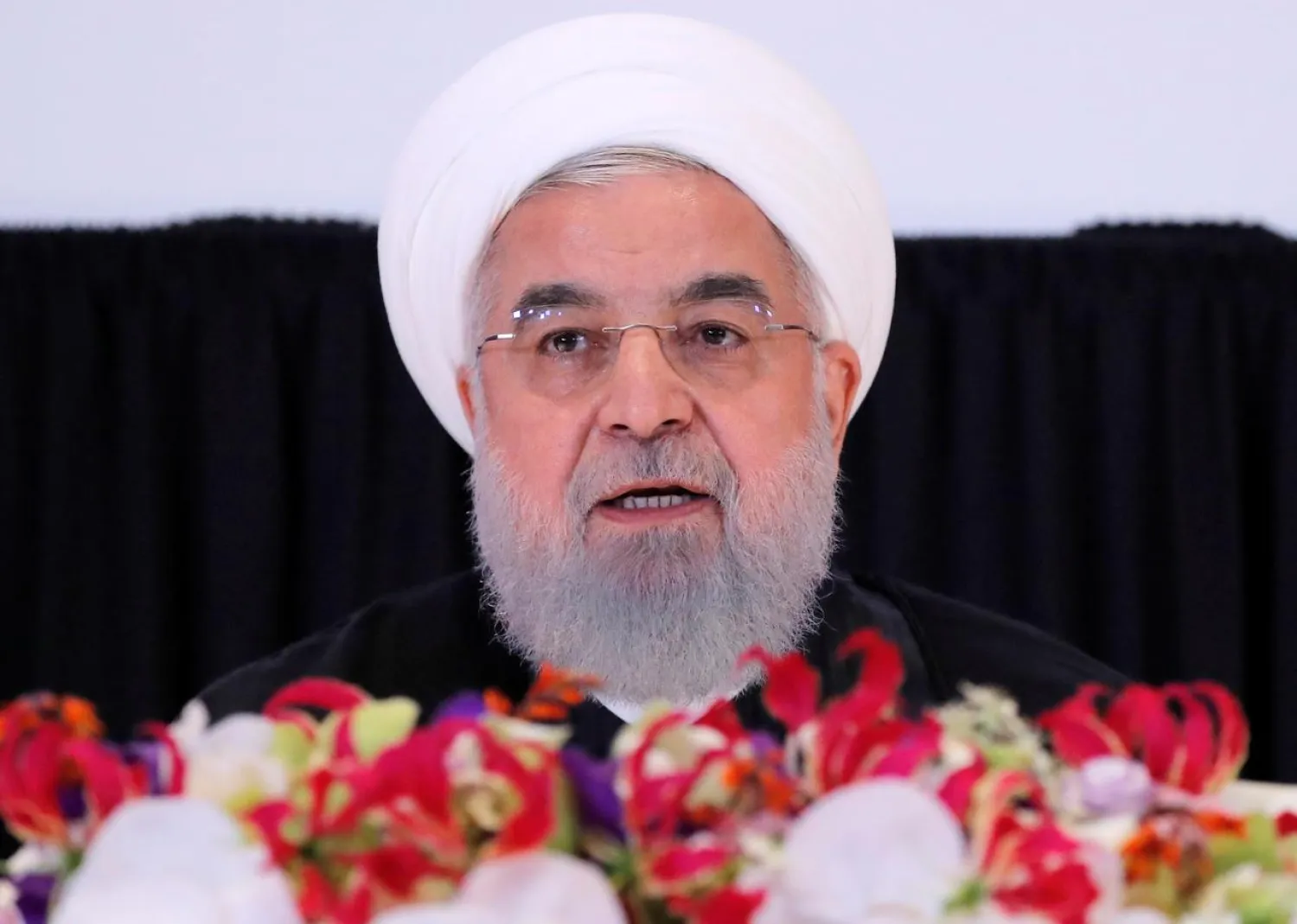
 Iran's President Hassan Rouhani speaks at a news conference on the sidelines of the 73rd session of the United Nations General Assembly at U.N. headquarters in New York, the US, September 26, 2018. REUTERS/Brendan Mcdermid /File Photo
Iran's President Hassan Rouhani speaks at a news conference on the sidelines of the 73rd session of the United Nations General Assembly at U.N. headquarters in New York, the US, September 26, 2018. REUTERS/Brendan Mcdermid /File Photo
TT

Khamenei Refuses to Lead Economic War

 Iran's President Hassan Rouhani speaks at a news conference on the sidelines of the 73rd session of the United Nations General Assembly at U.N. headquarters in New York, the US, September 26, 2018. REUTERS/Brendan Mcdermid /File Photo
Iran's President Hassan Rouhani speaks at a news conference on the sidelines of the 73rd session of the United Nations General Assembly at U.N. headquarters in New York, the US, September 26, 2018. REUTERS/Brendan Mcdermid /File Photo

Iranian President Hassan Rouhani said that Iran's Supreme Leader Ali Khamenei has rejected to lead the ‘economic war’, accusing the United States on Wednesday of plotting to use economic pressure to overthrow the Islamic republic’s clerical establishment, and ruling out the possibility of talks with Washington.

“Iran is in an economic and psychological war with America and its allies. Their aim is to change the regime but their wish will not come true,” Rouhani said in a speech in the northern province of Gilan as reported by Reuters.

Washington reimposed sanctions on Iran that were lifted in 2016 under the deal. The renewed US clampdown caused a crash of Iran’s currency, rampant inflation, and a flight of foreign investors desperately needed by Tehran to modernize its economy.

The other signatories to the deal – Britain, Germany, France, Russia, and China – oppose the reinstatement of US financial and oil sanctions and have sought to salvage the 2015 deal by finding non-dollar ways to conduct business with Tehran.

“There is no possibility of entering negotiations with America,” Rouhani said in a speech in the city of Lahijan, broadcast live on state television. “America wants to take Iran back to 40 years ago... to the era before the (1979) Revolution...They want regime change.”

Analysts say Khamenei guardedly backed the 2015 deal as he knew that Iranians, many of whom have periodically taken to the streets to protest at economic hardships, could not tolerate more pressure. Iranian leaders have warned that Tehran could drop out of the nuclear deal if the other signatories fail to secure the economic benefits to Tehran accruing from the pact.

“Our nation and the leadership are united against our enemies... We will continue our path of independence and freedom,” said Rouhani.

But if the deal collapses, Iran’s balance of power could tilt in favor of the pragmatist Rouhani’s hard-line rivals who oppose improving ties with the West and are close to Khamenei.

Meanwhile, Iran's Deputy Foreign Minister Abbas Araghchi said in Vienna that Iran hopes a new trade channel with Europe aimed at cushioning the blow of reimposed US sanctions will be working within weeks.

"We hope that in the coming weeks Instex would become operational,” he said -referring to the mechanism's official name – the Instrument in Support of Trade Exchanges which was launched in January by France, Germany, and the UK.

Araqchi said Instex was "a move in the right direction" but it was not yet clear how much it could achieve.

"But maybe it starts from humanitarian in order to set the patterns for doing business with Iran. And once the patterns are set then other kinds of goods including sanctioned goods and oil, of course, would be added to this mechanism," he added.

"We decided today to create working groups on different areas such as trade, energy, transportation etc in order to find similar mechanisms like Instex in other areas so economic cooperation with Iran can be expanded," Araqchi continued.

Instex was conceived as a way to help match Iranian oil and gas exports with purchases of EU goods, but those ambitions have been toned down. Diplomats say that, realistically, it will be used only for smaller transactions such as purchases of humanitarian products or food.

Araqchi disputed that, saying it could expand over time.


Top Trump Iran Negotiator Says Visits US Aircraft Carrier in Middle East

US Special Envoy Steve Witkoff delivers a press conference upon the signing of the declaration on deploying post-ceasefire force in Ukraine, during the so-called "Coalition of the Willing" summit, at the Elysee Palace in Paris, France, January 6, 2026. (Reuters)
TT

Top Trump Iran Negotiator Says Visits US Aircraft Carrier in Middle East

US Special Envoy Steve Witkoff delivers a press conference upon the signing of the declaration on deploying post-ceasefire force in Ukraine, during the so-called "Coalition of the Willing" summit, at the Elysee Palace in Paris, France, January 6, 2026. (Reuters)

US President Donald Trump's lead Iran negotiator Steve Witkoff on Saturday said he visited the USS Abraham Lincoln aircraft carrier currently in the Arabian Sea, with Washington and Tehran due to hold further talks soon.

"Today, Adm. Brad Cooper, Commander of US Naval Forces Central Command, Jared Kushner, and I met with the brave sailors and Marines aboard the USS Abraham Lincoln, her strike group, and Carrier Air Wing 9 who are keeping us safe and upholding President Trump's message of peace through strength," said Witkoff in a social media post.

Iranian Foreign Minister Abbas Araghchi said on Saturday he hoped talks with the United States would resume soon, while reiterating Tehran's red lines and warning against any American attack.


Israel’s Netanyahu Expected to Meet Trump in US on Wednesday and Discuss Iran

Israeli Prime Minister Benjamin Netanyahu delivers a speech during a special session to mark the 77th anniversary of the Knesset's establishment and the 60th anniversary of the dedication of the current building at the Knesset, the Israeli parliament, in Jerusalem, 02 February 2026. (EPA)
TT

Israel’s Netanyahu Expected to Meet Trump in US on Wednesday and Discuss Iran

Israeli Prime Minister Benjamin Netanyahu delivers a speech during a special session to mark the 77th anniversary of the Knesset's establishment and the 60th anniversary of the dedication of the current building at the Knesset, the Israeli parliament, in Jerusalem, 02 February 2026. (EPA)

Israeli Prime Minister Benjamin Netanyahu is expected to meet US President Donald Trump on Wednesday in Washington, where they will discuss negotiations with Iran, Netanyahu's office said on Saturday.

Iranian and US officials held indirect nuclear ‌talks in the ‌Omani capital ‌Muscat ⁠on Friday. ‌Both sides said more talks were expected to be held again soon.

A regional diplomat briefed by Tehran on the talks told Reuters Iran insisted ⁠on its "right to enrich uranium" ‌during the negotiations with ‍the US, ‍and that Tehran's missile capabilities ‍were not raised in the discussions.

Iranian officials have ruled out putting Iran's missiles - one of the largest such arsenals in the region - up ⁠for discussion, and have said Tehran wants recognition of its right to enrich uranium.

"The Prime Minister believes that any negotiations must include limiting ballistic missiles and halting support for the Iranian axis," Netanyahu's office said in a ‌statement.


Italy FM Rules Out Joining Trump’s ‘Board of Peace’

Italy's Minister for Foreign Affairs Antonio Tajani speaks to the press during the EPP Leaders’ meeting, in Zagreb, Croatia, 30 January 2026. (EPA)
TT

Italy FM Rules Out Joining Trump’s ‘Board of Peace’

Italy's Minister for Foreign Affairs Antonio Tajani speaks to the press during the EPP Leaders’ meeting, in Zagreb, Croatia, 30 January 2026. (EPA)

Italy will not take part in US President Donald Trump's "Board of Peace", Italian Foreign Minister Antonio Tajani said Saturday, citing "insurmountable" constitutional issues.

Trump launched his "Board of Peace" at the World Economic Forum in Davos in January and some 19 countries have signed its founding charter.

But Italy's constitution bars the country from joining an organization led by a single foreign leader.

Prime Minister Giorgia Meloni, a Trump ally, last month noted "constitutional problems" with joining, but suggested Trump could perhaps reopen the framework "to meet the needs not only of Italy, but also of other European countries".

Tajani appeared Saturday to rule that out.

"We cannot participate in the Board of Peace because there is a constitutional limit," he told the ANSA news agency.

"This is insurmountable from a legal standpoint," he said, the day after meeting US Secretary of State Marco Rubio and US Vice President JD Vance at the Olympics in Milan.

Although originally meant to oversee Gaza's rebuilding, the board's charter does not limit its role to the Palestinian territory and appears to want to rival the United Nations.
