


Manchester United’s VAR-Assisted Miracle Highlights Game’s Woolly Law

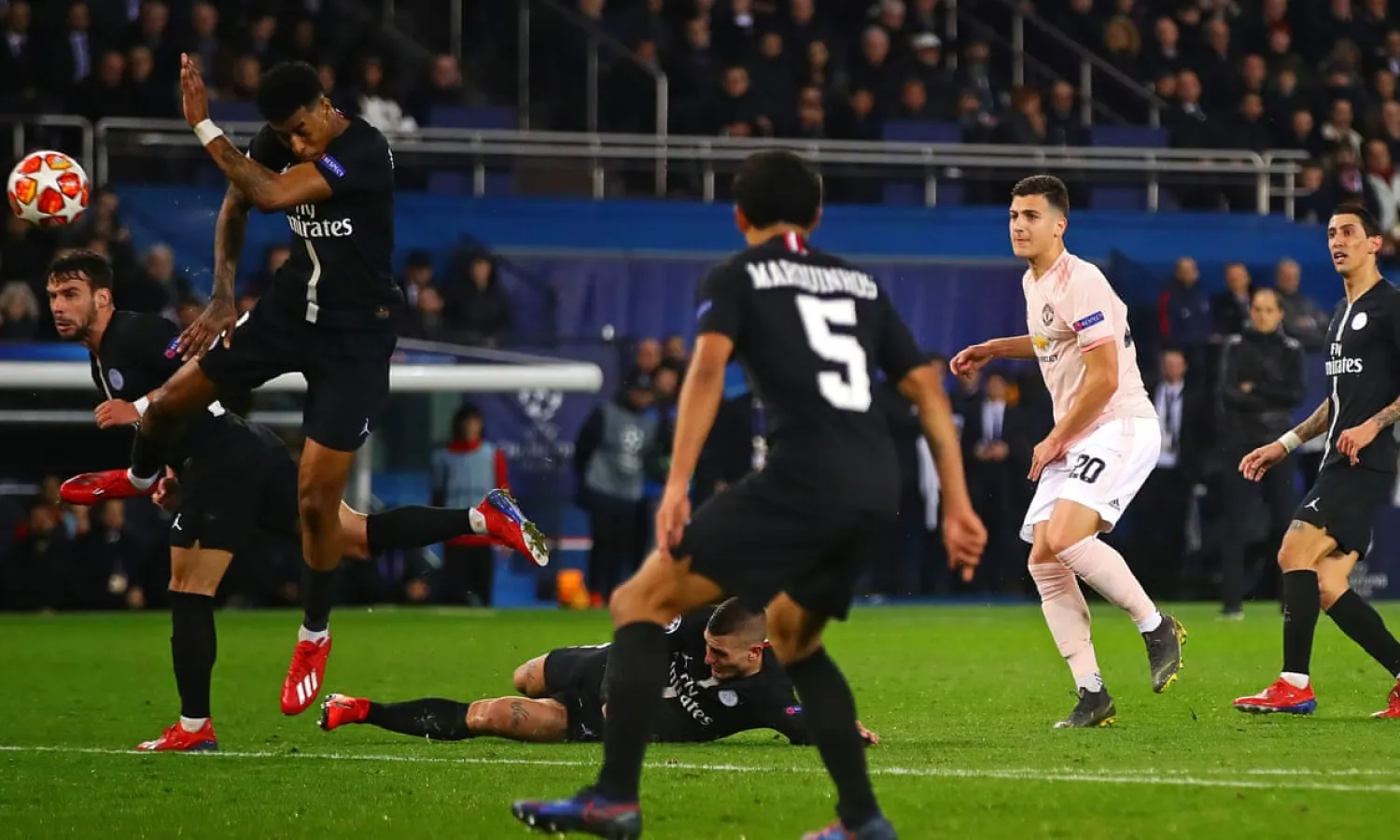
PSG’s Presnel Kimpembe (left) blocks Diogo Dalot’s shot with his hand, leading to the awarding of a controversial penalty by referee Damir Skomina. Photograph: Chris Brunskill/Fantasista/Getty Images
TT

Manchester United’s VAR-Assisted Miracle Highlights Game’s Woolly Law

PSG’s Presnel Kimpembe (left) blocks Diogo Dalot’s shot with his hand, leading to the awarding of a controversial penalty by referee Damir Skomina. Photograph: Chris Brunskill/Fantasista/Getty Images

he VAR decision that took Manchester United into the Champions League quarter-finals was a good example of why the new technology that will be in the Premier League from next season comes with the capacity to cause more arguments than it actually settles.

Though Neymar’s sweary reaction betrayed an understandable disappointment at Paris Saint-Germain going out of the competition in such a manner in injury time, his point about games being decided by remote officials who are not necessarily in tune with the contest on the pitch was a fair one. There was no clear and obvious mistake in Paris for a start. Diogo Dalot’s appeal for a penalty appeared as hopeful as the original shot which would surely have cleared the bar but for striking Presnel Kimpembe.

When you are a goal down in the closing seconds of a knockout game you are pretty much going to appeal for anything, no matter how much of a lost cause it may seem. The referee, Damir Skomina, was not surrounded by United players begging for a penalty, because from most areas of the pitch it was not even clear that Kimpembe was inside the area, let alone that the ball had hit him on an arm. But Dalot’s solitary protest must have alerted the VAR panel, who evidently whispered to the official that it might be worth taking a look at the monitor.

In other words this was not a case of an erroneous decision being overturned, which is what most people imagined VAR would be used for, but of a game being refereed remotely, which is a subtly different thing. Skomina did not appear to have arrived at a decision of his own over whether to award a penalty or allow play to continue, he was simply persuaded to go to review.

Whether that counts as progress depends on your point of view, though it could clearly become both irritating and time-consuming for spectators who have paid money to watch events unfold on the pitch to find them being run instead from some invisible television bunker.

Leaving that argument aside, the most obvious aspect of a dramatic finale was that VAR stirred up the controversy. The endless replays answered the question of whether the ball hit the defender’s arm – it clearly did – though offered no practical help over whether or not a penalty should have been awarded. The decision remained subjective; you either consider it a deliberate handball or you don’t, and VAR was unable to prove anything either way.

The situation in Paris was further complicated by a recent Uefa instruction to referees to award a penalty if the ball strikes a hand or arm that is considered to be in a raised or non-natural position. While the Fifa rule book still contains reference to the offense of handball being the deliberate act of making contact with hand or arm, Uefa referees are now being encouraged to take the notion of deliberate contact out of the equation. A defender might be trying to get his arms out of the way, as Manchester City’s Nicolás Otamendi plainly was against Schalke a couple of weeks ago, but because he was unable to put them behind his back quickly enough, the arm the ball struck was deemed to be in a non-natural position.

Which of course raises the question of what actually is a natural position for arms. You cannot really play the game with them folded across your chest or clasped behind your back. Was Kimpembe’s arm in a natural position or not? The defender jumped in the air while simultaneously turning his back to the ball. He was attempting to block the shot and succeeded, and though no one could say for certain it was deliberate handball, one could perhaps conclude he was careless to the risk of being penalized.

Though the script for Manchester United’s revival under Ole Gunnar Solskjaer continues to be nothing short of incredible there are some aspects of the VAR system that still need looking at before it is wheeled out in every game next season. Not the technical performance so much – replays are served up fairly smartly now and most people will be happy referees finally have the opportunity to take a second look at contentious incidents – but the grey areas within the laws of the game.

To wit: does it really matter if a forward’s big toe is offside in the build-up to a goal, does it confer an unfair advantage and is it worth holding the game up for five minutes or longer just to get to the truth of the matter? Similarly, unless a player actually uses his hand or arm to stop a shot, can we not simply forget all the nonsense about natural and non-natural positions and accept that contact may sometimes be unintentional?

There is so much room for debate in these areas that football’s rules and regulations can probably be considered too woolly at present to be assisted on every occasion by VAR. There is nothing wrong with the system, we just need to have a better idea of what it is we want it to look for. Is every handball a penalty? VAR cannot answer that. It can flag up the alleged offense, though as we have seen that is often the starting point of the argument rather than its conclusion.

While VAR has the potential to be an impressively forensic tool, at the moment it is merely highlighting the discrepancies and areas of interpretation contained within the rulebook. For any review system to work properly the questions it needs to answer must be in black or white rather than shades of grey. In terms of offsides and handballs in particular, football needs to find a way back to the days when everyone in the stadium understood what decision the referee was supposed to make.

(The Guardian)


Sunderland Worst Hit by Losing Players to African Cup of Nations 

14 December 2025, United Kingdom, London: Sunderland's Habib Diarra (L) and Leeds United's Gabriel Gudmundsson battle for the ball during the English Premier League soccer match between Brentford and Leeds United at the Gtech Community Stadium. (dpa)
TT

Sunderland Worst Hit by Losing Players to African Cup of Nations 

14 December 2025, United Kingdom, London: Sunderland's Habib Diarra (L) and Leeds United's Gabriel Gudmundsson battle for the ball during the English Premier League soccer match between Brentford and Leeds United at the Gtech Community Stadium. (dpa)

Premier League Sunderland will have to do without six players over the next few weeks and are the club worst hit as the Africa Cup of Nations takes its toll on European clubs competing over the holiday season.

Sunderland, eighth in the standings, had four of their African internationals in action when they beat Newcastle United on Sunday, but like 14 other English top-flight clubs will now lose those players to international duty.

The timing of the African championship, kicking off in Morocco on Sunday and running through to January 18, has long been an irritant for coaches, with leagues in Belgium, France, Germany, Italy, Netherlands, Portugal, and Spain also affected.

Hosting the tournament in the middle of the season impacts around 58% of the players at the Cup of Nations, though the Confederation of African Football did try to mitigate the impact by moving the start to before Christmas, so it is completed before the next round of Champions League matches.

The impact on European clubs was also lessened by allowing them to release players seven days, rather than the mandatory 14 days, before the tournament, meaning they could play for their clubs last weekend.

Sunderland's Congolese Arthur Masuaku and Noah Sadiki, plus full back Reinildo (Mozambique), midfielder Habib Diarra (Mali), and attackers Chemsdine Talbi (Morocco) and Bertrand Traore (Burkina Faso) have now departed for Morocco.

Ironically, Mohamed Salah’s absence from Liverpool to play for Egypt should lower the temperature at the club after his recent outburst against manager Arne Slot, but Manchester United will lose three players in Noussair Mazraoui, Bryan Mbeumo and Amad Diallo, who scored in Monday’s 4-4 draw with Bournemouth.

France is again the country with the most players heading to the Cup of Nations, and with 51 from Ligue 1 clubs. But their absence is much less impactful than previously as Ligue 1 broke after the weekend’s fixtures and does not resume until January 2, by which time the Cup of Nations will be into its knockout stage.

There are 21 players from Serie A clubs, 18 from the Bundesliga, and 15 from LaLiga teams among the 24 squads at the tournament in Morocco.


Rodgers Takes Charge of Saudi Team Al-Qadsiah After Departure from Celtic 

Then-Celtic head coach Brendan Rodgers greets supporters after a Europa League soccer match between Red Star and Celtic at Rajko Mitic Stadium in Belgrade, Serbia, Sept. 24, 2025. (AP)
TT

Rodgers Takes Charge of Saudi Team Al-Qadsiah After Departure from Celtic 

Then-Celtic head coach Brendan Rodgers greets supporters after a Europa League soccer match between Red Star and Celtic at Rajko Mitic Stadium in Belgrade, Serbia, Sept. 24, 2025. (AP)

Brendan Rodgers has returned to football as the coach of Saudi Arabian club Al-Qadsiah, six weeks after resigning from Scottish champion Celtic.

Al-Qadsiah, whose squad includes Italian striker Mateo Retegui and former Real Madrid defender Fernandez Nacho, is in fifth place in the Saudi Pro League in its first season after promotion.

Rodgers departed Celtic on Oct. 27 and has opted to continue his managerial career outside Britain for the first time, having previously coached Liverpool, Leicester and Swansea.

In its statement announcing the hiring of Rodgers on Tuesday, Al-Qadsiah described him as a “world-renowned coach” and said his arrival “reflects the club’s ambitious vision and its rapidly growing sporting project.”

Aramco, the state-owned Saudi oil giant, bought Al-Qadsiah in 2023 in a move that has helped to transform the club’s status.

“This is a landmark moment for the club,” Al-Qadsiah chief executive James Bisgrove said. “The caliber of his experience and track record of winning reflects our ambition and long-term vision to establish Al-Qadsiah as one of Asia’s leading clubs.”

Rodgers is coming off winning back-to-back Scottish league titles with Celtic, where he won 11 major trophies across his two spells. He also won the FA Cup with Leicester.

Al-Qadsiah's last two coaches were former Liverpool striker Robbie Fowler and former Spain midfielder Michel.


Portugal to Return to F1 Calendar in 2027 and 2028 

12 July 2025, United Arab Emirates, Abu Dhabi: Red Bull driver Max Verstappen leads into turn one during the Abu Dhabi Grand Prix at the Yas Marina Circuit, Abu Dhabi. (dpa)
TT

Portugal to Return to F1 Calendar in 2027 and 2028 

12 July 2025, United Arab Emirates, Abu Dhabi: Red Bull driver Max Verstappen leads into turn one during the Abu Dhabi Grand Prix at the Yas Marina Circuit, Abu Dhabi. (dpa)

Formula One will return to Portugal's Portimao circuit in 2027 and 2028 after the Dutch Grand Prix at Zandvoort drops off the calendar.

Formula One announced a two-year deal in a statement on Tuesday.

The 4.6-km Algarve International circuit in the country's south last hosted the Portuguese Grand Prix in 2020 and 2021, both seasons impacted by the COVID-19 pandemic with stand-in venues.

In 2020, seven-times world champion Lewis Hamilton took his 92nd career win at Portimao, breaking the record previously held by Michael Schumacher. Hamilton also won in 2021.

"The interest and demand to host a Formula One Grand Prix is the highest that it has ever been," said Formula One chief executive Stefano Domenicali, thanking the Portuguese government and local authorities.

The financial terms of the deal were not announced.

"Hosting the Grand Prix in the Algarve reinforces our regional development strategy, enhancing the value of the territories and creating opportunities for local economies," said Economy Minister Manuel Castro Almeida.

Portugal first hosted a grand prix in Porto in 1958, with subsequent races at Monsanto and Estoril near Lisbon. The late Brazilian great Ayrton Senna took his first grand prix pole and win at the latter circuit in 1985.

Formula One announced last year that Zandvoort, a home race for four-times world champion Max Verstappen, would drop off the calendar after 2026.

The championship already features a record 24 races and Domenicali has spoken of European rounds alternating to allow others to come in.

Belgium's race at Spa-Francorchamps is due to be dropped in 2028 and 2030 as part of a contract extension to 2031 announced last January.
