

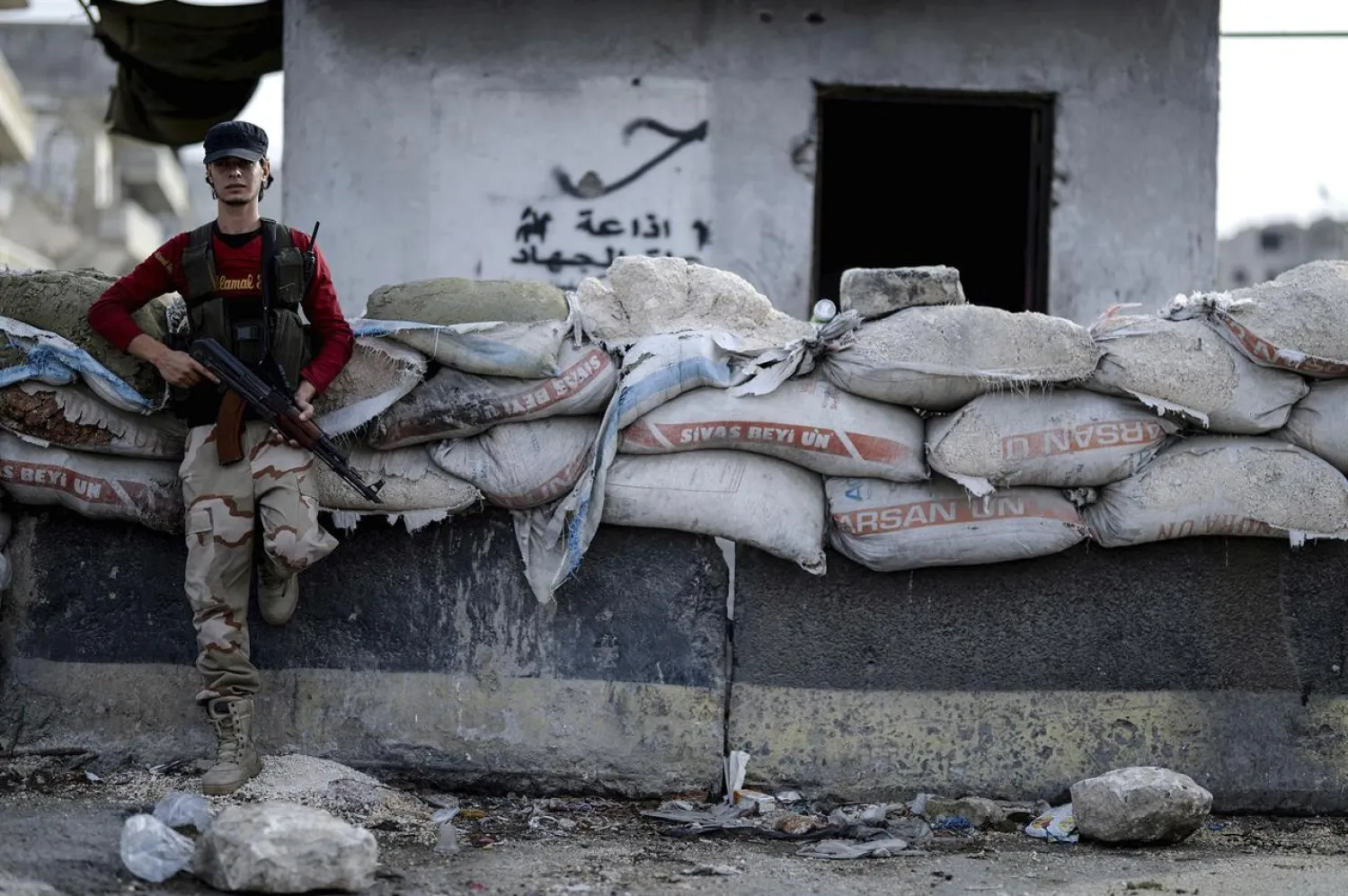

As ISIS Fight Nears End, Violence Flares on Other Syrian Front

 In this Oct. 13, 2018 file photo, a fighter of Syrian opposition stands at a checkpoint in northwestern city of Idlib, Syria. (Ugur Can/DHA via AP, File)
In this Oct. 13, 2018 file photo, a fighter of Syrian opposition stands at a checkpoint in northwestern city of Idlib, Syria. (Ugur Can/DHA via AP, File)
TT

As ISIS Fight Nears End, Violence Flares on Other Syrian Front

 In this Oct. 13, 2018 file photo, a fighter of Syrian opposition stands at a checkpoint in northwestern city of Idlib, Syria. (Ugur Can/DHA via AP, File)
In this Oct. 13, 2018 file photo, a fighter of Syrian opposition stands at a checkpoint in northwestern city of Idlib, Syria. (Ugur Can/DHA via AP, File)

While the final battle to retake the ISIS group's last pocket of territory rages in eastern Syria, violence is escalating in the country's northwest, pitting al-Qaida-linked militants against Syrian regime forces.

The alarming violence in the Idlib region threatens to unravel a truce reached between Turkey and Russia last year that averted a bloody assault by regime forces to retake the province, the last major rebel stronghold in war-torn Syria. The escalation raises fears once more of a major assault by the forces of President Bashar Assad.

Idlib has been in the hands of opposition forces for years, even as Assad's military has succeeded in retaking other rebel enclaves one after the other. The province is now home to some 3 million people, many of them displaced from other former opposition territory. Earlier this year, al-Qaida-linked militants took over the province, squeezing out most other factions after clashes with Turkey-backed opposition fighters.

Since then, government forces have intensified airstrikes and bombardment of Idlib towns. Since mid-February, some 100,000 people have been displaced, largely by government bombardment, and have fled to villages deeper in rebel-held territory, according to the Britain-based Syrian Observatory of Human Rights. The group said that around 140 people, including 69 civilians, have been killed.

The mounting violence points to how Syria's nearly 8-year-long civil war still has the capability to burst once more into major bloodshed. The focus of the US and other countries has been on defeating the ISIS group, which once held eastern and northern Syria, and Assad's conflict with his opponents has quieted in recent months after government victories and the truce. But the root of that conflict remains.

The militants, from an al-Qaida-linked group called Hayat Tahrir al-Sham, or HTS, Arabic for the Levant Liberation Committee, have also stepped up their attacks - in retaliation, they say, for the government bombardment.

In the early hours of a cold morning earlier this month, militants attacked several Syrian army positions and checkpoints on the edge of Idlib in the village of Masasneh, killing nearly two dozen soldiers - one of the most serious attacks on government forces since the truce reached in September. The attack triggered hours of fighting and bombardment that killed and wounded dozens of insurgents.

The Syrian Foreign Ministry warned afterward that the military was in "full readiness" to deal with repeated violations of the truce.

Russia, which backs Assad, and Turkey, which supports opposition factions, put together the truce in September. They agreed to establish a 15-20 kilometers (9-12 miles) deep demilitarized zone in Idlib in which they said militants will not have a presence. The deal also offered the Syrian government and Russia one of their main demands - opening two key highways that pass through Idlib and link northern Syria with Damascus and other cities. But neither provision was implementing despite a deadline for opening the roads by the end of 2018.

Still, the truce has been vital to keeping a degree of calm and preventing an all-out battle for Idlib that could be extremely bloody and drag in Russia and Turkey.

The US deputy ambassador at the United Nations, Jonathan Cohen, last month expressed American concern over the increase in government airstrikes and other violence in Idlib.

"Terrorism cannot be used as a pretext for targeting civilians," he said in a reference to al-Qaida-linked group's control of the area. "Any major military operation in Idlib would be a reckless escalation of the conflict and would result in a humanitarian catastrophe far beyond what we've witnessed."

The main immediate aim of the government operations appears to be to eventually force open the key highways crossing though Idlib - the M5 that links southern and northern Syria and the M4 that links the coastal city of Latakia with the northern city of Aleppo, said Akram al-Ahmad, a Turkey-based Syrian opposition activist who heads a monitoring group called the Syrian Press Center.

The towns most targeted by government bombardment have been Khan Sheikhoun, Saraqeb, and Maaret al-Numan, which control the M5 highway.

An HTS military commander known as Abu Khaled al-Shami released a video statement Wednesday expressing pride for killing government soldiers and vowing more attacks.

"Hayat Tahrir al-Sham will retaliate forcefully if regime forces try to advance toward liberated areas," he said.

The leaders of Russia and Turkey held another summit in mid-February after which both leaders said there will be no offensive by Syrian government forces on Idlib and promised to work together to prevent the province from becoming a "stronghold of terrorists."

On Friday, Turkey's defense minister said Turkey and Russia will begin patrols in the demilitarized zone in Idlib - though violence continued over the weekend despite some patrols.

Turkey has struggled to rein in HTS.

According to al-Ahmad and Rami Abdurrahman who heads the Observatory, there appears to be a split within HTS. On one side is its leader Abu Mohammed al-Golani, who has gotten closer to Turkey, and on the other is an Egyptian religious figure in the group known as Abu al-Yaqzan al-Masri, who represents hard-liners in HTS opposing Turkey's role. Al-Masri defected from the group in February along with other hard-liners.

Another militant group in Idlib, Horas al-Din, is also resisting the Turkish mediation. The group, made up mostly of non-Syrian al-Qaida-linked fighters, rejected the demilitarized zone, calling it a "great conspiracy."

The Syrian regime has repeatedly vowed that its forces will eventually retake the whole country.

The regime "is determined more than ever to regain control of its land and liberate from terrorism and illegitimate foreign presence," said the Syrian ambassador to the United Nations, Bashar Ja'afari.



Israeli Strikes Damage Hospital in Lebanon

File photo: Destroyed houses that were hit in an Israeli airstrike in Saksakiyeh village, south Lebanon, Friday, April 3, 2026. (AP Photo/Hussein Malla)
TT

Israeli Strikes Damage Hospital in Lebanon

File photo: Destroyed houses that were hit in an Israeli airstrike in Saksakiyeh village, south Lebanon, Friday, April 3, 2026. (AP Photo/Hussein Malla)

A hospital in the coastal Lebanese city of Tyre was damaged by Israeli airstrikes on nearby buildings that wounded 11 people, the health ministry said on Saturday.

The director of the Lebanese Italian Hospital told the state-run National News Agency (NNA) that it would "remain open to provide the necessary medical care" despite the damage.

Strikes destroyed two buildings nearby, an AFP correspondent saw, shattering windows and causing suspended ceilings to collapse in the hospital, the facility's management said.

A series of attacks hit the Tyre region on Saturday, including one on its port that struck a small boat and damaged others moored nearby, the AFP correspondent said.

Israel has been carrying out strikes across Lebanon and launched a ground invasion in the south after Hezbollah entered the war in the Middle East on the side of its backer Iran on March 2.

Tens of thousands of people have left Tyre, but around 20,000 remain, including 15,000 displaced from surrounding villages, despite Israeli evacuation warnings covering most of the city and a broad swathe of southern Lebanon.

The NNA also reported that Israeli forces abducted a man in Shebaa, near the Israeli border in the east, at around 3:00 am on Saturday.


Indonesia Slams 'Unacceptable' Peacekeeper Casualties in Lebanon

FILE PHOTO: UNIFIL vehicles drive on a main road in Qlayaa, amid escalating hostilities between Israel and Hezbollah, as the US-Israel conflict with Iran continues, in Qlayaa, southern Lebanon, March 27, 2026. REUTERS/Karamallah Daher/File Photo
TT

Indonesia Slams 'Unacceptable' Peacekeeper Casualties in Lebanon

FILE PHOTO: UNIFIL vehicles drive on a main road in Qlayaa, amid escalating hostilities between Israel and Hezbollah, as the US-Israel conflict with Iran continues, in Qlayaa, southern Lebanon, March 27, 2026. REUTERS/Karamallah Daher/File Photo

The Indonesian government on Saturday slammed as "unacceptable" an explosion that injured three of its peacekeepers in Lebanon within days of three other blue helmets from the Southeast Asian nation being killed.

The United Nations Interim Force in Lebanon (UNIFIL) said three peacekeepers were wounded in a blast that occurred inside a UN facility near Adaisseh on Friday afternoon, and rushed to hospital.

Two were seriously wounded.

The UN Information Center in Jakarta said the "origin of the explosion" was unknown but identified the injured soldiers as Indonesian.

"Repeated attacks or incidents of this kind are unacceptable," the Indonesian foreign ministry said in a statement.

"Regardless of their cause, these events underscore the urgent need to strengthen protection for UN peacekeeping forces amid an increasingly dangerous conflict situation."

The government urged the UN Security Council to investigate the events and "to immediately convene a meeting of troop-contributing countries to UNIFIL to conduct a review and take measures to enhance the protection of personnel serving with UNIFIL".

Friday's incident came just days after an Indonesian peacekeeper died when a projectile exploded on March 29 in southern Lebanon, where Israel and Hezbollah have been fighting since Lebanon was drawn into the Middle East war.

A UN security source told AFP on condition of anonymity Tuesday that fire from an Israeli tank was responsible for that attack.

A day later, two more Indonesian peacekeepers died after an explosion struck a UNIFIL logistics convoy, also in southern Lebanon.

The father of one of the two fallen soldiers, 33-year-old Zulmi Aditya Iskandar, said this week he was shocked that peacekeepers were losing their lives in the conflict.

"We were really sad and regretful, because this is a UN troop, a peacekeeping troop, not deployed for war," 60-year-old Iskandarudin told reporters at his house in West Java province.

The bodies of the three peacekeepers are scheduled to arrive in Jakarta on Saturday evening, according to the military.

The Indonesian National Armed Forces has said it will deploy more than 750 personnel to Lebanon next month as part of the scheduled UNIFIL peacekeeping troop rotation.


Strike Kills One Iraqi Fighter near Syria Border

Mourners attend the funeral of members of Iraq's Hashed al-Shaabi, who were killed in an airstrike in the town of al‑Qaim near the Syrian border, amid heightened regional tensions due to the US-Israel conflict with Iran, in Baghdad, Iraq, March 12, 2026. REUTERS/Stringer
TT

Strike Kills One Iraqi Fighter near Syria Border

Mourners attend the funeral of members of Iraq's Hashed al-Shaabi, who were killed in an airstrike in the town of al‑Qaim near the Syrian border, amid heightened regional tensions due to the US-Israel conflict with Iran, in Baghdad, Iraq, March 12, 2026. REUTERS/Stringer

An attack killed one fighter from the former paramilitary coalition Hashed al-Shaabi on Saturday, the alliance said, blaming the US and Israel.

Iraq has been dragged into the war between the United States, Israel and Iran, with strikes targeting both US interests and pro-Iran groups in the country, reported AFP.

"This treacherous attack resulted in the martyrdom of one PMF fighter and the wounding of four others, as well as a member of the ministry of defense," said a short statement from the group, which is also known as the Popular Mobilization Forces (PMF), adding it was a "Zionist-American attack".

The PMF is a coalition of armed groups -- formed in 2014 to fight extremists-- that is now part of Iraq's regular army, but also contains pro-Iran factions who have a reputation for acting independently.

PMF positions have been repeatedly targeted since the outbreak of war, with the group consistently blaming the attacks on the US and Israel.

According to the group's statement, the latest attack targeted a position in western Anbar province of the 45th Brigade, which belongs to the US-blacklisted, pro-Iran Kataeb Hezbollah group.

Kataeb Hezbollah is part of the umbrella movement known as the Islamic Resistance in Iraq, which has been claiming daily attacks since the start of the war on US interests in Iraq and the region.

The Pentagon has said helicopters have carried out strikes against pro-Iran armed groups in Iraq during the war.

Washington has strongly denied claims it has targeted Iraqi security forces.