

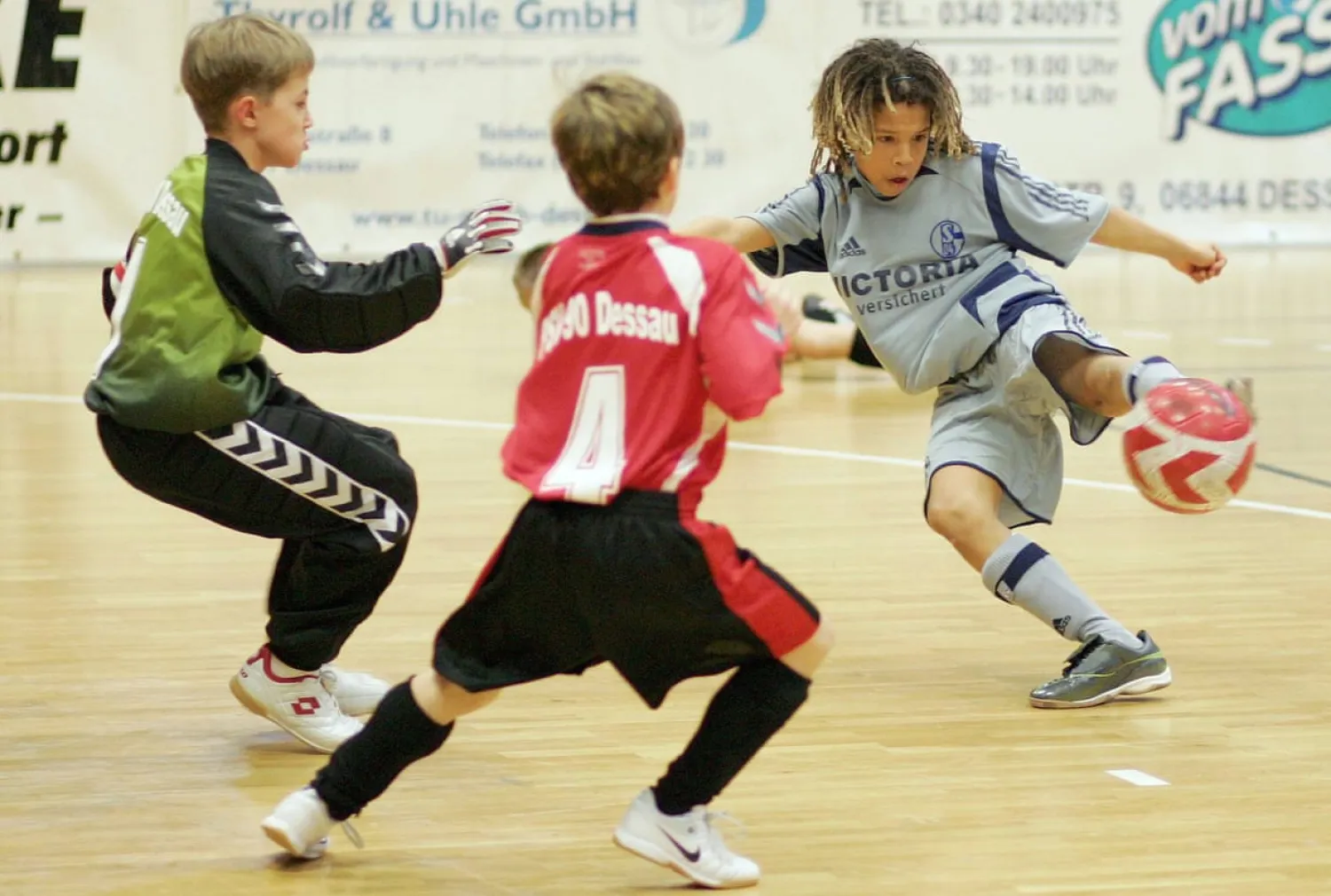

How Schalke's 'Melting Pot' Academy Produced a String of Young Players

A young Leroy Sané playing for the Schalke academy in 2007. Photograph: Imago/PA Images
TT

How Schalke's 'Melting Pot' Academy Produced a String of Young Players

A young Leroy Sané playing for the Schalke academy in 2007. Photograph: Imago/PA Images

Schalke have a proud history of producing footballers. Manuel Neuer, Benedikt Höwedes, Ilkay Gündogan, Mesut Özil, Max Meyer, Julian Draxler and Leroy Sané have all emerged from the Knappenschmiede academy. To understand why the club has brought through so many young players, you need to know a little about Gelsenkirchen’s social history.

“After the second world war, a whole mixture of cultures and backgrounds arrived to work in the region’s coal mines – such as Polish, Italian and Turkish people,” says Peter Knäbel, the man in charge of the academy. “We’re now reaping the benefits of that as the children of hard-working parents with contrasting instincts and mentalities come here and we have a fantastic melting pot.”

“We’re such a fortunate generation to have lived in a period of freedom for more than 70 years now – this wasn’t the case on two occasions – because of us both times. Now, how can we talk about the stereotypical ‘German mentality’ when the player born just 200 meters away is called Ahmed Kutucu?”

Outside on the pitch, sessions for the under-nines are underway. Every player has a ball for the opening 30 minutes, before they progress to a large, possession-based game with a goal in each corner for 10 minutes. The youngsters are then beckoned into a 20-meter square and ordered to keep the ball moving in groups of four. Instructions of “two touch” are followed by “now stay on it and dribble” as players are challenged to react to the commands.

The coaches are wary of telling the young players too much. “We don’t want coaches to give too much tactical instruction to the kids under the age of 14,” says Knäbel. “We talk about timing here and want the kids to think ‘when’ and ‘what’. So 4-4-2 and 3-5-2 don’t matter until you’re 14. The kids must learn to understand the games themselves. We let them play and, trust me, the result is always a part of our education – if an under-nines coach says that winning doesn’t matter, then just look into the eyes of the kids. They’re upset when they lose but the coach should never, ever be more upset than the kids.

“The reality is: this is sport, we play to win and we want to develop winners. You can develop a winner. We want kids to know when the decisive moments are and for them to be successful in moments of pressure – whether that’s knowing what to do in defense or attack.”

For the remainder of the 90-minute training session, the players move from exercise to exercise. Each activity varies in size, intensity and the physical demand it places on the players. There is a real fun element as coaches constantly test players with conflicting demands. No single exercise lasts longer than 20 minutes.

“We educate our coaches on whether they need to give advice or an objective to players. We need sessions and coaches to be flexible, but with clear principles. Remember, we’ve had the likes of Joël Matip and also Leroy Sané come through this system. You couldn’t find two more differing people or players.

“Coaches are the key to everything. If you have one good coach, then you have 18 good players. We study the coaches as both people and professionals before we assign them to a group. Look at Barcelona, Ajax and the top academies around the world, they have the same consistent messages and philosophies right from under-nines through to under-19s. That’s what we do here.”

We watch on as the under-17 and under-19 teams are put through their paces below the misty skies tainted by the nearby power station. Sessions run like clockwork and even rest periods are timed to the millisecond. Coaches stand over an intense 4v2 rondo, glaring with intensity. They do not need to utter a word as their presence alone screams authoritative messages. Knäbel says: “This is just the same as what the young kids were doing, but without the running; no child comes here to exercise. They’re always on the ball, working on technique and decision-making when they’re physically fatigued – as that’s when decisive moments occur.”

As the rondos and sprints turn into games, the coaches now bark tactical guidance, correcting body shapes and defensive presses before falling into silence for minutes at a time before intervening again. Players are added in and taken out of sessions and pitch-sizes are regularly altered – both increasing and decreasing the intensity of play as coaches pine for flexible players who can readjust and find solutions in different scenarios.

As the sessions wrap up, under-17 coach Frank Fahrenhorst tells me how important it is that players and staff have good personal relationships. “As coaches, we are responsible for teaching the players about responsibilities and discipline. This is our duty and it requires a specific supporting programme so that the boys can develop as people and learn independence, both on and off the pitch.”

Knäbel agrees, pointing to the club’s relationship with the Gesamtschule Berger Feld school, where players are educated while they train at Knappenschmiede. “Kutucu played for the first team last night and he’ll graduate in March. We place a huge importance on education and developing good people as well as good players. If the programme is running correctly, you get both. Coaches need to have interest in kids and their wellbeing, so we have regular contact with parents and schools. You can’t just concentrate on the pitch.”

“The game has become an industry and I shouldn’t complain as it has given me this job, but new football makes it difficult to understand the world. My brother works at an amateur club in the 13th tier of German football, with only 18 kids in the youth system and just one pitch for everyone. We need to prepare our kids at Schalke to go into the real world as they’ll probably end up playing in my brother’s league, as only 0.001% can go on to play for Manchester City.”

(The Guardian)


Chelsea Injuries up 44% After Club World Cup but Report Says Event Has Had ‘Minimal’ Impact

Chelsea's Reece James, center, lifts the trophy following the Club World Cup final soccer match between Chelsea and PSG at MetLife Stadium in East Rutherford, N.J., Sunday, July 13, 2025. (AP)
TT

Chelsea Injuries up 44% After Club World Cup but Report Says Event Has Had ‘Minimal’ Impact

Chelsea's Reece James, center, lifts the trophy following the Club World Cup final soccer match between Chelsea and PSG at MetLife Stadium in East Rutherford, N.J., Sunday, July 13, 2025. (AP)

Chelsea suffered a 44% spike in injuries after competing in the supersized Club World Cup this year, according to findings published on Tuesday.

But the newly expanded tournament has so far had a “minimal impact” on injuries overall, the latest edition of the Men’s European Football Injury Index found.

There was fierce opposition to FIFA's new flagship club event when it was confirmed in 2023 that it would increase from seven to 32 teams, with players' unions warning of physical and mental burnout of players due to an ever expanding match schedule. But FIFA pressed ahead and staged the tournament in the United States in June-July.

Chelsea went on to win the inaugural competition, receiving the trophy from US President Donald Trump at MetLife Stadium and taking home prize money of around $125 million. But, according to the Index, from June-October, Chelsea picked up more injuries — 23 — than any of the nine clubs from Europe's top leagues that participated in the Club World Cup.

They included star player Cole Palmer, and was a 44% increase on the same period last year.

While Chelsea, which played 64 games over the entire 2024-25 season, saw an increase in injuries, the Index, produced by global insurance firm Howden, found that overall there was a decrease.

“In principle you would expect this increased workload to lead to an increase in the number of injuries sustained, as a possible rise in overall injury severity,” the Index report said, but added: “The data would suggest a minimal impact on overall injury figures.”

Despite the figures, the authors of the report accept it was too early to assess the full impact of the Club World Cup, with the findings only going up to October.

“We would expect to see the impact to spike in that sort of November to February period,” said James Burrows, Head of Sport at Howden. “What we’ve seen previously is that’s where the impact is seen from summer tournaments."

Manchester City has sustained 22 since the tournament, which is the highest among the nine teams from Europe's top leagues — England, Spain, Italy, Germany and France.

Those teams have recorded 146 injuries from June-October, which is down on the previous year's figure of 174.

From August-October that number is 121, the lowest for that three-month period in the previous six years of the Index.


Sunderland Worst Hit by Losing Players to African Cup of Nations 

14 December 2025, United Kingdom, London: Sunderland's Habib Diarra (L) and Leeds United's Gabriel Gudmundsson battle for the ball during the English Premier League soccer match between Brentford and Leeds United at the Gtech Community Stadium. (dpa)
TT

Sunderland Worst Hit by Losing Players to African Cup of Nations 

14 December 2025, United Kingdom, London: Sunderland's Habib Diarra (L) and Leeds United's Gabriel Gudmundsson battle for the ball during the English Premier League soccer match between Brentford and Leeds United at the Gtech Community Stadium. (dpa)

Premier League Sunderland will have to do without six players over the next few weeks and are the club worst hit as the Africa Cup of Nations takes its toll on European clubs competing over the holiday season.

Sunderland, eighth in the standings, had four of their African internationals in action when they beat Newcastle United on Sunday, but like 14 other English top-flight clubs will now lose those players to international duty.

The timing of the African championship, kicking off in Morocco on Sunday and running through to January 18, has long been an irritant for coaches, with leagues in Belgium, France, Germany, Italy, Netherlands, Portugal, and Spain also affected.

Hosting the tournament in the middle of the season impacts around 58% of the players at the Cup of Nations, though the Confederation of African Football did try to mitigate the impact by moving the start to before Christmas, so it is completed before the next round of Champions League matches.

The impact on European clubs was also lessened by allowing them to release players seven days, rather than the mandatory 14 days, before the tournament, meaning they could play for their clubs last weekend.

Sunderland's Congolese Arthur Masuaku and Noah Sadiki, plus full back Reinildo (Mozambique), midfielder Habib Diarra (Mali), and attackers Chemsdine Talbi (Morocco) and Bertrand Traore (Burkina Faso) have now departed for Morocco.

Ironically, Mohamed Salah’s absence from Liverpool to play for Egypt should lower the temperature at the club after his recent outburst against manager Arne Slot, but Manchester United will lose three players in Noussair Mazraoui, Bryan Mbeumo and Amad Diallo, who scored in Monday’s 4-4 draw with Bournemouth.

France is again the country with the most players heading to the Cup of Nations, and with 51 from Ligue 1 clubs. But their absence is much less impactful than previously as Ligue 1 broke after the weekend’s fixtures and does not resume until January 2, by which time the Cup of Nations will be into its knockout stage.

There are 21 players from Serie A clubs, 18 from the Bundesliga, and 15 from LaLiga teams among the 24 squads at the tournament in Morocco.


Rodgers Takes Charge of Saudi Team Al-Qadsiah After Departure from Celtic 

Then-Celtic head coach Brendan Rodgers greets supporters after a Europa League soccer match between Red Star and Celtic at Rajko Mitic Stadium in Belgrade, Serbia, Sept. 24, 2025. (AP)
TT

Rodgers Takes Charge of Saudi Team Al-Qadsiah After Departure from Celtic 

Then-Celtic head coach Brendan Rodgers greets supporters after a Europa League soccer match between Red Star and Celtic at Rajko Mitic Stadium in Belgrade, Serbia, Sept. 24, 2025. (AP)

Brendan Rodgers has returned to football as the coach of Saudi Arabian club Al-Qadsiah, six weeks after resigning from Scottish champion Celtic.

Al-Qadsiah, whose squad includes Italian striker Mateo Retegui and former Real Madrid defender Fernandez Nacho, is in fifth place in the Saudi Pro League in its first season after promotion.

Rodgers departed Celtic on Oct. 27 and has opted to continue his managerial career outside Britain for the first time, having previously coached Liverpool, Leicester and Swansea.

In its statement announcing the hiring of Rodgers on Tuesday, Al-Qadsiah described him as a “world-renowned coach” and said his arrival “reflects the club’s ambitious vision and its rapidly growing sporting project.”

Aramco, the state-owned Saudi oil giant, bought Al-Qadsiah in 2023 in a move that has helped to transform the club’s status.

“This is a landmark moment for the club,” Al-Qadsiah chief executive James Bisgrove said. “The caliber of his experience and track record of winning reflects our ambition and long-term vision to establish Al-Qadsiah as one of Asia’s leading clubs.”

Rodgers is coming off winning back-to-back Scottish league titles with Celtic, where he won 11 major trophies across his two spells. He also won the FA Cup with Leicester.

Al-Qadsiah's last two coaches were former Liverpool striker Robbie Fowler and former Spain midfielder Michel.
