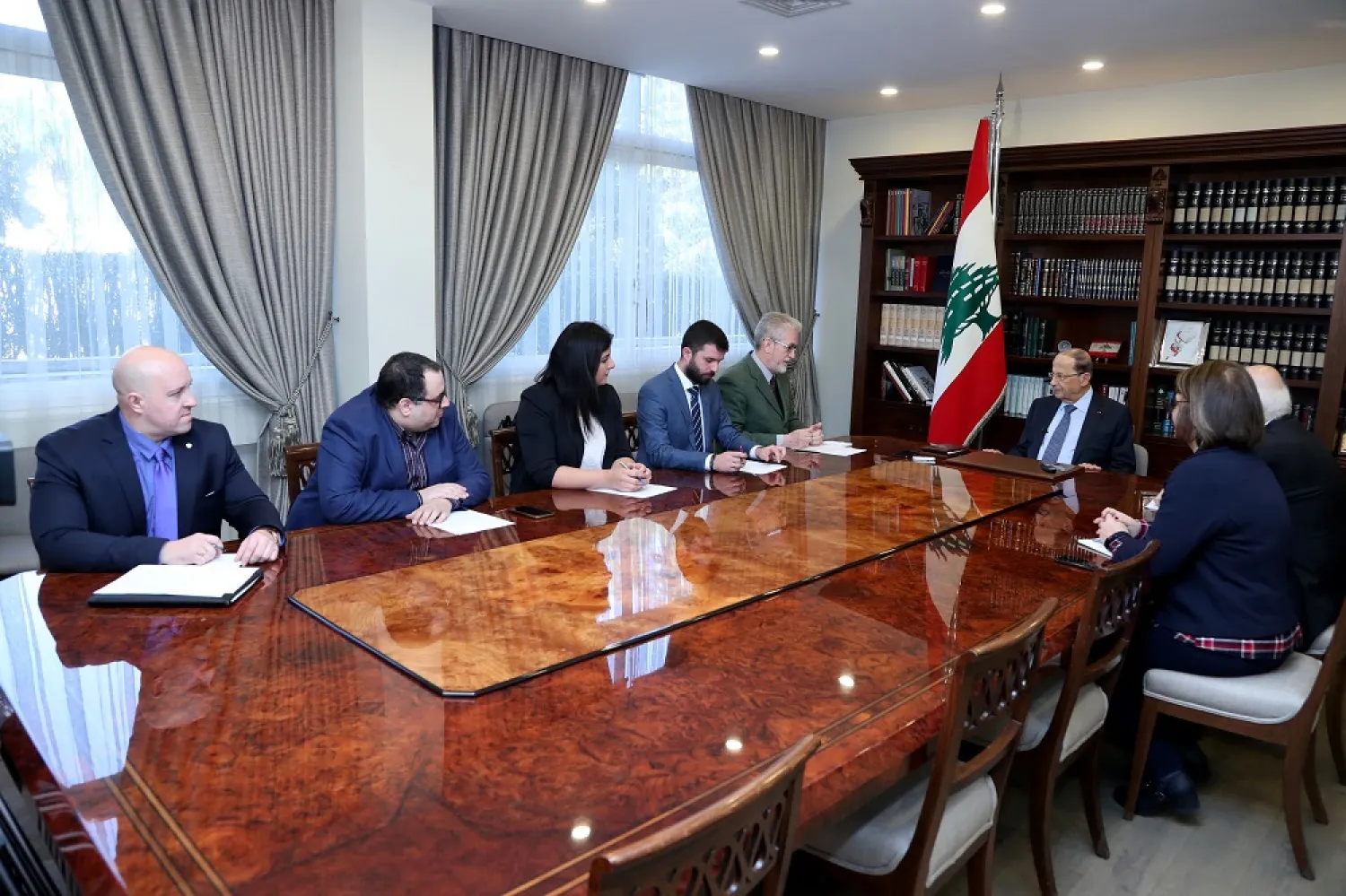
Lebanese President: Ties with Syria are Normalized, We Will Participate in its Reconstruction

Lebanese President Michel Aoun during his meeting with Russian correspondents at the Baabda Palace. (Dalati & Nohra)
TT

Lebanese President: Ties with Syria are Normalized, We Will Participate in its Reconstruction

Lebanese President Michel Aoun during his meeting with Russian correspondents at the Baabda Palace. (Dalati & Nohra)

Lebanon’s President Michel Aoun said relations between Beirut and Moscow “are historic and date back to the 19th century.”

He noted that during his upcoming visit to Moscow on March 25-26, he would discuss “means to develop these relations in various fields, in addition to other topics, including the issues of the displaced and the Russian initiative.”

Aoun met on Thursday with Russian media correspondents on the eve of his state trip where he is scheduled to hold talks with President Vladimir Putin.

Touching on the issue of displaced Syrians, Aoun said: “Lebanon will review the international conditions, but will act according to its supreme interests. The international community is not helping [Lebanon], while the country is helping the Syrians return home, as around 172,000 refugees have returned to their homeland to date.”

On relations with Syria, the president stressed that they are “normalized”.

“If a visit is required, it will be possible, but if it is not necessary, then the ambassadors, ministers and the Higher Coordination Council can discuss the relevant issues,” he said.

Emphasizing Lebanon’s intention to participate in the reconstruction of Syria, Aoun noted: “Pressure is exerted on everyone not to participate in this process, in light of the international community's linking reconstruction and repatriation of displaced people to the political solution.”

“The international community seeks to take the displaced hostage in the political solution talks,” he maintained.

Separately, Aoun said the embargo on Hezbollah was affecting all the Lebanese.

“Lebanon is living under the siege imposed on the region, especially since it cannot work with Syria, and Hezbollah is also financially besieged. So we became internationally trapped, because the negative impact of the blockade on [Hezbollah] affects all Lebanese, including Lebanese banks,” he remarked.


Macron Arrives in Syria as First Major Western Leader to Visit Country Under New Leadership

France's President Emmanuel Macron (L) is welcomed by Syria's Foreign Minister Asaad al-Shaibani (R) as he arrives fo a state visit at the Damascus International Airport in Damascus on July 6, 2026. (AFP)
TT

Macron Arrives in Syria as First Major Western Leader to Visit Country Under New Leadership

France's President Emmanuel Macron (L) is welcomed by Syria's Foreign Minister Asaad al-Shaibani (R) as he arrives fo a state visit at the Damascus International Airport in Damascus on July 6, 2026. (AFP)

French President Emmanuel Macron arrived Monday in Syria, making him the first major western leader to visit the war-torn country since the ouster of Bashar al-Assad in 2024. 

Ukrainian President Volodymyr Zelenskyy visited April, but Macron is the first leader from western Europe or North America to do so. 

The French president’s visit comes during a period of relative calm in the Middle East after the monthlong war in Iran and Lebanon.  

He will travel next to Ankara, Türkiye, for the NATO summit, where Syrian President Ahmed al-Sharaa is also expected to attend and hold a high-profile meeting with US President Donald Trump. 

Syria’s state-run SANA news agency said Macron would visit with a business delegation to discuss regional security as well as business and investment opportunities. 

Macron was greeted at Damascus airport by Syrian Foreign Minister Asaad al-Shibani. 

Macron hosted al-Sharaa in Paris in May 2025, where he urged European and US leaders to lift longstanding sanctions on Damascus. Most of those sanctions had since been lifted. 


Sudan Gold Mine Collapse Kills 15 Miners

Workers break rocks at a gold mine near Abu Delelq in Gadarif State, Sudan. (Reuters)
TT

Sudan Gold Mine Collapse Kills 15 Miners

Workers break rocks at a gold mine near Abu Delelq in Gadarif State, Sudan. (Reuters)

A partial collapse in a decommissioned gold mine in northern Sudan has killed 15 miners, a state company said on Monday.

The miners had snuck into the shut-down Mohamed Tawfiq mine, in Wadi Halfa near the Egyptian border, when "parts of the mine collapsed... killing 15 miners and injuring one," the Sudanese Mineral Resources Company said.

Since war erupted in April 2023 between the army and the paramilitary Rapid Support Forces, both sides' war efforts have been largely funded by Sudan's gold industry, in addition to foreign backers.

The war has devastated Sudan's already fragile economy and left much of the country out of work, pushing many into a dangerous gold rush.

Artisanal and small-scale gold mining, which takes place in unofficial zones or decommissioned mines, accounts for the majority of gold extracted.

These mines lack proper safety measures and use hazardous chemicals that often cause widespread illness in nearby areas.

Even before the war pushed 25 million Sudanese into acute food insecurity, artisanal mining employed more than two million people, according to industry figures.

Africa's third-largest country is one of the continent's top gold producers, and this year SMRC reported a "five-year high" in production of 70 tons in 2025.

But officials say much of the gold is smuggled across Sudan's borders.

Of last year's 70 tons, only "20 tons were exported through official channels", army-aligned Finance Minister Gibril Ibrahim told AFP.


Israel’s Detention of Prominent Gazan Doctor Is Arbitrary, UN Body Says

A woman holds a sign that reads "Free Dr. Hussam Abu Safiya, Free Gaza" during a protest in front of the Shin Bet offices, calling for his release, in Tel Aviv, Israel, on Jan. 1, 2025. (AP)
TT

Israel’s Detention of Prominent Gazan Doctor Is Arbitrary, UN Body Says

A woman holds a sign that reads "Free Dr. Hussam Abu Safiya, Free Gaza" during a protest in front of the Shin Bet offices, calling for his release, in Tel Aviv, Israel, on Jan. 1, 2025. (AP)

A UN human rights body on Monday called Israel's detention of Gazan doctor Hussam Abu Safiya arbitrary and sought his immediate release as rights groups and his lawyer warned that his life was in imminent danger.

In its finding, the ‌UN Working ‌Group on Arbitrary Detention said ‌that ⁠Israel's actions contravened multiple articles ⁠of the Universal Declaration of Human Rights as well as the International Covenant on Civil and Political Rights.

"The appropriate remedy would be to release Mr. Abu Safiya immediately and accord him an enforceable ⁠right to compensation and other reparations, ‌in accordance with ‌international law," it said.

It also voiced broader concerns ‌that the case, one of several ‌it has received, "may indicate a widespread or systematic practice of arbitrary detention in the country."

Earlier on Monday, the doctor's lawyer alleged that his health was ‌in grave danger and that he had been subjected to brutal ⁠abuse ⁠on a daily basis, prompting calls for his release from rights groups.

The Israel Prison Service did not immediately respond to a request for comment. Previously, it has rejected allegations that Abu Safiya and other doctors have been mistreated in prison.

The Israeli Supreme Court has in the past declined to comment on appeals for his release.