


Premier League Needs Some Remedial Work to Be Ready for VAR Next Season

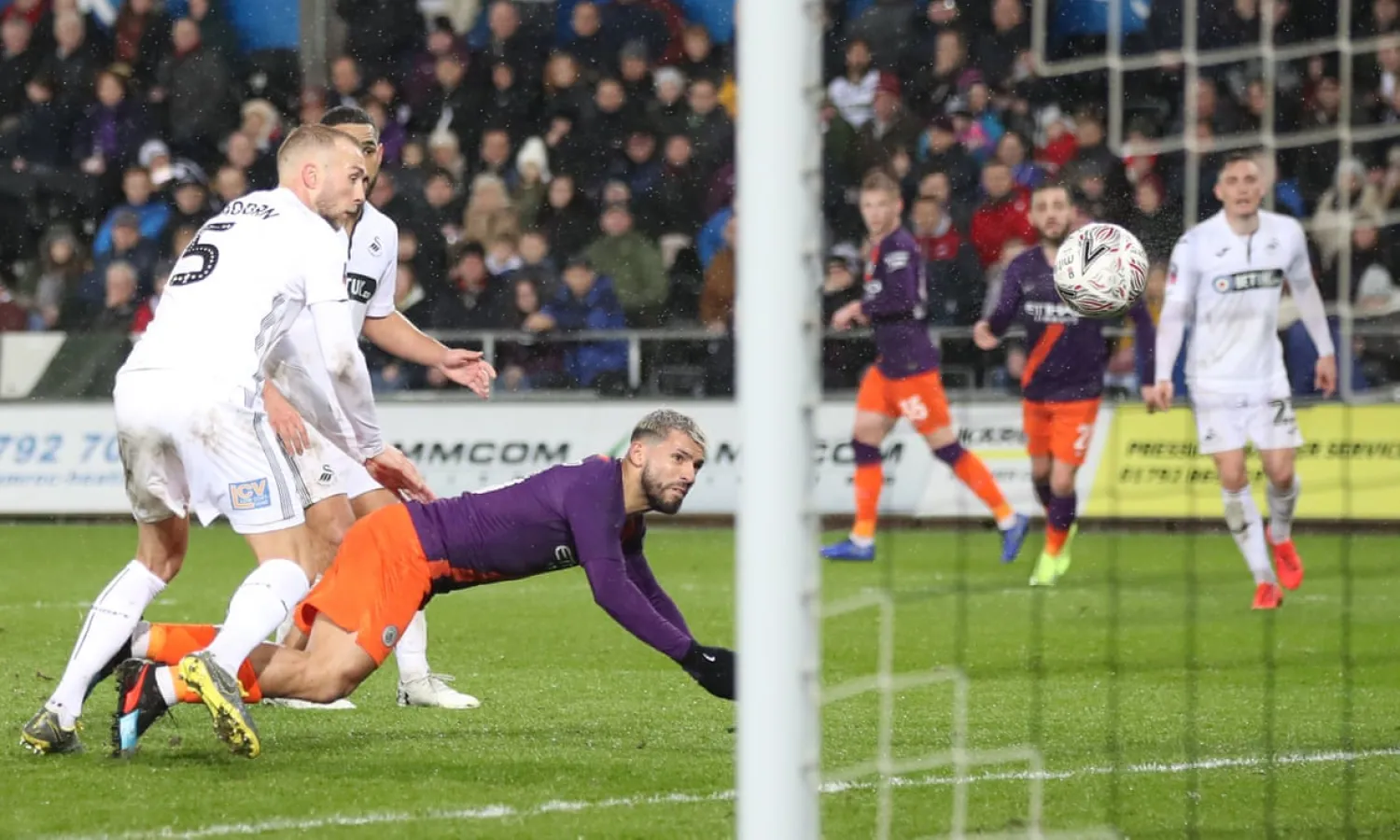
Sergio Agüero scores Manchester City’s late winner in the FA Cup tie at Swansea on Saturday. In hindsight it appears VAR would have disallowed the goal for a marginal offside call. Photograph: Nick Potts/PA
TT

Premier League Needs Some Remedial Work to Be Ready for VAR Next Season

Sergio Agüero scores Manchester City’s late winner in the FA Cup tie at Swansea on Saturday. In hindsight it appears VAR would have disallowed the goal for a marginal offside call. Photograph: Nick Potts/PA

No one wants to see a player sent off for an accidental foul, especially after four minutes of a game, but though it was possible to feel sorry for Harry Maguire against Burnley last Saturday it was almost a relief to come across a situation where everyone knew what the referee’s decision ought to be.

Maguire had to go, simple as that. His offense was considerably less heinous than that of Willie Young, the Arsenal center-half whose shockingly cynical lunge at Paul Allen in the 1980 FA Cup final led to red cards being introduced for professional fouls in the first place, but the overall result was exactly the same. A goalscoring opportunity was unfairly lost through no fault of the attacking team.

It has been mentioned that now the triple jeopardy situation has been amended, and a defender no longer automatically collects a red card for illegally preventing a goal in the penalty area, the same sort of leniency should apply to accidental fouls elsewhere on the pitch. Yet where, in that event, would have been the redress for Burnley? They would not have had an opportunity to score from the penalty spot, they would simply have had a free-kick from a fair way out, as West Ham did in 1980, which in all likelihood would have been successfully defended.

The only question the referee had to ask himself at Turf Moor was whether a foul had been committed. The answer was clearly yes, so as the rules presently stand, the unlucky Maguire received the appropriate punishment. It could be argued that an elegant and equable solution would have been to leave Maguire on the pitch and award Burnley a penalty, though the game has never embraced the idea of penalty fouls for offenses outside the box, and given the current level of controversy over incidents inside the area that is probably just as well. Maguire was unfortunate to fall foul of the rules so early in the game, but the key point is that the rules are clear so no one had any real complaints, not even the player himself.

That in its own way was quite refreshing after the grey area disputes of the last few weeks. Manchester United’s handball penalty against Paris Saint-Germain was a matter of interpretation and intense debate, as was Raheem Sterling’s first goal against Watford, which appeared to have been scored from an offside position.

A number of players have now been asked about their understanding of the rules and admitted they are as much in the dark as anyone else, which never used to be the case in football. Everyone knows that rugby union, for instance, has technical rules so arcane and complicated that no-one in the stands can possibly follow the referee’s reasoning in awarding decisions around a scrum or a rolling maul, which is why the official is now obliged to signal to the crowd what offense he has just penalized. However, football is a sport that formerly prided itself on having rules so transparent and straightforward that most spectators could understand them.

For the last century or so, in other words, the majority of people watching a football match would have a good idea of what the referee’s decision would be in any given situation. The official was not on the pitch for his interpreting skills or his ability to remember a long list of possible infringements, he was there to blow his whistle and stop the game when necessary and then make the appropriate form of restart. When referees got things wrong, which they did from time to time, the crowd would let them know about it in no uncertain terms. Now the crowd is often as puzzled as the players, even, perhaps especially, when VAR is involved.

There is a general assumption that everything is going to run super smoothly next season because VAR will be around to help referees get everything right. Already we have seen enough to realize this is probably a pipe dream. The rules need tightening first, especially around handball and offside. Had VAR been around at the time of Thierry Henry’s notorious handball in a World Cup play-off for France against Ireland the Irish might have made it to the 2010 tournament, but Presnel Kimpembe’s offense against Manchester United was nothing like as clear cut.

Last week when Sergio Agüero came on to score the winning goal against Swansea in the FA Cup the television commentator noticed after the event that he might have been fractionally offside and said the goal would probably not have survived VAR scrutiny. Yet if Agüero was so fractionally offside that no one on the pitch actually noticed in real time, do we really want to stop the game for a series of replays to establish that what looked a perfectly good goal should be discounted?

We really need to straighten these things out before VAR is introduced next season. Some people will argue that the letter of the law must be obeyed and the precision of VAR must be respected no matter how many replays are required. Others feel just as strongly that borderline offsides do not necessarily confer an unfair advantage, and the original purpose of the law, to prevent goal-hanging, has long been forgotten.

These arguments will run and run next season, quite possibly mid-match. That’s why it is good to have something everyone can agree about. VAR could not have done anything to help Harry Maguire. He had to go, and everyone knew it.

(The Guardian)


Sunderland Worst Hit by Losing Players to African Cup of Nations 

14 December 2025, United Kingdom, London: Sunderland's Habib Diarra (L) and Leeds United's Gabriel Gudmundsson battle for the ball during the English Premier League soccer match between Brentford and Leeds United at the Gtech Community Stadium. (dpa)
TT

Sunderland Worst Hit by Losing Players to African Cup of Nations 

14 December 2025, United Kingdom, London: Sunderland's Habib Diarra (L) and Leeds United's Gabriel Gudmundsson battle for the ball during the English Premier League soccer match between Brentford and Leeds United at the Gtech Community Stadium. (dpa)

Premier League Sunderland will have to do without six players over the next few weeks and are the club worst hit as the Africa Cup of Nations takes its toll on European clubs competing over the holiday season.

Sunderland, eighth in the standings, had four of their African internationals in action when they beat Newcastle United on Sunday, but like 14 other English top-flight clubs will now lose those players to international duty.

The timing of the African championship, kicking off in Morocco on Sunday and running through to January 18, has long been an irritant for coaches, with leagues in Belgium, France, Germany, Italy, Netherlands, Portugal, and Spain also affected.

Hosting the tournament in the middle of the season impacts around 58% of the players at the Cup of Nations, though the Confederation of African Football did try to mitigate the impact by moving the start to before Christmas, so it is completed before the next round of Champions League matches.

The impact on European clubs was also lessened by allowing them to release players seven days, rather than the mandatory 14 days, before the tournament, meaning they could play for their clubs last weekend.

Sunderland's Congolese Arthur Masuaku and Noah Sadiki, plus full back Reinildo (Mozambique), midfielder Habib Diarra (Mali), and attackers Chemsdine Talbi (Morocco) and Bertrand Traore (Burkina Faso) have now departed for Morocco.

Ironically, Mohamed Salah’s absence from Liverpool to play for Egypt should lower the temperature at the club after his recent outburst against manager Arne Slot, but Manchester United will lose three players in Noussair Mazraoui, Bryan Mbeumo and Amad Diallo, who scored in Monday’s 4-4 draw with Bournemouth.

France is again the country with the most players heading to the Cup of Nations, and with 51 from Ligue 1 clubs. But their absence is much less impactful than previously as Ligue 1 broke after the weekend’s fixtures and does not resume until January 2, by which time the Cup of Nations will be into its knockout stage.

There are 21 players from Serie A clubs, 18 from the Bundesliga, and 15 from LaLiga teams among the 24 squads at the tournament in Morocco.


Rodgers Takes Charge of Saudi Team Al-Qadsiah After Departure from Celtic 

Then-Celtic head coach Brendan Rodgers greets supporters after a Europa League soccer match between Red Star and Celtic at Rajko Mitic Stadium in Belgrade, Serbia, Sept. 24, 2025. (AP)
TT

Rodgers Takes Charge of Saudi Team Al-Qadsiah After Departure from Celtic 

Then-Celtic head coach Brendan Rodgers greets supporters after a Europa League soccer match between Red Star and Celtic at Rajko Mitic Stadium in Belgrade, Serbia, Sept. 24, 2025. (AP)

Brendan Rodgers has returned to football as the coach of Saudi Arabian club Al-Qadsiah, six weeks after resigning from Scottish champion Celtic.

Al-Qadsiah, whose squad includes Italian striker Mateo Retegui and former Real Madrid defender Fernandez Nacho, is in fifth place in the Saudi Pro League in its first season after promotion.

Rodgers departed Celtic on Oct. 27 and has opted to continue his managerial career outside Britain for the first time, having previously coached Liverpool, Leicester and Swansea.

In its statement announcing the hiring of Rodgers on Tuesday, Al-Qadsiah described him as a “world-renowned coach” and said his arrival “reflects the club’s ambitious vision and its rapidly growing sporting project.”

Aramco, the state-owned Saudi oil giant, bought Al-Qadsiah in 2023 in a move that has helped to transform the club’s status.

“This is a landmark moment for the club,” Al-Qadsiah chief executive James Bisgrove said. “The caliber of his experience and track record of winning reflects our ambition and long-term vision to establish Al-Qadsiah as one of Asia’s leading clubs.”

Rodgers is coming off winning back-to-back Scottish league titles with Celtic, where he won 11 major trophies across his two spells. He also won the FA Cup with Leicester.

Al-Qadsiah's last two coaches were former Liverpool striker Robbie Fowler and former Spain midfielder Michel.


Portugal to Return to F1 Calendar in 2027 and 2028 

12 July 2025, United Arab Emirates, Abu Dhabi: Red Bull driver Max Verstappen leads into turn one during the Abu Dhabi Grand Prix at the Yas Marina Circuit, Abu Dhabi. (dpa)
TT

Portugal to Return to F1 Calendar in 2027 and 2028 

12 July 2025, United Arab Emirates, Abu Dhabi: Red Bull driver Max Verstappen leads into turn one during the Abu Dhabi Grand Prix at the Yas Marina Circuit, Abu Dhabi. (dpa)

Formula One will return to Portugal's Portimao circuit in 2027 and 2028 after the Dutch Grand Prix at Zandvoort drops off the calendar.

Formula One announced a two-year deal in a statement on Tuesday.

The 4.6-km Algarve International circuit in the country's south last hosted the Portuguese Grand Prix in 2020 and 2021, both seasons impacted by the COVID-19 pandemic with stand-in venues.

In 2020, seven-times world champion Lewis Hamilton took his 92nd career win at Portimao, breaking the record previously held by Michael Schumacher. Hamilton also won in 2021.

"The interest and demand to host a Formula One Grand Prix is the highest that it has ever been," said Formula One chief executive Stefano Domenicali, thanking the Portuguese government and local authorities.

The financial terms of the deal were not announced.

"Hosting the Grand Prix in the Algarve reinforces our regional development strategy, enhancing the value of the territories and creating opportunities for local economies," said Economy Minister Manuel Castro Almeida.

Portugal first hosted a grand prix in Porto in 1958, with subsequent races at Monsanto and Estoril near Lisbon. The late Brazilian great Ayrton Senna took his first grand prix pole and win at the latter circuit in 1985.

Formula One announced last year that Zandvoort, a home race for four-times world champion Max Verstappen, would drop off the calendar after 2026.

The championship already features a record 24 races and Domenicali has spoken of European rounds alternating to allow others to come in.

Belgium's race at Spa-Francorchamps is due to be dropped in 2028 and 2030 as part of a contract extension to 2031 announced last January.
