


Can European Football Clubs’ Claims About Asian Fanbases Be Believed?

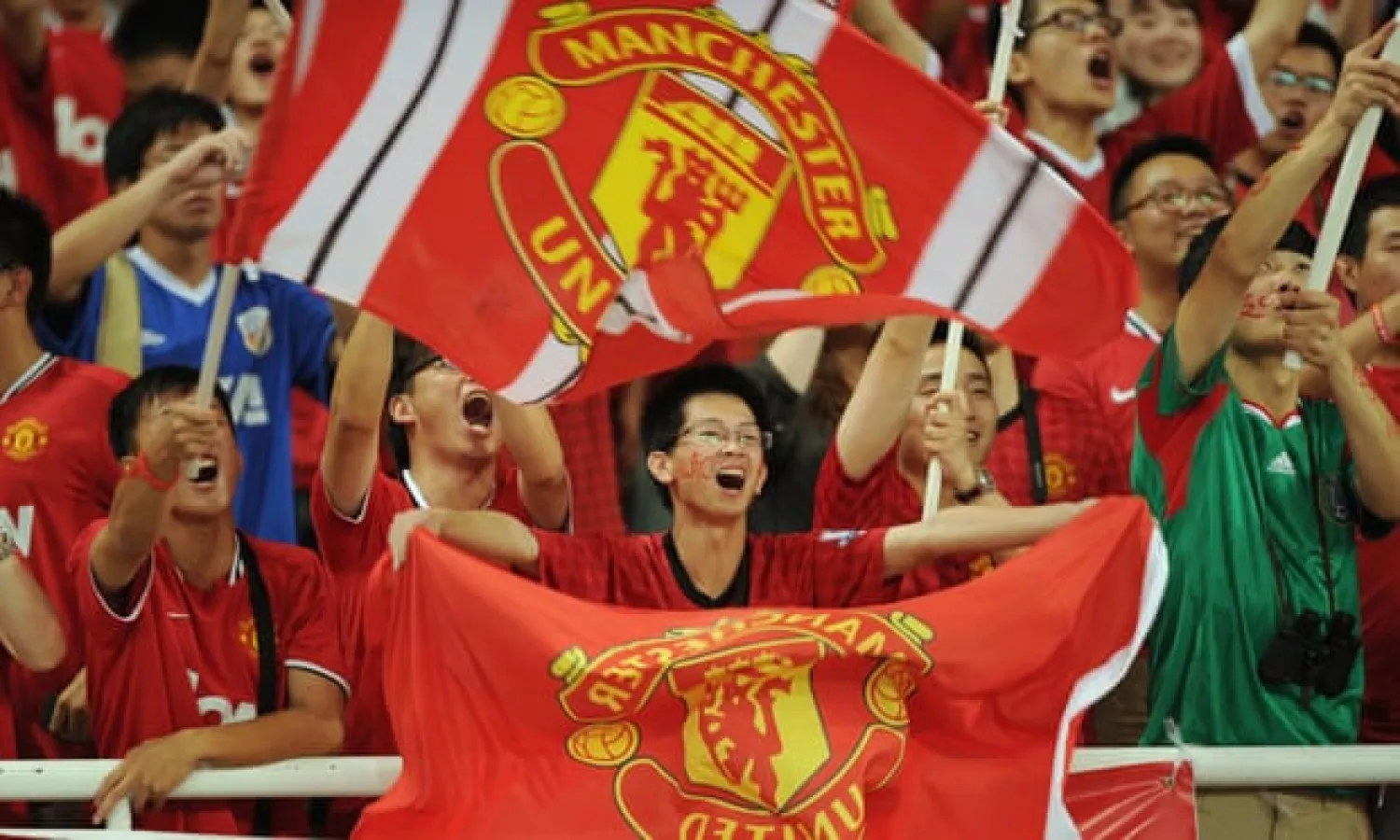
 Manchester United fans wait for the start of a friendly against Shanghai Shenhua in the Chinese city in 2012. Photograph: Peter Parks/AFP/Getty Images
Manchester United fans wait for the start of a friendly against Shanghai Shenhua in the Chinese city in 2012. Photograph: Peter Parks/AFP/Getty Images
TT

Can European Football Clubs’ Claims About Asian Fanbases Be Believed?

 Manchester United fans wait for the start of a friendly against Shanghai Shenhua in the Chinese city in 2012. Photograph: Peter Parks/AFP/Getty Images
Manchester United fans wait for the start of a friendly against Shanghai Shenhua in the Chinese city in 2012. Photograph: Peter Parks/AFP/Getty Images

Espanyol’s Chinese owner, Chen Yansheng, said in December that the best way to increase the club’s popularity in the world’s most populous country would be to sign a Chinese player. In January he signed the best, in the shape of Wu Lei, the top scorer in the 2018 Chinese Super League.

Wu’s La Liga debut against Villarreal on 3 February was decent but overshadowed by Espanyol’s PR department claiming his 13 minutes of action were watched by 40 million Chinese fans. The figures were then broadcast around the world.

That game was not on national television in China but was shown online, where the viewing figures for PPTV, which shows La Liga, were actually 10,584,992. Still impressive, but some way short of the original claim.

Yet Espanyol are only following a long European tradition (remember Mays of yore when BBC commentators talked of a billion people tuning in to FA Cup finals?). When Manchester City, with Sun Jihai, and Everton, with Li Tie, met on New Year’s Day 2003, it was reported that in their homeland anything from 350 million to 600 million watched a match that kicked off at 10pm Chinese time on a Wednesday. It is an unbelievable figure in the sense that it can’t actually be believed, but when it comes to China and Asia, it is not what is true that matters.

How else could Chelsea’s head of the Asia-Pacific region talk in 2015 of 250 million Asian fans? Another figure worthy of doubtful-looking emojis came in 2014 as Liverpool reported 580 million global fans. Two years earlier Manchester United announced 659 million “followers” were discovered in a survey of 59,000 adults, which was commissioned by the club. It stated that 325 million of these were from the Asia-Pacific region.

The club did not respond to an inquiry asking how they reached this figure but there is an explanation in the 2012 prospectus published as the club was listed, coincidentally of course, on the New York stock exchange. “Included in the definition of ‘follower’ [is] a respondent who either watched live Manchester United matches, followed highlights coverage or read or talked about Manchester United regularly.”

A visit to this newspaper’s online match report when the team lose will show quite clearly that not all who read and leave a comment are wishing United well, as Mark Dreyer, a China-based sports business consultant, observes. “The small print defines a ‘follower’ as anyone who takes an interest in Man United’s results, and that – laughably – includes fans of their biggest rivals,” Dreyer says.

China is said to have 108 million United followers. “If over 100 million people in China follow Man Utd in any normal sense of the word, then clubs like Real Madrid, Arsenal, Chelsea, Man City, Liverpool, Bayern Munich, Dortmund, AC Milan, Inter Milan, Juventus and PSG must all have something approaching that level, too. Yes, there are 1.4 billion people in China, but something like a third – at most – would be considered football fans, and so you quickly run out of people.” The same is true in South Korea. Anyone who has spent time there would be surprised to hear there are 15 million football fans in total, never mind that number of United followers.

If such figures were used to discuss “reach” then perhaps it would be different but the term “follower” is often used interchangeably with more traditional descriptions of support. In 2018, Manchester United’s managing director, Richard Arnold, unveiled an app that he said “will allow our 659 million Manchester United followers to easily connect to the club they love, wherever they are in the world”. Now the followers are no longer anyone who has seen or read about United but those with a passion for the club. Arnold never mentions the longer “f-word” again, and switches to fans and global fanbase. The comments are reported around the world.

Does this matter? Well, the lack of realism doesn’t help the perception of Asian players as it feeds the narrative that their abilities off the pitch, which often turn out to be overstated, outrank what they can do on it. For the clubs in question, such figures floating above negotiation tables with potential sponsors or investors cannot do any harm.

That more than 10 million fans in China saw a La Liga game that was watched by a reported 177,000 in Spain is worthy of note, just as Manchester United are the most popular English club in Asia, with impressive levels of support. The European tradition of making wild claims about Asia feels a little like Lionel Messi appealing for a throw-in that he knows is not his: it may not be a major issue in the grand scheme of things but it just feels unnecessary when you are doing pretty well as it is.

The Guardian Sport


International Olympic Committee Lifts Restrictions on Belarusian Athletes

The International Olympic Committee on Thursday lifted restrictions imposed on Belarusian athletes (Reuters)
TT

International Olympic Committee Lifts Restrictions on Belarusian Athletes

The International Olympic Committee on Thursday lifted restrictions imposed on Belarusian athletes (Reuters)

The International Olympic Committee on Thursday lifted all restrictions on Belarusian athletes, clearing the way for their return to international competitions, including at qualifiers for the Los Angeles 2028 Olympics, it said in a statement.

The IOC had recommended that Russian and Belarusian athletes and officials be banned from events since 2022 following Russia's invasion of Ukraine.

Belarus was used as a staging ground for ⁠the Russian invasion.

"The ⁠IOC Executive Board no longer recommends any restrictions on the participation of Belarusian athletes, including teams, in competitions governed by International Federations and international sports event organizers," Reuters quoted the Olympic body as saying.

Athletes from Belarus can now freely compete under their own flag and anthem, including in team ⁠sports. They can also take part in all qualifying events starting later this year for the 2028 Los Angeles Olympics.

At both the 2024 Paris Olympics and the 2026 Milano Cortina Winter Olympics, only a handful of Russian and Belarusian athletes were allowed to compete, in individual events only and as neutral athletes without their flag.

The IOC said the lifting of restrictions would not apply to Russian athletes.

There has been increased speculation a similar decision ⁠could be ⁠made for Russia in the coming months.

"The situation relating to the Russian Olympic Committee (ROC) is different from that relating to the National Olympic Committee (NOC) of Belarus. The NOC of Belarus is in good standing and complies with the Olympic Charter," the IOC said.

Russia's Olympic committee was suspended in October 2023 for recognizing regional Olympic councils for Russian-occupied regions of Ukraine - Luhansk, Donetsk, Kherson and Zaporizhzhia - following Russia's invasion.

The IOC said at the time this had violated the Olympic Charter and the territorial integrity of Ukraine’s Olympic Committee.


Italy's Tennis Chief Wants to Break Grand Slam 'Monopoly' with New Major

(FILES) Italy's Jasmine Paolini (L) and Angelo Binaghi, President of the Italian Tennis Federation, celebrate after victory in her women's singles final match against US's Coco Gauff during the WTA Rome Open tennis tournament at Foro Italico in Rome on May 17, 2025. (Photo by Tiziana FABI / AFP)
TT

Italy's Tennis Chief Wants to Break Grand Slam 'Monopoly' with New Major

(FILES) Italy's Jasmine Paolini (L) and Angelo Binaghi, President of the Italian Tennis Federation, celebrate after victory in her women's singles final match against US's Coco Gauff during the WTA Rome Open tennis tournament at Foro Italico in Rome on May 17, 2025. (Photo by Tiziana FABI / AFP)

Angelo Binaghi has dragged Italian tennis from the doldrums to a golden age since taking charge of the country's federation (FITP) a quarter of a century ago, with Jannik Sinner just the very best of some of the world's top players.

But the organizer of the Italian Open, which runs in Rome until May 17, has an even bigger goal -- breaking what he calls the Grand Slam monopoly and hosting a fifth major tournament in his home nation.

"The monopoly is scandalous and is a big handicap for tennis," Binaghi said in an interview with AFP and the Associated Press.

"It's a scandal that there is no meritocratic system, instead the system protects those who don't do as much as they could for tennis.

"There are four countries in the world that have a mountain of money to invest in tennis that other nations don't have. I'm trying to break that monopoly."

Binaghi insists that Italy is the place to host a fifth Slam given the explosion in popularity of the sport in recent years, pushed by the likes of Sinner and Jasmine Paolini, reigning women's champion here in Rome.

The 65-year-old said he was willing to organize the eventual tournament "anywhere in Italy and on any surface", but he was vague on the practicalities of creating a new Slam.

"Tennis is experiencing the sort of boom that will be difficult to replicate in the future, right at the time when our national football team is going through a disastrous period," he said.

"That makes our successes all the more important for our country."

- Fifth Slam? -

Binaghi suggested that his proposed tournament wouldn't be held at the Foro Italico where the Italian Open has blossomed into one of the tennis calendar's most prestigious events.

The center court in the Italian capital is set to have a retractable roof and an increased capacity of 12,500 by 2028.

But Binaghi said that the area around the grounds, which also houses the Stadio Olimpico where football clubs Roma and Lazio play their home matches, presents challenges for a Grand Slam.

"The existing site poses a number of problems: there is no metro stop, barely any buses, and it's difficult to find taxis," said Binaghi

"It's the most beautiful place to play tennis in the world, but it generates a mountain of extra costs. Every single structure apart from the center court, has to be put up and then dismantled, and that weighs on the budget.

"When I took over the FITP, the Italian Open was dead (...) tennis was the tenth or twelfth sport in Italy, we had no money, we had no players, we had nothing.

"It has been a hundred times more difficult to make the Italian Open what it is today than it would be to complete the final step needed to get a Grand Slam. As long as I am in charge, I will try to achieve it... And if we don't succeed, tennis will miss a unique opportunity that no-one else will have for the next 100 years."


IOC: No Summer Sports at the 2030 Winter Olympics

International Olympic Committee (IOC) President Kirsty Coventry speaks during the opening of the executive board meeting of the International Olympic Committee (IOC), at the Olympic House, in Lausanne, Switzerland, 06 May 2026. EPA/ANDREAS BECKER
TT

IOC: No Summer Sports at the 2030 Winter Olympics

International Olympic Committee (IOC) President Kirsty Coventry speaks during the opening of the executive board meeting of the International Olympic Committee (IOC), at the Olympic House, in Lausanne, Switzerland, 06 May 2026. EPA/ANDREAS BECKER

There will be no summer sports at the 2030 Winter Olympics in the French Alps, the International Olympic Committee (IOC) said on Thursday, with any potential crossover to come after that date.

The IOC has been reviewing all aspects of the Games in the past year, including potentially introducing traditional summer sports in the winter edition, to ⁠boost popularity and ⁠participation in the Winter Olympics.

It would also increase medal chances for countries that may not have strong winter sports traditions. Among potential additions mentioned were cycling and running ⁠with cross-country or snow events.

"For 2030 we have taken the decision, no crossover sports, no summer sports," IOC President Kirsty Coventry told a press conference.

She said any change would affect the Games from 2034 onwards. Salt Lake City will host the 2034 Winter Games.

"The Olympic program commission... will look at ⁠all ⁠avenues, and that would potentially lend itself to 2034," Reuters quoted her as saying.

Winter sports federations have opposed such plans, saying bringing in summer sports would dilute the brand of the Winter Olympics.

Introducing popular sports such as athletics or cycling in the Winter Olympics would also mean existing winter sports federations would have to share revenues with them.
