

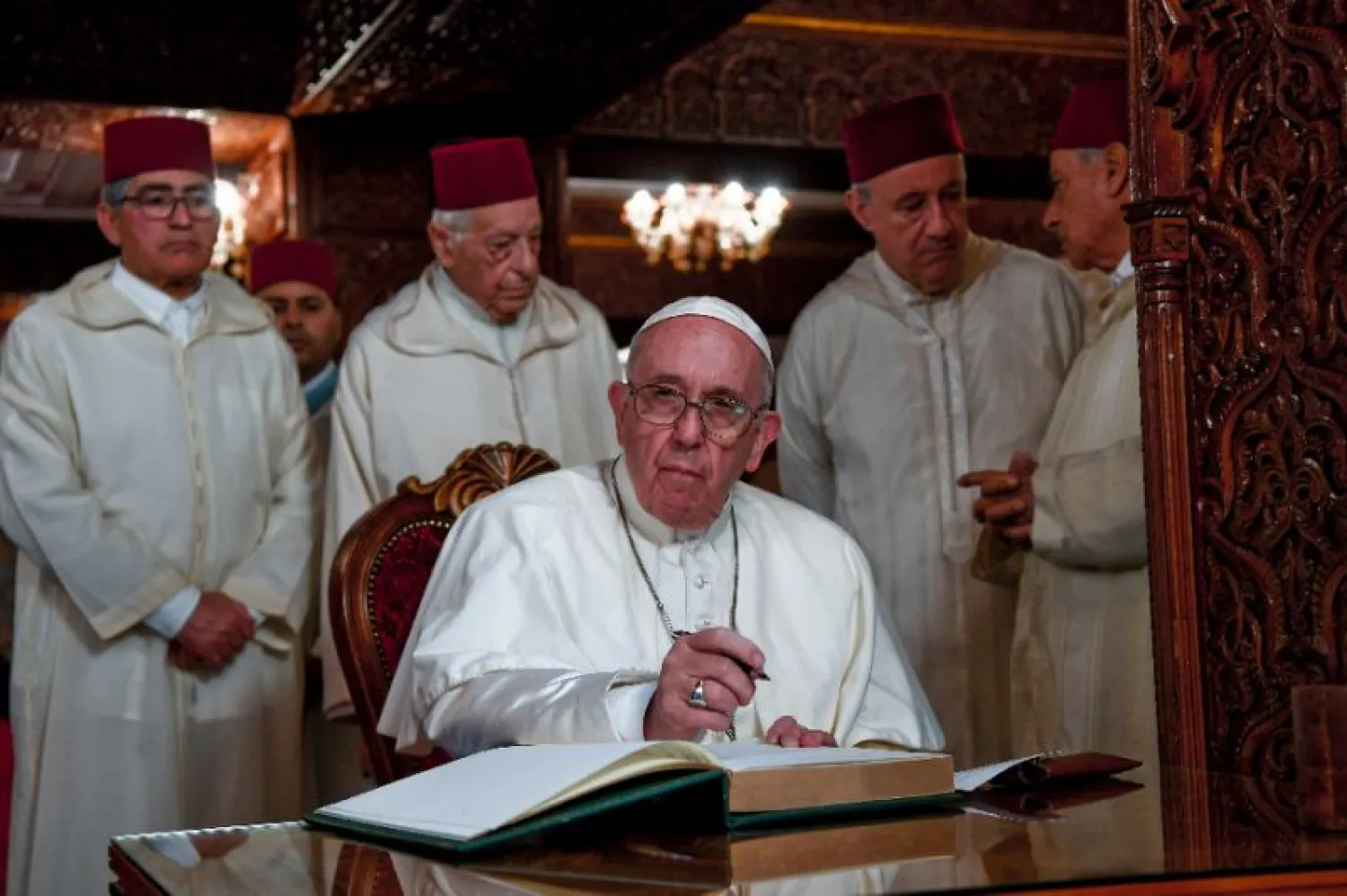

Pope, Moroccan King Declare Jerusalem ‘Common Patrimony’ of Three Religions

Pope Francis is the first pontiff to visit Morocco since John Paul II in 1985 | AFP
TT

Pope, Moroccan King Declare Jerusalem ‘Common Patrimony’ of Three Religions

Pope Francis is the first pontiff to visit Morocco since John Paul II in 1985 | AFP

Pope Francis on Saturday joined Morocco's King Mohammed VI in saying Jerusalem should be a "symbol of peaceful coexistence" for Christians, Jews, and Muslims, on the first day of a visit to the North African country.

The spiritual leader of the world's 1.3 billion Catholics was invited by King Mohammed VI for the sake of "interreligious dialogue", according to Moroccan authorities.

In a joint statement, the two leaders said Jerusalem was "common patrimony of humanity and especially the followers of the three monotheistic religions."

"The specific multi-religious character, the spiritual dimension and the particular cultural identity of Jerusalem... must be protected and promoted," they said in the declaration released by the Vatican as the pontiff visited Rabat.

The Moroccan king chairs a committee created by the Organisation of Islamic Cooperation to safeguard and restore Jerusalem's religious, cultural, and architectural heritage.

The joint statement came after US President Donald Trump's landmark recognition of the disputed city as capital of Israel, which sparked anger across the world, especially from Palestinians who see Jerusalem as the capital of their future state.

Improving relations with other religions has been a priority for the Argentine pontiff, whose papacy has been marred by clergy facing a wave of child sex abuse allegations.

Addressing thousands of Moroccans who had braved the rain to attend the welcome ceremony, Francis said it was "essential to oppose fanaticism".

He stressed the need for "appropriate preparation of future religious guides", ahead of meeting trainee imams later on Saturday.

Catholics are a tiny minority Morocco, where 99 percent of the population is Muslim. The king is revered across West Africa as "commander of the faithful".

Speaking at the ceremony at the Tour (or tower) Hassan mosque and nearby mausoleum in Rabat, the monarch also voiced opposition to radicalism.

"That which terrorists have in common is not religion, it's precisely the ignorance of religion. It's time that religion is no longer an alibi... for this ignorance, for this intolerance," he said.

Francis rode to the ceremony in his Popemobile, passing rows of Moroccan and Vatican City flags and an estimated 12,000 well-wishers who packed the esplanade.

Buildings had been repainted, lawns manicured, and security stepped up ahead of the first papal visit to Morocco since John Paul II in 1985.

A 17-year-old was arrested after trying to throw himself onto the king's limousine to seek the monarch's help, the police said.

Some 130,000 people across Rabat watched the first stage of the pope's visit, which was beamed onto giant screens, officials said.

After stopping by the royal palace, Francis and Mohammed visited an institute where around 1,300 students are studying to become imams and preachers.

There they heard from a French and a Nigerian student of the institute, which teaches "moderate Islam" and is backed by the king.

In Morocco, where Islam is the state religion, authorities are keen to stress the country's "religious tolerance" which allows Christians and Jews to worship freely.

But Moroccans are automatically considered Muslim, apart from a minority who are born Jewish. Apostasy is socially frowned upon, and proselytizing is a criminal offense.

The Pope finished his Saturday schedule by meeting migrants -- including children dressed in colorful hats -- at a center run by Catholic humanitarian organization Caritas.

"Everyone has the right to a future," said Francis, who has throughout his papacy highlighted the plight of migrants and refugees.

He criticized "collective expulsions" and said ways for migrants to regularize their status should be encouraged.

Caritas centers in Rabat, Casablanca, and Tangiers welcomed 7,551 new arrivals in 2017, according to the charity, helping migrants access services.

The number of people taking the sea route from Morocco to Spain has recently surged as it has become harder for them to pass through Libya.

On Sunday, the pope will celebrate mass at a Rabat stadium with an estimated 10,000 people attending.



Lebanon Ex-central Bank Chief's Corruption Case Being Dent to Top Court

The BDL headquarters in Beirut (NNA) 
TT

Lebanon Ex-central Bank Chief's Corruption Case Being Dent to Top Court

The BDL headquarters in Beirut (NNA) 

The corruption case of Lebanon's former central bank governor, who is widely blamed for the country’s economic meltdown, has been transferred to the country's highest court, judicial officials told The Associated Press on Tuesday.

Riad Salameh was released on $14 million bail in September after a year in prison while awaiting trial in Lebanon on corruption charges, including embezzlement and illicit enrichment.

The trial of Salameh, 75, and his two legal associates, Marwan Khoury and Michel Toueini, will now be heard at the Court of Cassation, according to a copy of the notice obtained by the AP. Salameh and the others will be issued with arrest warrants if they don't show up for trial at the court.

No trial date has been set yet. Salameh denies the charges. The court’s final ruling can't be appealed, according to the four officials who spoke on condition of anonymity, because they weren't authorized to speak with the media.

In September 2024, he was charged with the embezzlement of $42 million, with the court later adding charges of illicit enrichment over an apartment rented in France, supposedly to be a substitute office for the central bank if needed. Officials have said that Salameh had rented from his former romantic partner for about $500,000 annually.

He was once celebrated for steering Lebanon’s economic recovery, after a 15-year civil war, upon starting his long tenure in 1993 and keeping the fragile economy afloat during long spells of political gridlock and turmoil.

But in 2023, he left his post after three decades with several European countries investigating allegations of financial crimes. Meanwhile, much of the Lebanese blame his policies for sparking a fiscal crisis in late 2019 where depositors lost their savings, and the value of the local currency collapsed.

On top of the inquiry in Lebanon, he is being investigated by a handful of European countries over various corruption charges. In August 2023, the United States, United Kingdom and Canada imposed sanctions on Salameh.

Salameh has repeatedly denied allegations of corruption, embezzlement and illicit enrichment. He insists that his wealth comes from inherited properties, investments and his previous job as an investment banker at Merrill Lynch.

Lebanon’s current central bank governor, Karim Souaid, announced last week that he's filing legal complaints against a former central bank governor and former banking official who diverted funds from the bank to what he said were four shell companies in the Cayman Islands. He didn't name either individual.

But Souaid said that Lebanon's central bank would become a plaintiff in the country's investigation into Forry Associates. The US Treasury, upon sanctioning Salameh and his associates, described Forry Associates as “a shell company owned by Raja (Salameh’s brother) in the British Virgin Islands” used to divert about $330 million in transactions related to the central bank.

Several European countries, among them France, Germany, and Luxembourg, have been investigating the matter, freezing bank accounts and assets related to Salameh and his associates, with little to no cooperation from the central bank and Lebanese authorities.

Souaid said that he will travel later this month to Paris to exchange “highly sensitive” information as France continues its inquiries.


Over 100 Children Killed in Gaza Since Ceasefire, UNICEF Says

Palestinians walk past tents used by displaced people, during a windy winter day, in Gaza City, January 13, 2026. (Reuters)
TT

Over 100 Children Killed in Gaza Since Ceasefire, UNICEF Says

Palestinians walk past tents used by displaced people, during a windy winter day, in Gaza City, January 13, 2026. (Reuters)

The UN children's agency said on Tuesday that over ​100 children have been killed in Gaza since the October ceasefire, including victims of drone and quadcopter attacks.

“More than 100 children have ‌been killed ‌in Gaza ‌since ⁠the ceasefire ​of ‌early October," UNICEF spokesperson James Elder told reporters at a UN briefing by video link from Gaza.

"Survival remains conditional, whilst ⁠the bombings and the shootings ‌have slowed, have ‍reduced during ‍the ceasefire, they have not ‍stopped."

He said that nearly all the deaths of the 60 boys and ​40 girls were from military attacks including air ⁠strikes, drone strikes, tank shelling, gunfire and quadcopters and a few were from war remnants that exploded.

The tally is likely an underestimate since it is only based on deaths for which sufficient ‌information was available, he said.


Syrian Army Tells Kurdish Forces to Withdraw from Area East of Aleppo City

Buses carrying displaced residents drive past a building in ruins as they return to the Achrafieh neighborhood after days of fighting between government forces and Kurdish fighters in the northern city of Aleppo, Syria, Monday, Jan. 12, 2026. (AP)
TT

Syrian Army Tells Kurdish Forces to Withdraw from Area East of Aleppo City

Buses carrying displaced residents drive past a building in ruins as they return to the Achrafieh neighborhood after days of fighting between government forces and Kurdish fighters in the northern city of Aleppo, Syria, Monday, Jan. 12, 2026. (AP)

Syria's army told Kurdish forces on Tuesday to withdraw from an area they control east of Aleppo after dislodging fighters from two neighborhoods in the city in deadly clashes last week.

State television published an army statement with a map declaring a large area a "closed military zone" and said "all armed groups in this area must withdraw to east of the Euphrates" River.

The area begins near Deir Hafer, around 50 kilometers (30 miles) east of Aleppo city and extends to the Euphrates further east, as well as towards the south.

On Monday, Syria accused the US-backed, Kurdish-led Syrian Democratic Forces of sending reinforcements to Deir Hafer and said it sent its own personnel there in response.

The SDF denied any build-up of its forces in the region.

An AFP correspondent saw government forces bringing military reinforcements including artillery to the Deir Hafer area on Tuesday.

On the weekend, Syria's government took full control of Aleppo city after taking over its Kurdish neighborhoods and evacuating fighters there to Kurdish-controlled areas in the country's northeast following days of clashes.

The violence started last Tuesday after negotiations stalled on integrating the Kurds' de facto autonomous administration and forces into the country's new government.

The SDF controls swathes of the country's oil-rich north and northeast, much of which they captured during Syria's civil war and the fight against the ISIS group.