European Football Bosses Should Take Raheem Sterling’s Lead on Fighting Racism

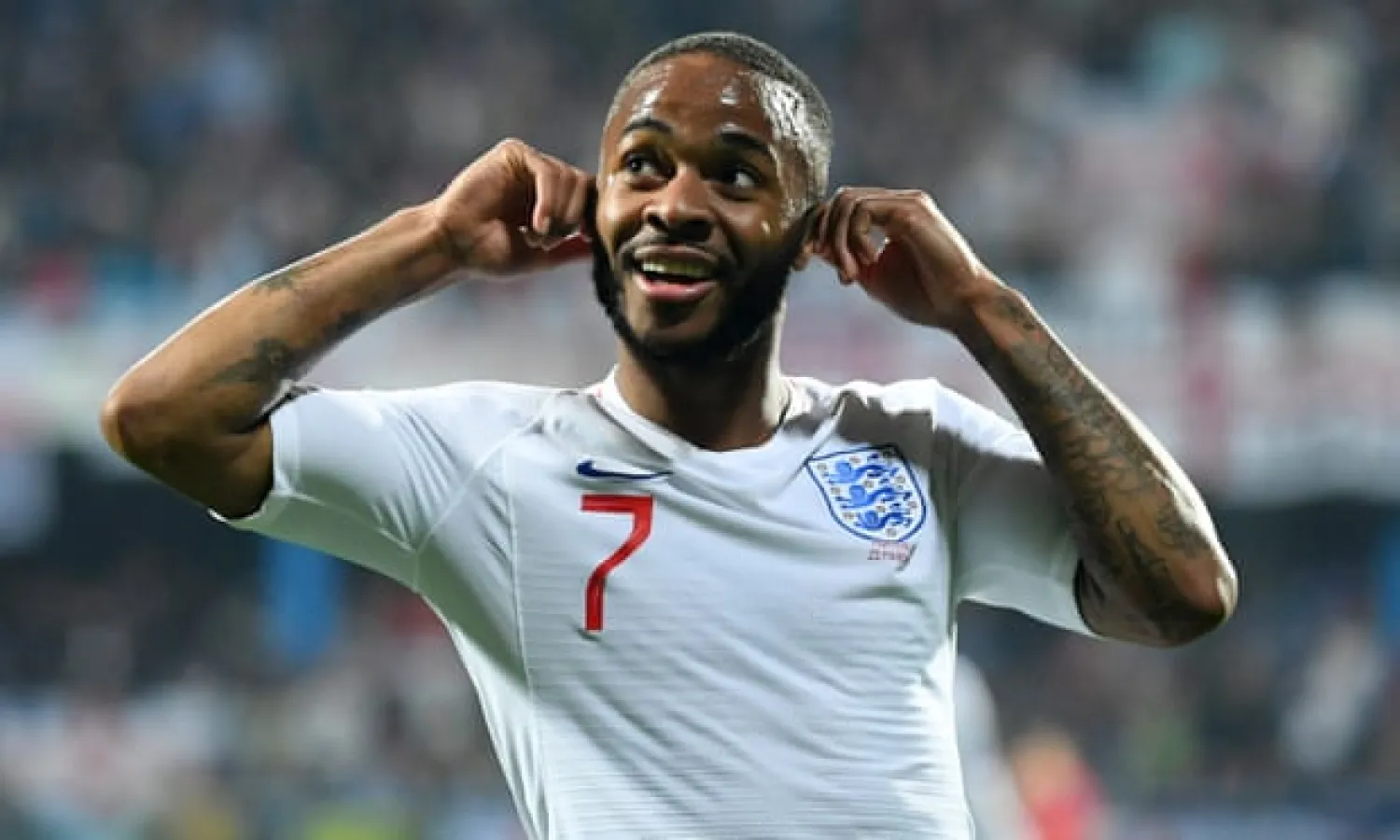
 Raheem Sterling responds to racist chants during the match. ‘Racism in Balkan football is not new and other forms of discrimination are widespread in football.’ Photograph: Michael Regan/Getty Images
Raheem Sterling responds to racist chants during the match. ‘Racism in Balkan football is not new and other forms of discrimination are widespread in football.’ Photograph: Michael Regan/Getty Images
TT

European Football Bosses Should Take Raheem Sterling’s Lead on Fighting Racism

 Raheem Sterling responds to racist chants during the match. ‘Racism in Balkan football is not new and other forms of discrimination are widespread in football.’ Photograph: Michael Regan/Getty Images
Raheem Sterling responds to racist chants during the match. ‘Racism in Balkan football is not new and other forms of discrimination are widespread in football.’ Photograph: Michael Regan/Getty Images

The shameful racist abuse of Raheem Sterling, Danny Rose and Callum Hudson-Odoi during England’s Euro 2020 qualifying match against Montenegro on Monday understandably triggered outrage in British football. Sadly, however, it is not the first time that black England players have been targeted during games in the Balkans. The scenes in the Montenegrin capital, Podgorica, were grimly similar to those in 2012, when again Rose was subjected to monkey chants during an England U21 game against Serbia in Kruševac, and to Zagreb in 2008, when Emile Heskey suffered the same ordeal playing against Croatia. England’s black players are not alone. A banana was thrown at the Italian international Mario Balotelli by Croatian fans at Euro 2012, Partizan Belgrade’s Brazilian midfielder Everton Luiz was abused by FK Rad fans in the Serbian SuperLiga a couple of years back – the list is depressingly long.

Racism in Balkan football is not new and other forms of discrimination, including homophobia, antisemitism or anti-Romany sentiment are widespread in the game – and beyond. On top of that, frequent expressions of ethnic hatred towards teams or players from neighbouring countries remain at the core of Balkan football fan culture. The lack of diversity and social debate about racism in the region leads many to trivialise the severity of racist behaviour and reduce it to a form of acceptable football-related “banter”. It is widely acceptable as a form of psychological terror against an opposing team and, more importantly, particular players. The fans doing the monkey chants on Monday were sitting in the main stand. They were most likely not fanatical hooligans but ordinary supporters, for whom this sort of behaviour is regarded as normal.

The fact that the Montenegro manager, Ljubiša Tumbaković, saw no reason to comment on the incidents in the post-match press conference says a lot about how seriously the issue is being taken. The Montenegrin FA issued a tame statement, while Montenegro’s sport and youth minister, Nikola Janović, described the game as a “sports festival” with a “carnival atmosphere”, condemning only “inexplicable messages” by some fans in the stadium. In 2013, the Croatian FA pledged its support to defender Josip Šimunić after he was fined for chanting a fascist slogan “Za dom – spremni” (“For the homeland – ready”). The fish really does rot from the head down.

Can this infuriating incident be the one that finally brings about meaningful change? Most probably not. There is an utter lack of political will from football associations across the region, and in politics more broadly, to systematically tackle the epidemic of football-related violence, hooliganism and discrimination. Regardless of punishments, little seems to change the region’s football culture.

Uefa’s disciplinary committee is expected to fine the Montenegrin FA and enforce a partial stadium closure. The effectiveness of these mechanisms as a deterrent for racist behaviour, however, can be questioned.

Many are calling for tougher penalties, some even for expulsion from next year’s European championship – something that would actually hurt countries and make them rethink their approaches towards discrimination. The regulations are there – although they could be stricter – the problem is that it’s not complemented by will and action at national level by FAs and clubs that are largely complicit. The Balkans obviously do not have a monopoly on racism, in football or more widely. The rise of rightwing politics, xenophobia and discrimination in Europe on and off the pitch is well documented.

The England manager, Gareth Southgate, succinctly said after the game that fines on their own would not change anything unless accompanied by educational programmes. It’s not one or the other, it’s both. Clubs such as Borussia Dortmund have demonstrated how change can be instigated when clubs work with fans and lead by example. There is a need for a combination of strong regulation and educational programmes paired with grassroots support. International football governing bodies need to realise that without the empowerment of grassroots initiatives and football NGOs that tackle discrimination and racism in the region’s football, little change will happen.

The UK has Kick It Out and in Europe Fare (Football Against Racism in Europe) – these are products of a long struggle against racism in football. Such organisations are hard to find in the Balkans. Now is the time to force FAs in the region to change their approach and to significantly invest in anti-discrimination programmes that go way further than shallow ad campaigns. The current outrage, with the accompanying media spotlight, the involvement of players, pundits and officials – all should be seized on and used to push football governing bodies to act, not just in the Balkans but beyond. If not, Monday’s “disaster”, as the Uefa president, Aleksander Čeferin, called it, will be repeated again and again.

The Guardian Sport


Irish Boxer Lee Reeves Dies at Age 31, Three Months after Dublin Title Fight Injury

Irish boxer Lee Reeves. Reuters
TT

Irish Boxer Lee Reeves Dies at Age 31, Three Months after Dublin Title Fight Injury

Irish boxer Lee Reeves. Reuters

Irish boxer Lee Reeves has died more than three months after being injured during a fight in Dublin, promoter Queensberry said Tuesday. He was 31.

"Everyone at Queensberry is devastated to learn of the passing of Lee Reeves," Queensberry Promotions said in a statement.

Reeves was hospitalized after being knocked out by compatriot Gary Cully in the 10th and final round of their Boxing Union of Ireland Celtic super-lightweight title fight on Aug. 1.

Reeves was carried from the ring on a stretcher after receiving initial treatment.

Queensberry had said after the fight that his condition was critical but stable.

“Lee was an immensely talented boxer, as well as a true role model and inspiration to his community,” the statement added Tuesday, according to The Associated Press. “Our deepest condolences go to Lee’s family, friends and all those who loved him. We ask that their privacy be respected at this incredibly difficult time. Rest in peace, Lee.”


Alonso to Enter Dakar Rally with Loeb and Aston Martin Team

November 5, 2026 Aston Martin's Fernando Alonso during a press conference ahead of the F1 Sao Paulo Grand Prix. (Reuters)
TT

Alonso to Enter Dakar Rally with Loeb and Aston Martin Team

November 5, 2026 Aston Martin's Fernando Alonso during a press conference ahead of the F1 Sao Paulo Grand Prix. (Reuters)

Double Formula One champion Fernando Alonso will compete in next January's Dakar Rally in an Aston Martin Dreadnought entry run by engineering partner Prodrive.

The 45-year-old Spaniard, a 32-time Grand Prix winner and two-time Le Mans 24 Hours winner, will be racing in the annual event for the second time after competing with Toyota in 2020, finishing 13th.

France's nine-time world rally champion Sebastien Loeb and Brazil's reigning world rally-raid champion Lucas Moraes will be his teammates in a three-car entry.

The 49th edition of the Dakar Rally will ‌be held in ‌Morocco from January 9 to 23, with a prologue and first ‌stage ⁠in Portugal, after ⁠being moved from Saudi Arabia due to security concerns.

The 24-round Formula One season is due to start in Bahrain in March after testing in late February.

Alonso, who will again have compatriot and five-time motorcycle Dakar winner Marc Coma as co-driver, is racing in the Las Vegas Grand Prix this weekend. He said he had turned his thoughts to Dakar after deciding to continue in Formula One with Aston Martin.

“In the end, the decision became simple. I wanted to embrace ⁠the challenge completely and take on both Formula One and the ‌Dakar Rally in the same year," he explained in ‌a statement.

"In 2020, Dakar was one of the most challenging and enjoyable experiences of my career. ‌I have enormous respect for this race and the specialists who have mastered it.

"Formula One ‌remains my priority. But I am a racing driver, and challenges like this are why I love competing. I’m looking forward to seeing what we can achieve."

LOEB CHASES FIRST DAKAR WIN

In October, Alonso told reporters at the Singapore Grand Prix that he felt the desert endurance race would be physically ‌incompatible with his Formula One commitments.

Loeb, 52, will also be chasing a first Dakar win after 10 previous attempts that have brought ⁠him 28 stage ⁠wins to date.

“Winning the Dakar is very important to me,” said the Frenchman, who will be partnered by Belgian Fabian Lurquin. “We have come close several times, and the motivation is there to keep working until we achieve it."

The Dreadnought is a digital-only tactical SUV created exclusively for gamers playing "Call of Duty: Modern Warfare 4" that will now be brought into the real world by Prodrive, Aston Martin's partners in endurance GT racing.

The Dakar will be Aston Martin Racing’s debut in the world rally-raid championship.

"Aston Martin's ambition for this program has been clear from the outset: to create a car capable of competing at the front of the world's toughest motorsport event," said Prodrive Chairman David Richards.

"By combining Aston Martin's vision with Prodrive's experience in rallying, endurance racing and Dakar competition, we have built a strong foundation. With an exceptional driver line-up and a highly capable engineering team, we look forward to seeing Dreadnought take on this remarkable challenge."


Owono Does Not Deserve 12-Match Ban Over De Miguel Death, Says Andorra Owner Pique

Equatorial Guinea's goalkeeper #01 Jesus Owono leaves the pitch at half time during the Africa Cup of Nations (CAN) Group E football match between Equatorial Guinea and Algeria at Moulay Hassan Stadium in Rabat on December 31, 2025. (AFP)
TT

Owono Does Not Deserve 12-Match Ban Over De Miguel Death, Says Andorra Owner Pique

Equatorial Guinea's goalkeeper #01 Jesus Owono leaves the pitch at half time during the Africa Cup of Nations (CAN) Group E football match between Equatorial Guinea and Algeria at Moulay Hassan Stadium in Rabat on December 31, 2025. (AFP)

FC Andorra owner Gerard ‌Pique said goalkeeper Jesus Owono did not deserve the 12-match suspension he received following the challenge that led to the death of Tenerife forward Jesus de Miguel.

Owono and De Miguel collided during a Spanish second-tier match on November 2. De Miguel was taken to intensive care and died the following day.

The disciplinary committee of the Spanish football federation (RFEF) banned Owono for violent conduct which resulted in serious ‌injury last week.

"Players, ‌former players, coaches, goalkeepers, everyone has ‌called ⁠it an accident," ⁠Pique said in a video posted on social media late on Monday.

"I truly believe that imposing the maximum sanction on Jesus for this action puts him in a situation he does not deserve, because he is not to blame for all of ⁠this having happened."

Former Barcelona player Pique ‌pointed to the three-match ‌ban handed to Albacete's Jose Corpas for accidentally kicking Sabadell ‌player Quadri Liameed in the head during a ‌recent match in Spain.

"Fortunately Quadri is fine, the consequences in this case were not fatal, and the committee decided to sanction Corpas with three matches," Pique added.

"With ‌all this, my reflection is: what is being sanctioned, the action or the ⁠consequences?"

The RFEF ⁠did not immediately respond to a request for comment outside regular business hours in Spain.

Owono, 25, has withdrawn from Equatorial Guinea's squad for Africa Cup of Nations qualifiers against Zimbabwe this month and Pique said it was unlikely the goalkeeper would return to action as soon as his suspension is up.

"Jesus is going to need far more than 12 matches before he is available and able to compete," he added. "No sanction is going to bring Demi (De Miguel) back to us."