


Saudi Arabia, UAE, Yemen Urge Security Council to Pressure Houthis, Iran

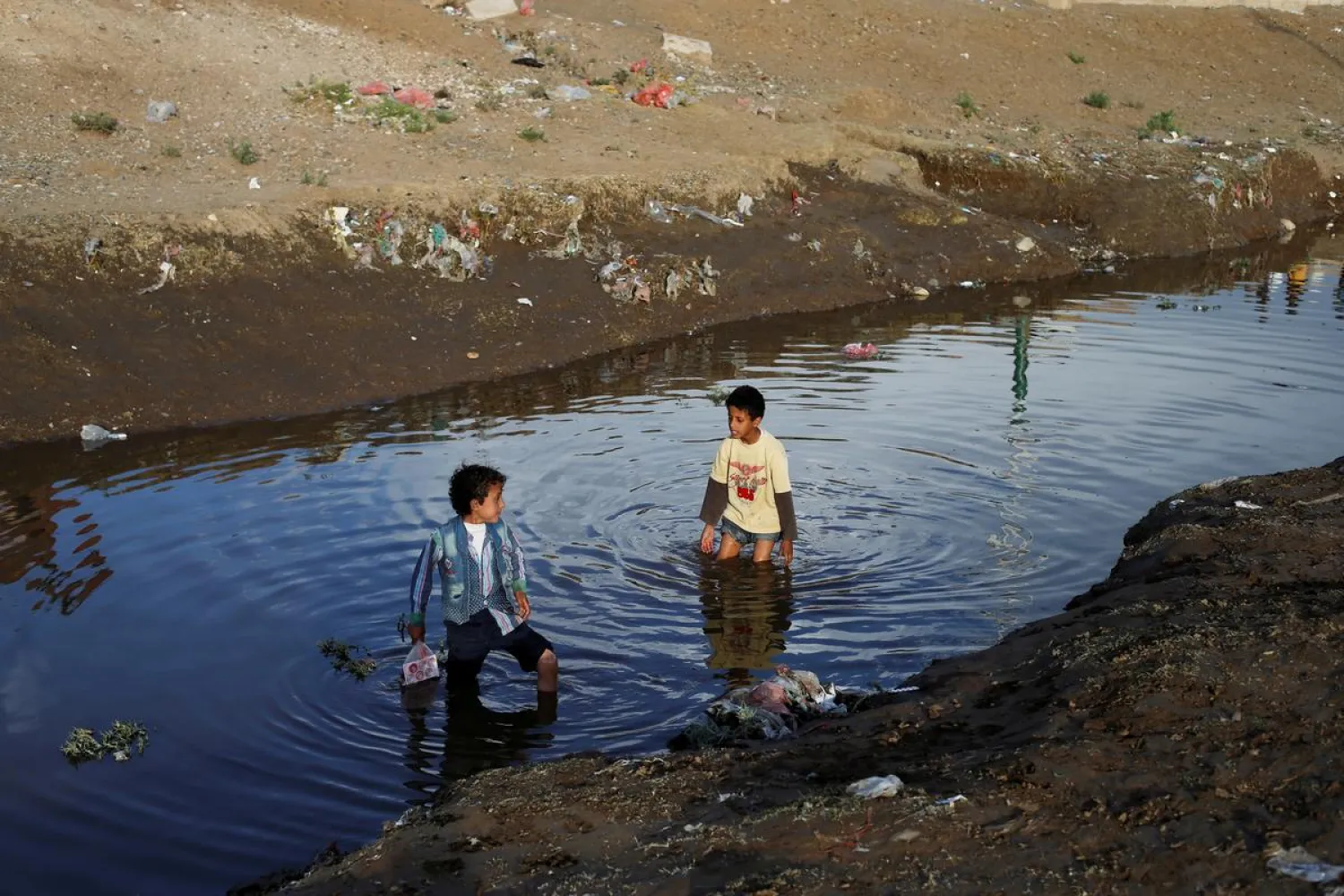
Children play in water at a sewage treatment pool amid an increase of cholera patients in Sanaa, Yemen March 17, 2019. (Reuters)
TT

Saudi Arabia, UAE, Yemen Urge Security Council to Pressure Houthis, Iran

Children play in water at a sewage treatment pool amid an increase of cholera patients in Sanaa, Yemen March 17, 2019. (Reuters)

The governments of Saudi Arabia, the United Arab Emirates and Yemen have sent a joint letter to the UN Security Council urging it to pressure the Houthi militias and their backers, Iran, to stop hindering the implementation of the UN-brokered Stockholm peace agreement.

They also demanded allowing the delivery of humanitarian aid to millions of starving Yemenis and respecting the ceasefire that was signed with the Yemeni government and Saudi-led coalition to restore legitimacy in the war-torn country.

In a joint letter by permanent representatives to the UN, Saudi Arabia’s Abdullah bin Yahya al-Mualimi, UAE’s Lana Nusseibeh and Yemen’s Abdullah al-Saad, delivered Security Council President Christoph Heusgen for April, the three countries stressed their commitment to a political solution and provision of humanitarian aid for Yemenis.

They stressed their continued support to UN special envoy to Yemen Martin Griffiths’ mission, especially his mandate to work towards the full implementation of the Stockholm agreement, which was reached in December 2018.

They also recalled that more than 100 days have passed since the end of the Swedish talks, but “despite the continuing setbacks caused by the Houthis and their Iranian supporters, our governments still believe that if the Stockholm agreement is fully implemented, this will improve the humanitarian situation of millions of Yemenis.”

“Further UN-led negotiations could also lead to achieving a political solution, which is urgently needed to end Yemen’s conflict,” they stressed, noting that the Security Council must continue to pressure Houthis and Iran to end their obstruction of the Stockholm agreement’s implementation process.

The three countries also warned of the enormous profits gained by the Houthis from controlling the flow of goods into areas they illegally occupy.

“This provides them with a perverse incentive to prevent aid from reaching starving people ــ a practice strongly condemned by aid organizations, such as the World Food Program.”

Looting aid and obstructing their delivery undermines the effectiveness of the humanitarian assistance provided by the Saudi-led coalition, which amounts to about $20 billion.

They pointed out that on Monday, Saudi Arabia and the UAE dedicated $200 million in aid to UN organizations in Yemen.

The funding is allocated to UN partners: $140 million to the WFP, $40 million to UNICEF to address sanitation issues and malnutrition among children and mothers and $20 million to the World Health Organization (WHO) to tackle cholera and provide intravenous feeding fluids.



Syria to Start Currency Swap on January 1st, Central Bank Governor Says

Syrian pounds are pictured inside an exchange currency shop in Azaz, Syria February 3, 2020. Picture taken February 3, 2020. REUTERS/Khalil Ashawi/File Photo
TT

Syria to Start Currency Swap on January 1st, Central Bank Governor Says

Syrian pounds are pictured inside an exchange currency shop in Azaz, Syria February 3, 2020. Picture taken February 3, 2020. REUTERS/Khalil Ashawi/File Photo

Syria will start swapping old banknotes for new ones under a ​plan to replace Assad-era notes starting from January 1, 2026, Central Bank Governor Abdelkader Husrieh said on Thursday.

Husrieh announced the introduction of the new Syrian currency, saying the decree "sets January ‌1, 2026, ‌as the start date ‌for ⁠the ​exchange ‌process". Sources familiar with the matter told Reuters in August that the country will issue new banknotes, removing two zeros from its currency in an attempt to restore ⁠public confidence in the severely devalued pound.

The ‌step is intended ‍to strengthen ‍the Syrian pound after its purchasing ‍power collapsed to record lows following a 14-year conflict that ended with President Bashar al-Assad's ouster in December.

Husrieh ​said the operation will take place through a smooth and orderly ⁠swap - a move bankers hope will ease fears that the new currency could fuel inflation and further erode the purchasing power of Syrians already reeling from high prices.

He added that a press conference will soon outline the exact regulations and mechanisms.


Türkiye Begins Black Box Analysis of Jet Crash That Killed Libyan Military Chief and 7 Others

Libyan national flags fly at half-mast in Tripoli on December 24, 2025, after the head of Libya's armed forces and his four aides died in a plane crash in Türkiye. (AFP)
TT

Türkiye Begins Black Box Analysis of Jet Crash That Killed Libyan Military Chief and 7 Others

Libyan national flags fly at half-mast in Tripoli on December 24, 2025, after the head of Libya's armed forces and his four aides died in a plane crash in Türkiye. (AFP)

The technical analysis of the recovered black boxes from a jet crash that killed eight people, including western Libya’s military chief, began as the investigation proceeded in cooperation with Libyan authorities, the Turkish Ministry of Defense said Thursday.

The private jet with Gen. Muhammad Ali Ahmad al-Haddad, four other military officials and three crew members crashed on Tuesday after taking off from Türkiye’s capital, Ankara, killing everyone on board. Libyan officials said the cause of the crash was a technical malfunction on the plane.

The high-level Libyan delegation was on its way back to Tripoli after holding defense talks in Ankara aimed at boosting military cooperation between the two countries.

The wreckage was scattered across an area covering 3 square kilometers (more than a square mile), complicating recovery efforts, according to the Turkish Interior Minister Ali Yerlikaya.

A 22-person delegation, including five family members, arrived from Libya early on Wednesday to assist in the investigation.


Lebanese President: We are Determined to Hold Parliamentary Elections on Time

President Joseph Aoun between Prime Minister Nawaf Salam and Speaker Nabih Berri (Lebanese Presidency file photo)
TT

Lebanese President: We are Determined to Hold Parliamentary Elections on Time

President Joseph Aoun between Prime Minister Nawaf Salam and Speaker Nabih Berri (Lebanese Presidency file photo)

Lebanese President Joseph Aoun reiterated on Thursday that the country’s parliamentary elections are a constitutional obligation that must be carried out on time.

Lebanon’s state-run National News Agency quoted Aoun as saying that he, alongside Prime Minister Nawaf Salam and Parliament Speaker Nabih Berri, is determined to hold the elections on schedule.

Aoun also emphasized that diplomatic efforts have continued unabated to keep the specter of war at bay, noting that "things are heading in a positive direction".

The agency also cited Berri reaffirming that the elections will take place as planned, with "no delays, no extensions".

The Lebanese parliamentary elections are scheduled for May next year.