


Solskjær Needs to Be More Than Just Not-Mourinho at Manchester United

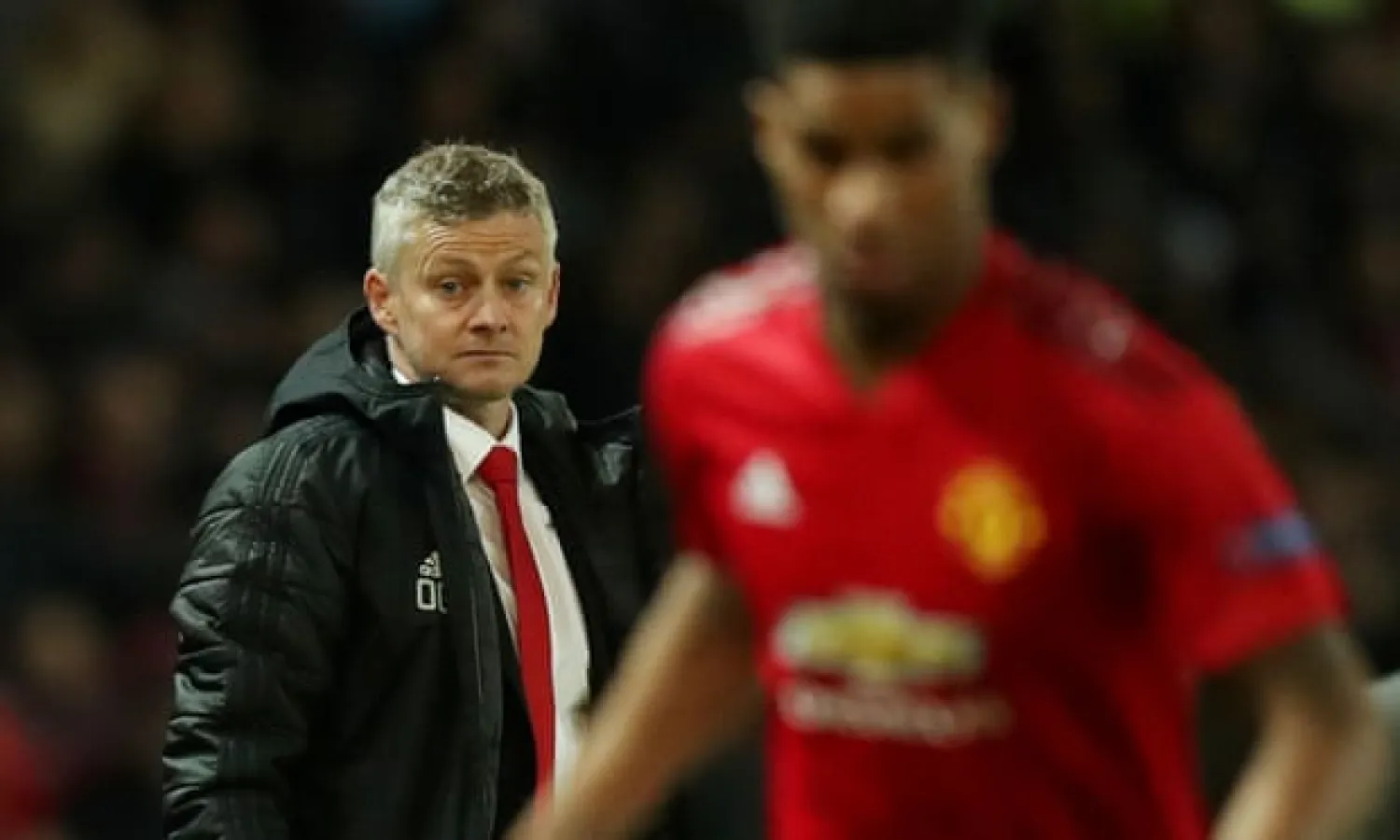
 Ole Gunnar Solskjær watches on against Barcelona as Manchester United head for a fourth defeat in five matches. Photograph: Paul Currie/BPI/Rex/Shutterstock
Ole Gunnar Solskjær watches on against Barcelona as Manchester United head for a fourth defeat in five matches. Photograph: Paul Currie/BPI/Rex/Shutterstock
TT

Solskjær Needs to Be More Than Just Not-Mourinho at Manchester United

 Ole Gunnar Solskjær watches on against Barcelona as Manchester United head for a fourth defeat in five matches. Photograph: Paul Currie/BPI/Rex/Shutterstock
Ole Gunnar Solskjær watches on against Barcelona as Manchester United head for a fourth defeat in five matches. Photograph: Paul Currie/BPI/Rex/Shutterstock

So Manchester United need a 2-1 win at the Camp Nou. Can anybody think of a time when they have done that? Yes, you at the back there – baby-faced man in the grey V-neck?

Really, this cannot go on. Sooner or later Ole Gunnar Solskjær is going to have to do something as manager that does not immediately draw comparison with Sir Alex Ferguson. Perhaps he will inspire a victory away to Barcelona – something United have never achieved. Perhaps there will even be two late goals, one prodded home at the back post in injury time after a corner has been flicked on. But if he does, it will feel less like football management than witchcraft. Give it Melisandre till the end of the season.

The first leg of the quarter-final seemed a match in which a number of doubts coalesced. There is no disgrace in losing 1-0 to Barcelona and, while United will have to do something they have never done if they are to progress, at this stage of the previous round they had to do something no side had ever done before.

There was much in Wednesday’s performance, at least after an oddly diffident opening 20 minutes, from which Solksjær could draw encouragement. United pressed ferociously and for long spells made Barça look sloppy in possession. Scott McTominay is beginning to blossom as a midfielder in his own right, rather than just being a bloke who is emphatically not Paul Pogba, as he often seemed to be under José Mourinho. If Diogo Dalot and Marcus Rashford had been a little more clinical, United might even have won.

But the truth is Barcelona were relatively comfortable after half-time. They survived their wobble, realised United are dangerous only on the counterattack (as Louis van Gaal noted when, with a robustness that obfuscated his point, he accused Solskjær of being a manager “who parks the bus”, sat deep and denied United’s rapid wide men space to run into. Solskjær had no solution.

That is only in part a criticism of him. United do not have a picklock with the tight technical skills to undo a massed defence – something that draws questions, again, about Pogba, a player who seems in danger of falling into the Steven Gerrard trap of being neither one thing nor the other. In a world in which midfielders tend to fall into two bands, he has elements of both but not enough of either. He might have thrived as a box-to-box player in the 80s but these days, at the very highest level, he seems too ebullient to function as a holder, but not quite deft enough to be a No 10.

In isolation, perhaps, the defeat would not matter too much for Solskjær. It’s Barcelona, it’s the quarter-finals of the Champions League. It happens. But it was his fourth defeat in five games in the middle of which, Ed Woodward’s touch as sure as ever, he was given a three-year contract.

In 1973 the Yale professor Harold Bloom proposed his theory of the Anxiety of Influence, positing an Oedipal relationship between writers and their literary forebears. John Milton, for instance, he argued could truly excel as a poet only after he had symbolically murdered his great idol Edmund Spenser. William Blake, likewise, had to cast off Milton. A similar dynamic can be seen in football, perhaps most strikingly in the case of Mauricio Pochettino.

That the Spurs manager is of the school of Marcelo Bielsa is obvious but so too his discomfort in talking about the influence of Bielsa. Pochettino has moved beyond the manager who came into his bedroom one night when he was 14 and made him a footballer on the basis of his legs. He is grateful to Bielsa for the start he gave him and the principles he instilled but he also sees his flaws and does things differently. A sense of loyalty seems to inhibit him from discussing that divergence too openly.

Solskjær, at some point, will have to go through a similar process, made all the harder by the fact the symbolic father he has to knife tends to sit a few rows behind him at games, while the stand he faces from the bench is named after him. Invoking “the Boss” at every turn was an effective tool to signal his difference from the previous regime and to highlight a return to the United Way but just as McTominay had to be more than just not-Pogba, so Solskjær has to be more than just not-Mourinho. And as, say, Dynamo Kyiv have found, a club cannot go through life living forever in the shadow of a previous manager.

In that, Solskjær’s opposite number at Barça, Ernesto Valverde, perhaps offers a valuable lesson. He played at Barcelona under Johan Cruyff and was appointed in part because he is of the school. And yet he was prepared to risk the wrath of the devout and take the most un-Cruyffian step of protecting a lead by packing men behind the ball.

Solskjær, similarly, must find his own way and become more than merely a conduit through which the Fergusonian vibe can flow – although perhaps not until after he has followed his mentor in pulling off a stunning 2-1 win at the Camp Nou.

The Guardian Sport


Portugal’s Fernandes Hopes to Win World Cup to Crown Ronaldo’s Career

 Al-Nassr's Cristiano Ronaldo in action during the AFC Champions League Two 2025/2026 semi-finals match between Al-Nassr and Al Ahli Doha in Dubai, United Arab Emirates, 22 April 2026. (EPA)
Al-Nassr's Cristiano Ronaldo in action during the AFC Champions League Two 2025/2026 semi-finals match between Al-Nassr and Al Ahli Doha in Dubai, United Arab Emirates, 22 April 2026. (EPA)
TT

Portugal’s Fernandes Hopes to Win World Cup to Crown Ronaldo’s Career

 Al-Nassr's Cristiano Ronaldo in action during the AFC Champions League Two 2025/2026 semi-finals match between Al-Nassr and Al Ahli Doha in Dubai, United Arab Emirates, 22 April 2026. (EPA)
Al-Nassr's Cristiano Ronaldo in action during the AFC Champions League Two 2025/2026 semi-finals match between Al-Nassr and Al Ahli Doha in Dubai, United Arab Emirates, 22 April 2026. (EPA)

Portugal midfielder Bruno ‌Fernandes expressed hope that he and his teammates can help crown Cristiano Ronaldo's international career by winning the 2026 World Cup.

The 41-year-old Ronaldo is set to appear in a record sixth World Cup in June, a tournament expected to be the final major chapter of the forward's career.

"Wrapping up ‌all this ‌last World Cup with ‌Cristiano (Ronaldo) ⁠winning it would ⁠be something amazing," Fernandes told Wayne Rooney in a BBC report published on Friday.

"I really hope we can make it happen, not just for Portugal, but for everything Cristiano gave ⁠to football and the world," ‌the Portuguese midfielder ‌and Manchester United captain said.

Ronaldo, considered one ‌of the greatest players ever to ‌have not won a World Cup, is the record scorer in international football with 143 goals.

The five-time Ballon d’Or winner was ‌part of Portugal's Euro 2016-winning team and has lifted the ⁠Nations ⁠League twice.

Portugal's opening Group K game is on June 17 against the Democratic Republic of Congo, followed by Uzbekistan on June 23, with both games in Houston. They play Colombia on June 27 in Miami in their final group game.

The World Cup runs from June 11 to July 19 in Canada, the United States and Mexico.


Defending Champion Alcaraz to Miss French Open with Wrist Injury

Spanish tennis player Carlos Alcaraz gives a press conference to announce his withdrawal from the Barcelona Open Banc Sabadell-Trofe Conde de Godo, in Barcelona, Spain, 15 April 2026. (EPA)
TT

Defending Champion Alcaraz to Miss French Open with Wrist Injury

Spanish tennis player Carlos Alcaraz gives a press conference to announce his withdrawal from the Barcelona Open Banc Sabadell-Trofe Conde de Godo, in Barcelona, Spain, 15 April 2026. (EPA)

Two-time reigning French Open champion Carlos Alcaraz said on Friday he will not play at this year's tournament as he recovers from a wrist injury.

"We have decided that the most prudent thing to do is to be cautious and not participate in Rome or Roland Garros," Alcaraz said on social media.

"It's a complicated moment for me, but I'm sure we'll come out stronger from this," the Spaniard added, saying that he and his team would monitor his recovery before deciding when and where he would return.

Alcaraz sustained the injury during the first round of the Barcelona Open last week, where he beat Otto Virtanen but subsequently pulled out of the tournament.

The 22-year-old announced his withdrawal from the Madrid Masters on April 17, increasing concerns over whether he would be able to appear at the French Open.

Alcaraz became the youngest man to complete the career Grand Slam in January with his triumph at the Australian Open. He holds a 22-3 record this season and also won a title in Doha.

Ranked second in the world, Alcaraz lost top spot following his defeat by Jannik Sinner in the Monte Carlo Masters final on April 12.

The seven-time Grand Slam winner, an expert on clay, triumphed at Roland Garros in 2024 and 2025. He saved three championship points against Sinner in last year's final.


Formula 1 Returns to Türkiye from 2027 on 5-year Contract

Formula One F1 - Turkish Grand Prix - Intercity Istanbul Park, Istanbul, Türkiye - October 10, 2021 General view at the start of the race REUTERS/Umit Bektas/ File Photo
TT

Formula 1 Returns to Türkiye from 2027 on 5-year Contract

Formula One F1 - Turkish Grand Prix - Intercity Istanbul Park, Istanbul, Türkiye - October 10, 2021 General view at the start of the race REUTERS/Umit Bektas/ File Photo

The Turkish Grand Prix is back on the Formula 1 calendar next season for the first time since 2021, on a five-year agreement.

After an initial announcement Friday by the Turkish government and President Recep Tayyip Erdogan, there was confirmation from F1 and its governing body.

Erdogan said the deal would be for “at least five years”.

The Istanbul Park circuit outside the city first hosted F1 from 2005 through 2011, and next year's race would be the first since Türkiye returned to the calendar in 2020 and 2021 during disruption caused by the COVID-19 pandemic. Valtteri Bottas won the most recent race for Mercedes.

“Many memorable moments have been made in our sport’s history at Istanbul Park and I’m excited to begin the next chapter of our partnership, giving fans the opportunity to experience even more incredible racing in a truly fantastic location,” Formula 1 chief executive Stefano Domenicali said.

Hosting F1 would “demonstrate to the world that our country is the safe haven of its region,” Erdogan said.

The news comes after the Iran war caused widespread disruption to sports in the region and forced F1 to call off races in Bahrain and Saudi Arabia scheduled for this month.

That left a large gap in this year’s schedule. The Miami Grand Prix next week will be the first F1 race since the Japanese Grand Prix on March 29.

F1’s return to Istanbul had been widely expected since Domenicali said in February that it was a candidate to return.

He added venues like Istanbul Park and the Portimão circuit, which will host the returning Portuguese Grand Prix next year, show F1 is not focusing too much on street races in glamorous locations.

Those can be some of F1's most lucrative events, like the Las Vegas Grand Prix, but are generally less popular with drivers than purpose-built race tracks.

“Türkiye is not 100% confirmed. Stay tuned on Türkiye, let me put it this way,” Domenicali said at the time. “This is also to answer to the people that were saying there were too many street races. The new ones that are coming are tracks, not street races.”

The return of Türkiye and Portugal next year will come as the Dutch Grand Prix, four-time champion Max Verstappen's home race, leaves the schedule after six years. The Belgian Grand Prix and the second Spanish race at the Circuit de Barcelona-Catalunya will host in alternate years from 2027, freeing up another slot.

F1 estimated Friday it has 19 million fans in Türkiye, and FIA President Mohammed Ben Sulayem called the race's return “a powerful reflection of the continued global growth and appeal of our sport.”

The Istanbul Park track was generally popular with drivers and its long, high-speed turn eight was often ranked as one of the most challenging corners in the world.

Felipe Massa is the most successful driver at the Turkish Grand Prix with three wins in a row for Ferrari from 2006 through 2008, while Lewis Hamilton has won the race twice.
