


Turkey’s Opposition Gets the Keys to Istanbul

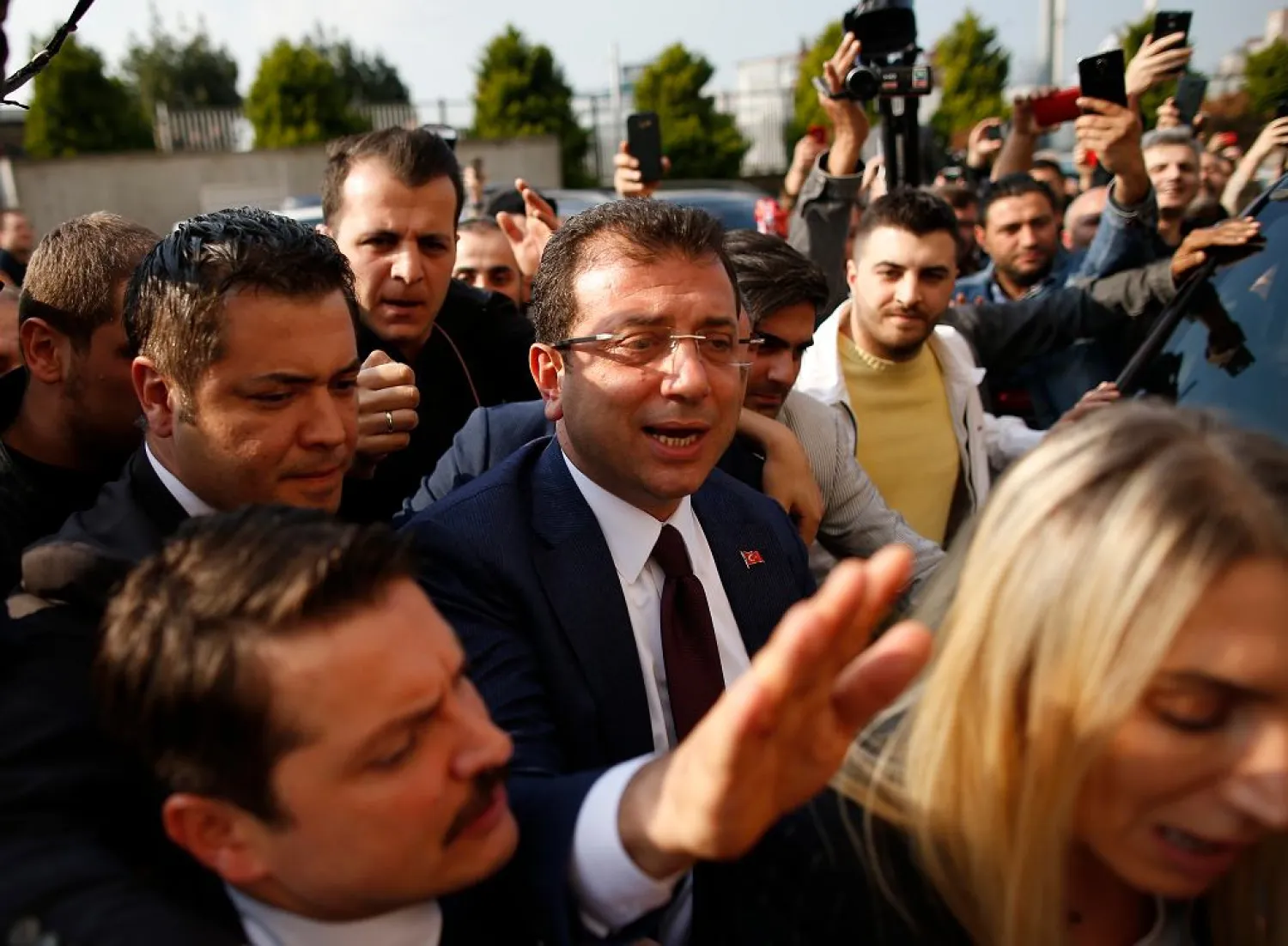
Ekrem Imamoglu, centre, of the opposition Republican People's Party (CHP) mayoral candidate in Istanbul, arrives to receive a certificate confirming his win by a slim margin against ruling party's candidate Binali Yildirim, in Istanbul, Turkey, Wednesday, April 17, 2019. (AP Photo/Emrah Gurel)
TT

Turkey’s Opposition Gets the Keys to Istanbul

Ekrem Imamoglu, centre, of the opposition Republican People's Party (CHP) mayoral candidate in Istanbul, arrives to receive a certificate confirming his win by a slim margin against ruling party's candidate Binali Yildirim, in Istanbul, Turkey, Wednesday, April 17, 2019. (AP Photo/Emrah Gurel)

Turkish authorities on Wednesday confirmed the opposition's candidate, Ekrem Imamoglu, as the mayor of Istanbul, ending more than two weeks of recounts of the March 31 vote demanded by President Recep Tayyip Erdogan's ruling party. All eyes, however, were turned toward Turkey's top electoral body, which has yet to consider a ruling party request for the vote in Istanbul to be invalidated and for the election to be repeated.

Imamoglu received a certificate confirming his win by a slim margin in Istanbul against the ruling party candidate, former Prime Minister Binali Yildirim, hours after a final appeal by the ruling party was rejected.

The final result of the elections gave a wafer-thin majority to the secularist opposition Republican People's Party (CHP) in Turkey's commercial hub, ending 25 years of control by the AK Party (AKP) and its predecessors.

The loss is especially hard for Erdogan who launched his political career in Istanbul as mayor in the 1990s and has triumphed in more than a dozen parliamentary, presidential and local polls since his party came to power in 2002.

The Turkish lira, which has dipped since the election, firmed on Wednesday.

Large crowds of supporters chanting "Mayor Ekrem" gathered outside a courthouse where the 48-year-old former district mayor was given his certificate, as well as outside the municipality, where he formally took over the city hall.

Addressing thousands of flag-waving supporters outside the municipality building, Imamoglu promised to work for all 16 million residents.

"We never gave up, we never gave up on our battle for democracy and rights," he said. "We are aware of our responsibilities and the needs of this city. We will start to serve immediately."

He called on the Supreme Electoral Board to terminate the uncertainty over the election in the city with "sensitivity, and rapidly."

Imamoglu's margin of victory ahead of the AKP candidate and former prime minister Binali Yildirim - prompted several AKP challenges.

In a major upset, Erdogan's party lost control of the capital, Ankara, and the country's financial and cultural hub, Istanbul, where the party had repeatedly contested results.

Citing alleged widespread irregularities, the ruling party on Tuesday filed an "extraordinary objection," asking the Supreme Electoral Board to cancel the Istanbul election. If accepted, elections in Istanbul could be repeated June 2.

The party maintains that the elections were marred by "organized irregularity" and has submitted three suitcases of documents purportedly detailing fraud to the electoral board.

The opposition Republican People's Party, or CHP, said the final count gave Imamoglu a 13,700-vote lead over Yildirim. That difference narrowed from the initial 25,000 votes announced before a series of recounts.

The opposition party says the ruling party's objections to the results lack credible evidence. It also points at ruling party statements prior to the elections reassuring the safety of the polls and rejecting the possibility of fraud.

Both Ankara and Istanbul had been held by Erdogan's conservative, religious-based party and its predecessor for 25 years.

Istanbul, with its 15 million residents and strategic location straddling Europe and Asia, made up 31% of Turkey's GDP of $851 billion in 2017 and draws millions of tourists.

The Istanbul metropolitan mayorship and its subsidiaries had a budget of $8.8 billion last year. The municipality has awarded lucrative contracts to businesses close to the government over the years and offers huge financial resources and employment opportunities.

Erdogan's rise to power began as Istanbul mayor in 1994 and he has repeated numerous times in pre-election rallies: "Whoever wins Istanbul, wins Turkey" and "Whoever loses Istanbul, loses Turkey."



Saudi Arabia, UK Announce 2029 as Saudi-UK Year of Culture

Saudi Arabia, UK Announce 2029 as Saudi-UK Year of Culture
TT

Saudi Arabia, UK Announce 2029 as Saudi-UK Year of Culture

Saudi Arabia, UK Announce 2029 as Saudi-UK Year of Culture

The Saudi Ministry of Culture and the UK Department for Culture, Media and Sport have announced the year 2029 as the official Saudi-UK Year of Culture, reported the Saudi Press Agency on Wednesday. The announcement follows an official visit by Britain’s Prince William to Saudi Arabia this week.

For nearly a century, formal relations between Saudi Arabia and the UK and Northern Ireland have evolved into a multifaceted international relationship that has expanded across culture, education, and innovation, reflecting shared values and a mutual commitment to long-term cooperation.

In recent years, cultural exchange has emerged as a cornerstone of Saudi-British relations, driven by joint initiatives in heritage conservation, visual and culinary arts, architecture, and higher education.

This ongoing expansion of cultural exchange lays the foundation for the Saudi-UK Year of Culture 2029, a year-long program celebrating creative dialogue and the shared heritage of Saudi Arabia and the UK, while deepening cultural ties for generations to come. It will also be a great opportunity for young people in both countries to connect in new ways.

Supported by Saudi Vision 2030 and the United Kingdom’s continued promotion of cultural innovation and creativity, the Saudi-UK Year of Culture 2029 will be an important milestone for both countries.


Saudi Aramco Achieves 70% Local Content Target through iktva Program

Saudi Aramco Achieves 70% Local Content Target through iktva Program
TT

Saudi Aramco Achieves 70% Local Content Target through iktva Program

Saudi Aramco Achieves 70% Local Content Target through iktva Program

Saudi Aramco announced on Wednesday that its supply chain transformation program, iktva (In-Kingdom Total Value Add), has achieved its target of reaching 70% local content.

Building on this milestone, the company said that it plans to increase local content in its goods and services procurement to 75% by 2030.

Since its launch, the iktva program has contributed more than $280 billion to the Kingdom’s gross domestic product, reinforcing its role as a key driver of industrial development, economic diversification, and long-term financial resilience.

Through the localization of goods and services, the program has strengthened the resilience and reliability of Aramco’s supply chains, enhanced operational continuity, reduced supply chain vulnerabilities, and provided protection against global cost inflation - capabilities that proved critical during periods of disruption.

Aramco President and CEO Amin Nasser expressed pride in the scale of transformation achieved through iktva and its positive impact on the Kingdom’s economy, noting that the announcement represents a major milestone in the program’s journey and reflects a significant leap in Saudi Arabia’s industrial development, fully aligned with the Kingdom’s national vision.

“iktva is a core pillar of Aramco’s strategy to build a competitive national industrial ecosystem that supports the energy sector while enabling broader economic growth and creating thousands of job opportunities for Saudi nationals,” he stressed.

By localizing supply chains, the program ensures operational reliability and mitigates disruptions that may affect global supply chains, he added, noting that its cumulative impact over a decade demonstrates the sustained value it continues to generate.

Over the past decade, iktva has emerged as a leading example of supply-chain-driven economic transformation, converting Aramco’s project spending into domestic economic multipliers that have created jobs, improved productivity, stimulated exports, and strengthened supply chain resilience.

The program has identified more than 200 localization opportunities across 12 key sectors, representing an annual market value of $28 billion. These opportunities have translated into tangible investment outcomes, catalyzing more than 350 investments from 35 countries in new manufacturing facilities within the Kingdom, supported by approximately $9 billion in capital. These investments have enabled the local manufacture of 47 strategic products in Saudi Arabia for the first time.

iktva has also contributed to the creation of more than 200,000 direct and indirect jobs across the Kingdom, further strengthening the local industrial base and national capabilities. To support continued growth, the program organized eight regional supplier forums worldwide in 2025, in addition to its biennial forum. These events helped connect global investors, manufacturers, and suppliers with localization opportunities in Saudi Arabia.


SDRPY Hosts Yemen Partners Group with UN and International Participation

Officials are seen at the SDRPY-hosted meeting in Riyadh. (SPA)
TT

SDRPY Hosts Yemen Partners Group with UN and International Participation

Officials are seen at the SDRPY-hosted meeting in Riyadh. (SPA)

The Saudi Program for the Development and Reconstruction of Yemen (SDRPY) hosted in Riyadh on Wednesday a meeting of the Yemen Partners Group (YPG), co-chaired by the Yemeni government, United Kingdom, and World Bank, with the participation of the United Nations and international organizations.

Yemeni Prime Minister and Minister of Foreign Affairs and Expatriates Dr. Shaya Mohsin Zindani; UN Secretary-General’s Special Envoy for Yemen Hans Grundberg; UN Resident Coordinator and Humanitarian Coordinator in Yemen Julien Harneis and Saudi Ambassador to Yemen and SDRPY Supervisor General Mohammed bin Saeed Al Jaber, as well as a number of ambassadors, representatives of international organizations, and donor entities attended the meeting.

Zindani expressed confidence in the new government and its clearly defined priorities that it will work to implement, which will help achieve stability and economic recovery.

He stressed the government’s aim to maximize benefit from the vital projects and initiatives provided by Saudi Arabia through the SDRPY, which offers important support for basic sectors and for boosting development efforts across Yemen.

Zindani expressed his appreciation to Saudi Arabia for its continued support to Yemen, commending the level of cooperation with the SDRPY and its efforts in supporting and empowering national institutions.

For his part, Grundberg emphasized the importance of the development projects provided by the Kingdom, particularly at this stage, noting positive indicators in Yemen, especially improvements in energy-sector stability.

Governor of the Central Bank Ahmed Ghaleb reviewed the bank’s priorities, stressing its commitment to transparency, the need to combat inflation, and the importance of international coordination and support to address challenges.

Al Jaber underscored the importance of continuing joint efforts to overcome obstacles facing peace and development in Yemen under the leadership of the Yemeni government.

The meeting is an important opportunity to learn about the priorities of the government and Central Bank, strengthening coordination to ensure that development and financial support is directed efficiently and effectively, and to assist donor entities and international organizations in aligning their interventions with the government’s priorities, he added.

The meeting reviewed a package of Saudi development projects worth SAR1.9 billion provided to Yemen in January, which helped boost energy-sector stability through the fuel derivatives grant, ensuring the continued operation of hospitals and vital service facilities.

It reviewed other development projects and initiatives scheduled for delivery during the coming period.