


In Praise of the Cup Winners' Cup, the Competition That Was Never Retained

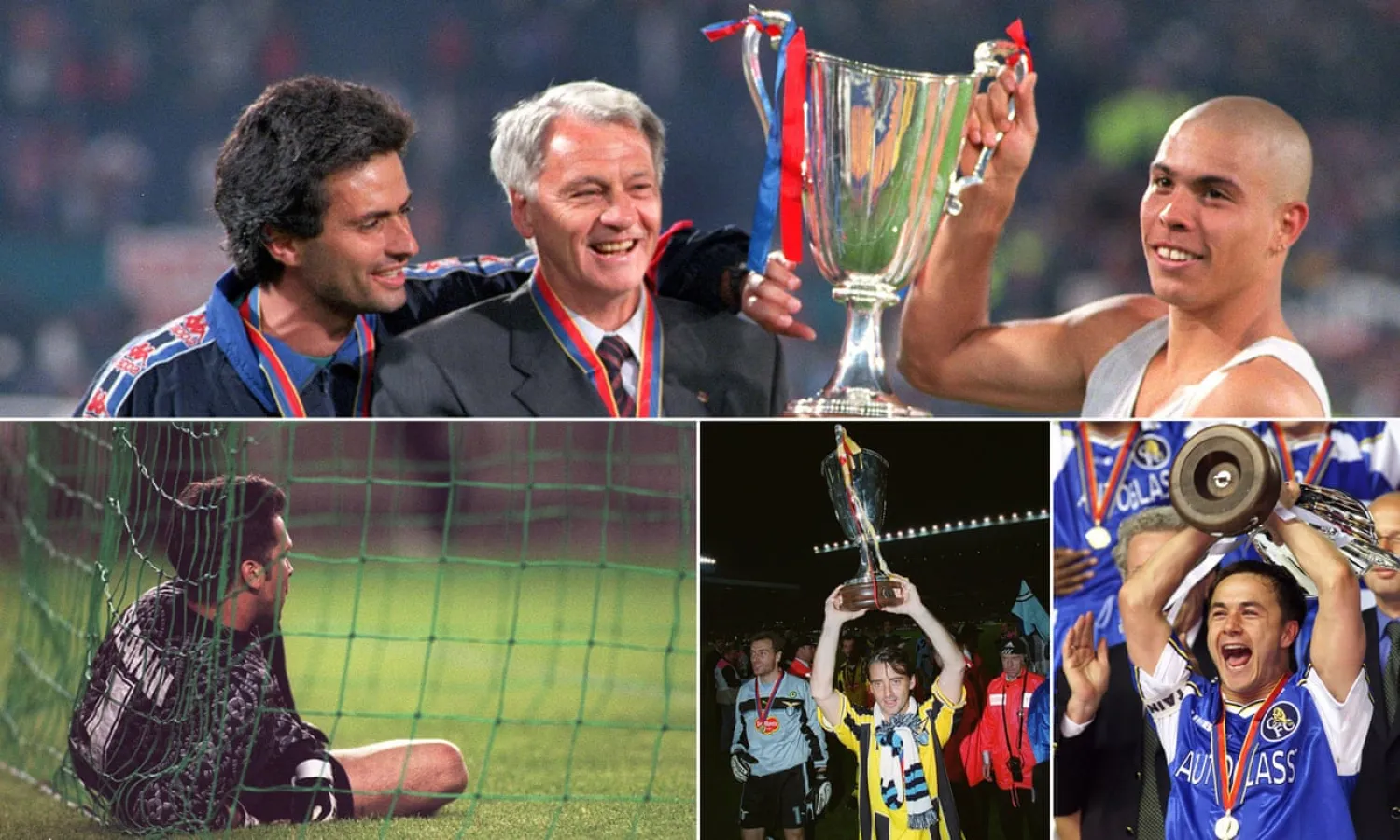
 Bobby Robson, José Mourinho and Ronaldo in 1997; David Seaman reflects on Nayim’s goal in 1995; Roberto Mancini triumphs with Lazio in 1999; and Dennis Wise celebrates Chelsea’s victory in 1998. Composite: Getty, Colorsport/Rex/Shutterstock, Reuters, Sportsphoto
Bobby Robson, José Mourinho and Ronaldo in 1997; David Seaman reflects on Nayim’s goal in 1995; Roberto Mancini triumphs with Lazio in 1999; and Dennis Wise celebrates Chelsea’s victory in 1998. Composite: Getty, Colorsport/Rex/Shutterstock, Reuters, Sportsphoto
TT

In Praise of the Cup Winners' Cup, the Competition That Was Never Retained

 Bobby Robson, José Mourinho and Ronaldo in 1997; David Seaman reflects on Nayim’s goal in 1995; Roberto Mancini triumphs with Lazio in 1999; and Dennis Wise celebrates Chelsea’s victory in 1998. Composite: Getty, Colorsport/Rex/Shutterstock, Reuters, Sportsphoto
Bobby Robson, José Mourinho and Ronaldo in 1997; David Seaman reflects on Nayim’s goal in 1995; Roberto Mancini triumphs with Lazio in 1999; and Dennis Wise celebrates Chelsea’s victory in 1998. Composite: Getty, Colorsport/Rex/Shutterstock, Reuters, Sportsphoto

Most of the great football tournaments start with a dynasty. Think Preston North End, the Invincibles and the First Division. Or Real Madrid’s early domination of the European Cup. In Italy, it was Genoa – brimming with English players and originally a cricket club – who took home six of the first seven championships.

All of these competitions were helped along by an all-conquering team who sent out out a message to any prospective challengers: this is a piece of silverware that is worth winning. But there is one tournament that clearly does not fit this pattern: the Cup Winners’ Cup, which was contested in 39 seasons but never retained.

Founded in 1960, the Cup Winners’ Cup functioned in a similar way to the European Cup, with domestic cup holders from each member Uefa member invited to compete. As with the more prestigious tournament, the Cup Winners’ Cup was initially treated with scepticism and Fiorentina only had to beat three teams – FC Lucerne, Dinamo Zagreb and Rangers – to claim the first title.

Clubs across the continent were quickly convinced by the merits of European football and the take-up was much higher the following season. The reigning champions made it through to another final but, despite the efforts of their Swedish star player Kurt Hamrin, they were beaten by Atlético Madrid after a replay (which was held nearly four months after the initial final as players had to travel out to Chile for the World Cup that summer).

Atlético Madrid won the replay convincingly at Hampden and so began the curse of the holder. It struck again 12 months later, when Atlético were demolished 5-1 by Tottenham, who became the first British club to win a major European trophy. Whereas Real Madrid could almost treat the European Cup as their own possession, the Cup Winners’ Cup had a nomadic lifestyle. The holders automatically qualified the following season but, as the European Cup was more prestigious, it often subsumed clubs that were eligible for both. With the superpowers of the game concentrating on the European Cup, there was a wonderful variety to the winners in the first decade of the cup’s existence. Indeed, it wasn’t until Milan edged out Leeds in the 1973 final in Thessaloniki that a club managed to claim the Cup Winners’ Cup for a second time.

Milan looked destined to retain the trophy the following year. They eased their way into the latter stages with victories over Dinamo Zagreb, Rapid Vienna and Paok Salonika before a tight semi-final win over Borussia Mönchengladbach secured their place in the final in Rotterdam, where they would face a club from the other side of the wall: German cup holders FC Magdeburg.

The East Germans had shocked Sporting Lisbon to reach the final and they pulled off another stunning result against Milan. Enrico Lanzi’s own goal gave the outsiders a half-time lead, before Wolfgang Seguin secured an unlikely triumph for Magdeburg, who became the only East German club to win a European competition.

Anderlecht reached three straight Cup Winners’ Cups finals in the late 1970s but even they did not win back-to-back titles. Spearheaded by Arie Haan, Rob Rensenbrink and Franky Vercauteren, the club swept aside West Ham in the 1976 final and thrashed Austria Vienna in 1978. Sandwiched between those glory years was another trip to the final, but two late goals from Hamburg denied the Belgians their place in the history books.

Juventus won the Cup Winners’ Cup in 1984 and followed it up with a victory in the European Cup the following season – emulating what Milan had done in the late 1960s – but no one came close to retaining the Cup Winners’ Cup until Ajax made it to two consecutive finals in 1987 and 1988. Even that Ajax side – most of whom would go on to win Euro 88 with the Netherlands – could not retain the trophy. They beat Lokomotive Leipzig to win the 1987 final but fell to a shock defeat against Belgian club KV Mechelen the following year.

The creation of the Champions League in 1992 ultimately killed the Cup Winners’ Cup. Although the old format of one-team-per-country remained for another few seasons, once multiple entrants were permitted, the quality of the Cup Winners’ Cup was gradually diluted.

Whereas Barcelona, Ajax and Bayern Munich once competed for the trophy, now the likes of Real Betis, Roda and Duisburg were representing those leagues instead – not as domestic cup winners, but runners-up. On one occasion, a semi-finalist – Heerenveen – was invited to compete, as the two KNVB Cup finalists had already qualified for the Champions League.

Even as the quality dropped, the old champions’ curse continued. In the 1990s, three more clubs won the trophy and then fell at the final hurdle while trying to defend it. Parma, who added Gianfranco Zola to a strikeforce already containing Faustino Asprilla and Thomas Brolin, looked a good bet to become the first club to retain the trophy in 1994 after they had beaten Royal Antwerp in the final the previous year. Arsenal had other ideas, however, with Alan Smith’s volley settling a tight final in Copenhagen.

The Gunners were favourites the following season, but the curse struck yet again deep into injury time when former Spurs midfielder Nayim lobbed David Seaman from the halfway line. Three years on, another 1-0 scoreline – this time in favour of four-time winners Barcelona – stopped PSG from winning consecutive titles.

Uefa announced that the competition would be scrapped after the 1998-99 season, giving reigning champions Chelsea the chance to become the first and only club to retain the title. They had established a reputation as a fashionable, cosmopolitan club under Gianluca Vialli and looked good value to end the hoodoo in the nick of time. They eked out a couple of wins against Helsingborg and Copenhagen in the early stages, before destroying Valerenga 6-2 on aggregate to book a place in the semi-finals.

There they met Real Mallorca, who were competing in Europe for the first time. After a 1-1 draw at Stamford Bridge, Mallorca sprung a major shock in Palma, winning 1-0 and dumping out the champions . The Spanish side went on to lose to Lazio in the final, with 23-year-old Alessandro Nesta becoming the last captain to lift the old silver trophy.

In all, the Cup Winners’ Cup was contested on 39 occasions. Eight reigning champions fell at the final hurdle in their title defence, although a further eight did not even compete in the tournament the following season. The first number illustrates why so many fans fell in love with this enigmatic competition, although the second explains why the curtain was finally brought down on it.

The Guardian Sport


Hamilton Says He Forgot Who He Was but Has Re-Set for New Season

Ferrari's British driver Lewis Hamilton drives on the second day of the Formula One pre-season testing at the Bahrain International Circuit in Sakhir on February 19, 2026. (AFP)
TT

Hamilton Says He Forgot Who He Was but Has Re-Set for New Season

Ferrari's British driver Lewis Hamilton drives on the second day of the Formula One pre-season testing at the Bahrain International Circuit in Sakhir on February 19, 2026. (AFP)

Ferrari's Lewis Hamilton has ‌admitted he "forgot who I was" but is now excited for the new Formula One season and ready to go racing again.

In a defiant message posted on Instagram, the seven times world champion made clear he was fully motivated again after a disappointing first season with the Italian team.

"I love this job so much and I love working with my team and driving ‌for the fans," ‌said the 41-year-old Briton, who ‌joined ⁠Ferrari from Mercedes ⁠last year amid much initial fanfare.

"I'm incredibly lucky to be able to do what I do, and I'm excited for the season ahead.

"I'm re-set and refreshed. I'm not going anywhere, so stick with me. For a moment, I forgot ⁠who I was, but thanks to ‌you and your support ‌you're not going to see that mindset again. I ‌know what needs to be done. This ‌is going to be one hell of a season."

The most successful driver in Formula One history had the worst season of his career last year, failing ‌to get on the podium in 24 races and sounding increasingly gloomy.

Ferrari also ⁠failed ⁠to win a race in 2025 but have looked strong in testing in Bahrain this month, with Hamilton's teammate Charles Leclerc fastest in this week's final session before the cars are flown to Australia for the first race on March 8.

Andrea Stella, the boss of champions McLaren, told reporters on Friday that he saw Mercedes and Ferrari as the teams to beat.

"McLaren and Red Bull probably very similar, Ferrari and Mercedes a step ahead," he said.


Juventus End Bad Week with 2-0 Loss Against Como

Juventus' players leave the pitch at the end of the Italian Serie A football match between Juventus and Como at the Allianz stadium in Turin on February 21, 2026. (AFP)
TT

Juventus End Bad Week with 2-0 Loss Against Como

Juventus' players leave the pitch at the end of the Italian Serie A football match between Juventus and Como at the Allianz stadium in Turin on February 21, 2026. (AFP)

Juventus blew their chance of climbing into the Champions League places in Serie A as they slumped to a 2-0 defeat at home to Como on Saturday.

A win would have lifted Juve above fourth-placed Napoli but, Juventus, thrashed 5-2 at Galatasaray in the first leg of the Champions League play-offs in midweek, they had no answer to the ambition of Como who moved one point behind them in sixth.

The visitors, who drew with AC Milan on Wednesday, were in front after just 11 minutes when Juve gave the ball away in midfield.

Anastasios Douvikas collected and played in Mergim Vojvoda on the right.

The Kosovar cut inside before unleashing a left-footed shot from 18 meters out. Michele Di Gregorio got a hand on it but couldn't prevent it hitting the back of the Juve net.

The second came just after the hour when Como counter-attacked from a poorly taken Juventus corner.

Maximo Perrone carried the ball all the way up the pitch before spotting Lucas Da Cunha on the right making a run into the box.

The captain drilled a low cross to Maxence Caqueret on the edge of the six-yard box who tapped into an empty net.

Victory at Lecce later on Saturday would give leaders Inter Milan a 10-point lead over AC Milan, who host Parma on Sunday.


Lionel Messi's Inter Miami Reloads for a Run at a Second Straight MLS Title

Argentine soccer player Lionel Messi waves to supporters before a friendly soccer match between Inter Miami and Atlético Nacional at the Atanasio Girardot Stadium in Medellín, Colombia, 31 January 2026. EPA/Carlos Ortega
TT

Lionel Messi's Inter Miami Reloads for a Run at a Second Straight MLS Title

Argentine soccer player Lionel Messi waves to supporters before a friendly soccer match between Inter Miami and Atlético Nacional at the Atanasio Girardot Stadium in Medellín, Colombia, 31 January 2026. EPA/Carlos Ortega

Less than three months removed from its first MLS Cup championship, Lionel Messi's Inter Miami shows no signs of a letdown.

The Herons have assembled one of the strongest rosters in Major League Soccer history heading into a season that begins this weekend and bookends around the biggest event of them all, the World Cup hosted by the United States, Mexico and Canada.

The ageless Messi — he turns 39 in June — is coming off his second straight MVP award, the first player in MLS history to accomplish that feat. He just keeps adding to a legacy that already ensures he'll be remembered as one of the greatest ever to play the beautiful game, The Associated Press said.

“He’s a quiet guy, but on the pitch he transforms into an animal,” teammate Yannick Bright told Italy’s La Gazzetta dello Sport. “After all he’s won, he never wants to lose, not even in training.”

Messi is hardly going it alone in Miami, which pulled off an impressive reload after bringing a title to South Florida.

MLS goalkeeper of the year Dayne St. Clair was lured away from Minnesota United, addressing the club's biggest area of concern. Germán Berterame arrived from Liga MX’s Monterrey to fill a designated player spot, giving the Herons another dynamic threat up front. Newcomers Micael, Sergio Reguilón and David Ayala should help the club cope with the departures of Sergio Busquets and Jordi Alba.

Miami begins its title defense Saturday night with a prime-time matchup against Los Angeles FC at the iconic Coliseum, which is expected to draw a crowd of more than 60,000.

Messi dealt with a muscle issue during the preseason, which put his availability for the opener in question. But he returned to full training this week and is expected to play.

Adding to the excitement in Miami, the Herons will hold the first game at their new Freedom Park stadium on April 4. The 25,000-seat facility completes a more than decade-long quest to build a soccer-specific stadium within the city.

Miami's possible challengers The Vancouver Whitecaps, who were bolstered by the summer signing of longtime German star Thomas Müller, reached the final of both the MLS Cup and CONCACAF Champions Cup in 2025.

They came up short in both games, losing 3-1 to Messi's squad for the league title and 5-0 to Mexico's Cruz Azul for the continental championship. With Müller set for his first full season in MLS, the Whitecaps are eager to bring home a trophy.

Los Angeles FC could the strongest club this side of South Florida, with Son Heung-Min also set for full campaign after his midseason arrival from Tottenham Hotspur provided a dynamic pairing with Denis Bouanga.

“I let Messi win this year,” Son joked during a December visit to Tottenham, "but next year ... we’ll be at the top.”

Also keep an eye on the Philadelphia Union, which claimed the Supporters' Shield for the league's best record during the regular season, and Minnesota United FC with its newest addition, Colombian icon James Rodríguez on a short-term deal.

World Cup break

The league's 30 clubs will have to navigate a seven-week shutdown while the expanded World Cup is held in North America.

MLS stadiums in Atlanta, New England, Seattle, Vancouver and Toronto will host World Cup matches, and many of the league's training facilities will be utilized by nations from around the globe.

The unique schedule has led to some strange quirks in the schedule, such as Atlanta United going more than three months between home games at Mercedes-Benz Stadium.

When MLS resumes play in mid-July, it will be interesting to see which teams do the best job of handling the long layoff.
