


Football Cannot Be Picky About When Var Is Applied – but Is One Angle Enough?

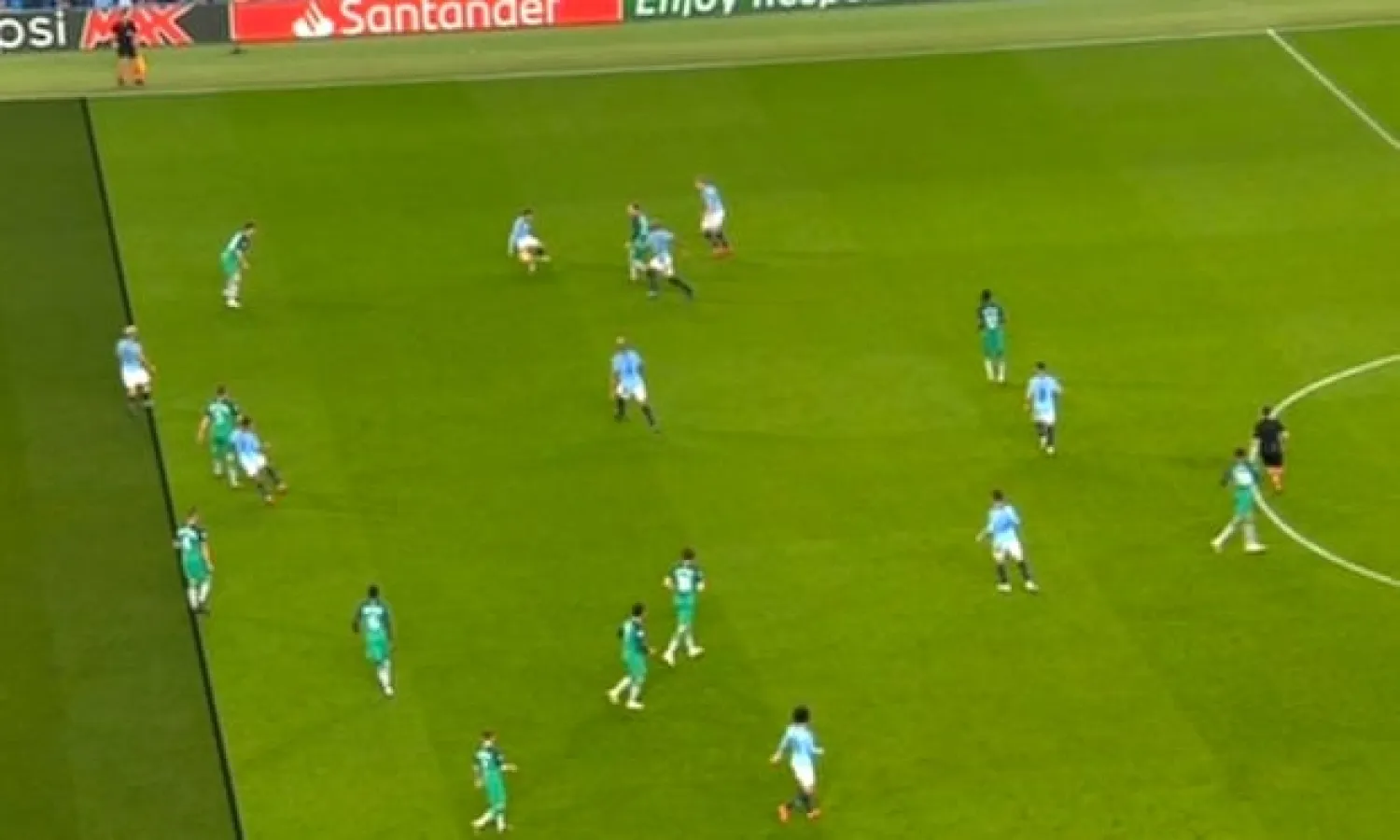
 Sergio Aguero is seen to be marginally offside as ball is loops through to him off Bernardo Silva’s leg. The decision meant that Sterling’s ‘hat-trick goal’ was disallowed and Spurs went through on the away-goals rule. Photograph: BT Sport
Sergio Aguero is seen to be marginally offside as ball is loops through to him off Bernardo Silva’s leg. The decision meant that Sterling’s ‘hat-trick goal’ was disallowed and Spurs went through on the away-goals rule. Photograph: BT Sport
TT

Football Cannot Be Picky About When Var Is Applied – but Is One Angle Enough?

 Sergio Aguero is seen to be marginally offside as ball is loops through to him off Bernardo Silva’s leg. The decision meant that Sterling’s ‘hat-trick goal’ was disallowed and Spurs went through on the away-goals rule. Photograph: BT Sport
Sergio Aguero is seen to be marginally offside as ball is loops through to him off Bernardo Silva’s leg. The decision meant that Sterling’s ‘hat-trick goal’ was disallowed and Spurs went through on the away-goals rule. Photograph: BT Sport

There is always the chance, when English clubs meet in European knockout football, that players who know each other so well will treat it as a pumped-up Premier League encounter rather than showing the respect and caution they might have afforded continental opponents, and the memorably frenetic showdown between Manchester City and Tottenham was an instant classic of the genre.

Never mind the woeful defending in the first 20 minutes, the inability of either side to hold on to an advantage or manage the game professionally, this was English football at its most appealing because both teams were going for goals and glory. Cagey it was not; it was simply a question of who could score more, and when the dust has settled on a thrilling and often controversial ding-dong between two of the best teams in the country it will be seen that the much-maligned away-goals rule had a lot to do with that.

Put simply, City went out because they failed to score at Tottenham. Spurs went through because they scored twice at the Etihad in the first 10 minutes, and from that point on there could never be equilibrium, one side or the other would always be winning. Many would like to scrap the away-goals rule, now regarded as an anachronism in modern, no-expense-spared football, but it was originally introduced in an attempt to avoid the awkwardness of replays in ties featuring teams from different countries, and it now functions just as well as a means of avoiding extra time and penalties.

What’s wrong with extra time and penalties? Well, nothing in theory, apart from the fact a shootout is an arbitrary and unsatisfactory way to separate evenly matched sides. In practice the main problem over the years has been the emergency tie-break tacked on to the end has tended to loom too large over the actual event, with teams settling for unadventurous, risk-free football in the knowledge they would be in with at least a 50-50 chance after the final whistle. City v Spurs was anything but risk free and unadventurous, it was glorious, and the away-goals rule deserves at least part of the credit.

Not that the Etihad quarter-final thriller has any chance of being remembered for that. Not when VAR was involved in two crucial decisions, awarding a goal to one side and cruelly robbing the other of what looked a winner. Pep Guardiola was not completely satisfied with the goal awarded to Fernando Llorente, arguing that from one camera angle the ball appeared to have gone in off his right arm. This is the question for football in 2019: is a single camera angle enough, when most others appeared to show nothing wrong?

Even VAR will not settle all disputes – to hear some City fans complaining you would think Llorente had punched the ball into the net – but what can be said is that the referee and the remote scrutineers examined plenty of replays before concluding there were no grounds for disallowing the goal. Llorente had not used his hand to propel the ball over the line, there was nothing in particular to see, and rather than blaming the review system City would have been better advised to look at their defending when a far from prolific striker went up for a header and scored with his hip.

On the second VAR decision of the match it was possible to feel much more sympathy for City. It looked as though Raheem Sterling had scored a winning goal, and with barely seconds remaining his third of the game had been celebrated as such. No offside flag had been raised against the scorer or Sergio Agüero, and the referee had not been besieged by Spurs players complaining about the latter’s position.

The reason for all that was that Agüero had been only marginally offside, and his transgression was difficult to see in real time. This is where VAR either comes into its own, or takes on a sinister aspect, depending on your point of view. The referee was told he may like to take another look before awarding the goal, and on doing so he spotted Agüero’s fractional infringement in the buildup.

Welcome to the modern world. The debate about whether VAR was simply doing its job and working as expected or sticking its nose in to undermine the referee’s authority on the pitch is sure to be a feature of next season, when it will be introduced in the Premier League. There is also a debate about whether goals should be disallowed for narrow offsides when the attacker was more or less in line and not obviously seeking to gain an illegal advantage, because there are more such borderline cases than may be imagined and VAR has the ability to spot them all.

Christian Eriksen had it exactly right when he said he felt like the luckiest man in the world when VAR overturned the goal decision. It was his mistake that had presented City with the ball at a stage in the game when Spurs were defending too deep without an outlet upfield to relieve the pressure, and he was lucky because he knew a less avoidable error by Agüero had come to his rescue. It therefore follows that City were unlucky, which minus the swearwords was what Fernandinho had to say about VAR after the game.

Yet technology is not only here, it is here to stay and the game cannot be picky about where and when it is applied. Without VAR City would be through to a Champions League semi-final, and rather than dancing on the pitch at the end Mauricio Pochettino would be pointing to a replay of the winning goal and claiming Spurs had been robbed, which they demonstrably would have been. That would not have been just unlucky, it would have been unsatisfactory.



Chelsea Injuries up 44% After Club World Cup but Report Says Event Has Had ‘Minimal’ Impact

Chelsea's Reece James, center, lifts the trophy following the Club World Cup final soccer match between Chelsea and PSG at MetLife Stadium in East Rutherford, N.J., Sunday, July 13, 2025. (AP)
TT

Chelsea Injuries up 44% After Club World Cup but Report Says Event Has Had ‘Minimal’ Impact

Chelsea's Reece James, center, lifts the trophy following the Club World Cup final soccer match between Chelsea and PSG at MetLife Stadium in East Rutherford, N.J., Sunday, July 13, 2025. (AP)

Chelsea suffered a 44% spike in injuries after competing in the supersized Club World Cup this year, according to findings published on Tuesday.

But the newly expanded tournament has so far had a “minimal impact” on injuries overall, the latest edition of the Men’s European Football Injury Index found.

There was fierce opposition to FIFA's new flagship club event when it was confirmed in 2023 that it would increase from seven to 32 teams, with players' unions warning of physical and mental burnout of players due to an ever expanding match schedule. But FIFA pressed ahead and staged the tournament in the United States in June-July.

Chelsea went on to win the inaugural competition, receiving the trophy from US President Donald Trump at MetLife Stadium and taking home prize money of around $125 million. But, according to the Index, from June-October, Chelsea picked up more injuries — 23 — than any of the nine clubs from Europe's top leagues that participated in the Club World Cup.

They included star player Cole Palmer, and was a 44% increase on the same period last year.

While Chelsea, which played 64 games over the entire 2024-25 season, saw an increase in injuries, the Index, produced by global insurance firm Howden, found that overall there was a decrease.

“In principle you would expect this increased workload to lead to an increase in the number of injuries sustained, as a possible rise in overall injury severity,” the Index report said, but added: “The data would suggest a minimal impact on overall injury figures.”

Despite the figures, the authors of the report accept it was too early to assess the full impact of the Club World Cup, with the findings only going up to October.

“We would expect to see the impact to spike in that sort of November to February period,” said James Burrows, Head of Sport at Howden. “What we’ve seen previously is that’s where the impact is seen from summer tournaments."

Manchester City has sustained 22 since the tournament, which is the highest among the nine teams from Europe's top leagues — England, Spain, Italy, Germany and France.

Those teams have recorded 146 injuries from June-October, which is down on the previous year's figure of 174.

From August-October that number is 121, the lowest for that three-month period in the previous six years of the Index.


Sunderland Worst Hit by Losing Players to African Cup of Nations 

14 December 2025, United Kingdom, London: Sunderland's Habib Diarra (L) and Leeds United's Gabriel Gudmundsson battle for the ball during the English Premier League soccer match between Brentford and Leeds United at the Gtech Community Stadium. (dpa)
TT

Sunderland Worst Hit by Losing Players to African Cup of Nations 

14 December 2025, United Kingdom, London: Sunderland's Habib Diarra (L) and Leeds United's Gabriel Gudmundsson battle for the ball during the English Premier League soccer match between Brentford and Leeds United at the Gtech Community Stadium. (dpa)

Premier League Sunderland will have to do without six players over the next few weeks and are the club worst hit as the Africa Cup of Nations takes its toll on European clubs competing over the holiday season.

Sunderland, eighth in the standings, had four of their African internationals in action when they beat Newcastle United on Sunday, but like 14 other English top-flight clubs will now lose those players to international duty.

The timing of the African championship, kicking off in Morocco on Sunday and running through to January 18, has long been an irritant for coaches, with leagues in Belgium, France, Germany, Italy, Netherlands, Portugal, and Spain also affected.

Hosting the tournament in the middle of the season impacts around 58% of the players at the Cup of Nations, though the Confederation of African Football did try to mitigate the impact by moving the start to before Christmas, so it is completed before the next round of Champions League matches.

The impact on European clubs was also lessened by allowing them to release players seven days, rather than the mandatory 14 days, before the tournament, meaning they could play for their clubs last weekend.

Sunderland's Congolese Arthur Masuaku and Noah Sadiki, plus full back Reinildo (Mozambique), midfielder Habib Diarra (Mali), and attackers Chemsdine Talbi (Morocco) and Bertrand Traore (Burkina Faso) have now departed for Morocco.

Ironically, Mohamed Salah’s absence from Liverpool to play for Egypt should lower the temperature at the club after his recent outburst against manager Arne Slot, but Manchester United will lose three players in Noussair Mazraoui, Bryan Mbeumo and Amad Diallo, who scored in Monday’s 4-4 draw with Bournemouth.

France is again the country with the most players heading to the Cup of Nations, and with 51 from Ligue 1 clubs. But their absence is much less impactful than previously as Ligue 1 broke after the weekend’s fixtures and does not resume until January 2, by which time the Cup of Nations will be into its knockout stage.

There are 21 players from Serie A clubs, 18 from the Bundesliga, and 15 from LaLiga teams among the 24 squads at the tournament in Morocco.


Rodgers Takes Charge of Saudi Team Al-Qadsiah After Departure from Celtic 

Then-Celtic head coach Brendan Rodgers greets supporters after a Europa League soccer match between Red Star and Celtic at Rajko Mitic Stadium in Belgrade, Serbia, Sept. 24, 2025. (AP)
TT

Rodgers Takes Charge of Saudi Team Al-Qadsiah After Departure from Celtic 

Then-Celtic head coach Brendan Rodgers greets supporters after a Europa League soccer match between Red Star and Celtic at Rajko Mitic Stadium in Belgrade, Serbia, Sept. 24, 2025. (AP)

Brendan Rodgers has returned to football as the coach of Saudi Arabian club Al-Qadsiah, six weeks after resigning from Scottish champion Celtic.

Al-Qadsiah, whose squad includes Italian striker Mateo Retegui and former Real Madrid defender Fernandez Nacho, is in fifth place in the Saudi Pro League in its first season after promotion.

Rodgers departed Celtic on Oct. 27 and has opted to continue his managerial career outside Britain for the first time, having previously coached Liverpool, Leicester and Swansea.

In its statement announcing the hiring of Rodgers on Tuesday, Al-Qadsiah described him as a “world-renowned coach” and said his arrival “reflects the club’s ambitious vision and its rapidly growing sporting project.”

Aramco, the state-owned Saudi oil giant, bought Al-Qadsiah in 2023 in a move that has helped to transform the club’s status.

“This is a landmark moment for the club,” Al-Qadsiah chief executive James Bisgrove said. “The caliber of his experience and track record of winning reflects our ambition and long-term vision to establish Al-Qadsiah as one of Asia’s leading clubs.”

Rodgers is coming off winning back-to-back Scottish league titles with Celtic, where he won 11 major trophies across his two spells. He also won the FA Cup with Leicester.

Al-Qadsiah's last two coaches were former Liverpool striker Robbie Fowler and former Spain midfielder Michel.